
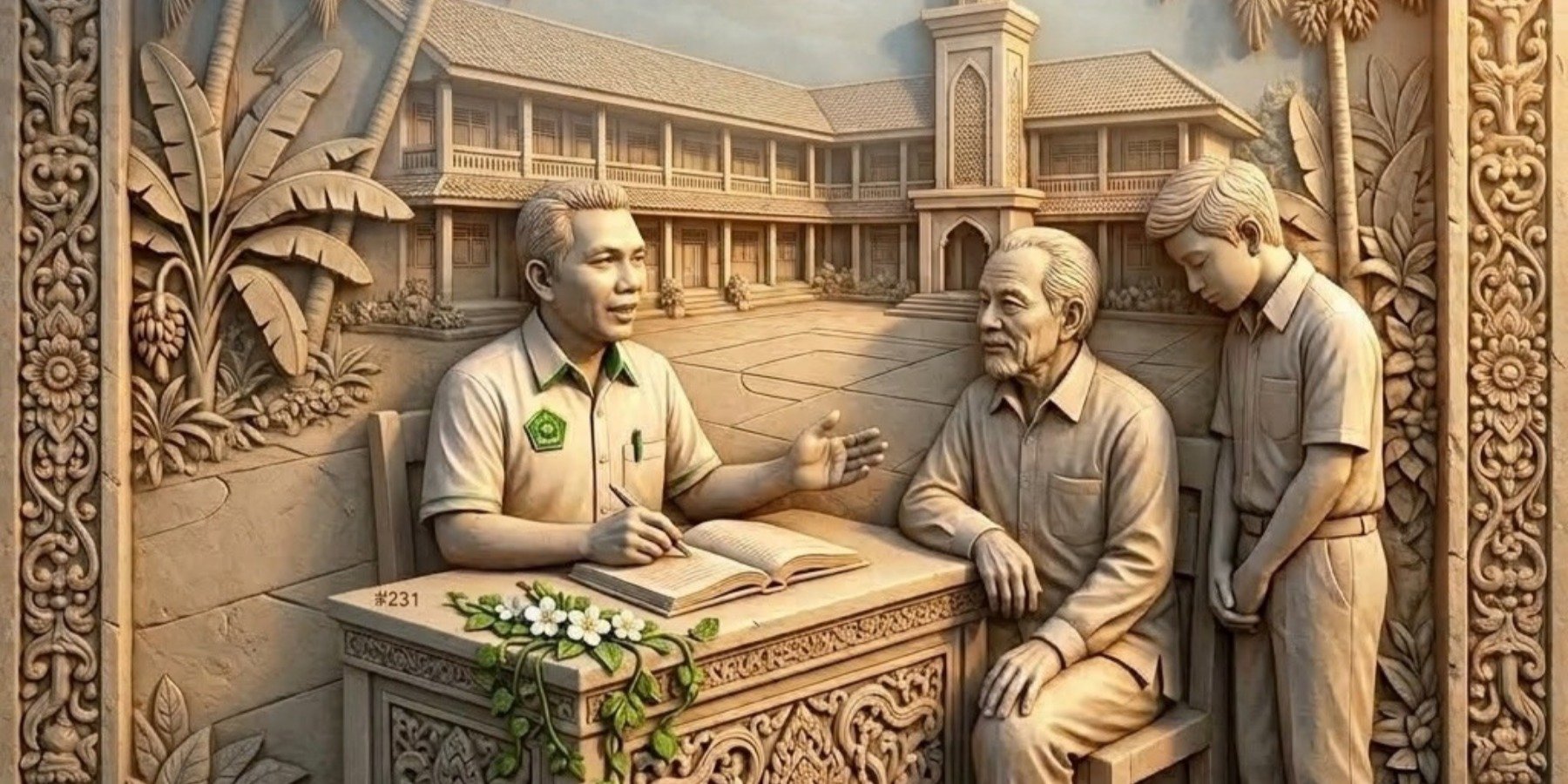
That speck of light did not fall from a clear sky. It rose from a chest that had long learned to keep a quiet fire alive among the ashes. On a dry Tuesday morning veiled in thin haze, he swung his leg over the black motorcycle and rode toward the Garden of Paradise, the school grounds where the nation’s children waited. Coconut palms, banana trees, cassava, areca, wild grass and tall weeds stood silent along the roadside, quiet witnesses to a journey he repeated without fanfare. He arrived on time, not because the world demanded perfection, but because he had chosen, once more, to rise from the leftover weariness of the night before.
An unscheduled meeting about the Pancasila Sanctity Day ceremony, set for the coming Thursday, asked for his full attention and then released him. He entered classroom XII F1 and opened the story of the Islamic kingdoms of Sumatra, beginning with Samudra Pasai, the early doorway of light, and moving toward Aceh Darussalam, which had guarded that same flame with fierce care. His voice moved steadily through the centuries until several fellow teachers stepped in to check the students’ uniforms and required items. He paused, let the inspection run its course, then continued. In that brief interruption he felt again how education must often share its space with small rules, and how the soul’s endurance grows precisely from the willingness to wait without losing direction.
Next he stepped into classroom XI F7, the room that carried his particular responsibility. Word had reached him of lies told by some of the students. Those young people had been asked to bring their parents. He took the news with a quiet weight in his chest and still began the lesson on the Ottoman conquest of Constantinople. He spoke of how a great power can rise from a resolve that refuses to die, even when it must cross seas and scale high walls. Beneath the historical account rested a quieter hope: that the young faces before him might understand honesty as a stronger fortress than any city wall.
Afterward he moved to classrooms XII F5 and XII F7. In both rooms he asked the students to continue the assessment left unfinished the previous week. He walked slowly between the desks, watching pens travel across paper, brows furrow, and the occasional small smile when an answer finally surfaced. In those ordinary moments a silent pride as an educator slipped in, not as applause, but as a reminder that every completed page was quiet proof the fire still burned.
Noon approached. The call to prayer drifted softly through the hazy air. He performed ablution, feeling cool water touch skin already warmed by road dust and classroom air. His steps toward the mosque inside the Garden of Paradise felt light. Some of the students followed behind him; others chose to wait and pray later at home. Inside the mosque the movements of standing, bowing, and prostrating felt warm rather than formal, held together by a simple togetherness. He sensed the breathing of those around him, including the younger ones still searching for their own direction. The shared prayer became a place where the body’s tiredness could rest for a moment and the heart could remember it did not walk alone.
When the prayer ended he took a short rest. He stepped outside the Garden of Paradise to buy a simple packet of rice for his midday meal. While he sat in a shaded spot, the parents of one student from XI F7 arrived with their child. He received them calmly. Slowly he described the breach that had occurred, speaking not to condemn but from a wish that truth should not remain buried under dust. The young person lowered his head deeply. His shoulders trembled slightly, and a sincere shame seemed to rise from somewhere inside him. He listened not only to the words of his teacher but also to those of his parents seated beside him. The counsel entered the guilty heart little by little, passing through the defenses a teenager so often builds when cornered. He watched shame gradually turn into awareness, watched a bowed head begin to find room to lift again. At the end of that long and quiet meeting the student reached for his teacher’s hand and kissed it with deep respect. The gesture was more than custom. Inside it lived a genuine apology, an admission of wrong, and a fragile hope of becoming better. He felt a small tremor in his palm, as though a tiny flame in the young chest had just been lit again by honesty. In that moment he understood that the deepest education often takes place outside the official curriculum, in the space where shame meets compassion and a teacher becomes witness to a soul beginning to rise after stumbling.
Still during the rest period he found a few minutes to send one of his artworks to the University of Minnesota Student Unions & Activities Call for Art 2027–2028 in the United States. The small act was another way of tending the fire beyond classroom walls, a reminder that dedication need not stop at the school gate. Each such submission was a quiet step toward the Education Impact Fund he carried in his mind, a commitment born from the belief that learning which touches the soul should keep traveling, even across oceans.
Afternoon arrived. He rode the black motorcycle home. At the house his wife asked to be taken to buy two packs of bakery bread for her mother’s adoptive father, who wished to return to his hometown the next day. Though the haze had thickened, he kept the mask in place and started the engine once more. The short ride to the supermarket felt like one more link in the same chain: to accompany, to protect, to fulfill. After the purchase his wife did not enter the house at once; she wanted to deliver the bread without delay. He understood. In a family there are many small journeys that must be completed so that the quiet work of caring for one another stays alive.
Evening settled in. He invited his children to walk with him to the neighborhood mosque. Their steps moved together beneath the soft glow of streetlamps. Inside the mosque the prayer felt familiar and warm. He stood beside his children and felt their presence as part of the same fire he tended at home. When they returned, his wife was already back from delivering the bread. He then went to collect his eldest child, who had just finished religious study. That night the family sat together for the evening meal. The soft sound of spoons against plates, the aroma of simple food, and the presence of the people he loved created a space where the quiet anxiety of a father could ease for a while. He thought of the remaining mortgage on the house, the numbers that sometimes pressed heavily in the dark hours. Yet at that table he also felt hope growing by slow degrees. Every day lived with consistency was a payment not recorded in any bank ledger but written inside the soul. Every lesson given, every counsel received, every prayer offered, every loaf of bread delivered belonged to the same long transformation.
He knew fatigue would return with the next morning. The haze might still cover the sky. Reports of broken trust might appear again. The mortgage figures would still wait. Yet he also knew the fire he tended did not require dramatic leaps. It needed only the willingness to rise each morning from the ashes, to keep burning even when the wind blew hard, and to turn small actions repeated with love into a lasting rising. In the ordinary struggle of a teacher inside a Garden of Paradise somewhere in Indonesia, he discovered that daily consistency is the purest form of love, and that a speck of light carefully kept will always guide the soul, both his own and the souls of the nation’s children entrusted to his care.
Explore the documentary art collection and support the mission by acquiring your NFT on OpenSea.
Lost in the narrative?
[Return to the story map]