
On a bright Monday morning still wrapped in the haze of smoke left by forest fires, fine ash clung to the seat of his black motorcycle like traces of a night that had not fully departed. He brushed the ash away with care, fixed the mask upon his face, and rode the black motorcycle toward the Garden of Paradise, the place where he taught the children of the nation. Coconut palms, banana trees, cassava plants, areca palms, wild grass, and weeds stood silent along the road, quiet witnesses to a journey repeated hundreds of times. He arrived on time, as always, because punctuality itself was the first form of respect offered to the young souls waiting for him.
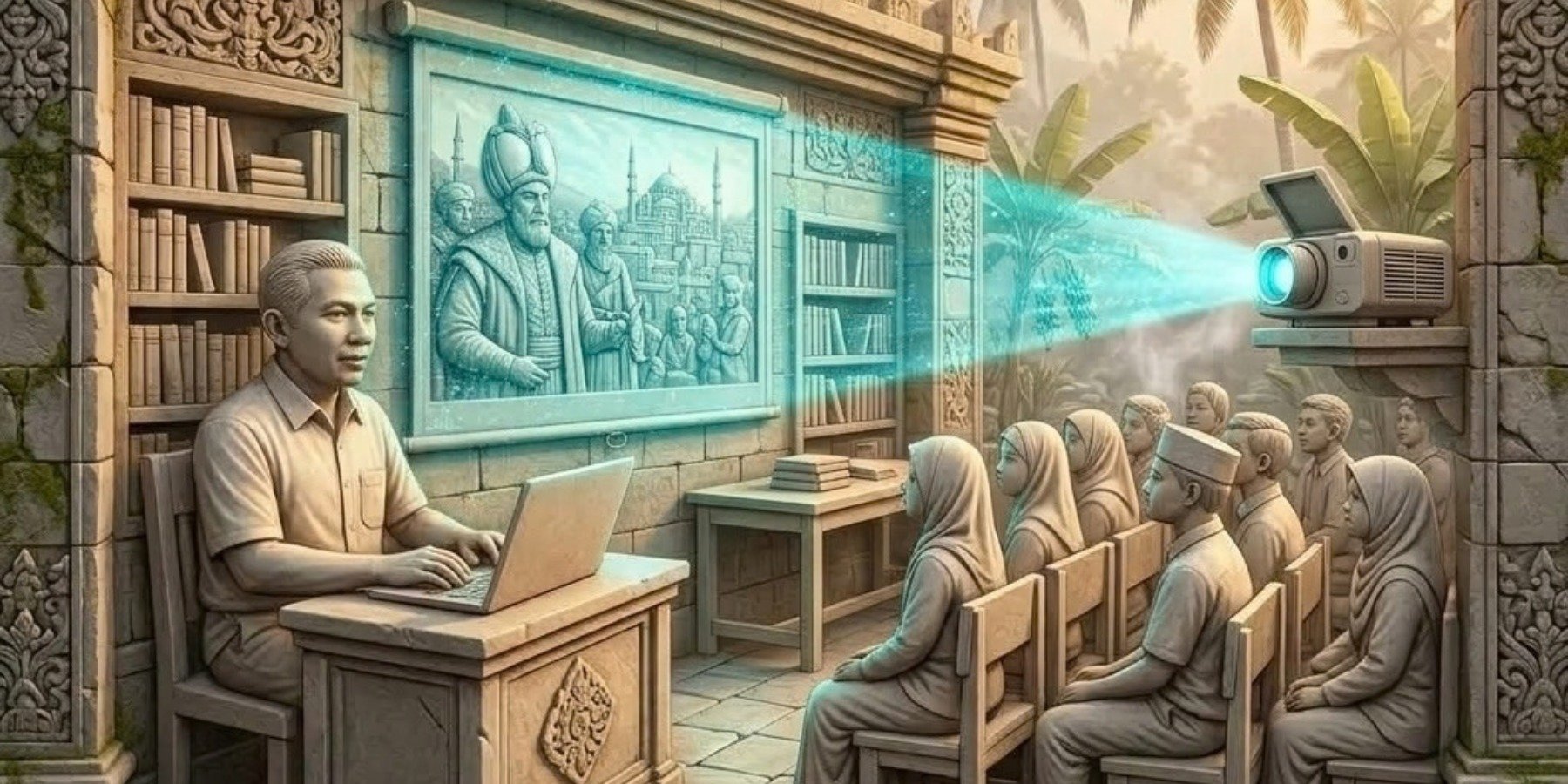
In class XI F6 he began the day by inviting the children of the nation to walk to the library of the Garden of Paradise. The room was quiet yet full of possibility; the shelves of books stood as walls reminding everyone that knowledge is never finished. The laptop opened, the beam from the projector lit the white wall, and the film about Muhammad Al-Fatih’s struggle to conquer Constantinople began to flow. That light did more than project images; it pierced the fog of boredom, the fog of doubt, the distance between past and present. The children of the nation watched with serious eyes. From the words of the Prophet foretelling that Constantinople would be conquered by the people of Islam, through days of battle before the mighty walls, through extraordinary strategy and the unyielding spirit of prayer, the story unfolded slowly. He stood beside that light, allowing the tale of Al-Fatih to speak first, then calmly explained that steadfastness, intelligence, and sincere prayer were legacies that could be carried home that very day. He did not force; he only invited them to take as example the attitude that had enabled a young man to redraw the map of the world. In silence he felt how every second of the film became a bridge between the weariness of his body and the small flame kindling in the eyes of his students. The projector’s light was never merely technology; it was an extension of dedication still trying to pierce the fog of uncertainty, the fog of knowledge poverty, the fog of a future that sometimes felt unclear.
Afterward he asked the children of the nation from class XII F7 to come to the same room. This time the film about the Islamic kingdoms of Sumatra was shown. Deep origins, the struggle against the Portuguese, a living culture expressed in dance, poetic songs, distinctive food and drink, and the rencong blade all flowed before them. He repeated the same journey for class XII F6. Each time the projector’s light shone, he felt as though he were sending rays across an ocean of time, carrying a rich local history so it would not sink into the fog of a modernity that moved too quickly. There, among the dust of books and artificial light, he rediscovered the reason he kept returning: because every child who sat quietly watching was proof that the fire of education could still burn even when strong winds blew from outside.
As noon approached, the call to prayer sounded. He performed ablution at once; cold water touched tired skin, washing away the morning’s dust and the lingering thoughts still wandering. Inside the mosque of the Garden of Paradise several children of the nation were already waiting. He led the midday prayer with gentle movements, never rigid, full of the warmth of a parent guiding children home to a safe place. In prostration he felt a silence that embraced him, releasing for a moment the weight of reports, the weight of bills, the weight of hopes that sometimes felt too heavy to carry alone. The prayer became a space where weariness was allowed to rest without guilt, where he could remember that he too was human and needed to be refilled before lighting the fire for others again.
After prayer he rested at his desk. A colleague handed him the monthly report already signed. He received it with hands still slightly damp from ablution water, then scanned the document with his phone and sent it to Google Drive. That small act, ordinary as it appeared, was part of the chain of consistency he kept. Every saved report was proof that he did not only teach but also ordered his household, ordered the remaining mortgage debt, ordered the hope that one day his family might breathe more freely. Behind those numbers lived the quiet anxiety of a father who wished to provide a secure roof, the silent pride of an educator who knew that every completed day was a small step toward the Education Impact Fund, the commitment he held so that the light of education might reach farther still.
Afternoon arrived. He turned the black motorcycle homeward, the mask still faithful on his face, the smoke haze still wrapping the road. At home he rested briefly, then together with his wife went to fetch their youngest child who had finished religious lessons. Masks still on their faces, haze still outside, yet on the black motorcycle there was a warmth the smoke could not extinguish. Later in the front room he helped his wife build a tiered wooden rack for her polybag plants. The pieces of wood were arranged and nailed one by one. The repeated sound of the hammer became the simple rhythm of the afternoon. Between those blows he felt how the hands that earlier had written on the board and held the projector remote now held nails and wood. That small transformation reminded him that rising again does not always come in great explosions; sometimes it is born from neatly stacked wood, from plants that will grow in polybags, from a house slowly rebuilt every afternoon.
Evening drew near. Together with his child he prayed in congregation at the mosque inside the housing complex, among the neighbors. The movements of the evening prayer were calmer, deeper, like shared breathing that gathered each person’s weariness into collective strength. Afterward they ate dinner together. At the simple table, beneath a lamp that was not too bright, he felt once more that true beauty often hides in routines that ask for no applause.
Before sleep he took a moment to send the rays of his work across the ocean toward the Open Call of Nord Art in Germany. That work, born from the ash of long days, now crossed the fog of distance and cultural difference, carrying the story of a teacher in Indonesia who every day burned himself in the fire of dedication. He did not know whether the light would be received or not; he only knew that sending it was already an act of courage, a belief that a small fire here could still shine there.
And at the end of the day, when the body finally lay down, Phoenix rose once more from the ash of fatigue, from the burden of responsibility, from the anxiety that had settled. He rose not with luxurious wings, but with wings made of daily consistency, of small actions repeated with love, of a fire that kept burning even when the wind of smoke haze blew hard. In that rising lay the purest philosophy: that true dedication is a form of love that needs no stage, that silent sacrifice is the most lasting transformation, and that every day lived with sincerity is a living digital monument. From the same ash the same fire can rise again, deeper, quieter, and more enduring, like rays of light still crossing the ocean mist.
Explore the documentary art collection and support the mission by acquiring your NFT on OpenSea.
Lost in the narrative?
[Return to the story map]