
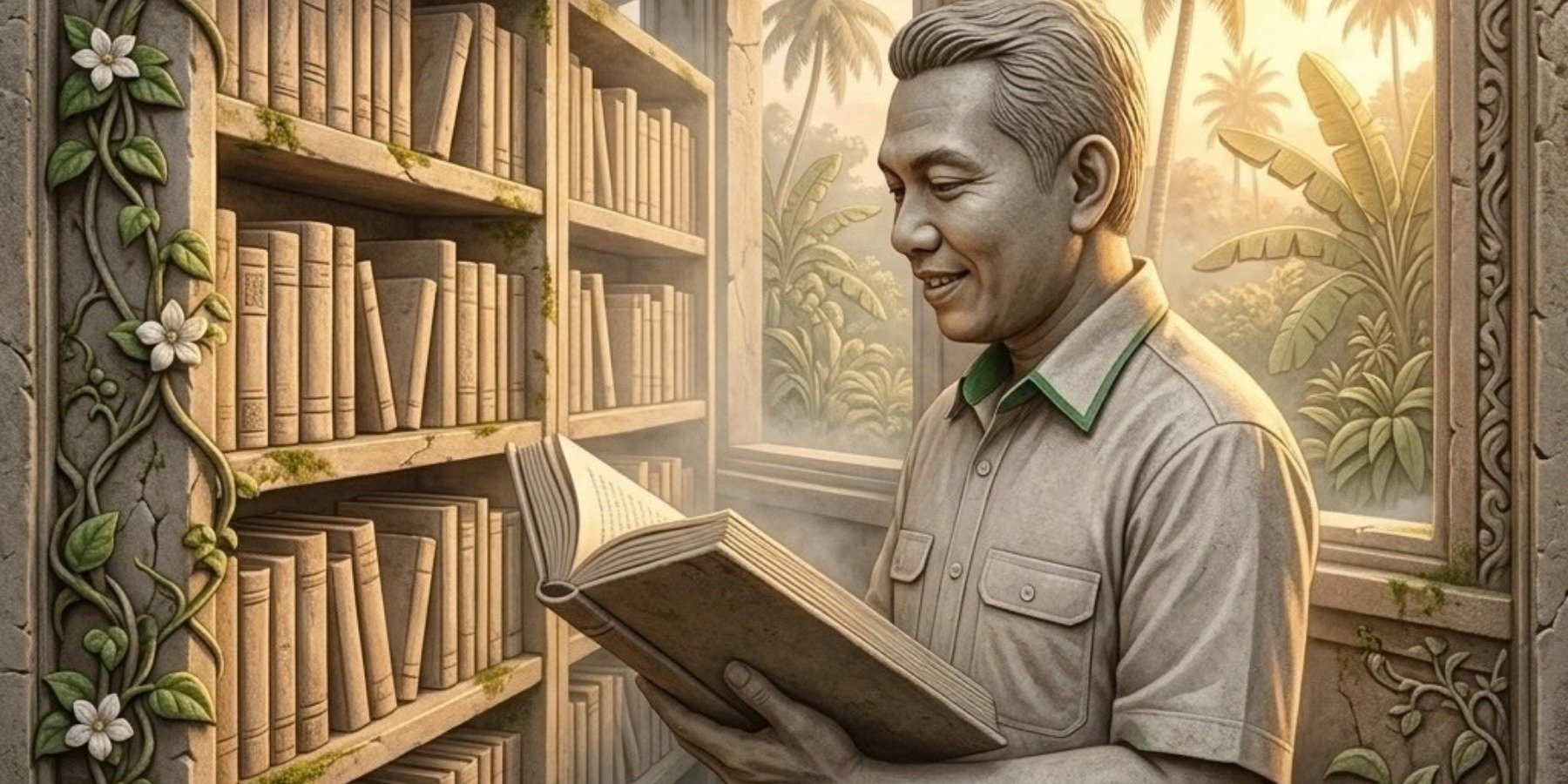
On a morning still veiled by thin smoke drifting from distant lands that had recently burned, he rose before the light itself. His body still carried the residual weariness of the day before, yet within his chest lived something older than that weariness: a fire that had never truly gone out. He put on his mask, mounted the black motorcycle that had long become an extension of his body, and rode past rows of coconut trees standing tall, banana leaves swaying gently, cassava plants still hiding their roots in the earth, towering areca palms, and the wild grass and weeds that never asked to be noticed. All of them stood as silent witnesses, as always, to the same journey repeated every single day. He arrived on time at the Garden of Paradise, the place where he educated the children of the nation.
Classroom XII F1 felt more alive the moment he invited them to move to the library. There the laptop was opened, the projector switched on, and a soft white light spilled across the whiteboard, opening a window onto a distant past. A film about the Islamic kingdoms of Sumatra began to move: from origins still shrouded in the mist of history to the shadows of Portuguese ships that arrived carrying forced change. That light did not merely illuminate the wall; it seemed to pierce the horizon of time itself, linking a small room in a remote corner of Indonesia with the oceans once sailed by their ancestors. He stood quietly at the edge, allowing the children of the nation to absorb it on their own, while inside him a quiet pride stirred: that today, once again, he had managed to open a small gap so they might see farther than the pages of a textbook.
While the room was still quiet, he walked slowly toward the bookshelves. His hand took down a volume about Salahudin Al-Ayubi. He did not sit. He stood before the shelves, body leaning slightly forward, and began to read with the quiet voice of the heart. The story flowed like a deep river. He imagined the man born in Tikrit, raised in the shadow of civil war, then rising not out of hunger for power but because of a blazing fire of justice in his chest. How Salahudin restrained himself when Jerusalem fell into his hands, refusing to avenge the blood that had once stained the streets of the holy city, and instead offering protection to the defeated. How he chose to give water to the thirsty in the midst of battle, how he wept when he heard of the people’s suffering, how he left a luxurious palace for a simple tent on the battlefield. Every page read while standing felt like a spark of fire piercing into the bone. He felt the tiredness in his legs, yet more strongly he felt the tremor in his chest: that true greatness is not the conquering of stone walls, but the conquering of the desire for revenge. That true liberation begins in a heart willing to release vengeance and choose compassion. The light from that story seemed to pierce the horizon of time, pierce the dust of history, and settle upon his chest as a reminder that every teacher, anywhere, is trying to liberate something finer than a city: the minds and souls of the children of the nation from the narrowness of ignorance and fear.
Not long after he finished reading, the children of the nation from class XI F7 arrived. He immediately played the film about Muhammad Al-Fatih. The projector light shone once more, showing the long journey of the conquest of Constantinople. The young people sat quietly, serious, eyes fixed. He stood behind them, letting the images speak for themselves of steadfastness, of prayers offered before every step, of strength born from unshaken conviction. The material on the Ottoman State in the time of Muhammad Al-Fatih flowed without the need for many words. The light of the film seemed to pierce the library ceiling, pierce the school roof, and touch a wider horizon: that every generation has its own walls to break through, and today that wall is the limitation of knowledge and hope.
Then he moved to classroom XII F5, and afterward to XII F7. He asked them to search for the meaning of nifaq, to find examples of it in the nearest everyday life, and to discover ways of avoiding it. Not merely an assignment, but an invitation to look at themselves in the mirror of honesty. He stood at the edge of the room, allowing them to write, to think, to wrestle with a question that was simple yet sharp. In moments like these the burning fatigue in his body softened into something quieter. A silent pride as an educator rose slowly, like embers hidden beneath ash.
Midday approached. The call to prayer drifted gently from the direction of the mosque within the Garden of Paradise. He performed ablution with cold water in his palms, feeling every drop cleanse not only the skin but also the remnants of morning smoke and the dust of the road. Inside the mosque the children of the nation were already waiting. He stood at the front and led the midday prayer. His movements were not rigid. His voice was calm and warm, like someone inviting a large family to approach together something greater than themselves. Between the units of prayer he felt their presence behind him: breaths in quiet harmony, young bodies still searching for direction, and his own heart full of gratitude for still being given the chance to stand in the same row. That prayer felt like a living rest, not a burden of obligation.
Afterward he returned briefly to his desk, then went out again on the black motorcycle. At a small stall by the roadside he bought a piece of kebab and a glass of iced chocolate. The simple midday meal felt enough. Between bites his thoughts drifted for a moment to the remaining mortgage on the family home that still clung like a shadow. Every day lived in full dedication was one small step toward that freedom. Every morning given to the children of the nation was one more page of the installment slowly diminishing. The fire of hope for financial freedom never went out, even though the wind of anxiety as a father sometimes blew hard. He remembered his commitment to the Education Impact Fund: that one day, when the house truly belonged to the family, a portion of that freedom would flow back to other children of the nation.
Afternoon drew near. He rode home on the same black motorcycle. At home he sat for a moment on the sofa and drank a glass of water that soothed his throat. Then together with his wife they went to fetch the youngest child who had just finished religious lessons. The short journey felt warm, like a thin thread binding back together the scattered pieces of the day.
Night arrived. He invited the children to the mosque inside the housing complex. Together with the neighbors they performed the evening prayer in congregation. The atmosphere there was simple: neon lights a little dim, carpets worn in places, yet a real warmth. He stood in the row, feeling the shoulders of his children beside him, feeling his wife’s breath behind him. That evening prayer felt like an invisible embrace, reminding him that in the midst of every burden there is still space to stand together in the same stillness.
Then they shared the evening meal. A small table, simple food, quiet laughter, and a gratitude that did not need to be spoken loudly. Afterward, before sleep, he took a moment to send the light of his day’s work to the Open Call of Weswal Gallery in Australia. One digital file containing the traces of this day, sent across the ocean, piercing the geographical horizon, with the simple hope that this quiet dedication might touch the eyes of people in a distant land.
And in the deepening night, when the body was already lying down and the eyes began to close, he felt once more the metaphor that always lived within him. Like the noble bird that rises from the ashes, he had burned himself today in the same fire of dedication. From the ashes of weariness, from the ashes of anxiety as a father, from the ashes of the remaining unpaid debt, he rose once again. The fire kept burning even though strong winds blew from every direction: the smoke of wildfires, the weight of the curriculum, the responsibilities of family. Transformation happened not through any great explosion, but through small actions repeated with full love: opening the laptop, playing a historical film, standing to read the story of Salahudin, asking the children to search for the meaning of nifaq, leading prayer with warmth, fetching the youngest child, eating together, and then sending the work across the world.
Daily consistency is the purest form of love. It is a rising that never ends. Every same morning is a new chance to open light, and every light that succeeds in piercing the horizon, however small, is proof that the soul of an ordinary human being can become a living monument.
Today, once again, he had shown that from the ashes an eternal fire can keep burning.
Explore the documentary art collection and support the mission by acquiring your NFT on OpenSea.
Lost in the narrative?
[Return to the story map]