
Sunday morning arrived with a near-perfect stillness, as if the world itself had chosen to hold its breath so that one educator could finally hear the quiet rhythm of his own heart. A thin veil of haze still mingled gently with the dry-season dust, wrapping the yard like a soft blanket reluctant to leave. In the middle of that silence he stood for a moment and watched the Phoenix regenerating. His wings rested folded and calm, a red-orange glow burning slowly in his chest—not a wild blaze demanding attention, but carefully tended embers kept alive with quiet care. Body and soul, worn from days of burning themselves in front of classrooms, were now recovering, while still carrying the remaining weight of the family home mortgage. Rest was never laziness. It was a sacred process of recharging so the fire of dedication could keep glowing for his students tomorrow.
He began the day by making a large cup of warm tea. The gentle spice rose slowly, easing the heaviness that still lingered in his chest from the long week. A simple packet of biscuits completed the quiet breakfast. He sat with his wife and children, sharing the morning meal in a warmth that reached gently into the silent room. There were no words, only the soft sound of spoons against plates and breaths meeting across the table. In that stillness he felt a deep gratitude. Every ordinary day he spent himself so that knowledge and care could light up the classroom; this morning he was allowed simply to be present, simply to be a father and a husband fully there.
After breakfast he turned to the household tasks. Sweeping the yard became a meditative movement, each stroke clearing dust from the ground and residual fatigue from the mind. Then he washed the dirty plates and glasses. Water ran over ceramic surfaces, carrying away leftover food and the last traces of tension from previous days. He worked without hurry, letting his hands follow the slower rhythm of a body that was healing.
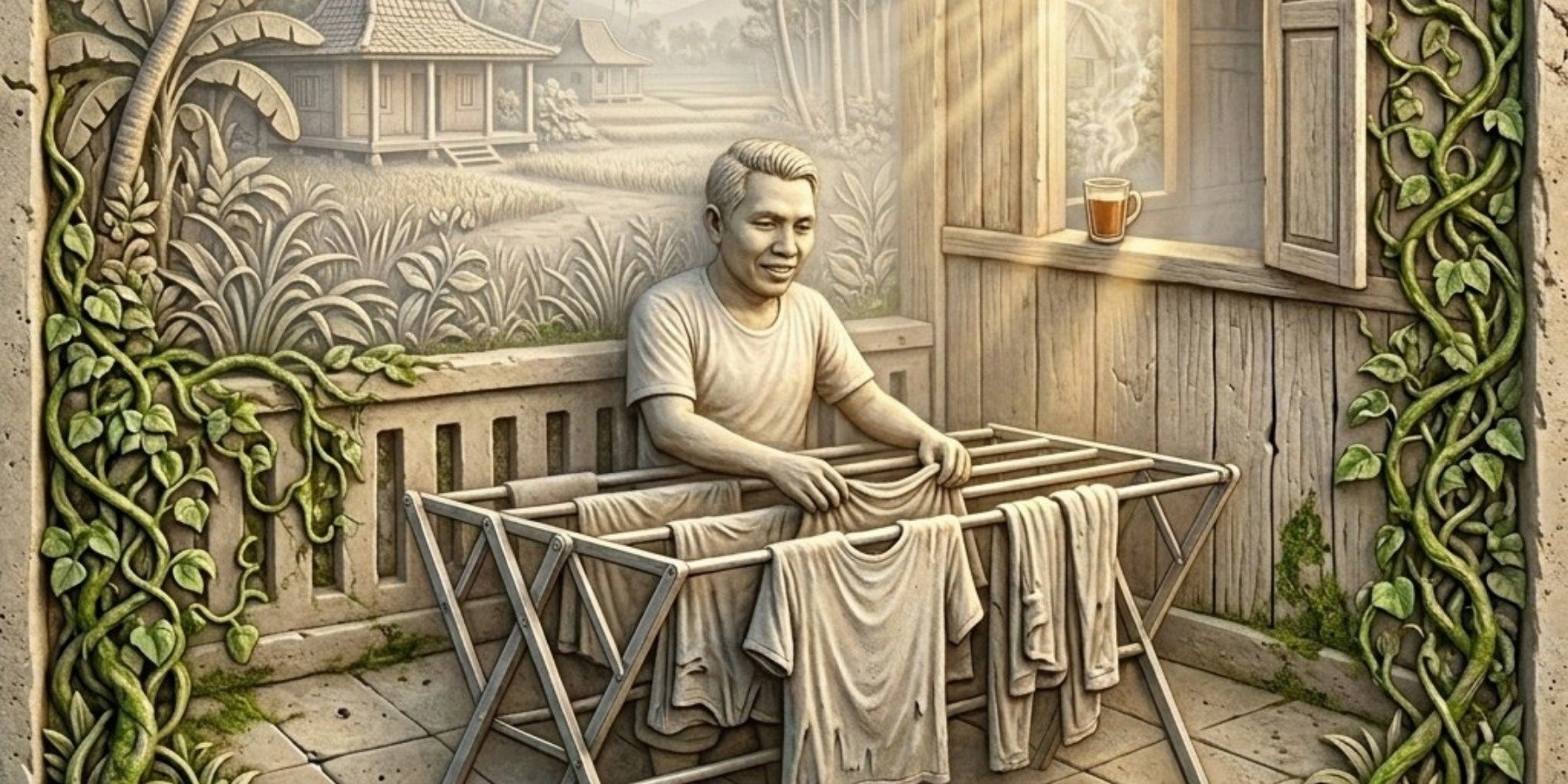
He also hung out the laundry he had washed the night before. He spread it across the lines on the front terrace. The early light, slightly held back by the collaboration of haze and dust, still managed to reach the terrace, laying soft stripes across the floor and the surfaces of the cloth. One by one he hung each piece and arranged them with care. Every garment became a small celebration of a life that continued. The children’s school shirts, his wife’s work clothes, his own faded T-shirts—all were hung with quiet attention. He felt the still-damp fabric at his fingertips, caught the simple scent of soap, and understood that behind every piece of clothing lived the stories of the people he loved. The light that pierced the haze seemed to help dry the cloth, and with it the last remnants of weariness that clung to his shoulders. He spaced the laundry carefully so air could move freely between the pieces, as if teaching himself that empty space, too, is necessary for anything to recover completely.
When the household work was finished he opened his laptop. On the softly glowing screen he submitted his first poem, titled “Silent Light,” to the open call for the MURI Acrostic Poetry Record Breaker. The process moved slowly; each click felt like releasing a small fragment of his inner life into a wider world. In the middle of it his children asked for pocket money. He gave it without hesitation and reminded them to wear their masks when they went to the small shop. After they left he returned to the submission and finished it. A quiet pride rose in him—not because the work would certainly be accepted, but because he was still able to create something in the spaces between a full life.
Later he kept his wife company while she sliced onions in the living room. He sat a short distance away, careful of the sharp scent that made his eyes water. The television was switched on, and together they watched in comfortable silence. The sound of the screen became background while he felt her presence beside him as a steadying anchor. In that moment he understood that love often feels most real when it needs no words, when it is enough simply to share the same space and let the quiet speak.
As noon approached the call to prayer rose. He invited the children to join the communal prayer at the neighborhood mosque. The short walk felt like returning to a larger home. Inside the mosque he stood level with his neighbors, bowed with them, felt the cool floor against his forehead, and listened to the breathing of the people around him. The prayer felt warm, never rigid—simply a gentle meeting between a tired body and something greater than itself. Afterward he was invited to lunch at a neighbor’s house beside the mosque. He ate with the others under a simple tent, sharing food prepared with quiet sincerity. Every bite felt like a gift, reminding him that community, too, is part of the recovery.
He returned home and explained that he had been delayed by the spontaneous invitation at the mosque. Not long after, he, his wife, and the children left to attend a wedding some distance away. The journey of about twenty-five minutes was made by motorcycle, masks still in place, wife and children riding carefully behind him. Dust and haze accompanied the midday ride, so he drove with steady attention. At every turn he felt the weight of the people he loved behind him, and that responsibility itself gave him new strength.
By late afternoon they were safely home. He rested a moment, drank a glass of warm water, and sat quietly on the sofa. Suddenly the neighbor next door asked for water because their well had run dry. His wife immediately helped channel water across. He checked the well inside their own house and felt grateful that water was still there. In that simple exchange he sensed how lives remain connected, how sharing is another way of keeping the embers inside from going out.
As evening came he again invited the children to the neighborhood mosque for prayer with the community. Afterward the family shared a quiet dinner. Before sleep he opened the laptop once more and sent the light of his work into the silent night—to the open call of The Cold Magazine in the United Kingdom and to the art documentor project in India. The act of sending felt like releasing a little quiet light into distant places, a silent commitment that even on a day of rest the dedication to education and art continued, including the steady support for the Education Impact Fund that flowed quietly in the background of his life.
When at last he lay down, his body felt lighter. The fatigue that had clung to him slowly dissolved, replaced by a deep peace. He understood that conscious rest is an essential part of the journey. The embers in his chest still glowed, calm, waiting for the right moment to burn again with greater wisdom. From ashes to fire, from weariness to new strength, so that tomorrow he could rise higher, carrying the silent light that pierces through space, illuminating classrooms, family, and a wider world with a dedication that never goes out.
Explore the documentary art collection and support the mission by acquiring your NFT on OpenSea.
Lost in the narrative?
[Return to the story map]