
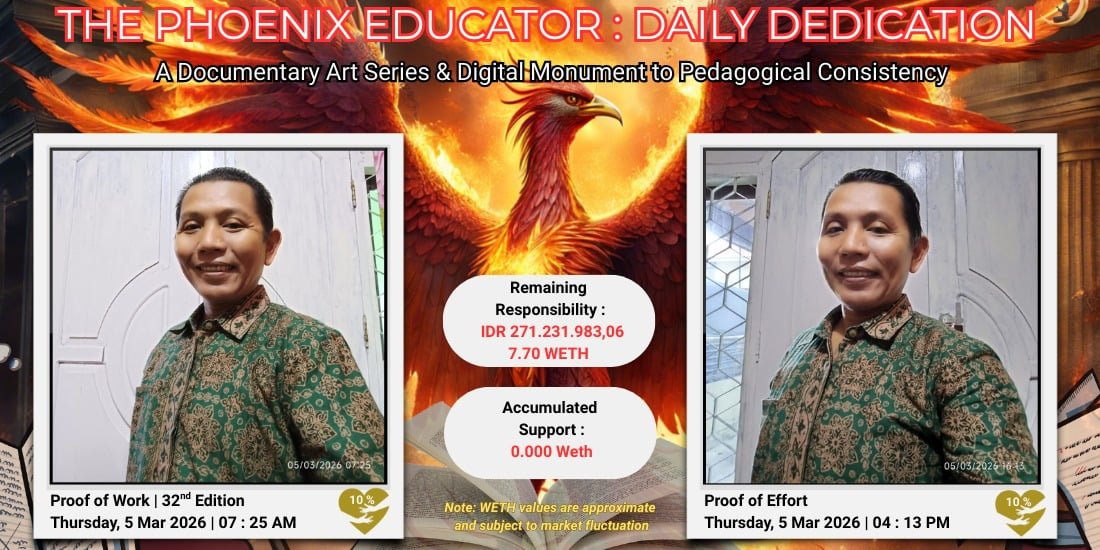
That morning, the sky still embraced gray clouds, yet rays of sunlight slipped through the gaps, creating a gentle light—like hope that never surrenders even when surrounded by shadows. The Phoenix flew low toward the Garden of Paradise, a place where knowledge is not merely stored but shared like flowing water that nourishes young souls. The streets were bustling, yet the flow remained smooth; life moves on, and the Phoenix learned not to resist the current but to ride its wind.
At the garden's gate, the Phoenix—with its faithful laptop clutched in its wings—asked one of the nation's children to carry several thick books. The small hands accepted the task with a shy smile, and together they walked toward the classroom. Along the corridor filled with the scent of old paper and the spirit of learning, the Phoenix asked in a light yet curious tone: “Later, what major will you choose in university?”
The child paused for a moment, gazing straight ahead, then answered in a calm voice as if long prepared: “Criminology.
That single word fell like a stone into a still lake—creating ripples that halted the Phoenix's steps. The Phoenix stopped; the child stopped too. They stood in the middle of the corridor, which suddenly felt silent. The Phoenix looked deeply into the child's eyes. Among all the nation's children who had ever passed before it, this was the first—perhaps the only one in recent years—to choose that path. Criminology: the science of human darkness, of why souls can fall, of how to seek truth amid the ruins of lies.
“What made you choose it?” the Phoenix asked, its voice soft yet urgent. “Do you often witness criminal acts around you? Or is there another story behind it?”
The child drew a slow breath, as if gathering courage from a deep well. “I was inspired by Sherlock Hormes,” he replied. (The name was spoken with a distinctive accent, yet full of respect—a variant born of love, not error.) “I love the way he thinks. He sees what others overlook. He connects small things into great truths. He doesn’t just catch criminals—he understands why they become criminals.”
The Phoenix smiled, but behind that smile surged a deep wave of emotion. Sherlock Holmes—the fictional character who gave birth to modern forensic science, who inspired Edmond Locard to establish the world’s first criminal laboratory in Lyon, France, in 1910, who influenced thousands of young people across the globe to pursue the path of truth-seeking—now lived again in the eyes of a child of the nation. Fiction turned real, a dream shaping life choices. Herein lies the true magic of pedagogy: not the teacher who instructs, but the story that ignites fire in a student's heart.
As an educator, the Phoenix placed a hand on the child's shoulder. “Become the Sherlock Hormes of the future,” it said, voice trembling with conviction. “But remember: Holmes' greatness lies not only in his intellect but in his courage to face truth—even when that truth hurts. The world needs thinkers like that, who don’t merely capture darkness but also light the way out of it. You can be the light for those who are lost.”
The child nodded, eyes sparkling. A seed had been planted—and the Phoenix knew such seeds are never wasted.
As afternoon approached, classes ended. The Phoenix flew home to its nest. Upon landing, a small cry was heard. Its youngest child was weeping because the beloved wife had scolded him. Without words, the Phoenix lifted the tiny body, held it close, and whispered gentle advice that was truly a prayer: about how a wounded heart can still heal with love, about how mistakes are the best teachers when met with forgiveness. Slowly, sobs turned to silence, then to a pure smile that lit up the room.
Afterward, as in their sacred daily ritual, the Phoenix, its wife, and the youngest strolled in the late afternoon. The sky began to dim, but the child's laughter was like a little sun refusing to set. He chattered about his world—a world still pure, full of color, untouched by doubt. Today, the Phoenix did not need to deliver food to the first and second children studying at the Qur’anic educational institution; the institution had provided everything. A small reminder that struggle need not always be solitary—there is community, there is system, there is grace flowing from a greater source.
Before Maghrib arrived, they returned home. The Phoenix gazed at the gradually darkening sky and whispered in its heart: One day, one photo, one mint closer to freedom: 271 million mortgage + 10% charity.
That number was no mere debt. It was the burden the Phoenix carried every day—a chain binding its wings to the earth. Yet each mint, each daily documentation, was a hammer striking that chain bit by bit. It was not only financial freedom being pursued, but the freedom to keep teaching, to keep sharing, to keep awakening young souls without the shackles of material exhaustion.
Behind it all, the Phoenix reflected: Education is not merely about transferring knowledge. It is about kindling fire—the same fire once lit by Sherlock Holmes in a child's imagination, the same fire a father kindles in his youngest child's heart through embrace and words of love. That fire is the Phoenix itself: dying each night in fatigue, burning in struggle, yet rising every morning with one purpose—to burn away darkness with the light of knowledge, love, and consistency.
For in the end, true freedom is not when the mortgage is paid off. True freedom is when that fire keeps burning—in the eyes of the nation's child who chooses criminology, in the brightening smile of the youngest, in every day documented as proof: that an educator, though wounded and bound, can still fly.
And the Phoenix continues to fly, one day, one photo, one mint at a time. Toward a paradise not only in the hereafter, but also in the heart of every child once touched by its light.
One day, one photo, one mint closer to freedom: 271 Million mortgage + 10% charity
Explore the documentary art collection and support the mission by acquiring your NFT on OpenSea.
Lost in the narrative?
[Return to the story map]