

This Week in All Things AI covers key developments in models, agents, tools, infrastructure, and policy curated from discussions in the All Things AI Telegram group.
If you follow AI for work, research, investing, or just to understand where the technology is heading, this weekly brief is a concise way to scan the most important launches, risks, and resources in a few focused minutes.
Across the week from Sunday 28 June to Saturday 4 July 2026, AI news focused on making large models faster, cheaper, and more agentic, as DeepSeek open‑sourced DSpark and DeepSpec for speculative decoding with 50–400% per‑user speedups, Coinbase showed that routing to open‑weights models and aggressively raising cache hit‑rates can flatten AI spend even as token usage explodes, and Together AI’s Vipul Ved Prakash argued that stable interfaces plus commoditized silicon are allowing open‑weights ecosystems to scale tokens at an order‑of‑magnitude lower prices. xAI’s Grok 4.5 entered private beta at SpaceX and Tesla on a new 1.5‑trillion‑parameter V9 foundation model augmented with Cursor data, while Anthropic released Claude Sonnet 5 as its most agentic mid‑tier model with 1M context and broad app/API integration, even as community threads questioned inconsistencies in its published performance charts.
Hardware and infrastructure advanced with Etched coming out of stealth touting custom low‑voltage, cluster‑memory inference racks backed by over $1B in contracts and Arm’s CEO describing AI CPU demand as “off the charts,” and on the agent side, new frameworks and skills—from Nous’s 60×‑faster Hermes web reading and Vercel’s eve agent framework, to OpenClaw’s phone companion nodes, WeChat’s mini‑app–based personal agents, obra/superpowers’ multi‑skill coding harness, and LangChain’s OpenWiki for codebase memory—underscored a shift from raw model IQ toward organizational memory, tools, and deployment economics as the real differentiators.
The sections that follow walk through these items day by day, with short context and links so you can dive deeper into the pieces most relevant to your work or interests.
DeepSeek just released DSpark for V4 Flash & Pro, a new speculative decoding method boosting throughput by 51% to 400%!
Deepseek also showed DSpark works well for other models like Gemma & Qwen

DS also showed DSpark works well for other models like Gemma & Qwen
Github: github.com/deepseek-ai/De…
Paper: github.com/deepseek-ai/De…
HF: huggingface.co/deepseek-ai/De…


Proposes DSpark, a semi-parallel speculative decoding system that gave DeepSeek-V4 about 60% to 85% faster per-user generation at matched throughput.
The biggest idea in DSpark is that faster


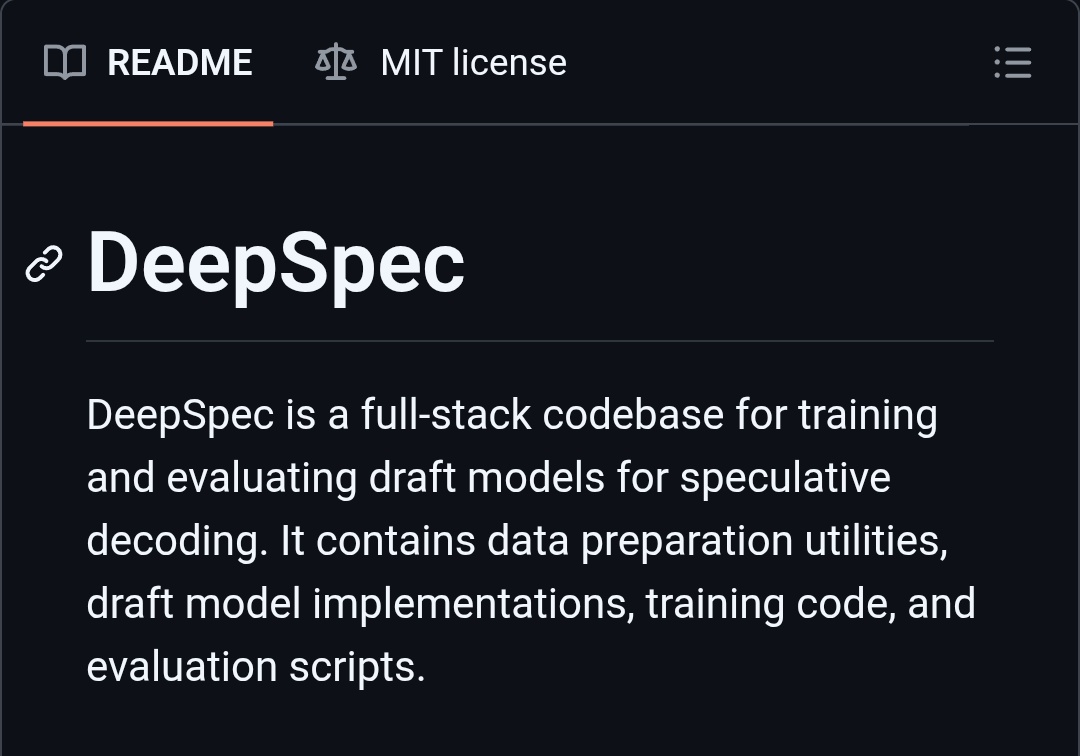
DeepSeek just open-sourced DeepSpec, an MIT-licensed full-stack codebase for training and evaluating speculative decoding algorithms. The

DeepSpec: a full-stack codebase for training and evaluating speculative decoding models
github.com/deepseek-ai/De…


Brian Armstrong explains how Coinbase halved its AI spend while token usage grew exponentially by implementing better defaults, routing, and caching instead of usage caps or alerts. Key tactics include defaulting to cheaper open-weight models like GLM 5.2 and Kimi 2.7 via an LLM gateway, AI-driven prompt preprocessing for optimal model selection, and raising cache hit rates from 5% to 60% in tools like LibreChat.

Better Defaults (not Usage Caps) – Engineers can choose any model they want, but defaults matter. We’re experimenting with defaulting


Next month I'll be looking to implement the kinds of things that Brian is doing here at Coinbase.
Most likely switching to GLM 5.2 as default and only using frontier models for harder
Better Defaults (not Usage Caps) – Engineers can choose any model they want, but defaults matter. We’re experimenting with defaulting

GLM-5.2 plus the US banning the most capable new models means open source caught up to SOTA closed source coding models
This could be v problematic for Anthropic’s and OpenAI’s revenue projections and IPO plans…

Elon Musk announces Grok 4.5 entering private beta at SpaceX and Tesla, powered by a new 1.5T parameter V9 foundation model with supplemental Cursor data training. Early evaluations indicate Grok 4.5 performance is close to or potentially exceeding Claude Opus, with reinforcement learning driving ongoing gains and the Grok Build harness improving daily.

Vipul Ved Prakash, CEO of Together AI who lurks in this group draws parallels between the PC industry's modular architecture and current AI developments, arguing that stable interfaces like transformers, OpenAI-compatible inference APIs, and agentic harnesses are driving specialization and explosive ecosystem growth.
The essay highlights rapid open-weights model progress through shared recipes (e.g., Rotary embeddings, GQA, MoE), modular frameworks for inference and training, and commoditized silicon, evidenced by Together AI's 10,000x token volume increase and high SWE-bench performance across frontier open models.
Open-weights companies are building viable businesses via API revenue and licensing, offering tokens over an order of magnitude cheaper than closed models, though the post warns of political risks from potential regulatory capture favoring incumbents.

DeepSeek announced peak/off-peak pricing for V4, launching mid-July. Rates double during Beijing business hours (9-12, 14-18).

 DeepSeek V4 GA (non-Preview) will launch in ~mid July with a price increase for "peak hours"

via Chas
New MCP for GEO analysis and website improvement loops
Thought it was interesting as I’ve not seen many that do this well

The first ever MCP that analyzes and ranks your website in AI search.
Simply talk to it and it'll find where you're missing, then goes in and handles the implementation.

Gokul Rajaram summarizes Nikesh Arora's interview with Harry Stebbings of 20VC on enterprise AI, where the Palo Alto Networks CEO argues "memory" or accumulated user/company context creates the primary competitive moat over raw model intelligence.
Arora stresses enterprises demand depth and zero-tolerance for errors in autonomous agents—unlike forgiving consumer AI—requiring massive edge-case training akin to Waymo's self-driving tech rather than bolting AI onto old workflows.
Key predictions include token prices falling 90%, half of G&A roles disappearing in three years, more demand for engineers and salespeople, and software evolving to offer "opinions" that amplify human output

@nikesharora, Chairman & CEO of @PaloAltoNtwks , interviewed by @HarryStebbings (@20vcFund )
Summary: Nikesh Arora took Palo Alto Networks from an $18 billion company to one worth $225 billion, and his read on enterprise AI is blunt: most companies are
Nikesh Arora on The Future of Token Costs | Memory Becoming the Moat & Why Enterprise AI Isn't Ready - 20VC with Harry Stebbings
Nikesh Arora, CEO of Palo Alto Networks, shares insights on navigating the rapidly evolving tech landscape, particularly in cybersecurity and AI. He e

Anthropic Releases Claude Sonnet 5 AI Model
Anthropic launched Claude Sonnet 5, its most agentic Sonnet model with substantial improvements over Sonnet 4.6 in reasoning, tool use, coding, and knowledge work, approaching Opus 4.8 performance at lower pricing. It features a 1M context window and is now the default for Free and Pro users, available across Claude apps, API, Claude Code, and integrations including Cursor, GitHub Copilot, Notion, and OpenRouter. Introductory pricing is $2 per million input tokens and $10 per million output tokens until August 31, followed by standard rates of $3/$15


Etched exited stealth announcing custom AI inference racks after a successful A0 tapeout, with $1B+ customer contracts and $800M raised, claiming state-of-the-art throughput, latency, and power efficiency on inference workloads.
The company highlights two innovations: Low-Voltage Inference to boost FLOPs density without thermal throttling for high-throughput tasks like trillion-parameter MoEs, and Cluster-Scale Memory to reduce latency via a shared low-latency pool across chips.
Backed by top investors including Jane Street and HRT plus AI leaders like Hinton, Karpathy, and Thiel, their 400+ engineer team from NVIDIA, Google, and TSMC plans first rack shipments this summer alongside production scaling.
I strongly recommend watching the Youtube interview linked below


via Huzefa
OpenClaw connects your phone to a self hosted AI gateway
OpenClaw released iOS and Android companion node apps that connect your phone to a self hosted AI agent gateway, which can run on macOS, Linux, or Windows (WSL2). The phone becomes the agent body with camera, location, voice and notifications, while the actual chat happens on your computer through the gateway and never on the phone. Privacy matters here, with commands like camera and screen capture needing explicit allowlists and approvals, and connections defaulting to LAN with TLS options for remote access.
via Anthropic
Fable 5 will be available starting tomorrow, Wednesday, July 1, to users globally on the Claude Platform, Claude.ai, Claude Code, and Claude Cowork. For Pro, Max, Team, and select Enterprise plans,1 Fable 5 will be included for up to 50% of weekly usage limits through July 7, after which it will be available via usage credits. We will re-enable access on AWS, Google Cloud, and Microsoft Foundry as quickly as possible.
via Alex
Metrics massaging by Anthropic.
They published two contradictory performance evals for Sonnet 5 within a day.
One saw Sonnet 5 pareto optimal against Opus 4.8, another with a significant gap albeit a lower pass rate.
Given that both charts referenced the same methodology, it means that either Anthropic faked the numbers or was sloppy in its application.
Imho it shows that without neutral third party tests, "Agentic" metrics are not to be trusted.
Here the 2 contradictory charts & reddit discussion:
Hermes Agent Upgrade Delivers 60x Faster Web Reading
Nous Research updated its popular open-source Hermes Agent to process scraped web pages directly, eliminating a redundant LLM summarizer that previously added time and costs. For large pages, content caches locally, with the agent accessing sections as needed, delivering 11.7 times average speedup and 23 times cost savings while matching or improving answer quality.

Scraping backends pass clean content straight to the agent without redundant processing steps; large pages are saved locally and paged on demand so you get the same quality at a fraction of the time and cost.

Web Search & Extract | Hermes Agent
Search the web and extract page content with multiple backend providers - including free self-hosted SearXNG.

feat(web_extract): truncate-and-store instead of LLM summarization by teknium1 · Pull Request #54843 · NousResearch/hermes-agent
Summary web_extract returns clean page content directly instead of running an auxiliary LLM over every scraped page - a live before/after eval shows 11.7x faster overall (176.6s → 15.1s across 4 UR...

via Bill Gurley of Benchmark Capital
WeChat has been a little quiet on AI front & perhaps even falling into being considered a laggard. But this week, Pony Ma presented a new vision on how to turn "mini-apps" (still no real equivalent in US) into AI handshakes


crossingriver.substack.com/p/4-million-mi…
4 Million Mini-Programs, One AI Agent: WeChat's Bet to Own China's Digital Life
With 1.4 billion monthly users and 4 million mini-programs, WeChat isn't building an AI chatbot. It's building the infrastructure layer for everything.

Tae Kim's Interview with Arm CEO Rene Haas: AI CPU Demand is 'Off the Charts'
An Interview with Arm CEO Rene Haas: AI CPU Demand is 'Off the Charts'
Key Context spoke with Arm CEO Rene Haas to discuss the state of the AI market.

Vercel's Andrew Qu on why agents are a new kind of software
In this Latent Space interview, Vercel's Chief of Software Andrew Qu explains how the company's evolution from shipping web applications to building agents — driven by pain points encountered while developing the v0 vibe-coding product (model switching, fallbacks, resumability) — led to eve, Vercel's agent framework that bundles prescriptive primitives like filesystem agents, skills, compaction, and subagents so developers don't have to rediscover best practices.
Qu argues agents are a genuinely new software category requiring different infrastructure for context, tools, and long-running work, and emphasizes two emerging priorities: skills as portable, on-demand knowledge that forward-corrects outdated model information, and an agent-readable web where Vercel already detects agent requests and serves Markdown instead of HTML. He also reveals that Vercel is effectively turning itself into an agent — with capabilities embedded across its website, Slack, and dashboard — while flagging multiplayer agent development (sharing context across teammates) as a key unsolved problem.
Vercel's Andrew Qu on why agents are a new kind of software
The Vercel Chief of Software explains how its agent framework, eve, was created - and why skills, sandboxes and agent-readable websites now matter.

obra/superpowers is an agentic skills framework for multiple coding harness built by Jesse Vincent
Rather than a single prompt, it bundles about 14 reusable skills - brainstorming, spec writing, plan writing, test-driven development, and systematic debugging among them - into a methodology the agent follows as it works.
The scale of adoption is hard to ignore: around 244,000 GitHub stars and 21,000 forks, making it one of the most-starred projects in the Claude Code ecosystem. It was created in October 2025, remains highly active with a v6.1.0 release in June 2026, and has been accepted into Anthropic's official Claude Code plugin marketplace.
Superpowers 6
TL;DR: Superpowers 6 is much, much faster and burns many fewer tokens to get the same high-quality outcomes. If you're tokenmaxxing, maybe skip this release, but if you care about your builds being up to 50% faster and up to 60% cheaper, you're going to love Superpowers 6.

GitHub - obra/superpowers: An agentic skills framework & software development methodology that works.
An agentic skills framework & software development methodology that works. - obra/superpowers

LangChain shipped OpenWiki last week. It is a command-line tool that reads your codebase, generates a wiki, and keeps it updated as the code changes. The wiki is not documentation for humans. It is context for coding agents.

Right now it's just for codebases, but we're working to expand it to everything for memory.
What do you want to see in a general purpose memory wiki agent?
github.com/langchain-ai/o…

Below is my personal website which aggregates links to many of my socials as well as the various content and community that I curate. Feel free to share this link to others who you think may find this content/community useful to them
The cover image of this newsletter via generated via the ChatGPT Image 2 model within the Krea tool via the following prompt
A close-up of water lilies using the palette knife technique, in the style of Monet, impressionist, rich and textured brushstrokes that capture the play of light, reminiscent of springtime meadows, Monet's French countryside color scheme