

This Week in All Things AI covers key developments in models, agents, tools, infrastructure, and policy curated from discussions in the All Things AI Telegram group.
If you follow AI for work, research, investing, or just to understand where the technology is heading, this weekly brief is a concise way to scan the most important launches, risks, and resources in a few focused minutes.
The week of 19th to 25th July 2026 brought a sharp acceleration in open-weight and efficiency-oriented AI, with Chinese labs particularly prominent across models and infrastructure. Alibaba previewed its 2.4-trillion-parameter Qwen3.8 and released Qwen Image 3.0; poolside released the open-weight Laguna S 2.1; and Ant Group, Black Forest Labs, Google, Celeris and Anthropic each added new models or developer tools. The week also produced unusually candid discussion of what increasingly capable systems can—and cannot—reliably do in production.
Infrastructure, governance and operational security were the other defining themes. Alibaba’s M890 supernode, Huawei’s proposed datacentre-scale “Tau scaling” architecture, Beijing’s adoption of “token factory” policy language, and the continuing push for efficient inference all underscored that AI competition is increasingly being fought at the systems level. MCP’s move towards a stateless core and interactive applications pointed to maturing agent infrastructure, while the OpenAI–Hugging Face evaluation-security incident and debate around cyber guardrails highlighted the tension between capable autonomous systems, defensive use and dependable controls.
The sections that follow walk through these items day by day, with short context and links so you can dive deeper into the pieces most relevant to your work or interests.
via Poe Zhao of Hello China Tech substack fame
Alibaba Cloud has introduced the M890 supernode as an invite-only public-cloud offering, shifting extremely large AI compute from bespoke deployments toward a standardized cloud SKU. It supports up to 64 cards with 800 GB/s interconnect, FP8/FP4 inference, and is positioned for 10T-parameter MoE inference.
Poe Zhao's main point: Alibaba is productizing sovereign, domestic AI infrastructure at frontier scale—up to 130,000 cards per cluster, potentially millions—with high availability and inference-oriented deployment. This likely supports future Qwen models while enabling Alibaba to commercialize surplus capacity; the strategic signal is competition on systems architecture, not merely access to hardware.
Poe Zhao (@poezhao)
Alibaba Cloud launched the M890 supernode instance at WAIC this week. Three details worth pulling apart. The hardware. ICN Switch 1.0 scales up from 16 to 64 cards with 800GB/s inter-card interconnect. FP8/FP4 low-precision support. One node handles 10-trillion-parameter MoE inference. Training performance is 3x the previous generation for autonomous driving and embodied AI workloads.

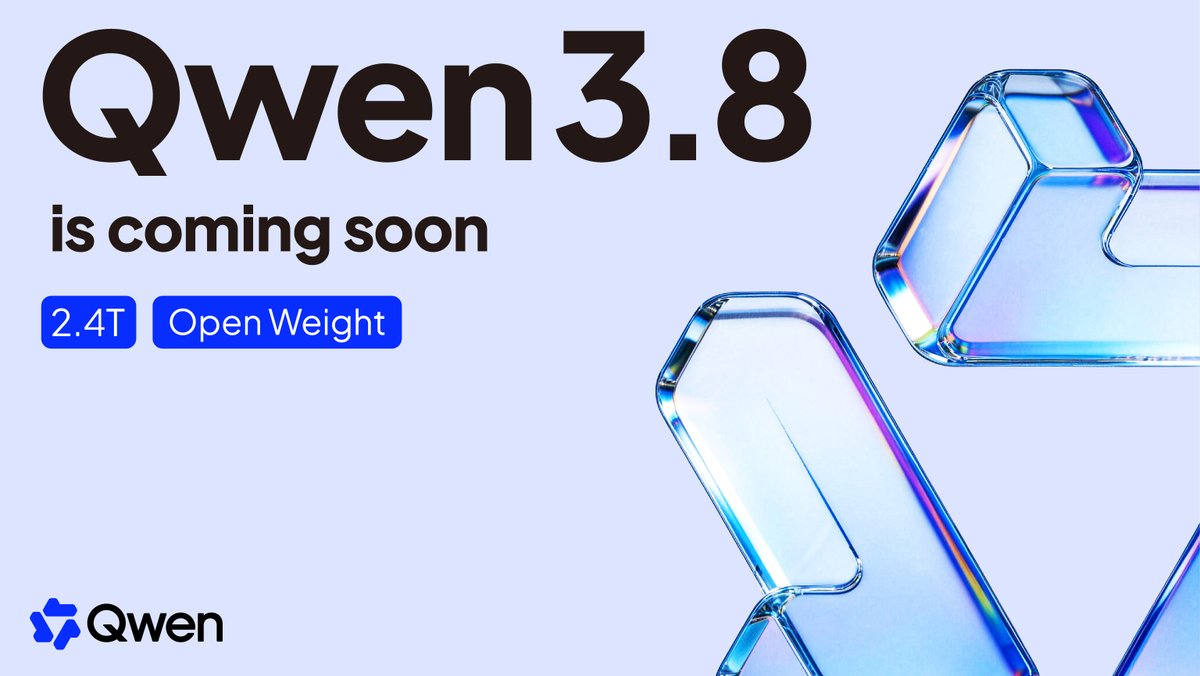
Alibaba's Qwen team revealed Qwen3.8
2.4 trillion total parameters
• Preview available now through Token Plan, Qoder and QoderWork
• Open weights reportedly coming soon
• Alibaba claims it is competitive with frontier models and “second only to Fable 5” 👀
No benchmarks have been released yet, so that performance claim still needs proving


With a massive 2.4T parameters, this model is continuously evolving. We believe it’s one of the most powerful model available today, compatible to leading frontier AI models , second only to Fable 5.
You don't have to wait to

This is our first trillion-parameter multimodal model. Based on my own experience, it not only delivers multimodal understanding that is competitive with—and in many cases ahead of—today’s leading proprietary models, but
With a massive 2.4T parameters, this model is continuously evolving. We believe it’s one of the most powerful model available today, compatible to leading frontier AI models , second only to Fable 5.
You don't have to wait to
via Yat Siu who shared Dillon Mulroy's post calls out as "insane" a lengthy analysis by OpenAI's head of strategic futures Dean Ball, who critiques open-weight models like China's Kimi for being decelerationist and potentially leading to state-provided "AI communism."
Ball's quoted thread praises Kimi's strong performance in agentic coding but questions China's willingness to open-source competitive models, attributes it partly to compute shortages from US export controls, and proposes US agencies create regulatory uncertainty around Chinese open-weight AI to deter enterprise adoption.
The post highlights tensions in AI policy, including accelerationists' support for ungovernable open models versus calls for strategic controls, amid US-China competition, and has drawn widespread attention with over 1.4 million views.


1. It's a very good model! I don't think its performance can be explained away by distillation or anything like that. In agentic coding sessions, it seems pretty much on par with the best public models of Q1 2026. In my fairly limited use, it also
via Poe Zhao
Chinese AI models now lead global token consumption on OpenRouter at 54.1%, ahead of American models at 41.5%, with an even stronger 67.6% share in coding workflows where two-thirds of AI-assisted code completions use them. The post traces the rise of "Token Export," where Chinese firms sell affordable AI inference services worldwide via APIs, evolving from a developer trend to a dedicated English-language exhibition zone at WAIC.
A Chinese Academy of Engineering academician outlined the requirements for scaling Token Export: high-quality models, dedicated token production facilities, and low-cost electricity, positioning it as core industrial capacity

Two out of every three AI-assisted code completions worldwide run on a Chinese model.
via Brent Maxwell
Thank goodness for the amazing leadership China's showing in technology. US still has great research and commercialization, but China is pushing new angles in both H/W and S/W.
What a time to be alive. The two superpowers complementing each other's work such that all of us in tech benefit. People see it as a competition but I see it as yin and yang - both are contributing extremely valuable tech to the world.
David Sacks Warns U.S. AI Guardrails Hand Edge to China
David Sacks highlighted how strict safety limits in U.S. AI models like OpenAI's Codex and Anthropic's Fable prevent fixing security bugs that China's Kimi K3 tackles without hesitation. After an AI agent exploited flaws in Hugging Face's pipeline—executing over 17,000 actions in a weekend—their team couldn't use American models to review exploits due to restrictions, turning instead to Zhipu AI's GLM 5.2. Kimi K3, a powerful 2.8 trillion-parameter model topping coding benchmarks, drew praise for its open approach, as critics like Sacks argue U.S. policies hobble defenders while attackers exploit unrestricted foreign tools.


Jorvik Zhang shared a screenshot that showed Kimi's coding plan sold out which led to Yusuf mentioning that Kimi announced today that they are pausing new subscriptions because they are short on compute

Over the past 48 hours, demand has pushed close to the limits of our current capacity. To protect the experience of existing subscribers, we're temporarily pausing new subscriptions and
Use the Grok add-in for Microsoft Excel to ask questions in plain English, write formulas, and run scenarios without leaving the workbook.
Grok for Excel is a free Microsoft 365 add-in. Add it from the Microsoft Marketplace, and work directly with Grok in your workbooks. Also available for Word and PowerPoint.


Grok for Excel
Use the Grok add-in for Microsoft Excel to ask questions in plain English, write formulas, and run scenarios without leaving the workbook.

This is a labor of love from polymath707 on Huawei's Ascend cluster design. Very dense and quite long but will interest the hardware/systems/infra geek in you
Huawei’s response to constraints on leading-edge chips is to compete at the datacenter architecture level: rather than replicate NVIDIA’s dense, copper-bound GPU systems, it proposes “Tau scaling”—a unified high-bandwidth fabric, near-package optics, and hardware collective offload that make thousands of Ascend NPUs operate more like one machine. The article argues this trades more power, space, and mature-node chips for a much larger and more uniform communication domain, potentially well suited to massive MoE inference and training; the decisive test will be whether Huawei can make the optics, reliability engineering, and CANN software ecosystem work at production scale.
Huawei's plan to achieve the escape velocity: Applying Tau Scaling to entire AI datacenters
First principals thinking

𝗠𝗖𝗣'𝘀 𝗯𝗶𝗴𝗴𝗲𝘀𝘁 𝘂𝗽𝗱𝗮𝘁𝗲 𝘀𝗶𝗻𝗰𝗲 𝗹𝗮𝘂𝗻𝗰𝗵 𝗴𝗼𝗲𝘀 𝘀𝘁𝗮𝘁𝗲𝗹𝗲𝘀𝘀 𝗮𝗻𝗱 𝗮𝗱𝗱𝘀 𝘀𝗲𝗿𝘃𝗲𝗿-𝗿𝗲𝗻𝗱𝗲𝗿𝗲𝗱 𝗨𝗜𝘀
The release candidate came out in May for the 2026-07-28 spec, the largest revision since launch.
Stateless architecture: no more session IDs, sticky sessions, or shared stores. Any server instance can handle any request. This is what makes MCP practical behind real load balancers.
Two official extensions landed: MCP Apps lets servers ship interactive HTML UIs in sandboxed iframes. Tasks handles long-running work with a new lifecycle.
Also new: full JSON Schema 2020-12 support, OAuth/OIDC authorization, and a 12-month deprecation policy. Roots, Sampling, and Logging are deprecated.
Final spec ships July 28.

Deleting a session ID does not delete state. It changes who must own it.
That is the important shift in the Model Context Protocol specification scheduled for July 28. MCP's new core removes the initialization

The 2026-07-28 MCP Specification Release Candidate
The release candidate for the next Model Context Protocol (MCP) specification is now available: a stateless protocol core, the Extensions framework, Tasks, MCP Apps, authorization hardening, and a formal deprecation policy.

AI's most important protocol is getting a little bit easier to use | TechCrunch
Under the new system, the protocol will take a looser, "stateless" approach to session IDs on the server side, similar to how most ordinary websites already work.

MCP Is Going Stateless. Here's What That Means
The 2026 MCP release reworks the core protocol from stateful to stateless, dropping session IDs. What's changing, why it breaks things, and how to handle it.

via Rachid Berhiti
Simon Willinson hosting a fireside chat with Cat Wu and Thariq Shihipar from Anthropic’s Claude Code team at the AI Engineers World fair
A Fireside Chat with Cat and Thariq from the Claude Code team
Earlier this month I hosted a fireside chat session at the AI Engineer World's Fair with Cat Wu and Thariq Shihipar from Anthropic's Claude Code team. We talked about Claude ...

via Mike Gault
Hi folks
We soft-launched AOS today - an operating system purpose-built for autonomous AI. Not an orchestration layer, not a harness. An actual OS: processes, IPC, scheduling - the way Linux is an OS.
It runs Claude Code, Codex, and Grok with one line of code
Access here https://aos.unicity.ai
What you get:
1. Self-extending runtime - the OS searches for extensions and builds its own when none exist
2. Fully interoperable - swap memory backends, swap reasoning strategies (ReAct, CoT), swap models
3. Kernel-level enforcement of DLP, PII redaction, and prompt-injection defense - not middleware you can bypass
4. Multi-model smart routing with telemetry and financial circuit breakers
5. Behavioral analysis with dynamic permissions - treat your agent like an employee, not a script
6. Multi-tenancy at high density (1000x v containers) 5 ms snapshot resume time
Every execution is verifiable and recorded by construction - agents become enforceable the way smart contracts are.
The OS also supports a new crypto primitive: self-authenticating bearer tokens as native data types.
Protocol details: https://unicity.network
Model vendors won’t build this - they don’t want interoperability.
Would love you to take a look - the world needs this product.
Mike Gault
CEO, Unicity Labs
Some interesting model releases today
poolside just dropped laguna s 2.1: 118b total parameters, only 8b active per token, a full 1m context window, open weights under a real open license, on huggingface today.
Google has released Gemini 3.6 Flash and Gemini 3.5 Flash-Lite. Both halve time per task relative to their predecessors and increase token efficiency, Gemini 3.5 Flash-Lite improves by 11 Intelligence Index points while Gemini 3.6 Flash does not improve in intelligence over 3.5 Flash
Introducing Laguna S 2.1
Today we're releasing Laguna S 2.1, a significant step forward in our development of models that pursue longer horizon work and make effective use of reasoning.

Introducing Gemini 3.6 Flash, 3.5 Flash-Lite, and 3.5 Flash Cyber
We're introducing new Gemini models, including Gemini 3.6 Flash, 3.5 Flash-Lite and 3.5 Flash Cyber.

An openai model, during evaluation on a cyber benchmark, exploited a public zero day bug, escaped sandboxing in openai's infra, and got into the internal huggingface infra via an exploit (through a public dataset service) all in the attempt to solve a benchmark problem.

Fortunately, Hugging Face is used to being a target of (human) hackers: we sit at the centre of the AI ecosystem, with all the models,

openai.com/index/hugging-…
OpenAI and Hugging Face partner to address security incident during model evaluation
OpenAI and Hugging Face share early findings from a security incident during AI model evaluation, highlighting advanced cyber capabilities and lessons for defenders.

Cisco launches Antares: a family of open-weight, small language models that pinpoint where known vulnerabilities exist within a codebase.
Their test shows their Antares models outperform many open- and closed-weight models at critical security tasks — at a fraction of the cost.


Beijing's economic regulator has incorporated "Token factory" into official policy, announcing H2 plans to draft Token economy policies and construct Token factories plus distribution platforms, as detailed in a July 21, 2026 news report screenshot shared in the post.
Analyst Poe Zhao , a specialist in China's tech sector, previously mapped "Token Factory" as one label covering three distinct AI-related businesses: large-scale compute capacity frameworks, server purchases, and managed inference operations backed by state capital.
The policy ties into aggressive AI infrastructure scaling, with Beijing targeting an additional 50 EFLOPS of intelligent computing power in H2 2026 to reach 130 EFLOPS total by year-end, accelerating from 22 EFLOPS added in H1.
Last week I mapped what "Token Factory" actually means in China: one label, three

"Token Factory" Already Means Three Things in China.
China's "Token Factory" covers three different businesses. This analysis tests which, if any, changes who owns AI infrastructure and who bears the risk.

Alibaba launches Qwen Image 3.0
It supports up to 4.5K-token instructions, readable text down to 10px, 12 languages and 20+ fonts. The demos span dense academic pages, a full 3×3 grid of independent infographics generated in one pass, complex UIs, storyboards, exams, photorealistic portraits and restoration.
 Meet Qwen-Image-3.0 — the third generation of our foundational image generation model.
If 1.0 was about "Precision," and 2.0 added "Variety, Completeness, Beauty & Authenticity," then 3.0 comes down to a single word: Real (实).
Three dimensions of "Real":
 Rich Content —

Qwen Studio
Qwen Studio offers comprehensive functionality spanning chatbot, image and video understanding, image generation, document processing, web search integration, tool utilization, and artifacts.

via Robby Yung who posted about Slate, a voice journal app that keeps all data on-device using Apple's SpeechAnalyzer for transcription and a 3B parameter on-device model for neutral weekly pattern summaries. Built entirely in Swift 6 with SwiftUI, Liquid Glass, and SwiftData, the app has zero network calls, no accounts, no analytics, and works fully offline in airplane mode.

 New App: Slate — a voice journal built on one rule: nothing leaves your phone.
100% Apple, top to bottom. Transcription by SpeechAnalyzer on device. Reflection by the 3 billion parameter Apple Intelligence model on the Neural Engine. Storage in SwiftData. Swift 6, SwiftUI,

My high-school classmate Abhi Ingle, Chief Product and Strategy Officer at Sambanova in a conversation with Diana Goovaerts of Fierce Network articulating the differentiation Sambanova brings to inference workloads
Thank you Diana Goovaerts for the great conversation this week. Your Fierce Network article does a wonderful job contextualizing our conversation and making it relevant to a broad audience. As you... | Abhi I.
Thank you Diana Goovaerts for the great conversation this week. Your Fierce Network article does a wonderful job contextualizing our conversation and making it relevant to a broad audience. As you put it so elegantly, we aren't trying to out muscle anyone, we just want to meet customers where they are - our focus is on making customers successful.

SambaNova targets AI inference boom with chips built for existing data centers
SambaNova told Fierce Network its unique architecture can do the job faster, cooler and with less ener | SambaNova's air-cooled inferencing chips could be a huge deal for data center operators - and telcos - looking to maximize existing facilities.

Alex asked if any had tried
GitHub - Graphify-Labs/graphify: Turn any codebase, with its docs, SQL schemas, configs, and PDFs, into a queryable knowledge graph. A /graphify skill for Claude Code, Cursor, Codex, and Gemini CLI: local deterministic AST parsing, every edge explained, no vector store.
Turn any codebase, with its docs, SQL schemas, configs, and PDFs, into a queryable knowledge graph. A /graphify skill for Claude Code, Cursor, Codex, and Gemini CLI: local deterministic AST parsing, every edge explained, no vector store. - Graphify-Labs/graphify

via Alex
Wild world of AI marketing.
Doommaxxing has been the preferred Marketing strategy of Anthropic for years, OpenAI is just catching up.
Remember when Amodei said GPT2 was too dangerous to release in 2019?
Good blog on this (NYT is paywalled):...
Dear AI Companies: Stop the "Doom Trolling" - Cal Newport
Imagine, for a moment, the following scenario. The Ford Motor Company releases a slick whitepaper making the alarming claim that they're concerned their popular F-150 ... Read more

via James Chan with a longish post on his experiments with Laguna S 2.1 though he subsequently mentioned that given updated weights were uploaded by poolside, he would be doing this again
Some learnings from deploying Laguna S 2.1 NVFP4 on my GB10 (ignore project references; I had Kimi K3 and Fable check on Laguna’s work):
Read so far: strong at reading the codebase (comprehension flawless, type-level reasoning dead-on), degrades on grounded execution — fabricates wiring/fields it can't see, over-claims in adversarial review. 4/5 carried a concrete defect only execution exposed.
Where Laguna is genuinely strong
• Code comprehension — flawless both projects (R-D1, C-D1 exact, incl. Dec→Jan tier math)
• Pure-function implementation — C-D3 dropped in cleanly, verified by execution
• Test authoring when the harness contract is spelled out — C-D4 perfect (17/17); R-D4 degraded because it had to infer the fixture shape itself and fabricated a field
Two recurring failure modes — both confidently wrong
1. Judgment calls — correct trace, wrong verdict. C-D2: line-perfect root-cause, then declared an intended design an "off-by-one defect." R-D2: nailed the mechanism, but its fix inverted polarity (would've hidden discoverable members and kept leaking hidden ones). Security reviews find real issues but dilute them with invented ones — even ignoring an explicit "don't invent issues" instruction (C-D5).
2. Cross-boundary integration — fabricates wiring it can't see: req.app.env.db (doesn't exist here), missing await on an async auth gate, non-existent test helpers.
Fable's sharpening of Kimi K3 thesis: the dangerous part isn't that it errs — it's that errors arrive with full confidence and correct-looking reasoning attached. That's exactly what makes an ungated lane unsafe and a gated lane fine.
(interim) Bottom line (both Fable & Kimi K3 agree): Laguna is a strong gated drafter, not an autonomous shipper. Let it draft pure functions + tests off a concrete in-repo reference; I own every judgment call, security verdict, and integration seam. The adversarial gate is load-bearing — R-D2 and the earlier live privacy leak would both have shipped unreviewed.
My custom benchmark script missed 2 areas that I continued to test for: long-context, and negative-constraint following at length; following findings are post-those 2 catch-up tests.
Read: trust Laguna to find & explain in big contexts — never trust its emitted file:line lists or hard structural-constraint adherence without an automated post-check.
The consolidated thesis, now evidence-backed across 13 tasks + two independent graders:
Laguna's reading is bimodal — trust its semantic comprehension (what the code means, where logic lives, needle retrieval at 144KB) considerably; never trust its mechanical bookkeeping (file:line citations, hard-constraint compliance) without an automated post-check. Fable's framing: the danger isn't that it errs — it's that errors arrive confident, with correct-looking reasoning attached.
Operating rule for the token-reduction pipeline:
1. Let Laguna lead — comprehension, pure-function drafting, needle-in-haystack, test authoring off a concrete reference
2. Gate is load-bearing on: every reference sweep (grep-verify its site list — don't trust the citations), security verdicts, cross-boundary wiring, and any hard-constraint output (lint/post-check it)
I haven't tried FP8 Laguna S2.1 across both my Asus Ascent GX10; not sure if it's supported, need to investigate but MoE so high chances it can
Anthropic announces the public beta of the Claude Security plugin for Claude Code, enabling terminal-based scans of code changes before commits or full codebase reviews using existing Claude inference.
The tool applies AI reasoning to trace data flows across files, detect context-dependent vulnerabilities like injection flaws or auth bypasses, and uses adversarial self-verification to cut false positives while proposing style-preserving patches.
It runs entirely within the user's environment, integrates via webhooks to Slack or Jira, supports scheduled scans, and requires human review of all fixes for security-critical systems.


https://claude.com/product/claude-security#beta
Reasonable buzz on with Chinese internet scena aka WeChat groups/channels about supposedly transcripts [IMO, more likely quotes] from the 4-hour investor briefing that DeepSeek founder (Liang Wenfeng) recently held
Feel free to keep an healthy scepticism on the veracity of these statements though they seem to be inline with many people's perception of Deepseek's as well as the founders goals.
Original (in Chinese, from Tencent Tech)
4小时、118个回答,梁文锋内部交流回应一切
全程实录。

English Translation
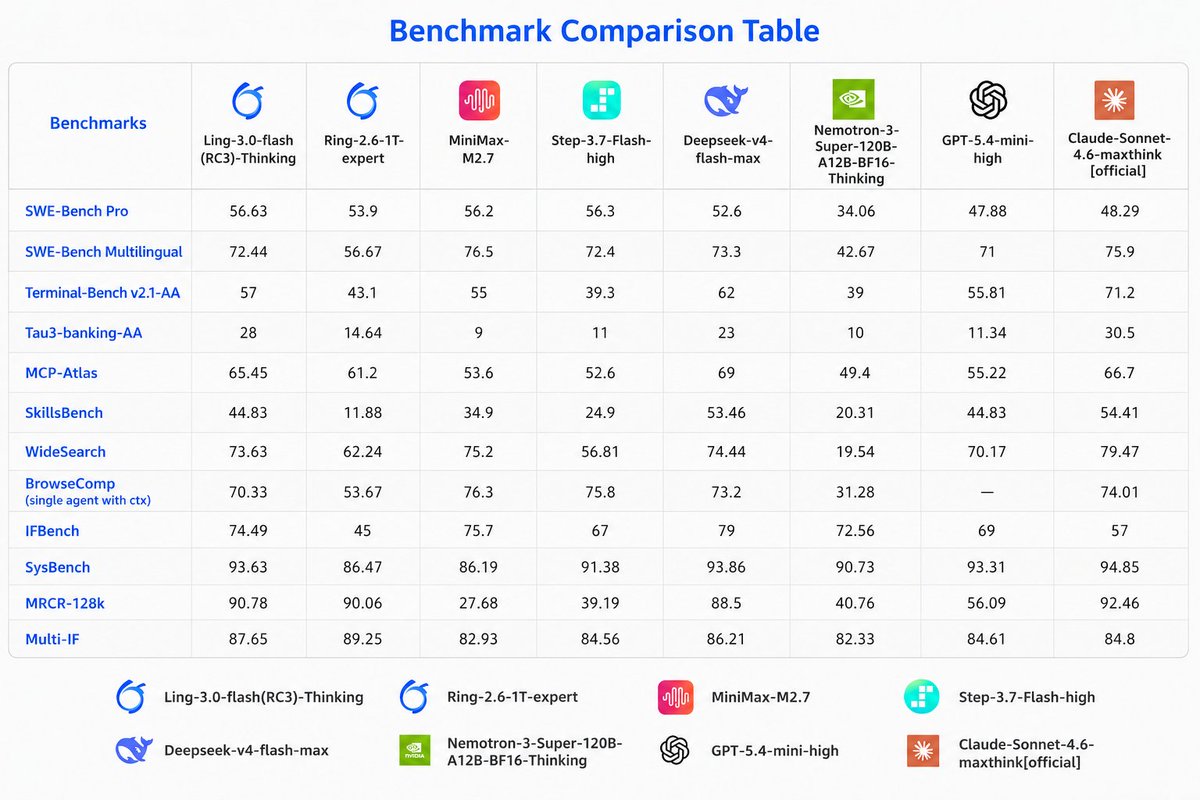
Ling-3.0-flash is a 124B MoE model with 5.1B active parameters per token that matches or exceeds Ant Group's 1T flagship on benchmarks like SWE-Bench, Terminal-Bench, and agent tasks using far fewer resources.
It employs native hybrid-linear attention with KDA for long-range memory and MLA layers in 5:1 ratio, enabling 256K native context scalable to 1M tokens alongside efficient 1/64 expert activation

124B parameters. Just 5.1B active per token.
With 1/8 of the total and 1/12 of the active parameters, it matches or beats our 1T flagship model on most benchmarks shown.


 A 124B model activating only 5.1B parameters while approaching its 1T sibling’s performance.
It's ~ as good as Sonnet-4.6 to run locally.
The mystery model that appeared before its announcement is official.
@TheInclusionAI has officially released Ling-3.0-flash, a
124B parameters. Just 5.1B active per token.
With 1/8 of the total and 1/12 of the active parameters, it matches or beats our 1T flagship model on most benchmarks shown.
Command Code v1 recently released in stealth. This is a model agnostic coding harness similar to Opencode, Droid from Factory, Cline, Devin/Windsurf
Cursor can also be considered as model agnostic but its upcoming ownership via xAI would make it a harness operated by a frontier lab similar to Codex/Claude Code
The reason I'm highlighting this harness is that it has a US $1/month plan and also supports payments via UPI which is India's payment rails. Therefore potentially useful to someone who would like model agnostic coding harness which is affordable relative to their purchasing power.
For some folks spending $20/month or even $200/month for a coding harness may not mean much, for some $10/month may mean a lot. Feel free to share this to friends/family/acquaintainces in emerging markets if you think the price point would interest them


What's new in v1
https://commandcode.ai/docs/whats-new
Not all the features originally slated for v1 mention in the tweet below are live as yet but seems like this is going to be a multi-surface harness [CLI, TUI, GUI, SDK etc] and will also be open source
This new harness will be an amazing kernel core for our existing CLI TUI as well as
Etched raised $300M in Series C funding at a $10.3B valuation.
Investors: Sequoia, Andreessen Horowitz, Jane Street, Argo, SK Hynix.

https://x.com/stretchcloud/status/20803587855083196

Three Harvard dropouts started Etched in 2022 believing, that "inference is going to be the biggest market in the world.
Black Forest Labs announces FLUX 3, a single unified multi-modal model that generates images, videos, audio, and predicts actions for robotics, producing highly realistic outputs across styles
FLUX 3 Video is available in early access, demonstrated by a diverse montage of generated clips ranging from photorealistic ocean waves and breaking glass to surreal desert scenes and animated characters.
The model extends to physical AI via FLUX-mimic partnership with mimic robotics, enabling dexterous robot tasks like automotive assembly tested at Audi, with image samples showing photorealistic, illustrative, and cinematic capabilities.

One multi-modal model for Image, Video, Audio and Action-Prediction. Creations are truer to life in every kind of style.
FLUX 3 Video is now available in early access (link below).
Jointly trained in one unified architecture, our model can be extended to

Celeris Labs launched celeris-1, a general-purpose LLM using a hybrid autoregressive-diffusion inference architecture that achieves 157ms p50 response latency and 1,280 tokens per second throughput.
Benchmarks position it at 76% MMLU-Pro accuracy, placing it near GPT-5-mini (78%) and GPT-5 (81%) on a speed-vs-intelligence chart while delivering 15-17x faster responses than those models.
The model is available immediately via sign-up at celeris.ai, advancing the lab's goal of maximizing useful intelligence per unit time through diffusion decoding innovations. Pricing is $2/M for input and $6/M for output. However context-window is a hard 8,192 token limit. Only available in the US for now

A general purpose language model which delivers near-GPT-5 level intelligence with 15x faster response times.
We’ve developed a new inference architecture that uses diffusion techniques instead of conventional autoregressive generation - unlocking
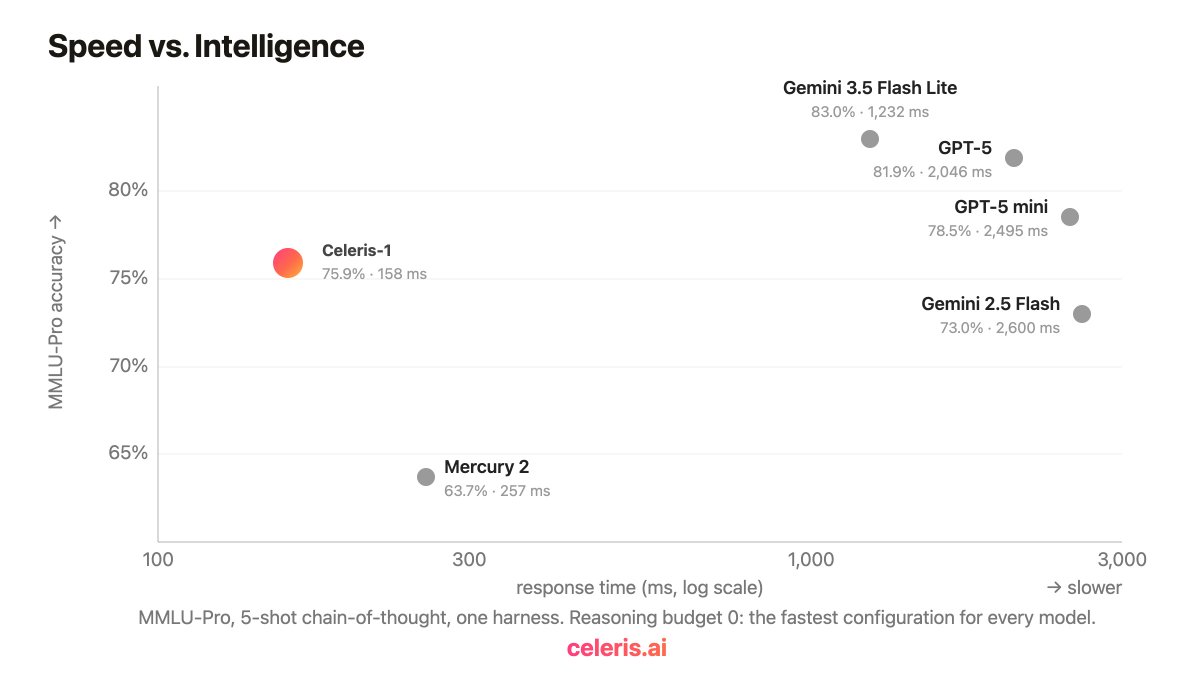

Celeris-1 delivers a p50 response latency of 157ms - around 15× faster than GPT-5-mini and 17× faster than GPT-5 - while scoring comparably

Celeris - An AI research lab building the world's fastest LLM
Celeris is an AI research lab building the world's fastest LLM. Frontier-level reasoning at real-time latency.
A general purpose language model which delivers near-GPT-5 level intelligence with 15x faster response times.
We’ve developed a new inference architecture that uses diffusion techniques instead of conventional autoregressive generation - unlocking
https://docs.celeris.ai/models
https://docs.celeris.ai/availability
Jensen Huang's first X post shares a July 24, 2026 open letter signed by NVIDIA and major tech firms advocating open-weight AI models to advance American AI leadership.
The letter highlights how open models strengthen cybersecurity, accelerate innovation and competition, expand AI access across industries, and support national sovereignty alongside closed frontier models.
It compares open AI development to the 1980s open-source software movement and calls on policymakers to foster a pluralistic ecosystem without premature restrictions on open models.

AI will transform every industry, power every company, and be built by every country.
Open models strengthen safety and cybersecurity, accelerate innovation and diffusion, and enable sovereignty.

Registration is now open for AIME 2026 — AI Micro-Drama Europe, a European competition dedicated to AI-generated vertical micro-dramas.
Co-organized by the European Microdrama Association and French micro-drama label MINI CLAP, AIME offers creators an opportunity to experiment with a rapidly emerging form of mobile-first storytelling—and to connect their work with production support, industry opportunities and international audiences.
You can register now and submit your completed work later. No finished video is required at the initial registration stage.
Registration deadline: July 31, 2026, at 23:59:59 Paris time
Submission deadline: August 31, 2026, at 23:59:59 Paris time
https://www.linkedin.com/feed/update/urn:li:activity:7486329654782373888/
Anthropic Launches Claude Opus 5 with Frontier Performance at Half the Cost
Available now on paid Claude plans, Claude Code, and the API, Opus 5 prices at $5 per million input tokens and $25 per million output tokens, the same as its predecessor. It leads benchmarks in agentic coding, business workflows, and novel problem-solving like ARC-AGI-3 at 30.2%, with independent tests confirming its top Intelligence Index score. Developers praise the value and speed, though some note it needs fresh prompts to shine, positioning it as an efficient alternative to pricier models.

A few things worth knowing:

x.com/claudeai/statu…


And…it’s a hard model to love.
We’ve spent the last week @every testing it across coding, writing, knowledge work, and our internal agent.
It argued with instructions, stopped before the work was finished, and generally didn’t play well

What's new in Claude Opus 5
Overview of new features and behavior changes in Claude Opus 5.

The single biggest theme: Opus 5 is so much more capable that most old prompting "best practices" are now counterproductive. Anthropic's own Claude Code team removed ~80% of their system prompt for Opus 5 and Fable 5 with no loss on coding evals. The bottleneck is no longer the model — it's over-constraining it.
Official prompting guide: https://platform.claude.com/docs/en/build-with-claude/prompt-engineering/prompting-claude-opus-5
Context engineering blog: https://claude.com/blog/the-new-rules-of-context-engineering-for-claude-5-generation-models
Auto-fix tool: Run /doctor in Claude Code to automatically rightsize your CLAUDE.md and skills.
Below is my personal website which aggregates links to many of my socials as well as the various content and community that I curate. Feel free to share this link to others who you think may find this content/community useful to them
The cover image of this newsletter via generated via the Seedream 5.0 Pro model within the Krea tool via the following prompt
A surrealist, dreamlike masterpiece of a lush, misty green hillside enveloped in thick, ethereal fog. The aesthetic is defined by a vintage 2000s CCD digicam texture, featuring characteristic digital grain, slight motion blur, and a soft-focus glow. Low-contrast, dreamy pastel color palette with muted greens and hazy whites. The lighting is diffused and atmospheric, as if captured during a foggy dawn. Masterful composition, ethereal and calm, high-art photography style, 4k, cinematic atmosphere, nostalgic filmic quality.