

This Week in All Things AI covers key developments in models, agents, tools, infrastructure, and policy curated from discussions in the All Things AI Telegram group.
If you follow AI for work, research, investing, or just to understand where the technology is heading, this weekly brief is a concise way to scan the most important launches, risks, and resources in a few focused minutes.
The week of 30th August to 5th September 2026 brought a relentless run of model launches and AI product updates across text, coding, image, speech, video, and infrastructure. Anthropic introduced Claude Fable 5.1 and Claude Mythos 5.1, Google released Gemini 3.8 Flash alongside its cyber-focused variant, Meta upgraded Muse Spark 1.3, and OpenAI began a staged rollout of ChatGPT 6 Astra. Microsoft also expanded its in-house model portfolio with MAI-Image 2.6 and MAI-Image 2.6 Flash for image generation, alongside MAI-Transcribe-2 for speech-to-text, while IFM’s fully open K2 Horizon family ranged from edge-scale models to 375B parameters. Inception’s Mercury 2.5 preview, meanwhile, showcased how diffusion-based language models could offer a compelling alternative for high-speed, latency-sensitive reasoning and agent workloads.
Video and multimodal AI also moved further toward interactive, real-time use. fal’s H3 Max, built on MiniMax H3, and related open inference work demonstrated video generation faster than playback; World Labs unveiled Atlas for controllable 3D scene reconstruction and world simulation; and Google added agentic video understanding to Gemini, allowing models to actively inspect relevant frames, audio, and transcripts rather than process a video uniformly. Perplexity’s hybrid compute feature illustrated a parallel shift in agent design, combining cloud models with local Apple Silicon processing for privacy-sensitive files, while Together AI’s planned Saudi data-centre partnership underlined how power access and compute capacity are becoming strategic constraints.
Taken together, the week showed that the race is no longer only about stronger general-purpose models, but about making multimodal AI faster, cheaper, more private, more deployable, and useful in real production workflows
The sections that follow walk through these items day by day, with short context and links so you can dive deeper into the pieces most relevant to your work or interest
Friends,
Video editing looks effortless — until you try it. I find it genuinely hard, and I have real admiration for people who've mastered it: the ones who see a story where the rest of us see six hours of messy footage.
Join me for the next session of my conversation series on Tuesday, Sep 22, 12:00 PM HKT (India 9:30 AM - London 5:00 AM - NY 12:00 AM Tue - LA 9:00 PM Mon Sep 21), via Google Meet, with Shamir Allibhai — filmmaker turned Meta PM on video/AI infra, now a repeat founder whose current company, Eddie AI, builds an AI assistant editor for professionals.
This isn't a product demo. We'll talk about the career — filmmaking, product work at Meta, repeat founding — what he hears from editors using AI tools in real pipelines, and why editing is so hard to master. I'll be bringing my own beginner's frustrations; bring yours.
Format: a round-table conversation, not a webinar — everyone engages Shamir directly. Drop a question in the thread beforehand if you'd like it teed up, or bring it on the day.
Register: https://luma.com/qo2351sz — Luma shows your local time on registration.
The session will be recorded and archived with my previous conversations — so if 5 AM in London or midnight in NY isn't your friend, the recording has you covered.
Together AI announced a partnership with Saudi AI firm Humain for a 250MW data center equipped with 120,000 semiconductors, expected to generate over $5 billion in annualized revenue through shared compute for open-source AI models.
The deal is based in Saudi Arabia as part of the kingdom's push to develop its AI industry and reduce oil dependence, enabling Together AI to secure capacity amid U.S. local opposition and moratoriums on new data centers.
Power access emerges as the core AI infrastructure constraint, with this collaboration illustrating how open-source players are leveraging international partnerships to scale compute without solely relying on domestic hyperscaler funding.


250MW data center. $5B+ in annualized revenue. Built with @HUMAIN in Saudi Arabia.
tinyurl.com/4nzcjcu7
Whilst I understand the rights of someone to offer such a product, IMHO this is equivalent to giving access to a cyber-offensive product to anybody with a credit card
Unrestricted AI API + Enterprise Policy Gateway | abliteration.ai
OpenAI-compatible unrestricted AI and uncensored LLM API for enterprise teams: AI red teaming, cybersecurity, trust and safety, synthetic data/evals, ML research, and defense/government contractor workflows. Policy Gateway adds policy-as-code, per-project keys, audits, and zero retention by default.

Based on GLM-5.3, which is #3 on Terminal-Bench 4.0 (behind only Opus 5 and Fable), with 2× the cyber exploitation of 5.2.
We abliterated and hosted it so it does the offensive cyber, red teaming, and agent testing work other

Sharing something sent to me from Ethan Wei of Minimax
===
Regarding the film and video sector, our recently released H3 and H3-Max models have garnered widespread coverage and attention on X. H3-Max delivers exceptional video generation speeds—producing a 5-second video in just 3 seconds and a 15-second video (at maximum duration) in around 10 seconds with high-quality results.
This capability has spawned a range of new use cases and innovative applications, including—but not limited to—live streaming, in-game narrative progression, real-time virtual try-ons, rapid prototyping of cinematic shots, and AR/VR extensions.

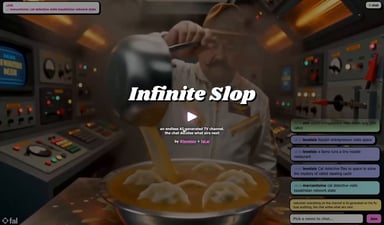
 Infinite Slop
levels.io/infinite-slop
An infinite and interactive AI generated live stream of slop that goes on forever and ever
Anything that you write in the chat is generated next and AI will try to connect it to the previous video so there's an actual


all the decisions are up to you, and since the model is so fast there's basically no delays

Infinite Slop by @levelsio + fal.ai
An endless AI-generated TV channel where you decide what airs next.
Create Video Generation Task - MiniMax API Docs
Video generation V2 endpoint. Provide multimodal input via the content array (text / image / video / audio); switch between MiniMax H3 and MiniMax H3 Max with the model field to support text-to-video, image-to-video (first & last frame), and reference-to-video, with output up to 2K.Note: To use MiniMax H3 or MiniMax H3 Max, please select the Pay-as-you-go API.

Lauren Tan software engineer at SpaceXAI (formerly Cursor, Meta, Netflix) who goes by the handle of poteto and is the creator of the pstack AI coding workflow plugin recently wrote an X article about pstack which is getting great buzz


2,000 PRs a month, and all of it rests on self-verifying agents: /create-verification-skill
The takeaway: give agents tools, not markdown.
Most won’t read this.
Make sure you do.
Came across this X post which links to an hour long video of Lauren going through her setup

"right now I've got 20-30 GrokBot agents running. they handle almost everything that used to eat my week
one of them is a Chief of Staff. it knows every other bot I have and hands out the work itself"
in a 56-minute speech, a SpaceXAI engineer

via Just|LDA who shared a link to the launch post of Anthropic's Claude Fable 5.1 and Claude Mythos 5.1


Mercury 2.5 from Inception is exclusively available via OpenRouter
This is diffusion based unlike other LLM's which are autoregressive
Diffusion language models represent a shift from traditional autoregressive generation by using diffusion processes to create text. Instead of predicting one token sequentially, these systems produce many words in parallel, resulting in faster inference and lower costs.
Price atleast till 9/7 is 0.04/0.15/0.004

80% off pricing through 9/7


Mercury 2.5 Preview from @_inception_ai reaches 1,107 tokens/sec through parallel token generation, with tunable reasoning, parallel tool calls, and schema-aligned JSON.
Built for latency-sensitive workloads.

https://openrouter.ai/inception/mercury-2.5-preview#providers
Perplexity's Mac app now supports hybrid compute, letting its "Computer" AI agent split tasks between cloud frontier models and local models running on Apple Silicon for privacy-sensitive work like bloodwork or tax files.
The approach routes private data to local processing with no token costs while using cloud models for non-sensitive steps, addressing limitations in most AI agents that ignore native vs. web runtimes.
Perplexity open-sourced its PII classifier on Hugging Face to detect when workloads should stay local and published a research blog detailing the privacy-protecting local runtime implementation.
Hybrid compute is available today for Perplexity Pro, Max, and Enterprise subscribers in the Perplexity Mac app with macOS 15+.

This will allow Computer to orchestrate local models that can run locally on Mac, particularly for agent steps involving sensitive and private files (eg your bloodwork, tax returns, litigation, etc).


Computer can start a task in the cloud, then move to a local model that runs on your Mac. Use it for steps involving private files or sensitive data.
Available today in the Perplexity Mac app.

Couple of posts on H3-Max. a video generation model post-trained by fal.ai on MiniMax H3 and optimized for high-speed generation. It delivers mainstream 480P and 768P output and generates faster than MiniMax H3. H3-Max is also available via Minimax's own inference platform
MiniMax H3 Max: Free AI Video Generator, Ranked #1, Post-Trained by fal | fal
MiniMax H3 Max is fal's post-trained MiniMax H3, ranked #1 for overall quality, prompt understanding and aesthetics. A 5-second clip at 768p renders in under 3 seconds with synchronized audio. Sign in for five free 15-second generations every day, and 50% off for 14 days.


The order-of-magnitude speedup was the secondary target. Happy that


I think we are going to see a new consumer paradigm emerge outside of endless video streaming.
Whats even crazier is the performance is close or matching SOTA closed sourced video models.
At 9.2 seconds
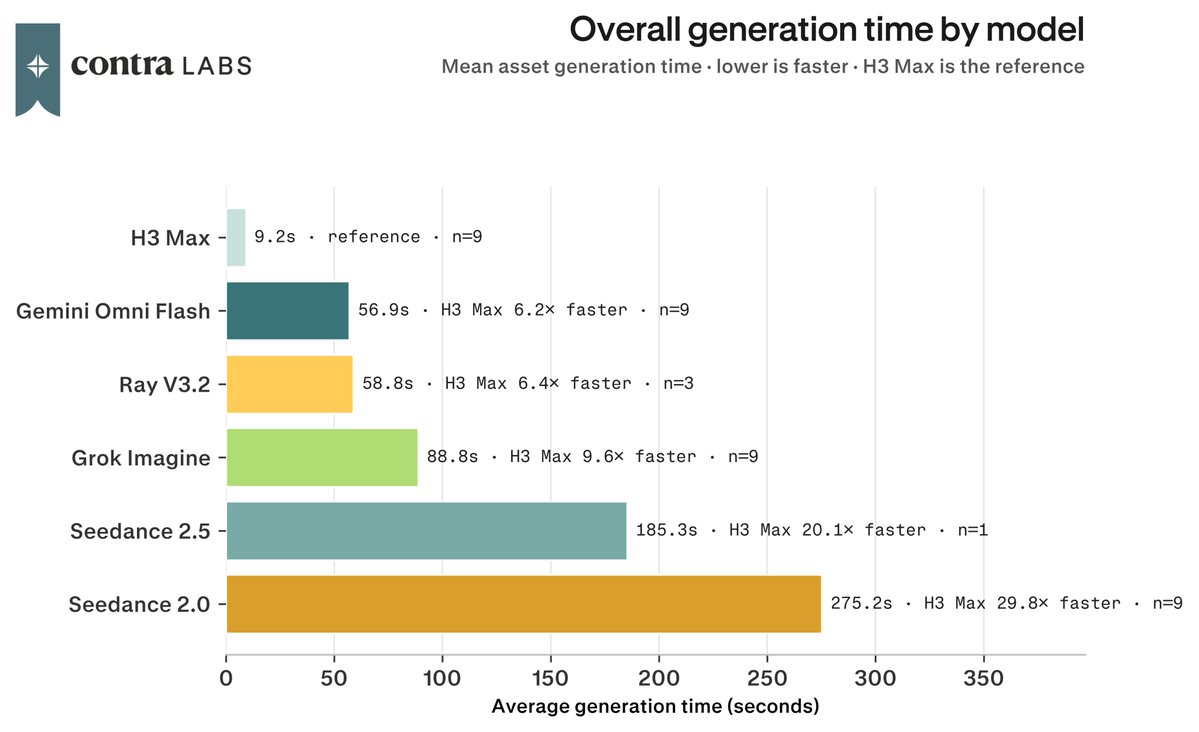
Through September 7, all text-to-video and image-to-video generations are 75% off.
That brings H3 Max down to $0.0125/sec at 480p and $0.02/sec at 768p. This means it only costs $0.10 to


 Video generation faster than playback!MiniMax H3 on vLLM-Omni + FastVideo's FastH3: a complete 10.1s MP4 - video AND synchronized audio - rendered in 8.7s!

Thanks to @MiniMax_AI for the great Minimax H3 release, the FastVideo team @haoailab for open-sourcing FastH3 and

Video Generation - MiniMax API Docs
MiniMax's video models (MiniMax H3, MiniMax H3 Max) enable efficient video content creation.
World Labs announces Atlas, a multimodal world model pretrained from scratch that generates images/videos with pixel-perfect camera control, reconstructs 3D scenes from sparse inputs, and simulates space-time dynamics using a unified autoregressive diffusion transformer.
Key demos show Atlas creating 1-minute 1440p videos from reference images along custom trajectories, producing explicit 3D outputs like point clouds and Gaussian splats, and enabling real-to-sim robotics workflows plus bullet-time reframing from a few phone cameras.
The model outperforms specialized 3D reconstruction and camera-controlled generation baselines per company benchmarks, with early access opening soon to support applications in robotics, VFX, and explorable world creation.

The world's first multimodal world model that generates image and video frames with pixel-perfect camera control and reconstructs them in 3D.
Model the world, move the camera, and simulate space & time.

This is impressive from Google Deepmind. Do take the time to watch the examples, read the prompts from Genevieve , a GDM Devrel staffer and recommend trying this yourself
Google for Developers announced agentic video understanding in Gemini, letting models dynamically search, scan, and inspect video segments across frames, audio, and transcripts instead of static 1 FPS processing.
It cuts token consumption by up to 88% and analysis costs by up to 66%, while boosting accuracy by up to 7% and enabling sub-second retrieval, long-form searches, anomaly detection, and precise counting in complex videos.
Supported now in Gemini 3.7 Flash, 3.6 Flash, and 3.5 Flash-Lite via Gemini API for uploads and YouTube videos in Google AI Studio and Enterprise Agent Platform.

Agentic video understanding gives Gemini the tools to dynamically search, scan, and inspect target video segments to achieve its goal. Building on agentic vision, Gemini now actively scans visual frames, audio, and transcripts

 ~88% fewer tokens
 ~66% lower cost
 ~7% higher accuracy
The result: a new Pareto frontier for video understanding across accuracy and cost.
Traditional video


instead of using static processing (ingesting media at a fixed frame rate), the model can now take an active, goal-directed role in determining what to watch, at what speed, and through which modality (frames, audio, or

Introducing agentic video understanding with Gemini
We're launching agentic video understanding across our latest Gemini models for improved accuracy and lower costs and token usage.
Google announces Gemini 3.8 Flash and Gemini 3.8 Flash Cyber, building on 3.7 Flash from three weeks prior by using long-running agentic loops for better reasoning and coding.
3.8 Flash improves multidisciplinary expert reasoning to 54.9% on HLE-Verified benchmarks while matching prior speed and cost; 3.8 Flash Cyber leads in CyberGym Pass@1 for C/C++ vulnerability discovery at 86.2%.
It scores 59 on the Artificial Analysis Intelligence Index at high reasoning—up 3 points from 3.7 Flash and matching GPT-5.6 Sol (xhigh) and Grok 4.6 (medium).
Available to developers via Google AI Studio and Android Studio, enterprises through Gemini Enterprise, consumers in Gemini App and Search, with 3.8 Flash Cyber accessible via the Fairwind Program.


@GoogleDeepMind released Gemini 3.8 Flash today. With high reasoning, it


This model has been a ton of fun to work with, excited to see what you all think!
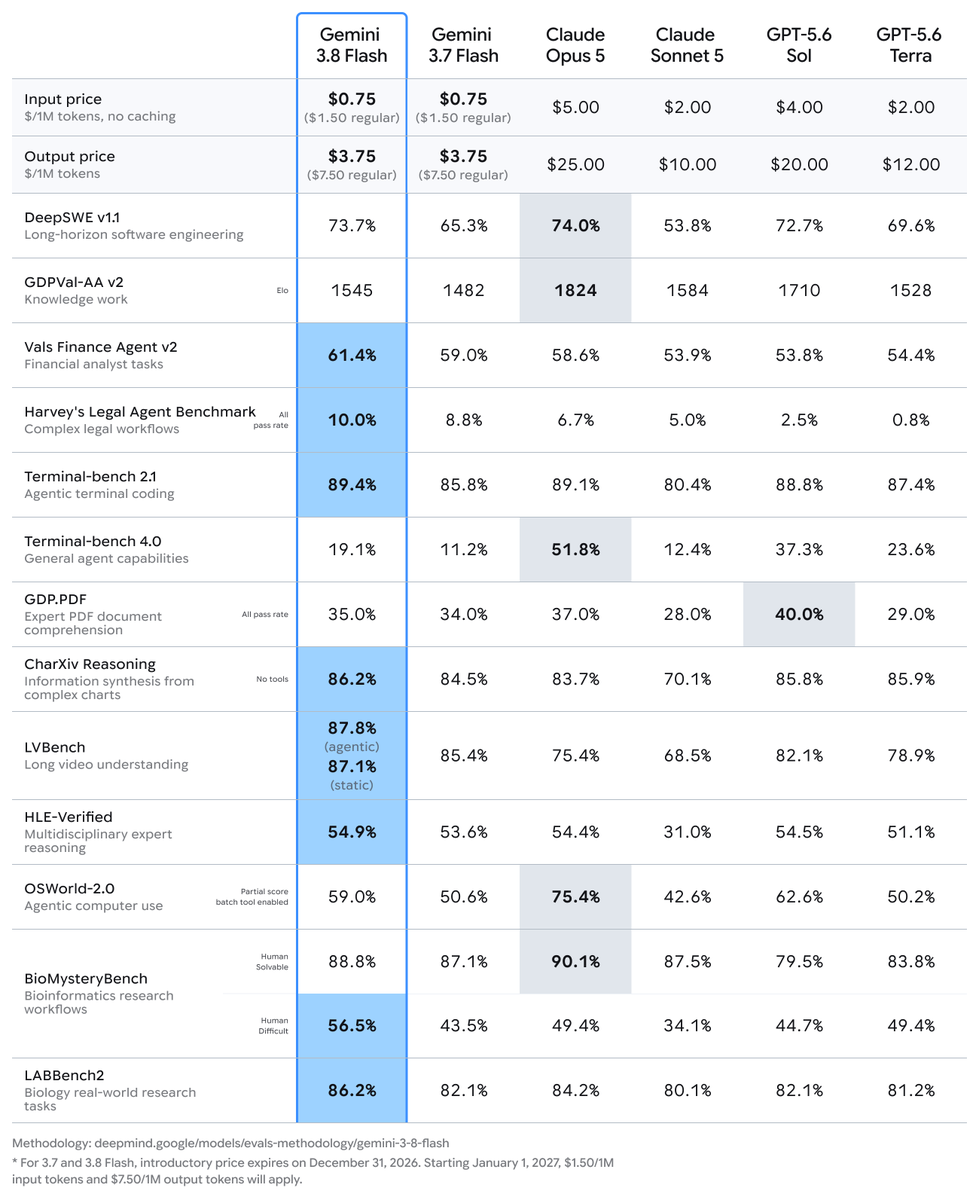
It's barely mid week and the model release train is relentless
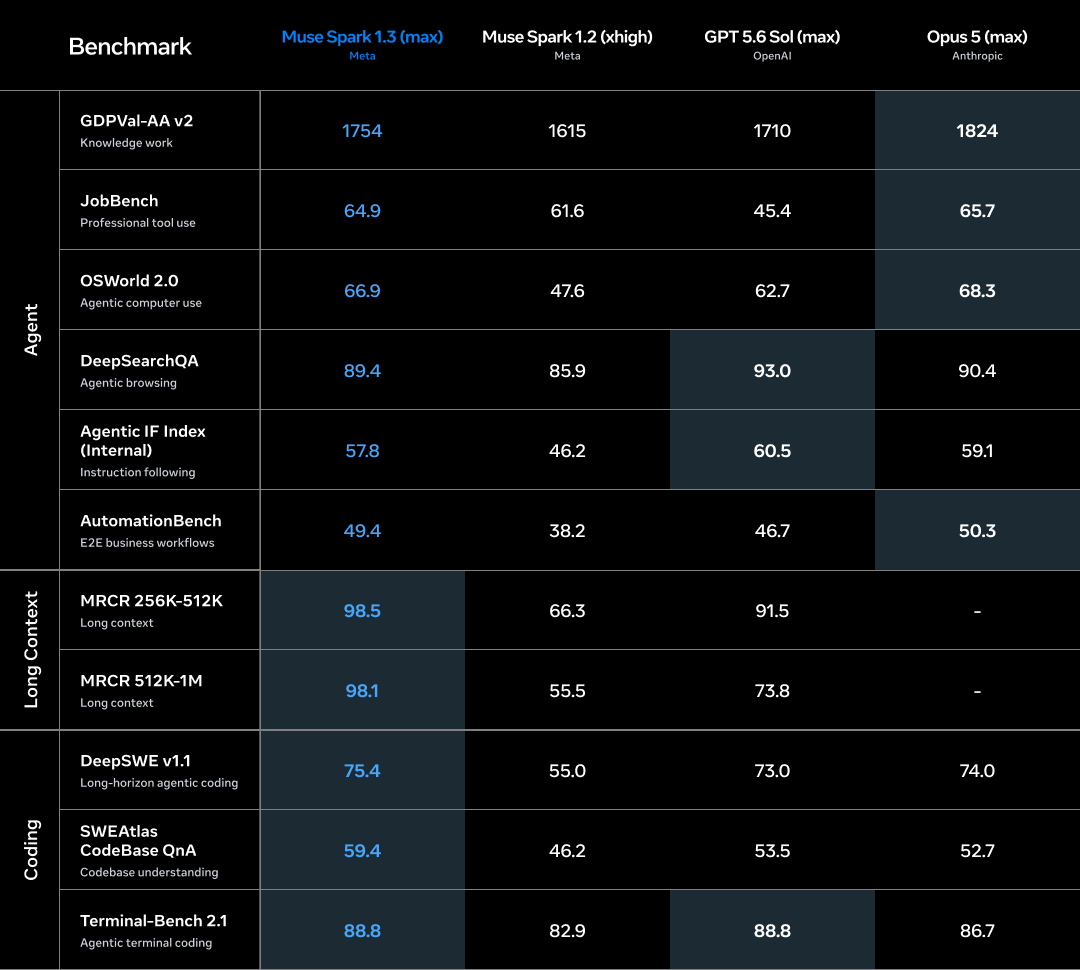
Meta Releases Muse Spark 1.3 with Top Coding and Agent Gains
The upgrade shines in benchmarks like 75.4 on DeepSWE v1.1, beating GPT-6.5.6 and Opus 5, while leading in OSWorld 2.0 and Terminal-Bench 2.1. It handles messy inputs by generating context, self-corrects plans, and uses 20% fewer tool calls than version 1.2. Now live in Muse Code and the Meta Model API, it's built for complex, ongoing tasks with more teases like a bigger model coming soon

Next up
 and Muse Spark open weights releases coming soon.

via Just | LDA who was once again very quick to find out about the launch OpenAI's Astra 6 model and linked to its launch post
ChatGPT 6 Astra comes out today.


Subsequently there was clarification that vast majority of users will probably not be able to access it today
Astra begins rolling out Thursday to enterprise customers with OpenAI's gated access program, Daybreak. OpenAI says it will become available over the coming days to ChatGPT Plus, Pro, Business and Enterprise customers, as well as through the OpenAI API and cloud platforms including AWS Bedrock and Microsoft Azure.
https://venturebeat.com/ai/welcome-to-the-agi-era-openai-launches-gpt-6-astra
OpenAI launches GPT-6 Astra and says welcome to the "AGI era"
OpenAI's new flagship posts big gains on specialized tasks, but it comes at a premium and does not clearly lead the coding pack.
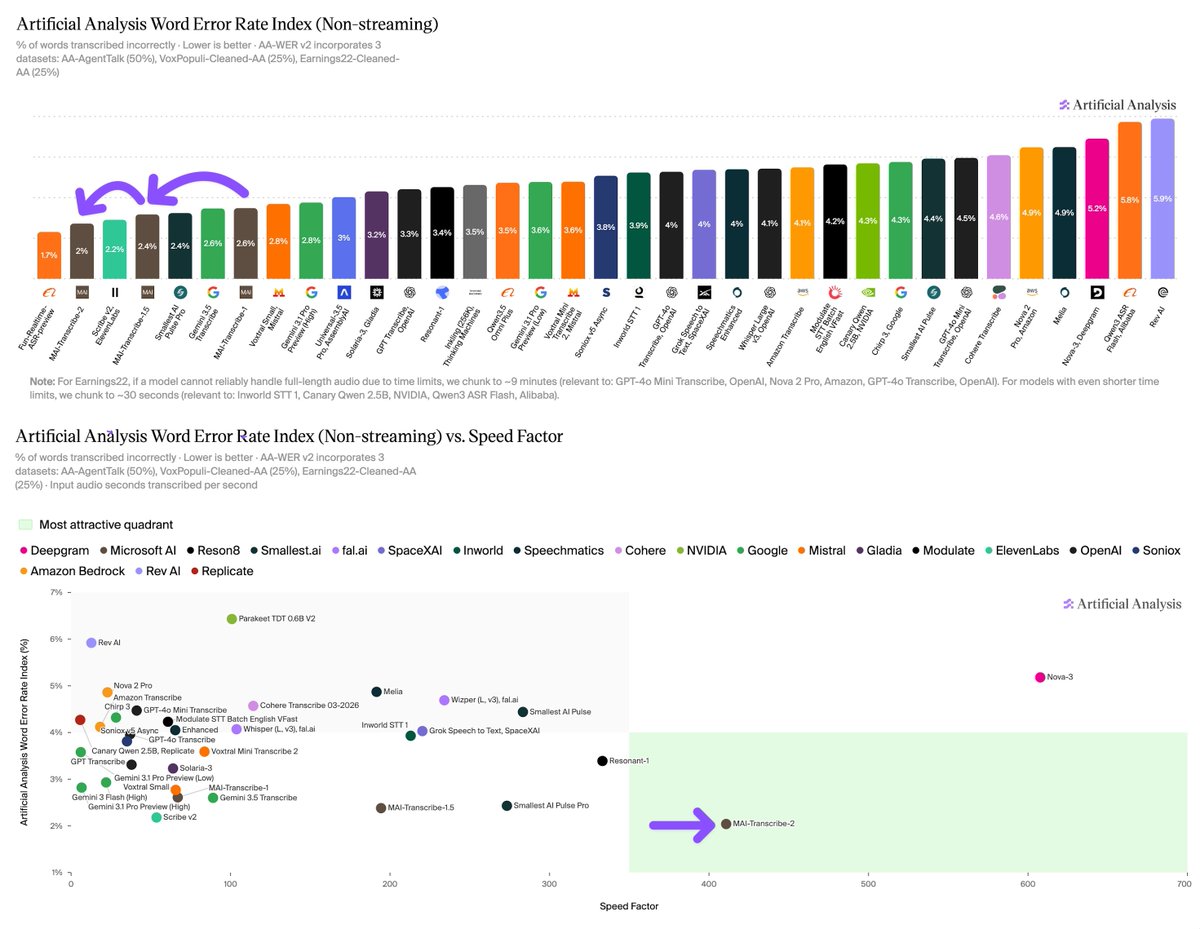
Microsoft AI launched MAI-Transcribe-2 as its new speech-to-text model, positioned as highest quality, lowest cost, and fastest transcription—claimed to be 10x faster than GPT-Transcribe—now available via Microsoft Foundry and OpenRouter.
A short demo video compares it side-by-side transcribing a technical lecture on the Nyquist sampling theorem, showing MAI-Transcribe-2 with under 4% error versus a competitor's 8% error and frequent mishearings like "nice quest sampling fear him."
The model supports 60 languages with automatic language ID, code-switching, speaker diarization, and word-level timestamps, ranking #1 on the FLEURS benchmark.


10x faster than GPT-Transcribe. 5x faster than Gemini 3.5
#1 on the Artificial Analysis accuracy-latency Pareto frontier
Priced at the lowest on the market.
Truly fantastic work from the team! Try it out below.

MAI-Transcribe-2 is @MicrosoftAI’s latest speech
For those here who use ChatGPT, Codex, Claude Code, Cursor, or similar AI tools for web research, I have published a new newsletter issue introducing my guide:
Choosing External Research Tools for AI Agents
It addresses a question I kept encountering: when are an AI tool’s built-in search and page-reading capabilities sufficient, and when might an external research provider genuinely help?
The guide covers the differences between search, extraction, crawling, structured data, provider-generated synthesis, browser-rendered pages, and authenticated X-native evidence. It also includes practical prompts and a reusable skill for routing research across available tools.
Octen, Exa, Perplexity, Parallel, Firecrawl, and TinyFish appear as examples, but this is not a ranking or a recommendation to connect everything.
The central idea is to begin with the evidence you need, use the minimum sufficient set of tools, and verify important claims against the underlying sources.
The newsletter introduction and link to the full guide are here:
You can also subscribe there if you would like to receive future updates. Candid feedback—particularly on anything that remains too technical or could be explained more clearly—is very welcome.
The Institute of Foundation Models at Mohamed bin Zayed University of Artificial Intelligence Abu Dhabi announced K2 Horizon a fleet of six foundation models developed by them ranging from 0.9B to 375B parameters
Their launch post emphasizes frontier performance on coding, agentic, reasoning, and tool-use benchmarks with smaller models setting new SOTAs, plus full openness including weights, code, training data/recipes, and checkpoints under Apache 2.0.
The release includes immediate availability on Hugging Face, vLLM, and inference partners, supporting deployments from edge devices to enterprise while promoting reproducibility in AI research.

- Frontier performance: Across coding and agentic tasks, K2 Horizon delivers top-tier performance in every size class—with the 0.9B, 3.7B and 7B models setting

via Caterina Zhang
Hello everyone. Are there any AI tools out there for turning audio music into visual in real time?
Abstract visual art
OpenRouter has added Microsoft's MAI-Image-2.6 and MAI-Image-2.6-Flash, supporting multi-image editing, web grounding, dynamic aspect ratios, and up to 1.5K output resolution.
MAI-Image-2.6 ranks #2 on Arena for text-to-image and editing plus #1 for editing on Artificial Analysis, while the Flash variant delivers comparable quality at 2.8x faster generation speed than GPT-Image-2-Medium and less than half the flagship price.
The rapid hosting on OpenRouter's unified platform gives developers immediate API access to Microsoft's latest image models following their Microsoft Foundry preview release.
MAI-Image-2.6 and 2.6-Flash support multi-image editing, web grounding, dynamic aspect ratios, and up to 1.5K output. More below ↓

Microsoft API and Models | OpenRouter
Access 17 Microsoft models through the OpenRouter unified API including MAI-Image-2.5 Pro, MAI-Voice-2-Flash, and MAI-Voice-2. Compare pricing, context windows, benchmarks, and capabilities between...
It's also 72% more efficient in GPU usage, so we can provide it at an incredible price.
This gives it the best price-performance score in the world.
Unbelievable work from

Businesses in China are experimenting with ways to package and market AI tokens to ordinary consumers, including as credit card rewards and telecom plan bundles
Chinese businesses are giving away AI tokens with coffee, credit cards, and dumplings
Driven by low-cost open-source models, Chinese banks, telcos, and cafes are bundling AI compute tokens into credit card perks, mobile plans, and free restaurant promotions.

Below is my personal website which aggregates links to many of my socials as well as the various content and community that I curate. Feel free to share this link to others who you think may find this content/community useful to them
The cover image of this newsletter via generated via the GPT Image 2 model within the Krea tool via the following prompt
Create a wide editorial illustration representing a practical field guide to researching with AI tools.
Use an overhead view of a calm, carefully arranged research desk. Include an open field-guide notebook, a compass-like decision tool, several source cards, a small website map, a structured data grid, and a verification checklist. Fine connecting lines should suggest that a researcher is choosing the appropriate route from a question to trustworthy evidence.
The composition should feel thoughtful, curious, methodical, and useful—not futuristic or promotional. The objects should represent choosing, investigating, comparing, and verifying information without depicting any particular software provider.
Independent publication aesthetic, sophisticated editorial illustration, warm ivory paper, charcoal and navy ink, restrained teal and muted amber accents, subtle tactile paper texture, crisp shapes, generous negative space, calm natural lighting, contemporary but timeless.
Wide 1.91:1 composition for a 1200 × 630 newsletter header. Keep the centre visually clear and place important objects inside a generous cropping-safe area.
No readable writing, letters, numbers, logos, company names, brand marks, laptop interfaces, robots, glowing AI brains, holograms, neon lighting, cyberpunk styling, stock-photo appearance, or visual clutter.