

This Week in All Things AI covers key developments in models, agents, tools, infrastructure, and policy curated from discussions in the All Things AI Telegram group.
If you follow AI for work, research, investing, or just to understand where the technology is heading, this weekly brief is a concise way to scan the most important launches, risks, and resources in a few focused minutes.
Reminding the members in the group here about the virtual roundtable on video editing and AI I'm hosting with Shamir Allibhai—filmmaker, former Meta PM on video/AI infrastructure, and now CEO/co-founder of Eddie AI.
📅 Tuesday, Sep 22, 12 noon SGT, Monday Sep 21, 9:00 pm PST
👉 https://luma.com/qo2351sz — shows your local time.
Join us! A recording will be available afterward.
The week of 13th to 19th September 2026 brought a growing focus on AI systems that can carry work through from instruction to result. OpenAI’s Agents API and discussions around domain-specific harnesses highlighted the infrastructure behind sustained agent work, while Claude’s merging of Cowork with chat and its new Projects experience brought task delegation, parallel cloud sessions, and document creation closer to everyday use. TypeSafe AI introduced Jev for fast, structured decisions such as routing and scoring, with availability through Vercel’s AI Gateway. Specialised applications also featured prominently: Wispr Flow’s Canto targeted real-world dictation, Odyssey-3 explored physical intelligence, and OpenMontage and Pocket FM’s Sherpa showed different approaches to coordinating video production and long-form storytelling.
Alongside these developments, the week raised questions about how AI should be evaluated, governed, and connected to information. Dario Amodei’s call to pace frontier development drew support from Sam Altman and Elon Musk, with independent evaluators given deeper access emerging as a concrete proposal. Xiaomi’s public MiMo training dashboard offered an unusual view into large-scale reinforcement learning, while Perplexity’s Q2D-Web study focused on the retrieval quality that shapes everything an assistant does afterward. My updated Portable LLM Council and Multi-Provider Research skills, together with a new guide to choosing AI models and search providers separately, explored practical ways to give users more control over those workflows. Claude Code’s addition of AGENTS.md support also marked a small step toward shared conventions, making instructions easier to reuse across tools.
The sections that follow walk through these items day by day, with short context and links so you can dive deeper into the pieces most relevant to your work or interest
Dario Amodei proposes steps for pacing the frontier: embedded evaluators, coordination among democracies, and global coordination with authoritarian governments
Sam Altman says he agrees with Amodei that “committing to having independent evaluators with employee-like access is a great idea”, and OpenAI will do the same
Elon Musk backs Dario Amodei's arguments about pacing the frontier, saying “Dario is right”

Anthropic is unilaterally committing to the first of these steps. We’ll provide third-party evaluators with permanent, employee-level access to our

Committing to having independent evaluators with employee-like access is a great idea, and we will do the same. We'll have more to share soon.
Anthropic is unilaterally committing to the first of these steps. We’ll provide third-party evaluators with permanent, employee-level access to our

Anthropic is unilaterally committing to the first of these steps. We’ll provide third-party evaluators with permanent, employee-level access to our
Dario Amodei - We Must Pace the Frontier
I have worked on AI for the last twelve years because I believe it could dramatically raise the quality of human life. I've written often about these incredible benefits: I believe that AI could cure most major diseases in the next 5-10 years, greatly accelerate economic growth rates, create a world of abundance and empowerment, and usher in a renaissance of democracy and freedom.

Harness Engineering Transforms AI Agent Development
A shift toward domain-specific harnesses is gaining speed, with Garry Tan noting that systems either become these customized frameworks or fade away. OpenAI launched its Agents API in public beta, offering managed services like context compaction and subagents while supporting any model and open-source flexibility. Builders like Harrison Chase from LangChain share practical guides on custom harnesses,

langchain.com/blog/how-to-bu…
great blog by @sydneyrunkle


It's not surprising to me that so many YC builders want to build domain-specific harnesses.
If you work long enough on a domain-specific problem, you quickly realize the opportunity. But you also realize how important that harness will be to

The new Agents API basically gives developers the Codex harness as an API:
• One call → cloud agent
• Long-running sessions
• Automatic context compaction
• Parallel subagents
• MCP + built-in tools
•


Build and run cloud agents with the Codex harness, fully managed by OpenAI.
We handle orchestration, long-running sessions, and context management. You focus on what makes your agent unique.
Available in public beta.


How one engineer with agents goes from writing code line by line to running a team of 5000, and how their own coding agent stays fast and safe while doing it:
0% → 0:00 - why one

🔄 Updated skills and guides
Inspired by OpenAI’s article on rethinking skills and prompts for GPT-6 Astra I had Astra audit and refine two skills I’ve previously shared here:
• Portable LLM Council — for reviewing business and technical decisions from multiple perspectives.
• Multi-Provider Research — for choosing and using external research tools with AI agents.
The article makes a useful point: as models improve, it’s worth revisiting older instructions and removing unnecessary complexity.
The updated skills are available in the linked repositories—feel free to grab the latest versions.
I also used Astra to audit and tidy up the Notion guide linked from the Multi-Provider Research repository. There are a few small updates, so it’s worth revisiting if you’ve read it before.
For the background and guides, here are my original newsletter posts:
Choosing external research tools for AI agents
Introducing Portable LLM Council
🎬 A product brief, a few screenshots, your brand kit—what would it take for an AI agent to turn those into a finished explainer?
That’s the idea behind OpenMontage, an open-source project that connects research, scripting, visuals, narration and rendering into a video production workflow.
What caught my attention is how it brings together your own material, stock footage and AI-generated assets—with human approval along the way and cost estimates before spending.
The engine is public; the Studio app is still in private alpha. Paid generation can add costs.
🛠 Explore the open-source project on GitHub
💬 For those building with AI: is coordinating the tools now the bigger challenge—or getting consistently good output from each one?
TypeSafe AI Launches Jev for Fast Structured AI Decisions
Diogo Almeida, co-author of the InstructGPT paper that introduced RLHF at OpenAI, announces Jev from TypeSafe AI as a new "System One" model trained with RLCD for calibrated, structured decisions rather than text generation.
Jev outputs typed results like choices, scores, or true/false answers with confidence levels, enabling developers to handle multiple queries in one 150ms call. Priced at just $0.042 per million input tokens with free outputs, it promises 20-200x speed and 40-400x cost savings over typical models for decision tasks, eliminating hallucinations by avoiding string generation.

I’ve spent the last 2 years in stealth building a new way to train models (RLCD), and a new type of frontier AI model that we are releasing today: Jev
• 20-200x faster
• 40-400x

Introduction - TypeSafe AI
Jev is TypeSafe's flagship model and the first System One model. Send state and typed questions; get structured answers your code can use directly.
Odyssey AI lab unveils Odyssey-3, a foundation world model that controls robots and humanoids, drives cars on Indian roads, pilots drones, plays video games, and trains other AIs.
Built as an autoregressive diffusion transformer, it simulates diverse physical and virtual scenarios from visual data, enabling efficient adaptation with just tens of hours of demonstrations per task.
The model generates training environments for recursive learning, creating physical agents that natively interface with real-world systems and support iterative intelligence improvements.

It can control robots, power humanoids, drive cars (on the roads of India!), train AIs, pilot drones, and even play video games.
We can’t wait to see what intelligent systems it enables.

Introducing Odyssey-3: A General-Purpose Physical Intelligence
Odyssey-3 is a foundation world model that can power robots, drive cars, train AIs, pilot drones, and even play video games.

Meta now lets AI agents handle the boring parts of WhatsApp Business setup
A new WhatsApp Business MCP server lets developers use AI coding agents like Claude, Cursor, Codex, and ChatGPT to handle setup, messaging templates, testing, and troubleshooting.
Meta now lets AI agents handle the boring parts of WhatsApp Business setup | TechCrunch
A new WhatsApp Business MCP server lets developers use AI coding agents like Claude, Cursor, Codex, and ChatGPT to handle setup, messaging templates, testing, and troubleshooting.

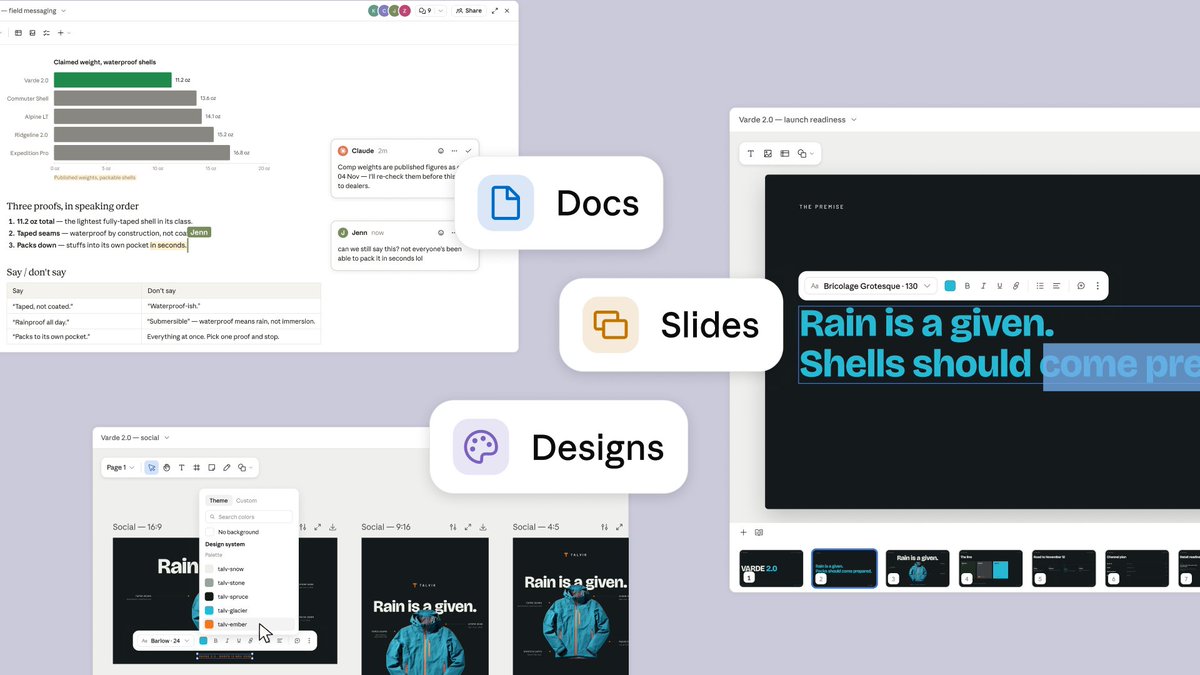
Claude is merging its dedicated Cowork workspace with the main chat into a single unified experience, allowing seamless handoff of quick questions or complex tasks like reports that Claude continues autonomously even when the app is closed.
New integrated tools enable creating and editing Claude Docs, Slides, and Design artifacts directly in conversations, with options for manual fixes, comments, presentations, exports, and single-link sharing while retaining user final approval.
The update preserves all existing Cowork chats, projects, and artifacts, rolling out first to Pro and Max users over the coming weeks starting September 16, 2026, with Docs, Slides, and Design in beta for paid plans.

Claude Cowork and chat are now one Claude | Claude by Anthropic
Starting today, Claude Cowork and chat are one Claude, rolling out on Pro and Max plans. Hand over the task and Claude does the work. You keep the final say.

Xiaomi Livestreams Massive AI Model Training with Full Transparency
Led by Fuli Luo, Xiaomi's MiMo team is livestreaming reinforcement learning for MiMo-V2.6 models on a public dashboard, tracking compute at 2 billion tokens per step, multi-task environments, and advanced grading systems. The larger Pro version has 1 trillion total parameters and nears $700,000 in costs, while the Flash variant advances faster at lower expense, with daily runs hitting $493,000 and $247,000 respectively. Researchers praise the openness, calling it a rare glimpse into large-scale RL usually hidden by frontier labs, as benchmark scores climb steadily on tasks like DeepSWE.


You love to see it.
Jev is now available on the Vercel AI Gateway
Jev is TypeSafe AI’s System One evaluation model for fast, structured decisions in software. It evaluates shared state against typed questions and returns choices, scores, and boolean probabilities, supporting classification, routing, rubric-based assessment, and automated verification. Multiple questions can be evaluated in parallel within a single request

Build agents that decide, route, score, and stop in milliseconds:
𝚊𝚠𝚊𝚒𝚝 𝚎𝚟𝚊𝚕𝚞𝚊𝚝𝚎({
𝚖𝚘𝚍𝚎𝚕: '𝚝𝚢𝚙𝚎𝚜𝚊𝚏𝚎-𝚊𝚒/𝚓𝚎𝚟',
𝚜𝚝𝚊𝚝𝚎,
𝚚𝚞𝚎𝚜𝚝𝚒𝚘𝚗𝚜,
});

TypeSafe AI's Jev now available on AI Gateway - Vercel
Use Jev from TypeSafe AI on Vercel AI Gateway to classify, route, score, and automate workflows with typed outputs, probabilities, and confidence.
TypeSafe AI's Jev now available on AI Gateway - Vercel
Use Jev from TypeSafe AI on Vercel AI Gateway to classify, route, score, and automate workflows with typed outputs, probabilities, and confidence.

Evaluation
Evaluate shared state against typed questions and get back structured choices, scores, and boolean probabilities through Vercel AI Gateway.

Wispr Flow announces Canto, its new real-time speech model for dictation, claiming a 3.4% word error rate on 9.8 hours of real-world English audio from over 2,300 speakers—the lowest among models tested on their internal dataset.
Canto uses supervised fine-tuning plus reinforcement learning (GRPO) trained on user corrections and contextual vocabulary, targeting practical low-latency dictation rather than clean read speech.
It's now rolled out for everyone, with nothing to switch on.
Wispr says that they already training its successor at more than ten times the scale, with better recognition in difficult conditions and broader language coverage ahead.
Canto: a speech model built for the real world | Wispr Flow
Today, the Wispr Advanced Interfaces Lab is introducing Canto, our latest speech model for real-time dictation. On an evaluation of real-world dictations, Canto achieved the lowest word error rate among all the models we tested.
Claude AI's redesigned Projects shifts from folders to a single conversation where users describe goals and Claude autonomously directs parallel cloud threads that persist and operate independently even offline.
Threads leverage shared project memory and a dedicated library for files/artifacts, enabling coordinated workflows like task delegation, conflict resolution, and context retention across sessions similar to briefing a chief of staff.
Now in beta for select Pro and Max cloud users in Claude Code, with rollout expanding soon and local device support planned; existing projects will upgrade gradually.
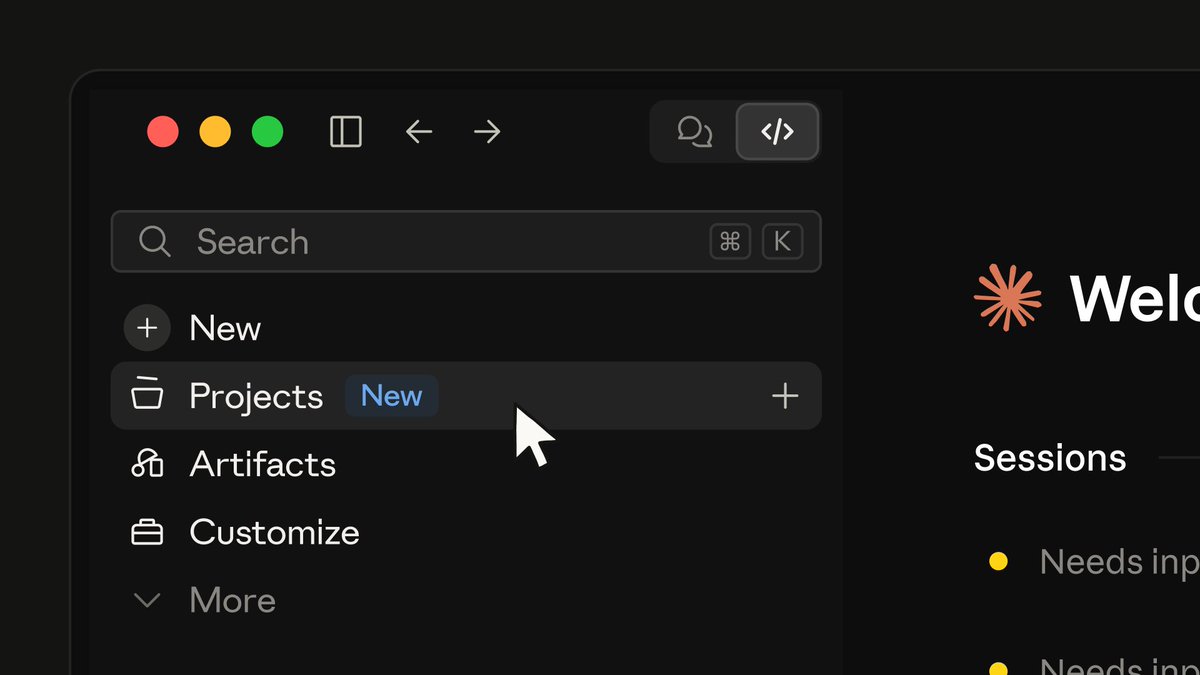

A Project is an ongoing conversation that coordinates a stream of related work for you. You describe a goal, Claude splits it into threads, runs them in parallel in the cloud and keeps going after you close your laptop.
Starting

A project is one conversation with Claude. It splits the work into threads itself, runs them as parallel cloud sessions, passes context between them, and keeps going when you leave.
In beta for select users.


I've been using it every day since it lets me operate at a higher level of abstraction. I fire off a batch of tasks and move on. Claude has context on everything I'm working on and can give me an
A project is one conversation with Claude. It splits the work into threads itself, runs them as parallel cloud sessions, passes context between them, and keeps going when you leave.
In beta for select users.

I stopped managing sessions. I just send thoughts as they come, Claude splits them into threads, and the project remembers how I work. It's where I do a ton of my coding now.
[screenshot: my actual

A project is one conversation with Claude. It splits the work into threads itself, runs them as parallel cloud sessions, passes context between them, and keeps going when you leave.
In beta for select users.
Just saw mention of GLM-5.3-FlashX on ZAI website, not seeing this in zcode or via OpenRouter as yet. Read some buzz on X
GLM-5.3-FlashX is now live, delivering inference speeds of 200 tokens/s for faster responses and a smoother experience.
Pricing of GLM-5.3-FlashX from ZAI [0.37/1.25/0.075] is more than double of GLM-5.3-Flash [0.15/0.5/0.03]
https://docs.z.ai/guides/vlm/glm-5.3-flash
https://docs.z.ai/guides/overview/pricing
via Lisa Gu
Pulled multiple all nighters on this one and so excited the world can finally see it
Rohan Nayak, CEO of Pocket FM, announces Sherpa, their advanced AI fiction writing tool that drove the company's ARR from $250M to $500M in one year by scaling content production 1200% with 550K+ creators generating 2.6M annualized hours.
Sherpa uses a Narrative World Model for long-term continuity, hierarchical planning across seasons-to-scenes, and a Prose Engine trained on 5.5B hours of playtime and retention data to maintain engagement in serialized stories.
Pocket FM's owned distribution enables one-tap audio production, performance-based revenue share, and localization, allowing 10% of writers to earn over $200K and creating blockbusters exceeding $100M while fostering a creator-AI feedback loop.

We accelerated from $250M in ARR to $500M because Sherpa helped increase content production by 1200% in 1 year
Sherpa was trained on 5.5B hours of playtime with minute by minute dynamic retention data.
550K+ creators

Sherpa by Pocket FM | Free AI Fiction Writing Tool
Sherpa by Pocket FM is a free AI fiction writing tool that helps anyone turn ideas into stories. Write it, produce it into audio and publish it.

via Matt Weigand
Hey everyone - I’m Matt Weigand at Perplexity.
A lot of my interest comes back to search: if a model doesn’t find the right information, everything that follows starts with an incomplete picture.
If you are interested in what Perplexity is doing with web research, check out this study we just published - Q2D-Web. The study digs into evaluating how well search systems retrieve relevant documents at web scale. It’s work I’m excited to share more about here, along with what better retrieval means for people building and using AI.
Q2D-Web: Evaluating First-Stage Retrievers at Scale- https://www.perplexity.ai/hub/blog/q2d-web.
Look forward to connecting!
Finally, Anthropic taking small steps to use conventions used by other harnesses
Claude Code now [as of version 2.1.277] reads AGENTS.md if there is no CLAUDE.md
Hopefully they will in the future also read skills from .agents/skills so one doesn't have to do symlink jugglery

You choose your AI assistant. But did you know you can also choose how it searches?
The models that help you think, write, and reason don’t have to determine which tools find information for them.
In a compatible AI application, you can connect search and retrieval providers separately. That gives you more freedom to combine the models, tools, and costs that suit you.
I built the multi-provider-research skill to help your assistant work with those tools—choosing suitable providers, checking source evidence, and explaining gaps. You can start with just one provider.
I’ve put together a practical guide covering:
• What harnesses, skills, and providers actually mean
• How to get started with options such as Exa, TinyFish, Octen, and Perplexity
• Free allowances and lower-cost combinations worth exploring
Choose Your AI. Choose How It Searches.
https://goolamabbas.github.io/separate-intelligence-and-search/
The guide links directly to the skill and further reading. I’d love your feedback, especially if this is your first time exploring skills or connected search tools.
Below is my personal website which aggregates links to many of my socials as well as the various content and community that I curate. Feel free to share this link to others who you think may find this content/community useful to them
The cover image of this newsletter via generated via the GPT Image 2.5 model within the Krea tool via the following prompt
Create an artistic representation of the Garden of Eden from the Book of Genesis, capturing its lushness and tranquility, Mysterious --no buildings, people