
This Week in All Things AI covers key developments in models, agents, tools, infrastructure, and policy curated from discussions in the All Things AI Telegram group.
If you follow AI for work, research, investing, or just to understand where the technology is heading, this weekly brief is a concise way to scan the most important launches, risks, and resources in a few focused minutes.
The week of 11th to 17th October 2026 brought advances in sustained AI work alongside a stronger push towards specialised, more economical models. Meta introduced Muse Wonder, with memory and focus mechanisms designed to help agents retain context and pursue longer tasks, and released Muse Spark Open for coding and multimodal agent workflows. NVIDIA’s Nemotron 3.5 Super VL added another open-weight option for agents working across documents, images and video. Specialisation was equally prominent: Paper Instruments’ Ultramarine 1 Flash targeted professional deliverables with substantial cost savings claimed on internal benchmarks, while Scaledown’s Constrained Decoding Models and Perplexity’s updated decision models focused on answering structured questions efficiently. Creative and conversational tools also offered finer control, from Fish Audio’s Drama 3 voice performances and Grok Voice 3.0’s spoken interactions to Krea 3’s image-editing beta and Vivix W1’s steerable, streaming video.
The practical questions were how to fund these capabilities, where to run them and how to retain control. Accenture’s reported $29 central Claude allowance, with additional usage charged to projects, made the relationship between AI spending, time saved and consulting revenue explicit. Microsoft’s Maia 300 roadmap and planned multi-gigawatt deployments from 2027 addressed inference efficiency at infrastructure scale, while Google’s experimental AI Edge Foresight showed how meeting assistance could run locally on a Mac. Perplexity’s SPACE sandbox combined continuity for long-running agents with external controls over networks and credentials, complementing Satya Nadella’s argument that deploying organisations must retain responsibility through observability, limited permissions and independent safeguards. The debate between Dwarkesh Patel and Tyler Cowen added a wider question: how quickly technical capability translates into changed jobs when institutions, trust and human judgement also shape adoption.
The sections that follow walk through these items day by day, with short context and links so you can dive deeper into the pieces most relevant to your work or interest
Google AI Edge Foresight is a free, experimental macOS app from Google’s AI Edge team. It acts as an on-device AI meeting companion and note-taker.
Key points:
- It listens to system audio and the microphone so it works with any meeting platform (Zoom, Google Meet, etc.) or in-person conversations.
- You jot short bullet points during a meeting; the app expands them into fuller, polished notes using the real-time local transcript.
- All processing stays on the Mac — audio, transcripts, notes, and files never leave the device. It works fully offline.
- Powered by EmbeddingGemma 2 (a 740-million-parameter multimodal embedding model) and Gemma 4
- Extra features include Live Assistance (detects questions spoken in the meeting and suggests answers), a local knowledge base (search PDFs, Google Docs, Office files, Markdown, bookmarks, and Drive), and post-meeting chat over your notes and documents.
- Optimized for Apple Silicon Macs only (Intel Macs are not supported). Direct download from Google’s site (~160 MB); not in the Mac App Store. Built with Flutter.
It serves as a privacy-focused, local-first alternative to cloud-based note-takers like Granola, and as a showcase for Google’s on-device Gemma models.
Official page: https://developers.google.com/edge/foresight
Vivix W1 is a streaming-native multimodal model from Vivix AI for real-time interactive video/worlds. Unlike traditional clip-based generators, it continuously generates evolving audio-visual content that can be steered live by text, voice, touch, motion, images, or other inputs
Why it’s all over feeds today: Extremely aggressive pricing and speed. Limited-time rate around $0.003 per generated second (~$0.18/min). Vivix claims roughly 20× faster generation and under 1/50th the cost of models like Seedance 2.5, with comparable quality in their side-by-sides—making continuous/interactive video practical instead of prohibitively expensive.
Playground and API are live (standard / fast / ultrafast tiers). Company openly notes remaining gaps in cinematic fidelity, complex motion, and dense scenes.
Company background
Founded around January 2025 and registered in Hong Kong (with mainland China operations). Founder/CEO is Liu Yu (刘宇),— CUHK Multimedia Lab PhD, former young SenseTime Research Executive Director who managed large AIGC/multimodal teams and thousands of GPUs. He previously led the consumer app “Instant Painting” (秒画). Co-founders include former SenseTime colleagues.
It raised aggressively (seed from IDG + Sequoia China/HSG in early 2025, followed by rounds with BlueRun, 5Y Capital, Monolith, JD.com, Alibaba Pictures, etc.).
Reports put post-A valuation around $1.32B by late 2025. Team size has grown from a small core to the 50–200 range
https://platform.vivix.ai/vivix-w1-model/
Key takeaways from Satya Nadella’s X article
Satya argues that Super Intelligence systems (frontier models + agents) are fundamentally different from traditional software. We used to be able to trace behavior to a specific code path. With today’s models we cannot attribute outputs or actions to particular training data or weight configurations. Despite this opacity, we are giving these systems access to sensitive data and the ability to take mission-critical actions.
Core claims:
You cannot outsource responsibility to the model provider. Assurances from the lab do not relieve the deploying organization.
Separate the supply of intelligence from authority over it. Do not treat the stack as nested black boxes.
Apply an engineering (not just alignment) approach: surround non-deterministic models with deterministic system design, human controls, reliable operating procedures, and industry standards.
Treat frontier (closed and open-weight) models like insider risks — not because they are necessarily malicious, but because any sufficiently capable actor with access to important systems can make mistakes or be compromised. Classic enterprise controls apply: identity, least privilege, logging, containment boundaries.
Specific principles he lists: model diversity (no single model should own an important outcome or verify its own work), full observability (tamper-proof, human-readable evidence of every meaningful action), continuous verifiability (including failures and attacks), independent controls and auditability, containment (assume compromise; always have an authorized “emergency brake” to pause or shut down mid-task), and incident disclosure with shared learnings.
His punchline: “The most trustworthy Super Intelligence system will not be the one with the model we trust most. It will be the one that enables us to trust the model the least.”

Microsoft is scaling its custom Azure Maia AI accelerators to multi-gigawatt deployments starting in 2027, making them the primary inference system for its products and services.
Maia 200 is already in production, running workloads such as Microsoft Copilot (with GitHub Copilot and Microsoft Foundry coming by year-end), OpenAI models, Microsoft’s own MAI models, and open-source models. It is deploying in the US, Europe, and Australia and delivers up to 1.7× more tokens per watt than leading GPU infrastructure for Microsoft’s AI features.
Maia 300 (2027) targets long-context reasoning, low-latency conversation, and multi-step agentic tasks. It is expected to deliver ~40% more tokens per megawatt than leading GPU systems and up to 7× the rack-scale token throughput of Maia 200. Key design points include a software-defined dataflow architecture, high HBM4 bandwidth (18 TB/s peak within a 950 W TDP), chiplet design on TSMC N2P, low-precision formats (including MXFP4) for larger contexts, and dense racks of 96 accelerators in a 167 kW envelope.
The program emphasizes co-design of hardware and software for efficiency as AI moves toward sustained, agentic “Super Intelligence” workloads.


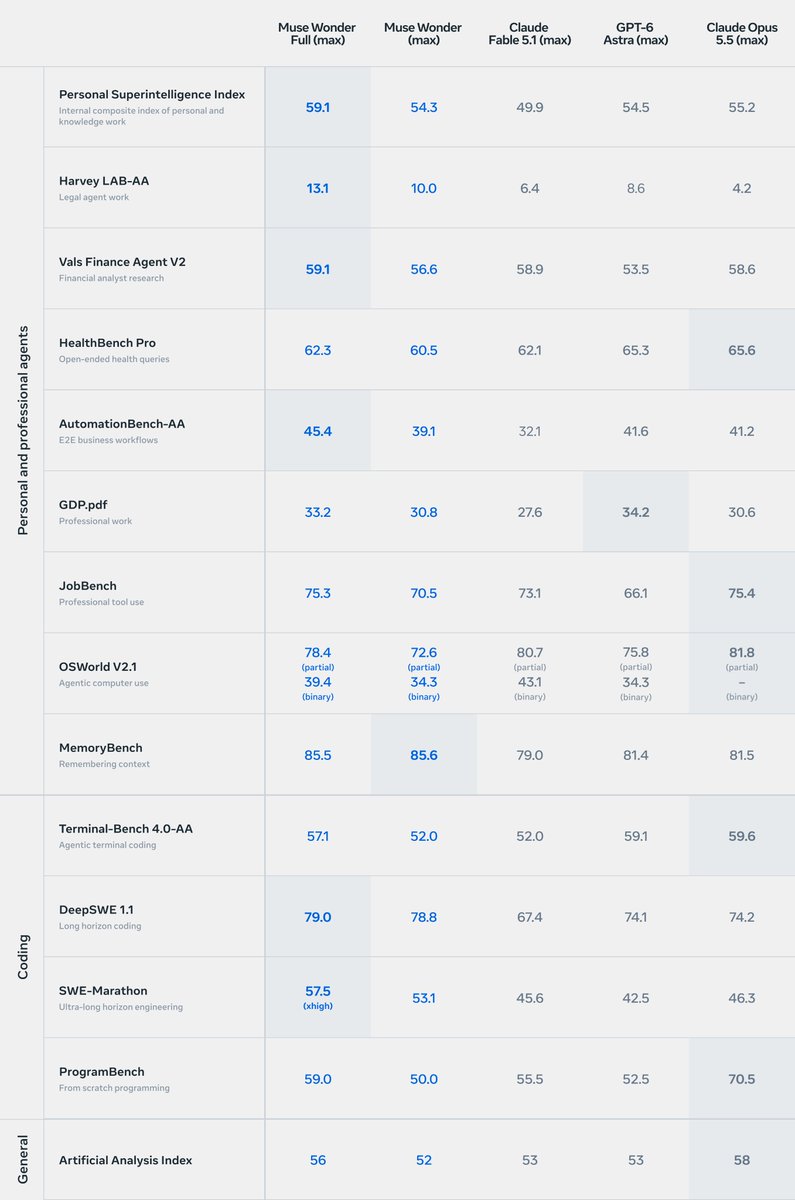
Muse Wonder (and Muse Wonder Full) are Meta’s new frontier models for personal and professional AI agents
They deliver state-of-the-art performance on agentic tasks, memory, and coding. Key innovations are Active Memory (retaining and retrieving relevant personal/context details across conversations) and Active Focus (sustained effort on hard goals, trying alternatives, recovering from blockers, seeking clarification, and checking before major actions).
Trained at Meta’s gigawatt-scale Prometheus data center, they build on prior Muse Spark work in pretraining and RL. They excel in domain expertise (e.g., legal, finance, health tasks), long-running coding (SWE-Marathon), and generalize well to unfamiliar tasks as test-time compute scales—thanks to stronger base models. Safety emphasis includes alignment, resistance to misuse (CBRN/cyber), and careful handling of private data.
Muse Wonder Full (max) outperforms Fable 5.1 (max) on Artificial Analysis' Intelligence Index, matches Sonnet 5.5 (max), and is just shy of Opus 5.5 (max)
Availability: Muse Wonder via Meta Model API and Muse Code; Muse Wonder Full for Muse Code subscribers. It will soon power Muse experiences (starting with subscribers) and artifact generation.


Muse Wonder is available for users on

Muse Wonder: A Frontier Model For Personal & Professional AI Agents
Muse Wonder is Meta's frontier AI model that keeps track of what matters to you with Active Memory & Active Focus to work towards your goals at work & life.
Zai just debuted a legal specific model: GLM Legal, and it is the new #1 open-weight model on Harvey’s Legal Agent Benchmark and LegalBench.
Z.ai released GLM-Legal, a specialized model built on GLM-5.3-Flash via targeted mid-training and post-training, focused on agentic legal tasks such as contract review, evidence analysis, and compliance workflows integrated into their AutoClaw platform.
It leads Harvey's Legal Agent Benchmark with a 19.2% all-pass rate, outperforming models like Kimi K3 (12.9%), Claude Fable 5 (11.3%), and GPT-6 Astra (5.4%), while matching frontier performance on LegalBench and PLawBench with a leaner parameter count.
Available via beta API and AutoClaw for legal professionals, it emphasizes real-world utility through reinforcement learning in legal environments and practitioner feedback loops to improve output depth and accuracy.

Built on GLM-5.3-Flash, GLM-Legal matches frontier models on mainstream legal benchmarks.
Designed for real legal workflows: contract review, evidence analysis, compliance, and more.
Tech Blog: z.ai/blog/glm-legal
Apply for API Access:


- Open source: It's on the plan. We want to make sure the capabilities are solid enough first.
- Benchmark credibility: We improved both Harvey-style tasks and other formats.

via David An
This is super relevant for anyone working with LLMs. This is the second session I did with Dr. Arno Malcher in which i discuss Prompt OWNERSHIP. https://www.linkedin.com/feed/update/urn:li:activity:7515399511784132609/
Neal Patel announces Constrained Decoding Models (CDMs) from Scaledown as specialized alternatives to LLMs for tasks like classification, entity extraction into JSON, and summarization of long multimodal inputs up to 1M tokens.
CDMs process input once without token-by-token generation, achieving 200x faster inference and 467x lower cost than frontier LLMs while outperforming on benchmarks like DecisionBench.
A demo video contrasts slow, iterative LLM decoding on invoice extraction against near-instant CDM results; the models are live via OpenRouter, Vercel, LangChain, and others with 50M free input tokens offered.

Introducing a new AI model architecture: Constrained Decoding Models (CDMs)
LLMs were built to write. Most production workloads just need an answer: fast, consistent, and affordable.
CDMs are

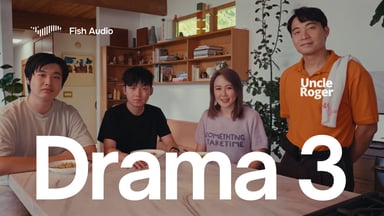
Fish Audio Drama 3 is the company’s latest and most emotive/controllable text-to-speech model, designed for directed performances rather than flat narration.
Key Highlights
Stronger emotion and control: Uses plain-language stage directions (e.g., [choked up, crying quietly], [through gritted teeth], mid-sentence shifts). It produces more natural tears, restrained anger, spontaneous laughs, whispers, and other paralinguistic cues than the previous S2.1 Pro. Direction can be in a different language from the script.
Production features: Multi-speaker scenes (up to ~16 speakers) in one pass; audio inpainting/infilling to regenerate a single word or short segment while preserving surrounding voice, mood, and rhythm; multi-turn “director” revisions (e.g., “make that take gentler and sadder”); better long-form and streaming support.
Pronunciation: Ranked #1 on Artificial Analysis’ Pronunciation Robustness benchmark (93.2% overall vs. 88.1% for S2.1 Pro), with strong gains on brand/place names, context-dependent words, numbers, codes, paths, and emails.
Architecture: 35B-parameter Mixture-of-Experts backbone (~3B active per token, initialized from Qwen3.5-35B-A3B) with hybrid attention (Gated DeltaNet + full attention) and a codebook-MTP audio decoder. Outputs 44.1 kHz; supports ~80–83 languages. Requires a high-end NVIDIA GPU (e.g., ≥48 GB for FP8) for local runs.
Availability Live on fish.audio, the iOS/Android apps, and the API (model header drama-3 or drama-3-preview). Open weights are on Hugging Face (fishaudio/drama-3) under the Fish Audio Community License (free commercial use below $500k annual revenue for you and affiliates; commercial services need a separate license). Day-0 support via SGLang-Omni and partners including ComfyUI, OpenRouter, and others. Launch pricing was discounted (e.g., ~80% off API through mid-November).
It is positioned especially for audiobooks, audio drama/podcasts, games/animation dialogue, and short video. A technical report and launch demos (including one featuring Uncle Roger) are available on Fish Audio’s site and GitHub.

Introducing Drama 3: the most emotive and controllable TTS model in the world
And yes, it's open-weight.
You can now control how even a single word should sound, change its tone, and shift your voice


Now comes Drama 3: our most emotive & controllable TTS model.
You can direct a voice in plain English, add different emotions to a single sentence, and control how even a single word should sound.
It's also open-weight.
Introducing Drama 3: the most emotive and controllable TTS model in the world
And yes, it's open-weight.
You can now control how even a single word should sound, change its tone, and shift your voice
Drama 3 Preview is the new open

Fish Audio Drama 3: The Most Emotive Text-to-Speech Model We've Built
Drama 3 is Fish Audio's most emotive text-to-speech model: far more feeling than S2.1 Pro, and No. 1 on Artificial Analysis' Pronunciation Robustness benchmark.
via Aman Pandey
Been learning a lot from this group daily, so I thought this was a nice group of people to share what I’ve been building recently.
—
Grok Gadgets is an open-source MCP layer for physical devices, built to make hardware a native part of the Grok ecosystem rather than a bolt-on integration.
• One Grok Bot conversation should be able to reach everything around you: "turn off the lights, lock the door, start the coffee and show my calendar on the desk display" as one request.
• Any builder can make their hardware Grok-ready with an SDK: ESP32 boards, Raspberry Pi and Linux devices, Home Assistant homes, and over time robots, lab equipment, and coordinated drone fleets.
• Each builder runs their own relay. Users connect it to Grok Bot once with a sign-in, and devices dial out, so homes never open inbound ports.
• Today, Grok Bot already calls these tools natively from the iPhone and Mac apps and drives a real ESP32 display, even over cellular with my laptop asleep. Access is OAuth-based and revocable.
It is built 100% in the open. Sharing it for anyone thinking about how agents step into the physical world.

check it out here: grokgadgets.org
built 100% open and in public

- Daanish Khazi announces Ultramarine 1 Flash, a post-trained GLM-5.3 Flash model from Paper Instruments specialized for knowledge work in finance, law, consulting, and operations, generating deliverables like Excel models, PowerPoint decks, and memos in a Linux sandbox with tool use.
- It matches or exceeds Claude Fable 5 performance on internal knowledge-work benchmarks (59.3 vs 57.8 score) at $0.13 per task—roughly 60x cheaper—via large-scale non-verifiable agentic RL using synthetic tasks, rubrics, and a custom Feather harness, trained by a 5-person team for ~$300k.
- The model is available via API now with 131k context; weights and training code release in 2 weeks as an open experiment, positioning it as an efficient drop-in alternative for AI companies serving professional users.

It was post-trained by a team of 5 for ~$300k all-in. Available on API now, with weights releasing in 2

Ultramarine 1 Flash - Paper Instruments
Ultramarine 1 Flash is an open model for professional work. It makes the decks, models, and memos that people in finance, law, consulting, and operations put in front of clients, at a fraction of the cost of frontier models.
TypeSafe AI just shipped Jev 1.14.0 for JevDay, adding image inputs and longer context.

But before announcements we have to talk philosophy…
The needs of early adopters / tinkerers / dreamers are quite different from what is needed for extremely stable infrastructure.
For the Jev release, we erred on the latter, but this release is for the former -
https://typesafe.ai/blog/jev-1-14
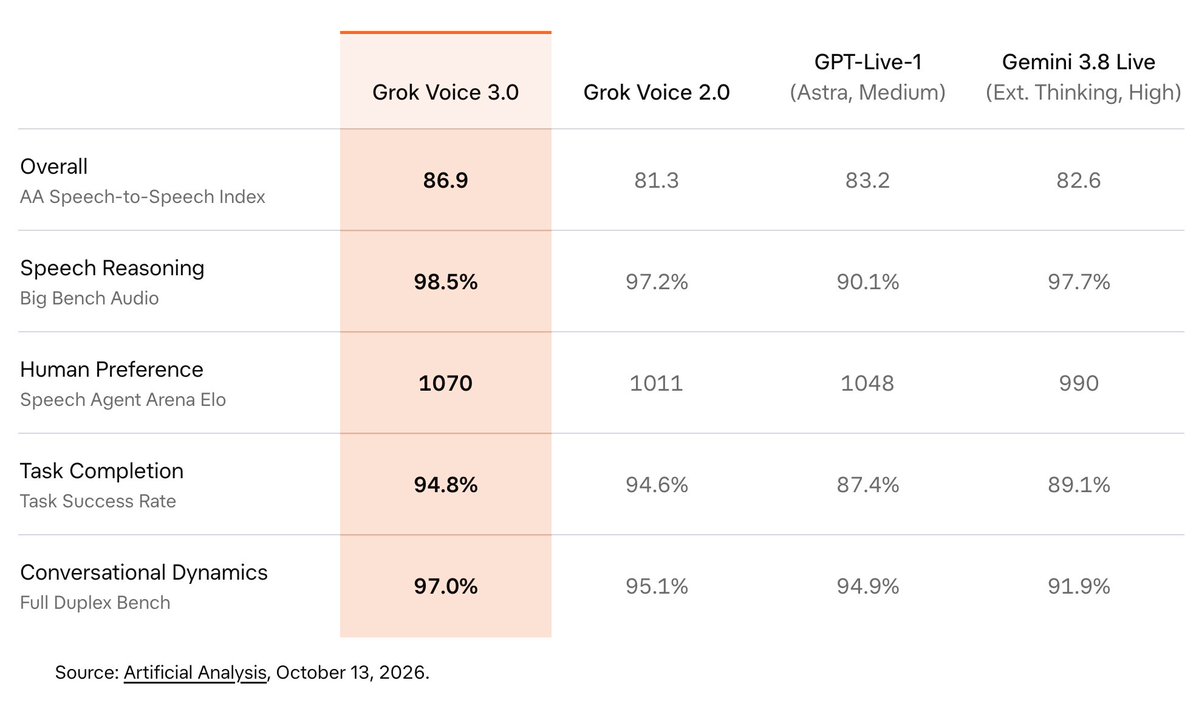
Grok Voice 3.0 is announced as the leading speech-to-speech model with an 86.9 AA Speech-to-Speech Index score, outperforming Grok Voice 2.0, GPT-Live-1, and Gemini 3.8 Live across speech reasoning, task success, and conversational dynamics.
- It delivers sub-second latency at 40% lower than competitors while achieving 71.6% on τ-Voice and 94.8% task completion, powering 70% autonomous resolution of Starlink support calls daily.
- Available immediately via xAI API and Voice Agent Builder at $0.08 per minute, with images showing benchmark tables and performance-vs-speed plots confirming its frontier edge in agentic voice tasks.

It excels at resolving customer calls, responds in under a second, and costs less than other frontier models.
Grok Voice 3.0 is @spacexai 's successor to Grok Voice 2.0, a Speech to Speech model available

What do AI labs know that the public doesn’t? In this NYT conversation, AI podcaster Dwarkesh Patel and economist Tyler Cowen debate how quickly AI will transform work.
Patel expects AI that learns on the job to automate entire roles within a few years. He wants labs to expose their strongest internal models to public scrutiny. Cowen is skeptical of the timeline: institutions move slowly, and human trust and real-world judgment could keep people central for decades.
How can the public judge AI’s trajectory if the strongest systems remain behind closed doors?
Read the NYT conversation — gift link
via Matthew Weigand
Perplexity is giving away the software it has been using to combat rogue AI agents
SPACE, the sandbox platform behind Computer, to help developers build safer autonomous AI agents. If you're interested, you can check out the repo here: https://github.com/perplexityai/SPACE
SPACE combines isolated execution with continuity for long-running work. Agents can pause, resume, recover from mistakes, and explore alternatives while preserving their files and running state. Network controls and platform-held credentials stay outside the sandbox, adding protection that does not depend on the model following instructions.
Meta just dropped Muse Spark Open — the most capable US open-weight model to date.
816B total params (42B active), natively multimodal, 1M-token context, built for coding and long-horizon agentic work. First model in its class optimized to run locally on two M5 Ultra Mac Studios via MLX. Benchmarks show it topping charts in areas like MCP-Atlas at 89.2 and Terminal-Bench at 76.4
Weights are live on Hugging Face + major clouds. APIs available through Together, Groq, OpenRouter, and more.

Built for coding and agentic work, it excels at long-horizon tasks, complex software engineering, and multi-step reasoning.
Key Model Specs:
→ 816B total / 42B active parameters
→ 1M token


816B total params, 42B active. 1M-token context. natively multimodal. built for coding and agentic work like long-horizon tasks, hard software engineering, multi-step reasoning.
america!


FWIW, I used to have a freepik/magnifc subscription because I got it at 75% discount (Javi Lopez suckered me in) but then they jacked up the price close to renewal and I personally don't do much image generation except for the once-a-week cover image for the All Things AI newsletter. I then signed up for Krea at 60 EUR per year so around 1.5 HKD per day which my 'man-math' can justify
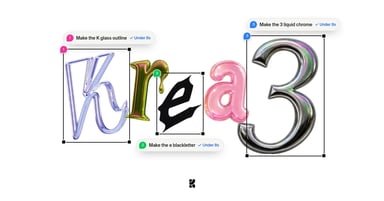
Krea AI launches the public beta of Krea 3, an image editing model that completes end-to-end 2K edits in under 8 seconds while matching quality of GPT Image 2.5 and Nano Banana Pro.
The model features bounding box controls for precise multi-turn edits that only alter required pixels, supports up to 4K resolution, and preserves character consistency across scenes.
Beta is available now via krea.ai with final release next week, including expanded benchmarks, LoRAs, style references, and hints at open-source models.


Krea 3: an image model built for editing at scale
Krea 3 is a new image editing model built for production. It keeps your product intact and is priced for volume.
Introducing Krea 3
Krea 3 is our new image editing model. Edits take under 8 seconds at native 2K, and products and characters stay consistent from one image to the next.

NVIDIA launched Nemotron 3.5 Super VL as an open 120-billion-parameter multimodal model (12B active in a mixture-of-experts design) with a 1M-token context window, built for always-on specialized agents.
It unifies reasoning, instruction following, tool use, and understanding of text, images, documents, and video in a single model, delivering leading accuracy on multimodal agentic tasks at roughly one-fifth the parameter count of NVIDIA’s largest reasoning models while claiming up to 5× higher single-GPU throughput for high-volume workflows.
Weights are available under the OpenMDW license on Hugging Face and partner platforms, with accompanying training recipes and smaller Bolt edge models for local deployment.


https://openrouter.ai/nvidia/nemotron-3.5-super-vl
Accenture’s reported $29 monthly Claude allowance highlights a practical question for enterprise AI: who pays when employees start using it heavily?
According to an internal announcement reviewed by 404 Media, Accenture began centrally funding US$29 per person per month for many Claude Enterprise users from October 1. Additional usage must be charged to a specific project or team. Some employees reported spending $500–$1,000 a month, including on Claude Code development for clients. Premium plans reportedly include $250 in weekly usage.
The project-funding detail is central to Aakash Gupta’s take. Moving the extra cost into a project’s budget gives someone responsibility for weighing the AI bill against the work it helps deliver.
That gets particularly interesting in consulting. On work billed by the hour, completing a task faster can reduce the hours available to bill. On fixed-fee work, the same time saving can improve margins. The economics depend on how the engagement is priced.
Seen this way, the $29 allowance raises a broader issue than spending control: how should firms price and fund work when AI changes the time needed to deliver it? Accenture says it continues investing in AI, with access guided by role and business need.
404 Media — original reporting and company response
Aakash Gupta — the project economics behind the policy
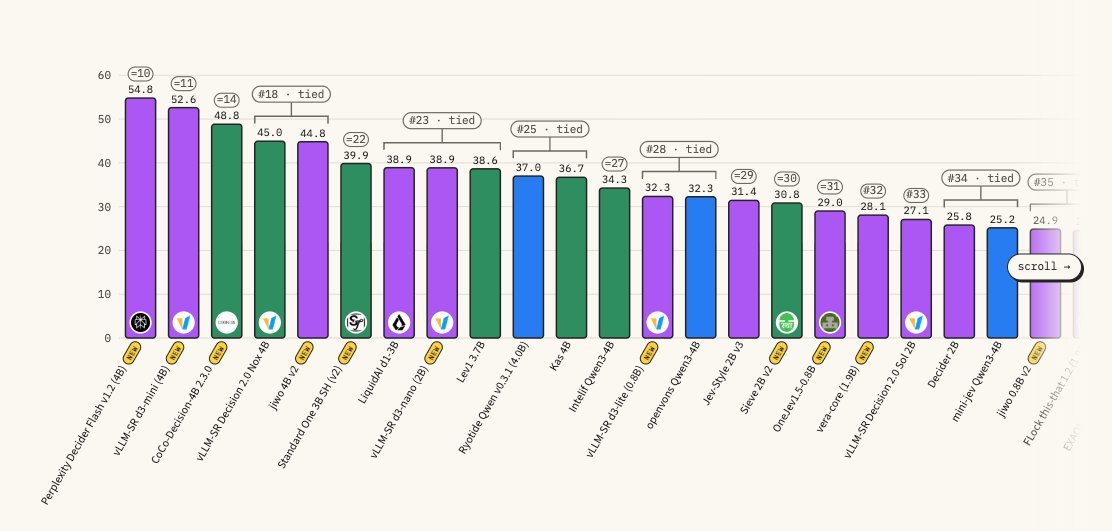
Perplexity has released pplx-decider-v1.2 (27B) and pplx-decider-flash-v1.2 (4B), its next-generation open-weights multimodal decision models.
pplx-decider-v1.2 (27B) — $0.02 / 1M tokens
pplx-decider-flash-v1.2 (4B) — $0.01 / 1M tokens
Key Improvements in v1.2
* Better quality: Higher text and vision scores after significantly more training compute and larger datasets. Models are more general, robust, and better calibrated. Reranking capabilities were added.
* Much faster inference: Up to 5× faster because all questions in a request share context and run in a single forward pass (one commenter described this as the main source of the speedup). Models were retrained to be inference-aware.
* Flash variant: Distilled smaller model that punches well above its size class.
* Other technical notes (from related posts): New attention schema improvements for better batching; continued use of non-causal attention patterns from prior versions.
Availability
Open weights on Hugging Face + available via Perplexity API, OpenRouter, Vercel AI Gateway.
Use *-latest aliases for automatic updates

pplx-decider-flash-v1.2: 4B params, 1 cent per million tokens (top 4B model on HF Decision Index)
pplx-decider-v1.2: 27B params, 2 cents per million tokens (#2 on HF Decision Index overall - for now, will

Text and vision scores improve. Inference is up to 5x faster: all questions in a request run in one pass.
Flash is the top 4B on the Decision Index.
Text and vision scores improve. Inference is up to 5x faster: all questions in a request run in one pass.
Flash is the top 4B on the Decision Index.

- overall improved performance across both text and vision. we significantly increased training compute and dataset size, so the model should be much more general, robust, and
Text and vision scores improve. Inference is up to 5x faster: all questions in a request run in one pass.
Flash is the top 4B on the Decision Index.
Below is my personal website which aggregates links to many of my socials as well as the various content and community that I curate. Feel free to share this link to others who you think may find this content/community useful to them
The cover image of this newsletter via generated via the Nano Banana 2.1 model within the Krea tool via the following prompt
ancient hidden temple found deep inside a lush rain forest| ancient greek ruins| rubble| gray dull background| vibrant colorful green leaves| hyperrealistic| highly detailed| cinematic| single ray of golden sunlight| beautiful| cgssociety| artstation| oil painting