

This Week in All Things AI covers key developments in models, agents, tools, infrastructure, and policy curated from discussions in the All Things AI Telegram group.
If you follow AI for work, research, investing, or just to understand where the technology is heading, this weekly brief is a concise way to scan the most important launches, risks, and resources in a few focused minutes.
The week of 18th to 24th October 2026 brought a clearer focus on making capable AI practical to use: faster responses, lower costs and tools that can act beyond a chat window. MiniMax’s M3.1 Flash and Inception’s Mercury 3 paired claims of stronger performance with gains in speed and efficiency, while Kimi K3.1 Pro extended the push towards more capable coding and multimodal agents, with its weights scheduled for November. These developments matter because useful agents often need many rounds of reasoning and action to finish a task; the time and cost of each round shape what becomes viable. Cursor’s computer use brought that idea into testing desktop apps and iOS simulators. Voice followed a similar practical direction, from Mistral’s Voxtral 3 and voice-agent tools to Gradium’s compact Phonon speech generation models, which can run locally without an internet connection.
The infrastructure underneath these experiences also received attention. Exa 3.0 aimed to give agents more relevant information with less repetitive text, addressing the cost of what models read as well as what they generate. DeepSeek opened its production inference framework, while Google’s TorchTPU and AWS’s TorchNeuron public beta sought to make alternative chips easier for PyTorch developers to use. Together, these announcements point towards greater choice over how AI is built and deployed, though the maturity of those options varies. Our guide to Perplexity Decisions and TypeSafe/Jev explored a complementary design choice: using models for specific judgements while keeping the next action under the control of application code.
The sections that follow walk through these items day by day, with short context and links so you can dive deeper into the pieces most relevant to your work or interest
Anthropic says it is committing 5% of its shares to a Public Benefit Fund, for a total of ~20% with co-founder and staff pledges, plus 2% per 50% valuation rise

It will start off with 5% of our shares. For every 50% increase in the company’s value over a set baseline, we can

Investing in the public benefit
We’re committing a portion of Anthropic’s shares to the Anthropic Public Benefit Fund, a new entity with a structure that increases the stake as the company grows.

We plan to use these funds to ensure more people can share in the benefits of AI, and to increase our ability to
It will start off with 5% of our shares. For every 50% increase in the company’s value over a set baseline, we can
Investing in the public benefit
We're committing a portion of Anthropic's shares to the Anthropic Public Benefit Fund, a new entity with a structure that increases the stake as the company grows.

MiniMax launches M3.1 Flash, saying it delivers “a generational leap” in agentic tasks, coding, computer use, and cybersecurity, with weights due October 23
MiniMax announces M3.1 Flash, a fast and efficient AI model that evolved from their anonymous Space Bunny version, which processed over 200 trillion tokens and led global leaderboards.
It delivers strong results in agentic tasks with scores like 62.2% on Automation-Bench, 73.7% on DeepSWE coding, and 91% on BabyVision, while running at 3x the speed and 1/3 the cost of its predecessor M3.
API pricing starts at $0.15 input/$0.60 output per million tokens with cache reads at $0.015, and model weights are scheduled for release on October 23, enhancing accessibility for developers.


 Yes, Space Bunny - which has topped global leaderboards with 200T+ tokens - was an earlier version of M3.1 Flash.
 Redefining the performance economics of agentic AI. M3.1 Flash achieves frontier-level intelligence
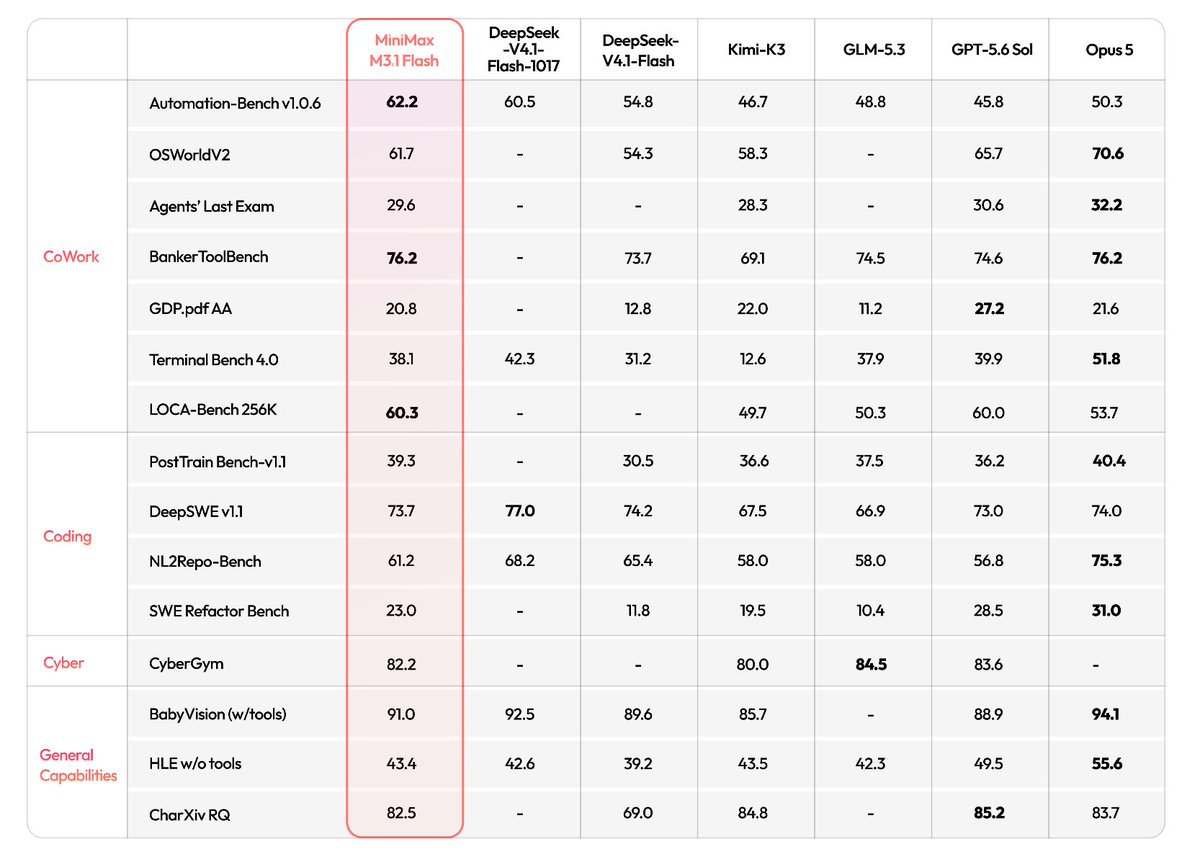

MiniMax-M3.1-Flash is @MiniMax_AI's new Flash reasoning
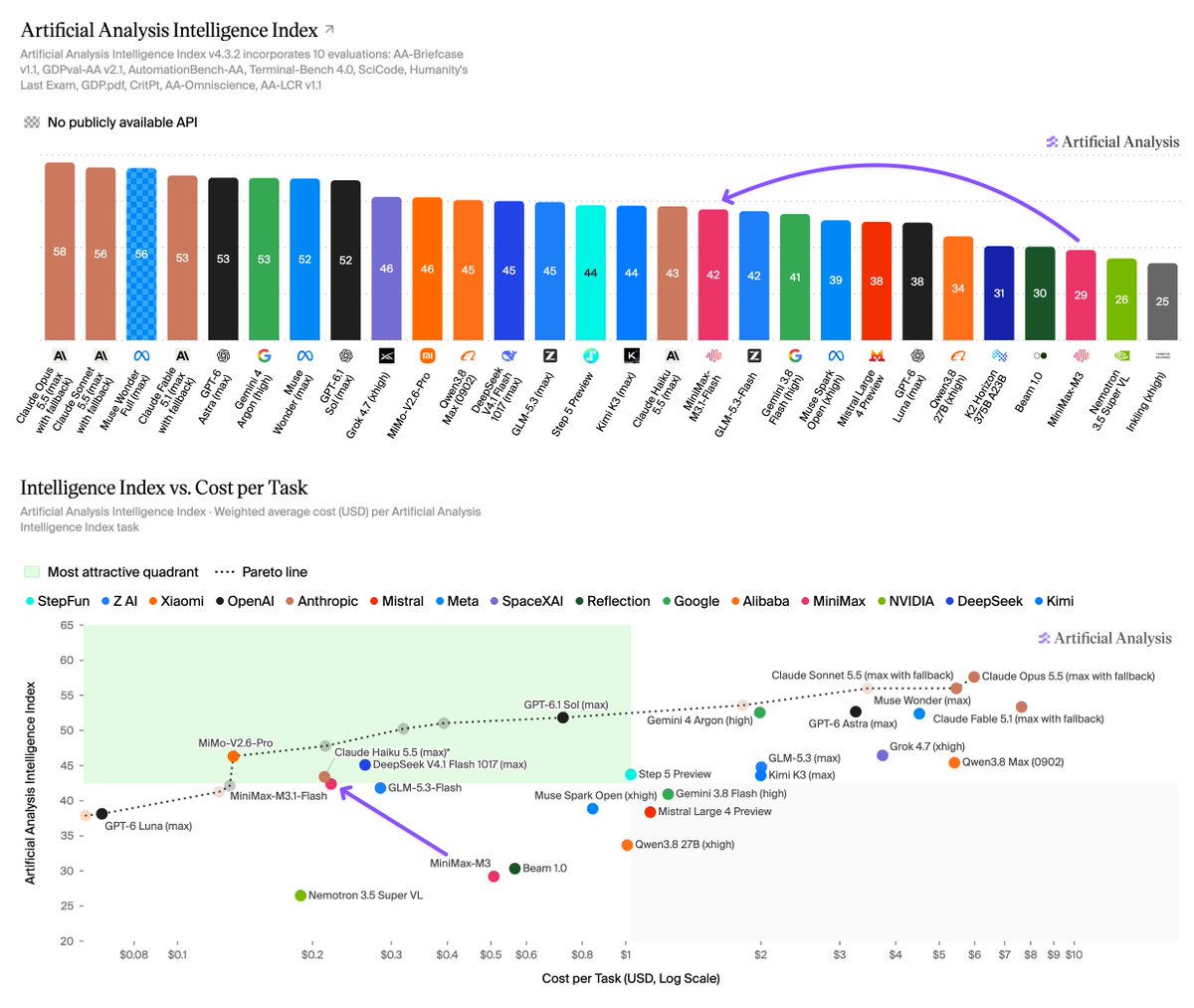

MiniMax-M3.1-Flash is a +106 pt increase from the previous variant, MiniMax-M3 with 1482 pts at #19
 Yes, Space Bunny - which has topped global leaderboards with 200T+ tokens - was an earlier version of M3.1 Flash.Redefining the performance economics of agentic AI. M3.1 Flash achieves frontier-level intelligence
MiniMax M3.1 Flash: Redefining Agent Performance and Cost - MiniMax Research
Today, we officially roll out MiniMax M3.1 Flash. As a next-generation Flash model, M3.1 Flash delivers a generational leap in agentic tasks, coding, Computer Use and cybersecurity, while making online inference nearly three times faster and reducing usage costs by 70%.

Exa 3.0 is out, upgrading its search API for AI apps and agents with better retrieval, improved ranking of long documents, and broader coverage across shopping, local businesses and real-time data.
A standout is Dynamic Highlights which selects relevant passages across search results and removes repetition. Exa reports 95% fewer tokens than feeding in full pages, while improving answer quality—potentially reducing downstream LLM costs. There’s also Exa Lite at $4 per 1,000 searches, alongside the higher-quality Auto option at $7. All upgrades are available now.
Inception Unveils Mercury 3, Fastest High-Performance AI Model Yet
The new diffusion-based LLM matches or beats models like GPT-6 Luna and Claude Haiku 5.5 on benchmarks such as IFBench, GPQA Diamond, and SWE-Bench Atlas, all while handling a 1 million token context window. Co-founder Stefano Ermon notes it's 40 times larger than the original Mercury 1 but keeps the same blazing throughput, proving intelligence can scale without slowdowns. Available now via Inception API and partners at launch pricing of $0.10 per million input tokens and $0.35 per million output tokens, it's already powering real-time tools like browser agents and smart-glasses search.


@_inception_ai's new diffusion model generates 1,000+ tok/s with 1M context, 4x more than Mercury 2.5. Inception reports it beats GPT-6 Luna and Haiku 5.5 on IFBench, GPQA Diamond, and SWE-Bench Atlas.
50% off at launch: $0.10/M in, $0.35/M out

fal launches FLUX 3 Max, claiming 22× faster AI video generation than Seedance 2.5

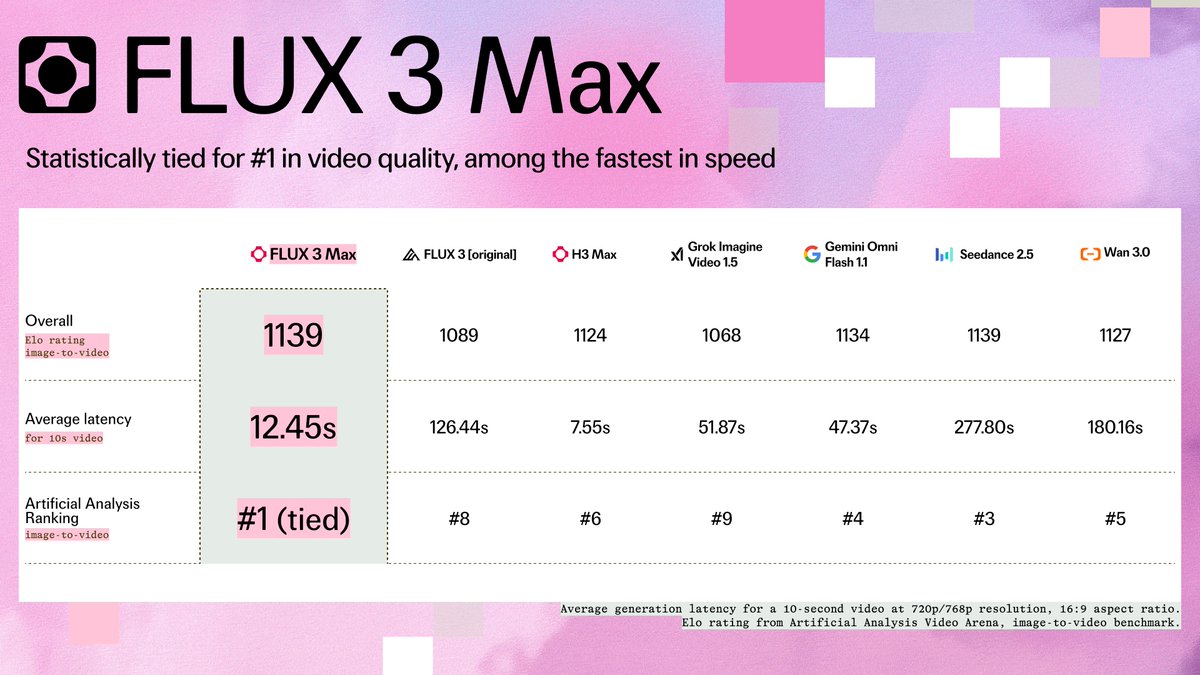

Fastest in the west. Fast enough to try anything. And everything.
Generate a 10-second video in 12 seconds.
Tied for #1 in image-to-video. 22× faster than Seedance 2.5 at the same quality.
FLUX 3 is a model designed for customization. @fal adapted and

DeepSeek Open-Sources DeepInfer for Efficient AI Model Inference
DeepSeek released DeepInfer, the optimized inference framework powering its DeepSeek-V4.1-Flash model in production, under an Apache-2.0 license. Alongside it, they open-sourced deepseek-recipe to match their official API in self-hosted setups, supporting features like advanced parallelism, NVIDIA Blackwell GPUs, Huawei Ascend chips, and high-throughput tools. Early testers reported strong results, such as 15 tokens per second decode on a single Intel Arc B70 with 256 GB RAM, helping developers cut costs and boost efficiency for large-scale AI deployments.
 Introducing DeepInfer, our in-house inference framework, now fully open source!
Powering DeepSeek-V4.1-Flash at scale with high throughput and low latency. We’re sharing our production stack to help the community lower compute costs, reduce energy use, and make AI more
GitHub - deepseek-ai/DeepInfer: DeepInfer: High-performance, large-scale inference framework for...
DeepInfer: High-performance, large-scale inference framework for DeepSeek models - deepseek-ai/DeepInfer

github.com/deepseek-ai/De…
Supported features:
- Optimized kernels, model and sampler runtime
- Parallelism: Attention DP / balanced CP, MoE EP + EPLB
- DSpark and
GitHub - deepseek-ai/DeepInfer: DeepInfer: High-performance, large-scale inference framework for...
DeepInfer: High-performance, large-scale inference framework for DeepSeek models - deepseek-ai/DeepInfer
Marvell is showing how light could help tackle AI’s memory bottleneck. Its Photonic Fabric Memory Module uses optical connections to provide up to 32TB of memory as far as 50 metres from compute allowing memory capacity to grow independently of GPUs.
Why this matters: AI systems could gain more memory without adding accelerators simply for their memory capacity. The broader interview connects this technology with custom chips and faster interconnects, aimed at improving infrastructure utilisation and the economics of AI inference.
The key idea is more flexibility in how AI systems combine compute and memory, with optical connectivity helping overcome the constraints of keeping everything physically close together.
Full interview
Mistral AI launched Voxtral 3, a family of state-of-the-art speech-to-text and text-to-speech models designed to power real-time voice agents via a new API.
Key capabilities include multilingual transcription in 50+ languages with diarization and context biasing, plus expressive TTS in 35+ languages and 50+ dialects that adapts emotion, pace, and emphasis implicitly or via tags, with Pro Voice cloning from 30 minutes of audio.
The release includes a voice agent SDK built on LiveKit for a unified streaming pipeline of transcription, reasoning with tool calls, and speech output, available via EU-hosted API or self-deployment for sovereign control.


@MistralAI has released Voxtral 3: a new Text to Speech model and three

When should an app ask a person to step in? Which team should handle a support request?
These are the kinds of judgments decision models can help with, while your code controls what happens next.
I’ve put together a guide to Perplexity Decisions and TypeSafe/Jev, with a practical example and a companion skill to help your coding agent build with them.
Thanks to Perplexity’s API team for feedback on early drafts, which helped shape the final version.
Here’s a short introduction, with links to both:

Explore my practical guide to Perplexity Decisions and TypeSafe/Jev, with a worked example and a companion coding-agent skill to help you build. x.com/i/article/2112…
Where could this be useful in something you’re building?
Gradium has released Phonon, a family of compact text-to-speech models that runs entirely on your device, enabling offline speech generation with no cloud calls or per-use API fees. The 31M and 40M parameter models cover English, French, German, Spanish and Portuguese; Phonon-31M is just ~64MB and available under Apache 2.0.
Built for phones, laptops, browsers and embedded hardware, Phonon reportedly starts speaking in 7.5ms on a Snapdragon 8 Elite Gen 5 and runs faster than real time on a Raspberry Pi 5. Gradium reports stronger listener preference than Kokoro, Magpie and Pocket TTS in its blind evaluations. The practical appeal: responsive, private voice output for assistants, accessibility tools, games and in-car applications.
Two hyperscalers are now competing for PyTorch workloads on their own silicon
Google open-sourced TorchTPU. It's a native PyTorch backend for Cloud TPUs, built with Meta, and moving code over is as simple as changing .to("cuda") to .to("tpu"). Google says it replaces PyTorch/XLA, and Hugging Face Transformers and Diffusers now run on TPUs natively.
This matters because TPUs become a drop-in target for the roughly 85% of AI code written in PyTorch.
AWS TorchNeuron is now an open-source public beta It runs PyTorch on Trainium2 and Trainium3 with a one-line device change, under the Apache 2.0 license, and Amazon is sending code upstream to loosen PyTorch's ties to Nvidia.
For those in the group who use image/video models via API and have kicked the tires with Fal, Higgsfield etc and want to stretch their money more might want to kick the tires of this service


Everything in Higgsfield, but at the original cost
> UI : layouts as same as higgsfield, but with 0 markups
> MCP/CLI : create with Claude, ChatGPT, etc.
> API : use it in your own codebase
No

Sume: Create, post, scale ads with your AI creative team
Sume's AI agents find the ads that work, remake them with your product, and post them to TikTok, Instagram, YouTube and Meta. Chat, canvas and studio.
Moonshot AI Unveils Kimi K3.1 Pro, a 3-Trillion-Parameter Powerhouse
The 3-trillion-parameter model supports a 1-million-token context window and handles text and images, matching top proprietary systems like GPT-6 Astra on coding and agent tasks. It scored 65.7% on Terminal-Bench 4.0, beating OpenAI's entry and ranking fourth overall on Artificial Analysis's Intelligence Index. With API pricing at half of leading competitors and a faster variant available now, full open weights arrive by November 4, giving developers affordable high-performance tools.

 1M-token context, 2.8T total / 104B active params (MoE), Multimodal. Full-project coding: games in Unreal, Unity & Godot. Excels at parametric 3D modeling in Blender & CAD. More reliable at

@Kimi_Moonshot's new reasoning model gains 11 points over Kimi K3 (max,

Cursor's Computer Use Lets AI Agents Control Your Desktop
Cursor rolled out 'Computer Use' in its desktop app, giving AI agents full control to click, type, launch simulators, and test apps without human handoffs. Developers can trigger it automatically or by mentioning it in prompts, making workflows smoother for building and demoing features like favoriting trails in a hiking app. Users praise it as a leap forward, turning agents into independent operators that handle end-to-end tasks locally, closing gaps with tools like Claude and OpenAI. The free update is available now for desktop users.

Agents can drive desktop apps like the iOS Simulator to test the features they build.

Fermion AI open-sourced Phonon-2.5, a 156MB multilingual speech model that sets a new accuracy-to-size Pareto frontier on the FLEURS benchmark across 25 languages, outperforming OpenAI's Whisper large-v3 despite being roughly 20x smaller.
The model compresses a 2.5GB base down to 6.2% of its original size while boosting average word accuracy to 101.8% of the full-precision version, running an hour of audio in about 20 seconds locally on a MacBook Air.
Phonon-2.5 is integrated into the free Detta Mac app for on-device dictation in 25 languages under open weights and CC-BY-4.0 licensing.

We brought a 2.5 GB model down to just 6.2% (!!) of its original download size, and simutaneously improved its accuracy.
Phonon-2.5 achieves 101.8% of its

It is a miniscule 156MB download, which is more accurate on average, than OpenAI’s Whisper large-v3 ( 20x its size!)
Transcribe an hour of multilingual audio in just 20 seconds on

Detta - dictation for the Mac
Detta turns speech into finished, formatted text in any app, with recognition running entirely on your Mac.

Below is my personal website which aggregates links to many of my socials as well as the various content and community that I curate. Feel free to share this link to others who you think may find this content/community useful to them
The cover image of this newsletter via generated via the ChatGPT Image 2.5 model within the Krea tool via the following prompt
beautiful utah desert, rock arcs, lush vegetation, landscape, alex ross, eddie mendoza, raphael lacoste, sebastian ludke, concept art, matte painting, highly detailed, rule of thirds, dynamic lighting, cinematic, detailed, magnificiant landscape, denoised, centered