

This Week in All Things AI covers key developments in models, agents, tools, infrastructure, and policy curated from discussions in the All Things AI Telegram group.
If you follow AI for work, research, investing, or just to understand where the technology is heading, this weekly brief is a concise way to scan the most important launches, risks, and resources in a few focused minutes.
The week of 25th to 31st October 2026 put the efficiency of AI work in focus, with improvements spanning models, search and the tools agents use to act. OpenAI’s GPT-6.1 Terra targeted faster, lower-cost computer use, while Particle-1 and BottleCapAI’s ThinkingCap claimed substantial reductions in reasoning tokens with little loss of accuracy. The practical question is how much time and computation a task needs, alongside whether the model can complete it. Parallel’s Decisions API combined live web retrieval with structured judgements, and Octen’s Pulse Search offered a faster route to known web destinations, with conventional search still recommended for fresh news. Vercel Labs’ agent-desktop extended computer use through operating-system accessibility data, while OpenRouter shifted default routing towards speed and reliability, accepting a modest price increase. These developments showed why the cheapest token price alone can be a poor guide to the cost of useful work.
Assessing that progress also requires better evidence and closer attention to the infrastructure supporting it. Artificial Analysis moved most of its Intelligence Index to private and held-out evaluations, while OpenAI’s announced results in mathematics, complexity theory and physics brought scientific verification into the discussion. On the financing side, SpaceX’s announced $40 billion GPU lease, scrutiny of Anthropic’s filing and Alex Song’s comparison of GPU clouds with airline economics highlighted the commitments behind expanding compute capacity. General Compute offered a different approach, raising capital to deploy specialised inference chips, with its first major deployments targeted for 2027. The tension is worth watching: cheaper, faster AI may expand demand, but infrastructure returns still depend on utilisation, pricing and how quickly hardware loses its value.
The sections that follow walk through these items day by day, with short context and links so you can dive deeper into the pieces most relevant to your work or interest
SpaceX Secures $40 Billion Lease for NVIDIA GPUs to Build Massive AI Compute
Through a master finance lease with an Apollo Global Management entity, SpaceX will acquire next-generation NVIDIA Vera Rubin GPU pods for its expanding terrestrial compute systems. The structure lets Apollo buy the hardware and lease it back, with quarterly payments over about five years starting in 2027, keeping the commitment off SpaceX's balance sheet. This supports powering Grok for users and cloud services, with investments expected to pay back in under a year. The news followed an Apollo note questioning AI's broader financial impact, lifted SpaceX shares, and prompted Bernstein to raise its price target to $268.

"SpaceX has reached a binding commitment to enter into an approximately $40 billion master finance lease for GPUs and related equipment with an entity managed by Apollo Global Management, Inc. (Apollo). This lease will
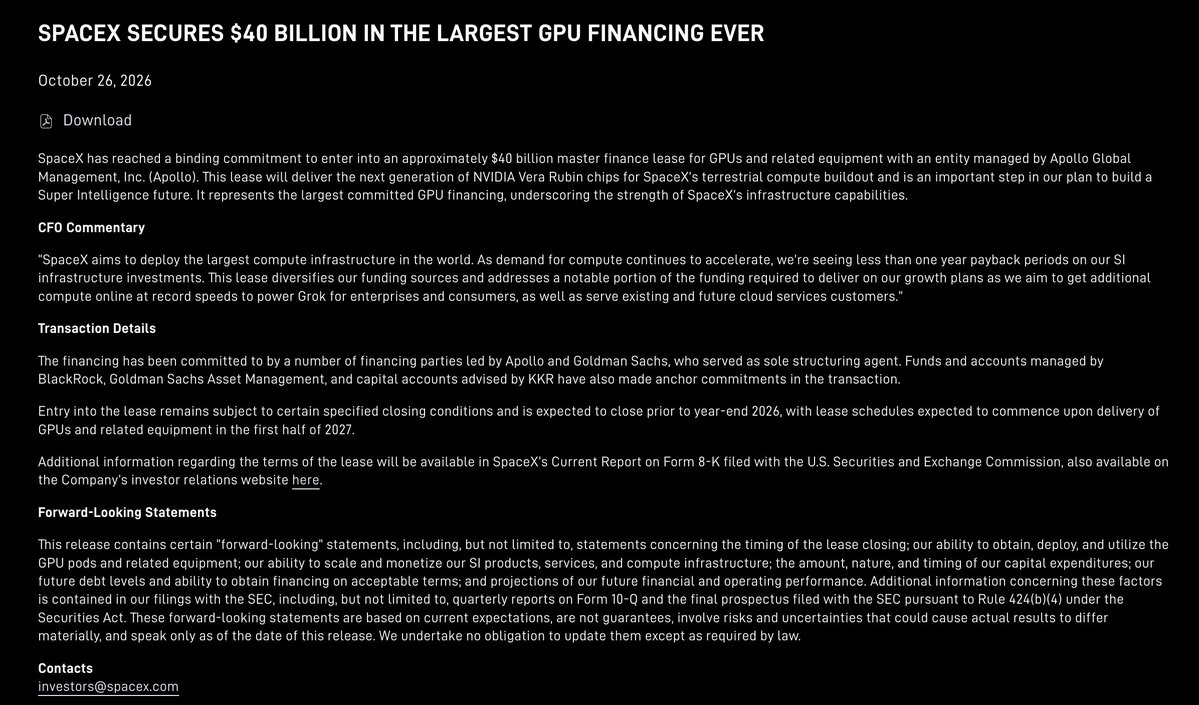

via Alex
Anthropic S1 released
*Revenue 60% lower than rumored/leaked
* Costs artificially lowered by recategorization and delayed into next decade through commitments
* $450 billion in non-cancelable commitments
*700+ billion in total commitments
via Lisa Gu
Presenting, Fundamentally Flawed, a series asking what if our flaws became a physical part of us? Made with fal/seedance2.5!
https://www.instagram.com/reel/De95b3thnAK
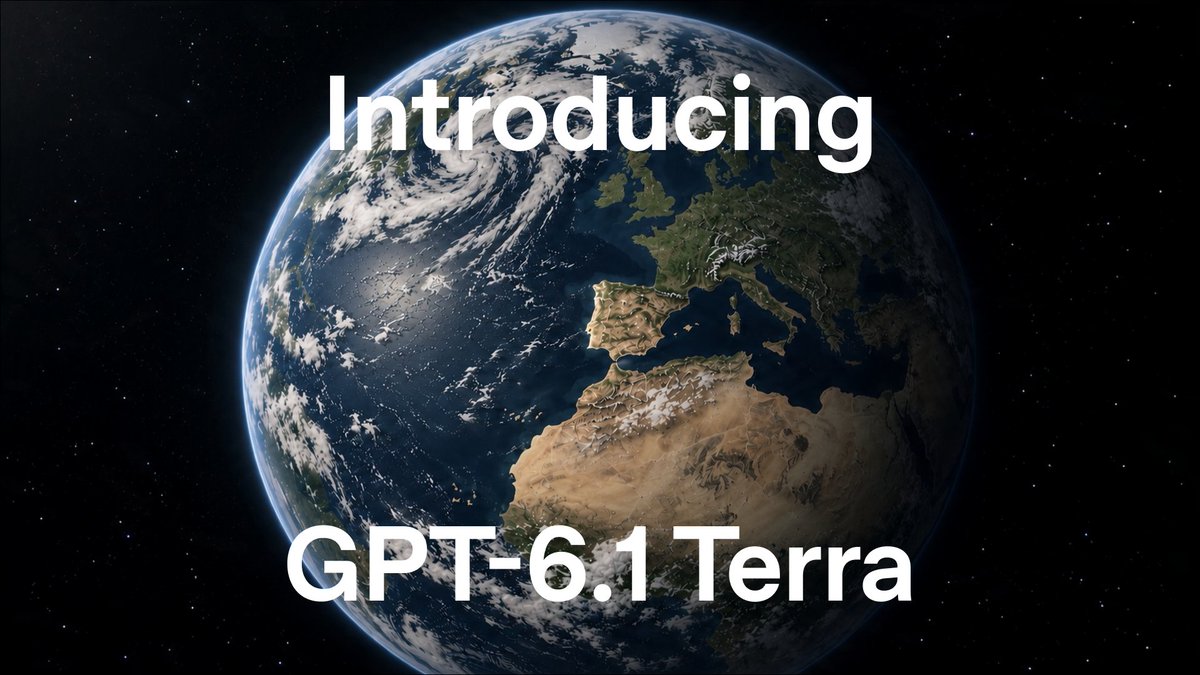
OpenAI releases GPT-6.1 Terra, touting “fast and capable computer use at scale” and clearer, more natural writing, priced at $1/1M input and $5/1M output tokens
OpenAI announced GPT-6.1 Terra, a model designed for fast computer use, screen understanding, app actions, and natural writing with improved factuality and reduced hallucinations for everyday work tasks.
It advances the cost-intelligence frontier with 50% lower API prices than GPT-5.6 Terra, matching higher-end models like GPT-6 Astra on Agents’ Last Exam at one-tenth the price per token while completing tasks over 3x faster.
Available immediately to Plus, Pro, Enterprise, and Edu users in ChatGPT Work and Codex, and via API as gpt-6.1-terra for developers handling automation, coding agents, and research.

OpenAI announces three breakthroughs in computer science, math, and physics, including that the Exponential Time Hypothesis, a longstanding conjecture, is false

Back in 1999, Russell Impagliazzo and Ramamohan Paturi at UC San Diego made

AI starting to help us improve our understanding of the universe! openai.com/index/building…
Working with academic communities to build scientific understanding
OpenAI shares model results on the Kakeya conjecture, Exponential Time Hypothesis, and quantum chromodynamics-and how researchers can verify and build on them.

Grok Bot will make keeping up with X much easier and cheaper
Elon flexing his access to X and subsidising agentic access to it via Grok Bot.
I guess I have to use my existing credits in the X developer API when I use the X MCP server in other harnesses or when I use the xurl CLI.
I'm expecting Zuck/Alexander to offer similar thing for Instagram within Muse

Ask @bot to manage your bookmarks, go over your DMs, or draft an article for you free of additional charge
In case you aren't familiar with the xurl CLI
https://github.com/xdevplatform/xurl
via Robby Yung

The team believe that frontier models drastically overthink, and therefore burn tokens unnecessarily
So @BottleCapAI (named after Europe's greatest innovation) takes an existing open model and trains it

 ThinkingCap: Gemma-4-26B-A4B is out!
The most token-efficient Gemma-4-26B-A4B available.
 Up to 69% fewer thinking tokens, 38.9% on average
 Negligible accuracy loss 0.15pp
 ThinkingCap PRO: up to 87.6% fewer thinking tokens, 62% on average - Contact our

Parallel Decisions API (launched by Parallel Web Systems / @p0, founded by ex-Twitter CEO Parag Agrawal) is a new web-grounded decisions engine.
It combines the speed of fast “System One” decision models (like Jev) with live web retrieval, so you get typed answers with current context + citations in a single call — instead of the usual multi-step search + classify pipelines.
### Key features
- Web-grounded typed answers: Yes/no probabilities (`noul`), multi-choice, or scored rubrics, each with probability, confidence, and source citations.
- Batching: Up to 100 related questions about the same entity/context in one request (they share one retrieval).
- Low latency: Typically 500–900 ms.
- Cost: $0.001 per request ($1 / 1,000 calls). Batching makes multi-question enrichment extremely cheap.
- Free tier: 5,000 free requests on signup. Also available free (lower limits) as the web_decisions tool via Parallel’s MCP server (`https://mcp.parallel.ai/mcp`).
### Example use cases
- Fact-checking content
- Refreshing stale CRM / banking / company records
- Lead classification & routing with fresh signals
- Compliance / KYB rechecks
- Competitor inventory tracking
- Support ticket triage
- Trading strategy backtesting signals
Internal demos showed strong results (e.g., 426 companies rechecked in <10 s for ~$0.85 with high accuracy; 500 leads routed in <9 s for ~$0.50).
### Links
- Announcement tweet: https://x.com/p0/status/2115111877558898931
- Blog post: https://parallel.ai/blog/decisions-api
- Docs / Quickstart: https://docs.parallel.ai/decisions/decisions-quickstart
- Platform (signup + free credits): https://platform.parallel.ai
- Question types: https://docs.parallel.ai/decisions/question-types
Good fit for agent workflows, enrichment pipelines, or any place you currently do “search the web then classify.”
General Compute raises $100M Series A at $800M post-money valuation (up from ~$60M in May). Co-led by Blackbird Ventures and Abstract Ventures. Prior $400M debt facility from Upper90 (using inference chips as collateral). Anchored by a ~$100M ARR customer deal.
What they’re building: A heterogeneous AI inference cloud. They buy specialized silicon (SambaNova, Cerebras, Positron AI, etc.), deploy it into existing colos (including former bitcoin mining sites), and offer bare metal or tokens-per-second SLAs. Prefill on GPUs + decode on purpose-built ASICs.
Value prop: Fast inference demand (agents, coding, voice) is exploding vs. slow/batch. Specialized chips deliver much higher tokens/sec per user and better efficiency on the memory-bound decode stage. Customers get frontier non-Nvidia hardware without owning/managing it. First big deployments targeted for Q1 2027 (30–75+ MW pipeline).
They’re positioning as the deployment/balance-sheet layer for alternative silicon, countering the “neoclouds are doomed” narrative by focusing on inference rather than training.
Sources:
- Announcement tweet: https://x.com/general_compute/status/2115114419067727995
- TechCrunch: https://techcrunch.com/2026/10/27/general-compute-raises-100-million-series-a-countering-the-neocloud-disaster-narrative/
- Company site: https://www.generalcompute.com/
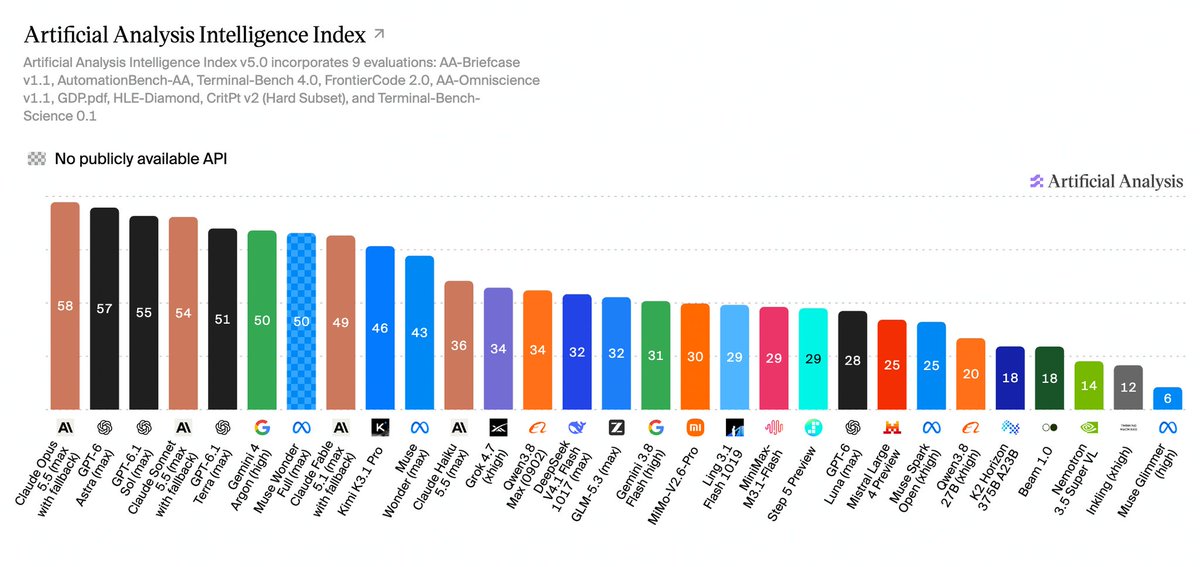
Artificial Analysis launched Intelligence Index v5 with 60% of the composite score now derived from private datasets and held-out evaluations, adding FrontierCode 2.0 for real-world coding tasks and Terminal-Bench-Science for agentic research workflows.
Claude Opus 5.5 (max) tops the index at 58, followed by GPT-6 Astra (max) at 57 and GPT-6.1 Sol (max) at 55, as Anthropic and OpenAI occupy the top five spots across nine diverse benchmarks.
Open-weight models trail leaders by 12 points with Kimi K3.1 Pro at 46, while cost per index task differs by over 13x among top models, highlighting varying efficiency in agentic and knowledge-intensive evaluations.

The Artificial Analysis Intelligence Index is our composite measure of model capabilities across tasks
Finance veteran Alex Song leverages his ABS trading and Ramp operator experience to frame GPU neocloud financing as analogous to aircraft engine ABS, highlighting perishable inventory (idle H100 hours vs empty seats), 85%+ fixed costs, and break-even utilization around 65-75%.
Core parallels include NVIDIA's duopoly role akin to Boeing/Airbus, take-or-pay contracts in bankruptcy-remote SPVs at 70-80% LTV, and returns concentrated in the final utilization increments, with the attached table mapping airframe/engine ABS credit metrics to GPU depreciation via architectural cycles and obsolescence.
Replies underscore nuances like model efficiency gains potentially boosting GPU output beyond fixed aircraft seats and risks from rapid tech shifts, shorter asset lives, and simultaneous drops in utilization, rates, and collateral values amplifying leveraged losses.

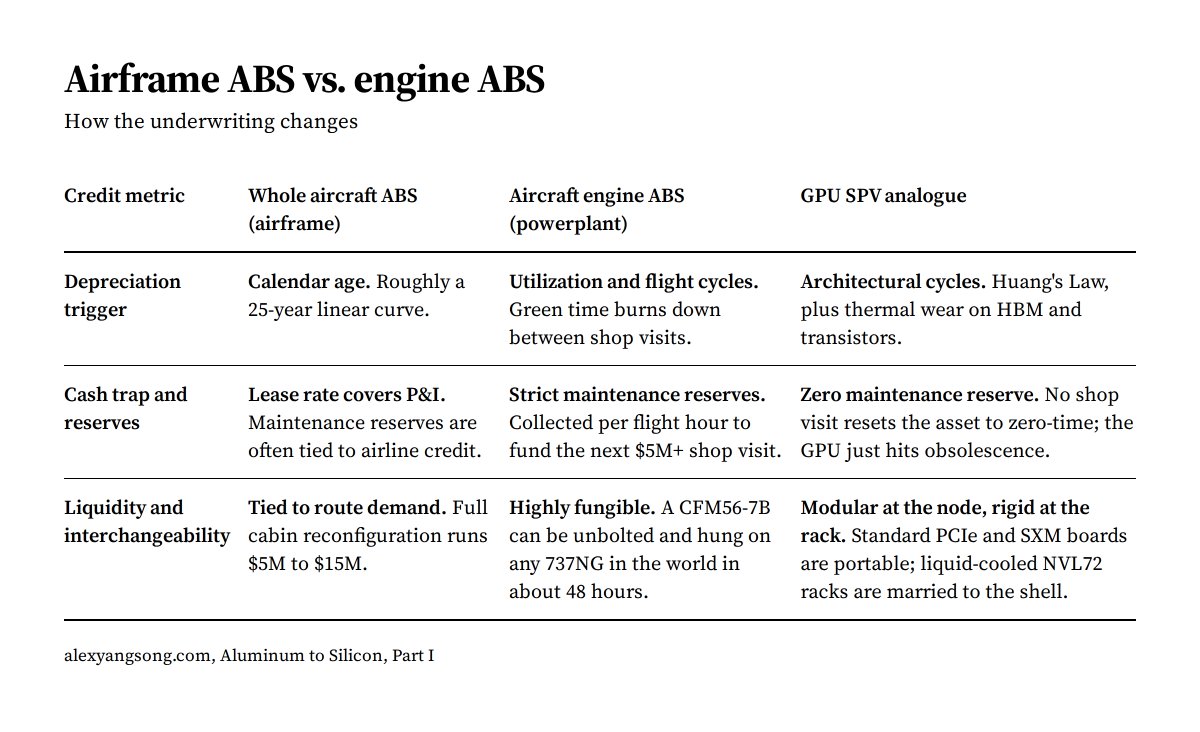
Aluminum to Silicon, Part I: Why GPU Neoclouds Run on Airline Economics
GPU neoclouds look a lot like airlines, and the debt behind them looks a lot like aircraft engine ABS. Part I of a series by Alex Song.
Particle-1 — new developer-focused coding model from Particle (founded by Suhail Doshi, ex-Mixpanel).
What’s unique
Post-trained on DeepSeek V4.1 Flash via reinforcement learning specifically for token efficiency. Claims ~45% fewer tokens on average (28–52% fewer output tokens across coding benchmarks) while keeping accuracy close to the base model. Tasks finish faster because it reasons less, explores more efficiently, and does fewer trial-and-repair cycles. Aimed at software engineering agents (debug, plan changes, multi-step work). 1M context, vision support, tool calling.
Pricing & availability
- Particle’s own API: $0.25/M input, $0.03/M cached input, $1/M output (peak; off-peak roughly half).
- Also on OpenRouter and Vercel AI Gateway (`particle/particle-1`), often cheaper via the gateways.
Links
- Blog: https://particle.ai/blog/introducing-particle-1
- Site / API: https://particle.ai · Docs: https://docs.particle.ai
- Suhail announcement: https://x.com/Suhail/status/2115497949421883648
- OpenRouter: https://x.com/OpenRouter/status/2115564621717512295
- Vercel: https://x.com/vercel_dev/status/2115556868416475592
Kuan Zou the Founder of Octen, announced Octen Pulse / Pulse Search a generative web search API designed so that “the model is the index.” A single inference maps a query to real URLs in roughly the time and cost of one LLM token.
The problem it solves
Traditional search forces an AI to stop generating, call an external API, and wait hundreds of milliseconds. The more it searches, the longer the wait, so systems ration searches. Pulse turns that pause into a “pulse”: search can happen mid-thought, on every keystroke, or across an entire spreadsheet in one pass
How it works
Octen-WebGR-4B (a ~4B-parameter model fine-tuned from Qwen3-4B) has effectively memorized ~200 million web pages in its parameters. Given a query, it generates a two-token semantic identifier constrained to a table of real URLs. One forward pass replaces the usual multi-stage pipeline of query understanding, recall, and ranking.
Lite mode: returns titles + URLs in ~10 ms (P50), ~$0.0001 per call ($0.1 per 1,000).
Standard mode: adds highlights, full content, and images (~23 ms P50).
Best suited for navigational queries (docs, official sites, help centers, popular destinations). For news, fresh pages, or heavily filtered needs, Octen still recommends their conventional real-time Web Search.
Tech report: arXiv:2610.35256
Models: Hugging Face collection (Octen-WebGR-4B and 0.6B; weights/table under CC BY-NC 4.0)
API: docs.octen.ai/api-reference/pulse-search
OpenRouter Overhauls Routing to Prioritize Speed and Reliability Over Lowest Price
The company rebuilt its algorithm to score providers on real-world performance like latency, throughput, error rates, and output quality, not just the cheapest price. Early tests show big wins: time to first token dropped 17% on average, throughput rose 16%, and errors fell sharply, with costs up only about 6-7%. Shashank Goyal called the old system a 'race to the bottom,' while CEO Alex Atallah noted 20% faster responses and 60% fewer rate-limit errors. The update is live now, making default routing snappier and more reliable for users connecting to hundreds of models.
https://x.com/OpenRouter/status/2115852889835114689
https://x.com/alexatallah/status/2115886732637807091
https://x.com/shashankgoyal95/status/2115856476845617573
Vercel Labs Releases Agent-Desktop for AI Control of Desktop Apps
Agent-desktop, built by Lahfir at Vercel Labs, lets AI coding agents control macOS, Windows, and Linux apps by reading the OS accessibility tree for structured JSON snapshots and stable references. This skips unreliable pixel matching, saves processing tokens by focusing on specific UI parts, and enables headless, parallel agent operation while users keep working. Early testers praise it for filling gaps in AI 'computer use' features, supporting end-to-end native app testing, though it relies on apps providing good accessibility data and raises security questions around filesystem access.


agent-browser, for your whole computer
→ Computer Use for any coding agent
→ macOS, Windows and Linux
→ Runs in bg while you keep working
→ Agents use your computer in parallel, each with its own cursor


Vercel's new agent-desktop skips that problem by reading the operating system's accessibility tree instead of a screenshot,
agent-browser, for your whole computer
→ Computer Use for any coding agent
→ macOS, Windows and Linux
→ Runs in bg while you keep working
→ Agents use your computer in parallel, each with its own cursor
Below is my personal website which aggregates links to many of my socials as well as the various content and community that I curate. Feel free to share this link to others who you think may find this content/community useful to them
The cover image of this newsletter via generated via the ChatGPT Image 2.5 model within the Krea tool via the following prompt
impressionist painting on canvas, sunset in Provence, in the style of impressionist masters, warm colors, delicate brushstrokes