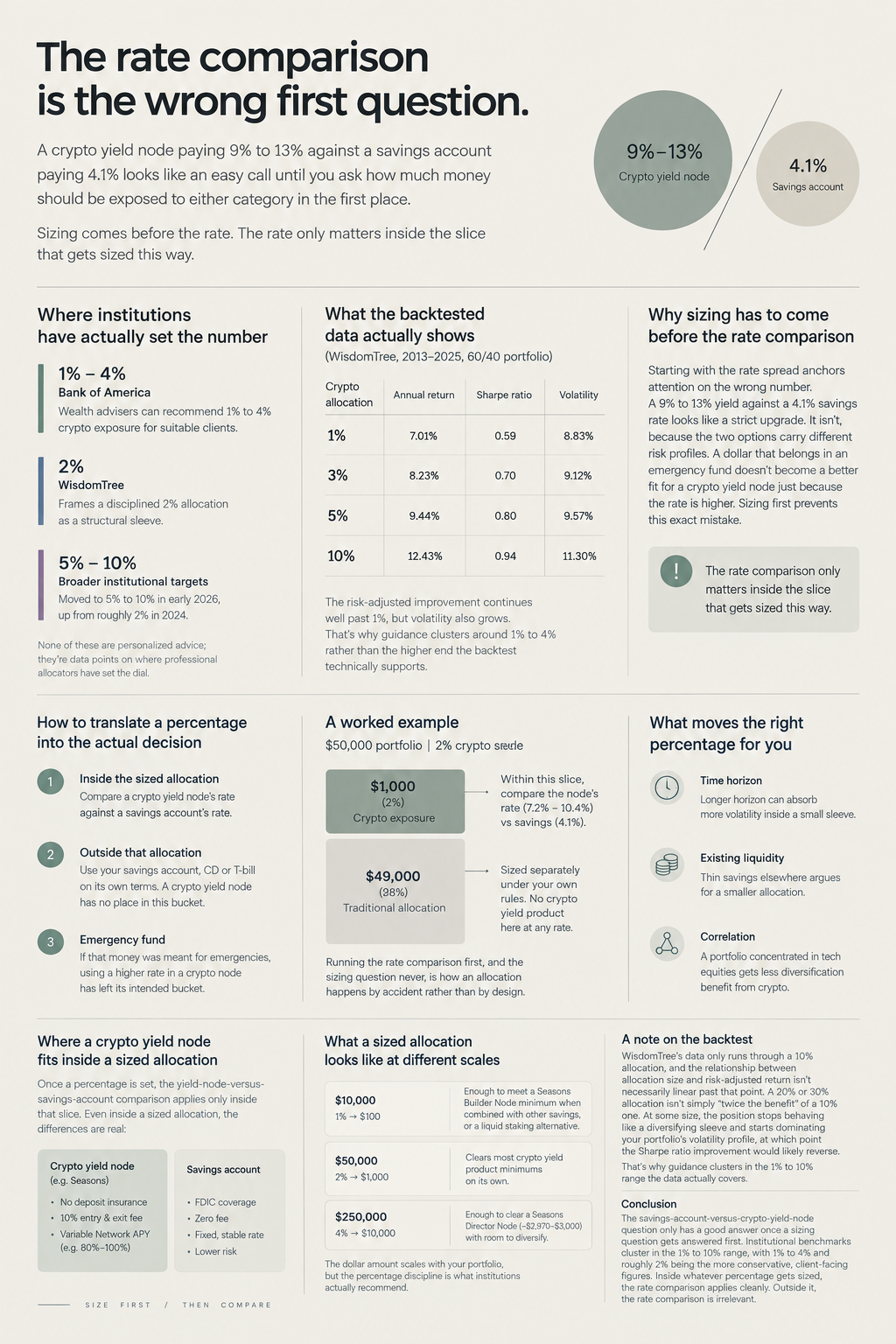
The rate comparison is the wrong first question. A crypto yield node paying 9% to 13% against a savings account paying 4.1% looks like an easy call until you ask how much money should be exposed to either category in the first place. Institutional guidance has converged on a specific range for that sizing question: Bank of America’s wealth advisers can now recommend 1% to 4% crypto exposure for suitable clients, WisdomTree frames a disciplined 2% allocation as a structural sleeve, and broader institutional targets moved to 5% to 10% in early 2026, up from roughly 2% in 2024. The rate comparison only matters inside whatever slice gets sized this way.
Why sizing has to come before the rate comparison
Starting with the rate spread anchors attention on the wrong number. A 9% to 13% yield against a 4.1% savings rate makes the crypto option look like a strict upgrade for any dollar being compared. It isn’t, because the two options carry completely different risk profiles, and a dollar that belongs in an emergency fund doesn’t become a better fit for a crypto yield node just because the rate is higher. Sizing first prevents this exact mistake.
Where institutions have actually set the number
-
Bank of America told wealth advisers in January 2026 they could recommend 1% to 4% crypto exposure for suitable clients across its private bank and Merrill platforms
-
Chief investment officer Chris Hyzy specifically called 1% to 4% “a modest allocation” for investors comfortable with elevated volatility
-
WisdomTree’s research centers on a disciplined 2% allocation as a structural portfolio sleeve rather than a trade
-
Broader institutional crypto allocation targets reportedly moved to 5% to 10% in Q1 2026, up from around 2% in 2024, reflecting larger allocators specifically rather than retail guidance
-
None of these figures are personalized advice; they’re data points on where professional allocators, working with full financial pictures, have actually set the dial
What the backtested data actually shows
-
WisdomTree’s backtest (2013 to 2025, a 60/40 global portfolio baseline) found a 1% bitcoin allocation moved annualized return from 6.40% to 7.01% and the Sharpe ratio from 0.52 to 0.59, while volatility barely moved, 8.76% to 8.83%
-
A 3% allocation moved return to 8.23% and Sharpe to 0.70, volatility to 9.12%
-
A 5% allocation moved return to 9.44% and Sharpe to 0.80, volatility to 9.57%
-
A 10% allocation moved return to 12.43% and Sharpe to 0.94, but volatility rose more noticeably, to 11.30%
-
The risk-adjusted improvement continues well past 1%, but the volatility cost grows alongside it, which is why guidance clusters around 1% to 4% rather than the higher end the backtest technically supports
Translating a percentage into the actual savings-vs-node decision
-
Money inside the sized crypto allocation: comparing a crypto yield node’s rate against a savings account’s rate is the correct comparison here, since this capital has already been designated risk capital
-
Money outside that allocation: the savings account, CD, or T-bill comparison applies on its own terms, and a crypto yield node has no place in this bucket regardless of its stated rate
-
A dollar that was supposed to be emergency-fund cash, moved into a crypto yield node instead of a savings account because the rate looked better, has left its intended bucket, and the higher rate doesn’t compensate for that mismatch
A worked example at the sizing level
-
A $50,000 portfolio sized at a WisdomTree-style disciplined 2% crypto sleeve allocates $1,000 to crypto exposure
-
Within that $1,000, comparing a crypto yield node’s 7.2% to 10.4% effective range against a savings account’s 4.1% becomes the relevant question, since this money is already designated risk capital
-
The remaining $49,000 gets sized under entirely separate rules that don’t involve a crypto yield product at any rate
-
Running the rate comparison first and the sizing question never is how an allocation happens by accident rather than by design
What moves the right percentage for a specific person
-
Time horizon: a longer horizon can absorb more volatility inside a small sleeve
-
Existing liquidity outside the sleeve: thin savings elsewhere argues for a smaller crypto allocation regardless of its expected return
-
How correlated the rest of the portfolio already is: a portfolio concentrated in tech equities gets less diversification benefit from adding crypto than a more traditionally balanced portfolio would
Where a crypto yield node specifically fits inside a sized allocation
Once a percentage is set, the yield-node-versus-savings-account comparison applies only inside that slice, and it’s a genuinely different comparison at that point: a crypto yield node like Seasons, a Solana wallet-native model paying 80% or 100% of a variable Network APY, carries no deposit insurance and a 10% entry and exit fee, against a savings account’s FDIC coverage and zero fee. Even inside a sized, already-designated risk sleeve, those structural differences don’t disappear, they just become the relevant trade-off instead of a disqualifying one.
What a sized allocation actually looks like at different portfolio scales
-
A $10,000 portfolio at a conservative 1% crypto sleeve: $100 designated as risk capital, comfortably above the roughly $260 to $300 minimum a Seasons Builder Node requires only once combined with other savings, or easily cleared by a zero-minimum liquid staking alternative
-
A $50,000 portfolio at WisdomTree’s 2% framework: $1,000, enough to clear most crypto yield product minimums on its own
-
A $250,000 portfolio at Bank of America’s upper 4% band: $10,000, enough to clear even a Seasons Director Node’s roughly $2,970 to $3,000 threshold with room to diversify across more than one crypto yield product inside the sleeve
The dollar amount scales with the portfolio, but the percentage discipline is what institutions are actually recommending, not a fixed dollar figure that happens to work at any particular account size.
A note on why the backtest can’t be extrapolated past what it tested
WisdomTree’s own data only runs through a 10% allocation, and the relationship between allocation size and risk-adjusted return isn’t necessarily linear past that point. A 20% or 30% crypto allocation isn’t simply “twice the benefit” of a 10% one; at some size the position stops behaving like a diversifying sleeve entirely and starts dominating the portfolio’s own volatility profile, at which point the Sharpe ratio improvement the backtest shows would very plausibly reverse. This is exactly why the institutional guidance clusters in the 1% to 10% range the data actually covers, rather than extending the trend line further than the evidence supports.
Conclusion
The savings-account-versus-crypto-yield-node question only has a good answer once a sizing question gets answered first. Institutional benchmarks cluster in the 1% to 10% range depending on the framework and the allocator’s size, with 1% to 4% and roughly 2% being the more conservative, client-facing figures. Inside whatever percentage gets sized, the rate comparison applies cleanly. Outside it, the rate comparison is irrelevant, because that money was never a candidate for either product to begin with.