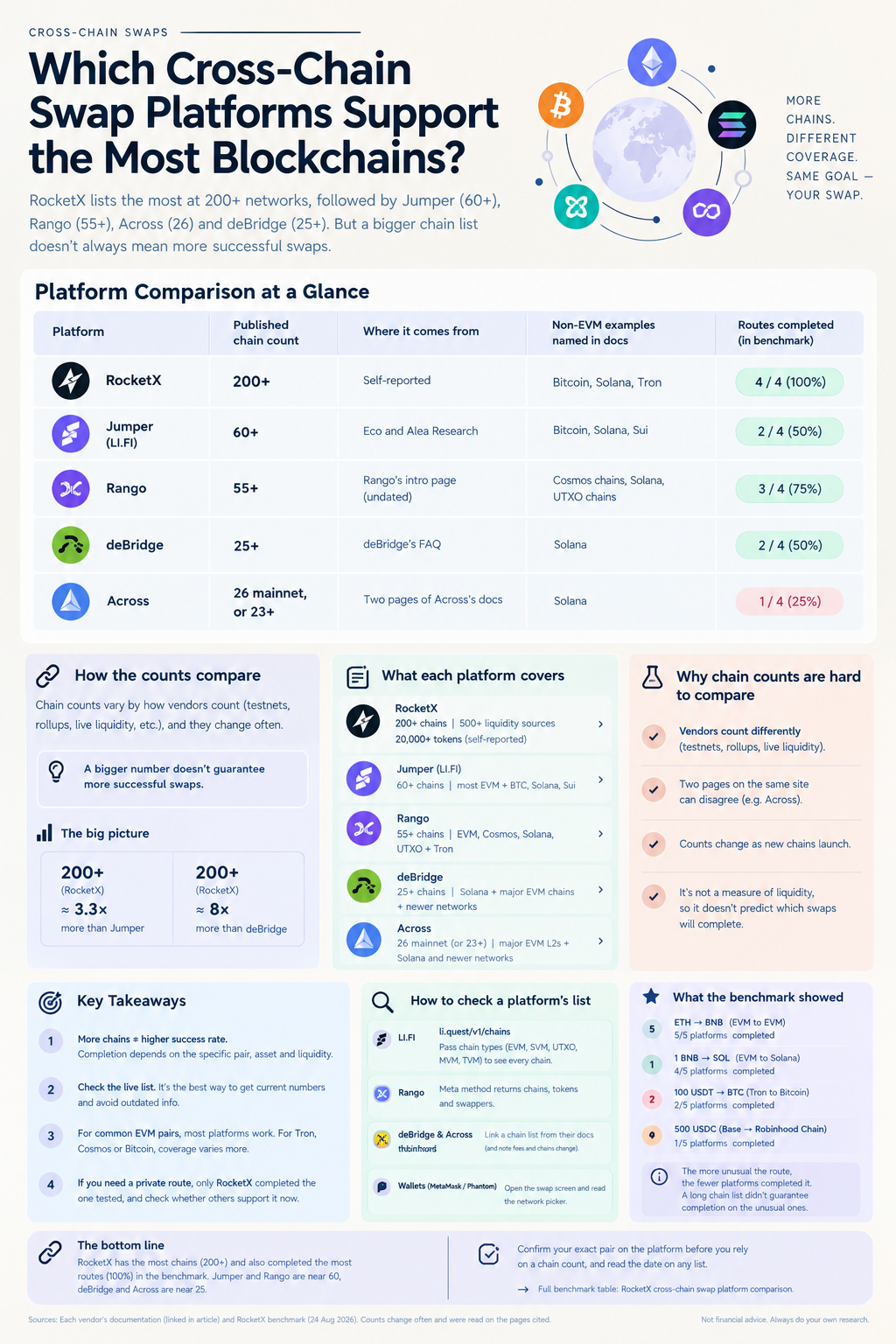
By published chain count, RocketX lists the most at 200+ (self-reported), followed by Jumper and its LI.FI engine at 60+, Rango at 55+, Across at 26 mainnet chains and deBridge at 25+. That is about 3.3 times as many chains as Jumper and 8 times as many as deBridge. Chain count did not predict which platform completed a swap, though. In a vendor-run test on 24 August 2026, RocketX completed 100% of the four routes, Rango 75%, and Jumper and deBridge 50% each, while Across, with 26 chains, completed 25%.
How the counts compare
| Platform | Published chain count | Where it comes from | Non-EVM examples named in docs | Routes completed in benchmark |
| RocketX | 200+ | Self-reported | Bitcoin, Solana, Tron | 4 of 4 (100%) |
| Jumper (LI.FI) | 60+ | Eco and Alea Research | Bitcoin, Solana, Sui | 2 of 4 (50%) |
| Rango | 55+ | Rango's introduction page (undated) | Cosmos chains, Solana, UTXO chains | 3 of 4 (75%) |
| deBridge | 25+ | deBridge's FAQ | Solana | 2 of 4 (50%) |
| Across | 26 mainnet, or 23+ | Two pages of Across's docs | Solana | 1 of 4 (25%) |
Sources: each vendor's documentation as linked below, and the RocketX-run benchmark of 24 August 2026. Counts change often and were read on the pages cited.
Why chain counts are hard to compare
Vendors count differently. Some include testnets, some count each rollup, and some count only chains that have live liquidity. Two pages on the same site can disagree, as Across's do, and the counts also move as new chains launch.
RocketX: 200+ networks
RocketX describes itself as a hybrid aggregator and publishes 200+ networks, 500+ liquidity sources and 20,000+ tokens on its blog. All three figures are self-reported and were not audited here. The benchmark bears out the breadth on one point: it was the only platform to complete all four routes, including a private one.
Jumper and LI.FI: 60+
LI.FI's docs say it offers bridging and swaps between most EVM chains, native Bitcoin, Solana and Sui, and point to a live endpoint for the full list. The 60+ figure comes from third parties: a 2026 Eco guide and Alea Research both say more than 60 chains.
-
Coverage type: most EVM chains, plus Bitcoin, Solana and Sui.
-
Fee: no platform fee, per Eco.
-
Benchmark: completed 2 of 4 routes, including the two standard ones.
Rango: 55+
Rango's introduction page says it supports more than 55 blockchains, 100 DEXes, 22 bridges and 24 wallets, and names EVM, Cosmos, Solana and UTXO chains. The page has no date. Some Rango material and third-party reviews cite higher counts, so treat 55+ as a floor and read the live list.
-
Coverage type: EVM, Cosmos, Solana, UTXO chains and Tron.
-
Fee: zero in its app, with underlying swapper fees passed through.
-
Benchmark: completed 3 of 4 routes, including Tron to Bitcoin.
deBridge: 25+
deBridge's FAQ says it supports 25+ blockchains, naming Solana, Ethereum, Polygon, Base, Arbitrum, Optimism, Avalanche and BNB Chain among the major ones, and Story, Monad, Injective, Sei and Linea among newer ones.
-
Coverage type: EVM chains and Solana, with some newer networks.
-
Fee: a flat native fee plus 4 basis points (0.04%).
-
Benchmark: completed 2 of 4 routes and did not support Tron to Bitcoin.
Across: 26 or 23+
Across's feature page lists 26 mainnet chains, including Solana, MegaETH, Plasma, Monad and Hyperliquid. Its why-Across page says 23+ mainnet chains and 8 testnets.
-
Coverage type: major EVM layer 2s plus Solana and newer networks.
-
Fee: fixed, with relayers competing on speed.
-
Benchmark: completed 1 of 4 routes and did not support BNB to SOL.
Wallets: MetaMask and Phantom
Wallets count chains too. MetaMask's support page listed 16 networks for Swaps when read, including Bitcoin, Solana and Tron, and sources bridging through aggregators such as LI.FI. Phantom's Cross-Chain Swapper announcement names Solana, Ethereum and Polygon. A wallet's list is shorter than an aggregator's because it exposes only the routes it can support cleanly.
Tokens matter as much as chains
A chain list says where a platform can send funds. A token list says what it can send. RocketX self-reports 20,000+ tokens. Rango's terminology page says it supports over 10,000 tokens and lets you trade custom tokens on all EVM chains and Solana. That is about 2 to 1 in tokens against about 3.6 to 1 in chains (200+ against 55+), so the platforms rank in the same order but by different margins.
A small token like a newly launched memecoin may exist on only one chain and one DEX. The platform that supports the chain still needs a pool for that token, and no chain count reflects that.
How to check a platform's list yourself
Vendor pages go stale, so the best source is the live list.
-
LI.FI publishes a live endpoint at li.quest/v1/chains, and its docs say you can pass chain types EVM, SVM, UTXO, MVM and TVM to see every supported chain.
-
Rango's docs describe a meta method that returns every supported blockchain, token and swapper.
-
deBridge and Across both link a chain list from their docs pages, and both note that fees and chains change.
-
For a wallet, open the swap screen and read the network picker, since that is the list that applies to you.
Reading the live list takes a minute and removes the risk that a guide, including this one, quotes an old number.
Why the most chains is not the same as the most useful
Take the benchmark's four routes. Across lists 26 chains and completed 25% of them. deBridge lists 25+ and completed 50%. Jumper lists 60+ and also completed 50%. Rango lists 55+ and completed 75%. RocketX lists 200+ and completed 100%.
The link between count and completion is rough and positive, with clear exceptions: Jumper's count is a little above Rango's and its completion was lower, and Across's 26 chains gave it the lowest completion. Four routes is a tiny sample, and a route needs a chain pair, an asset pair and live liquidity, not just chain support.
How to choose
-
If your chain is an established EVM network, nearly every platform above will cover it, so pick on speed and fee.
-
If your chain is Tron, a Cosmos chain or Bitcoin, check the platform's list on the day you swap, because coverage differs most there.
-
If you need a private route, note that only RocketX completed the one tested, and check whether others support it now.
Reading the benchmark next to the chain counts
The benchmark's four routes were chosen to cover different kinds of infrastructure: an EVM to EVM swap, an EVM to Solana swap, a route from Tron to native Bitcoin and a private route between Base and Robinhood Chain. Each one tests something different from a chain list.
-
On 100 USDT from Ethereum to BNB, all five platforms completed the swap, so it separated nobody on coverage.
-
On 1 BNB to SOL, four of five completed it, and Across did not support the pair.
-
On 100 USDT from Tron to Bitcoin, two of five completed it (40%), Jumper errored, and Across and deBridge did not support the pair.
-
On the private 500 USDC route from Base to ETH on Robinhood Chain, one of five completed it (20%).
The pattern is that the more unusual the route, the fewer platforms completed it, and a long chain list did not guarantee completion on the unusual ones. The plain Ethereum to BNB swap tells you almost nothing about coverage, since every platform finished it.
What most people get wrong about chain counts
Most readers treat the number as a quality score. A count of 200 tells you a platform can list a chain, not that it has liquidity in your pair. In the benchmark, completing a route came down to the specific pair, and platforms with similar counts finished with different results.
Conclusion
RocketX publishes the most chains at 200+, and in the benchmark it also completed the most routes at 100%. Jumper and Rango sit near 60, deBridge and Across near 25. Confirm your exact pair on your platform before you rely on a chain count, and read the date on any list. RocketX's cross-chain swap platform comparison has the full benchmark table.
Disclosure: written for the RocketX 4.0 creator campaign run through Scribble Network. RocketX is a campaign client, and its chain figures above are self-reported.