


If you have been wondering how much do you need to start earning defi yield in 2026, the answer is surprisingly low.
You can technically start earning onchain yield with just a few dollars through lending or liquid staking protocols. But there is a big difference between being able to earn a few cents of yield and having enough capital for the strategy to actually become meaningful.
For someone with around $250, that distinction becomes much more interesting.
At that level, traditional validator setups are completely out of reach, while protocols such as Aave, Lido and Jito let you deploy relatively small amounts. Seasons sits somewhere between these two worlds. Its Builder Node threshold is 1,000 $SEAS, which was around $260 at the September 4, 2026 reference point in the Seasons campaign materials. The important part is that you do not need to operate hardware, maintain a validator or lock your capital into a staking contract.
So if the question is not merely “Can I earn something?” but “What is the lowest entry defi yield setup that starts to make practical sense?”, Seasons Builder is one of the more interesting thresholds to examine.

The cost-to-enter table
The practical answer is simple: if you only want to start earning yield with a small amount, pooled lending and liquid staking can be accessed with very little capital; if you specifically want a wallet-native node position without running hardware, the Seasons Builder threshold is 1,000 $SEAS, with the September 4 fact sheet putting the entry cost at about $260 before live price and execution differences.
Why the cheapest way to earn yield is not the same as running a validator
There is a real distinction between depositing capital into someone else’s infrastructure and operating your own node.
A lending market such as Aave allows users to supply supported assets and earn interest without running infrastructure. Aave says supplier rates change dynamically according to factors including utilization and governance parameters. Aave’s documentation on supplying assets
Ethereum’s own documentation similarly distinguishes between solo staking and pooled staking. A solo validator requires 32 ETH, while pooled staking allows users to participate with much smaller amounts. Ethereum currently documents some pooled options accepting as little as 0.01 ETH. Ethereum’s staking comparison
Jito provides another example on Solana. Users can stake SOL through JitoSOL without operating their own validator infrastructure, while retaining a liquid token that can be used elsewhere in DeFi. JitoSOL liquid staking
That is why the lowest entry DeFi yield can be only a few dollars. The user is buying exposure to an existing system rather than becoming the operator responsible for maintaining it.
The cost is therefore not necessarily the amount of capital required to access the protocol. It can instead be transaction fees, slippage, protocol fees and the opportunity cost of having capital deployed.

Ethereum: $80,000 is the rough starting point for solo validation
Ethereum provides the clearest example of the difference between earning staking yield and operating a validator.
To activate your own Ethereum validator, you need 32 ETH. You also need to run the required node and validator software and maintain the hardware and internet connection needed to keep it operating.
At recent September 2026 ETH prices around $2,450 to $2,570, 32 ETH represents roughly $78,000 to $82,000.
That number changes with ETH’s market price, but the 32 ETH requirement itself is the important part.
The 32 ETH is not simply a fee you pay to Ethereum. It is the capital deposited into the staking system for the validator. You also have infrastructure and operational considerations on top of the deposit.
This creates a huge difference between “I want to earn ETH staking yield” and “I want to run my own Ethereum validator.”
The first can be done through a pooled staking protocol with a much smaller amount, the second requires 32 ETH.
Solana has a different validator cost structure
There is no equivalent 32 SOL activation threshold that defines the minimum capital required to become a validator. Instead, the economics are dominated by the infrastructure required to run a performant validator and the recurring cost of voting.
Current Solana validator infrastructure guidance calls for high-performance hardware, substantial RAM, enterprise NVMe storage and high-bandwidth networking. The Good Shell’s 2026 analysis estimates roughly $800 to $1,400 per month for production hosting and about 1.1 SOL per day in vote-related costs under its stated assumptions.
That means the operating cost can become significant even before considering the amount of SOL staked to the validator.
The Good Shell estimates roughly $60,000 to $90,000 annually in its headline breakdown, while its more detailed cost table gives a wider total depending on whether operational labor is included. The Good Shell’s 2026 Solana validator cost analysis breaks down vote fees, hosting, testnet infrastructure and labor separately.
Hardware requirements are similarly substantial. Its Solana validator requirements guide describes a production setup using high-core-count AMD EPYC hardware, 256 GB or more of ECC RAM, enterprise NVMe storage and 10 Gbps symmetric networking.
Everstake’s 2026 Solana validator hardware and cloud guide likewise highlights the hardware, bandwidth and infrastructure requirements involved in running a production validator.
So while Solana does not give you a single “32 SOL” style entry number, that does not mean validation is cheap.
Where Seasons changes the entry equation
This is where the Seasons Builder model becomes particularly relevant to the comparison
On August 3, 2026, Seasons’ Node Software v2 lowered its node-operator threshold from 10,000 $SEAS to 1,000 $SEAS, creating the Builder Node tier.
The Seasons Builder Node guide describes the 1,000 $SEAS threshold for Builders, a Builder position requires no dedicated server, no validator hardware and no uptime commitment. The wallet itself functions as the node within the Seasons system. That changes the capital requirement dramatically compared with running physical network infrastructure.
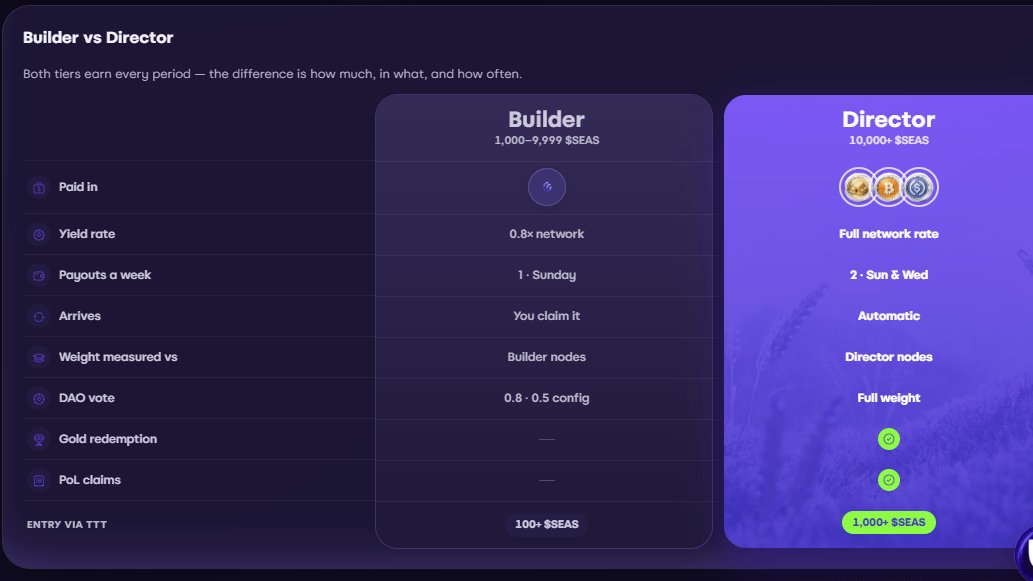
The Builder threshold is 1,000 to 9,999 $SEAS. The Director threshold begins at 10,000 $SEAS.
The Builder Node versus Director Node comparison explains the distinction between those two tiers and their respective payout structures, but there is an important detail that the headline threshold does not show. The amount of $SEAS you need to acquire is not necessarily the same as the amount you need to hold after the transaction.
A 10% transfer fee applies to eligible $SEAS buys and sells, that matters because someone trying to establish a net 1,000 $SEAS Builder position needs to acquire more than 1,000 $SEAS gross.
According to the Seasons fact sheet dated September 4, 2026, roughly 1,112 $SEAS is required to end up with approximately 1,000 $SEAS after the applicable fee and typical slippage assumptions. The same fact sheet puts the Builder entry cost at approximately $260 and the Director entry cost at approximately $2,600 at the stated September 4 prices.
Those dollar figures are not permanent, $SEAS moves in the market, so anyone actually buying the position should verify the live price and execution conditions first.
This is also why the 10% fee needs to be considered on the way out. Someone calculating only the cost of getting into a Builder position and ignoring the applicable exit fee would not be calculating the complete transaction cost. The fee is not a minor detail here, a 10% transfer fee has a much larger effect on the real entry and exit calculation than the gas costs associated with a typical DeFi transaction.

What does a Builder actually earn?
Builders receive 80% of the Network APY, the Seasons materials currently describe the Network APY in a variable range, with the September 2026 running range around 9% to 13%. If that range holds, 80% of it would work out to approximately 7.2% to 10.4% for a Builder.
The broader documented Network APY range is 6.58% to 21.07%, which demonstrates why the yield should not be treated as a fixed return.
Builder rewards are denominated in $SEAS. Rewards are allocated weekly on Sunday and claimed through Seasons Terminal. The rewards do not expire and can be collected in a single transaction according to the Seasons fact sheet, the Director tier is different. Directors receive 100% of Network APY under the current structure, so the two tiers should not be treated as interchangeable.
For anyone who qualifies for Builder rewards and wants to understand the mechanics of putting those rewards back to work, the Seasons guide to using Builder Node yield covers that process.
What if you only have $250?
With $250, you can participate in many pooled DeFi strategies, you can supply supported assets to a lending market or acquire a liquid staking position, subject to the particular network’s transaction costs, liquidity and protocol requirements.
A $250 budget is also approximately in the range of the September 4 Seasons Builder entry estimate. However, the live $SEAS price and the 10% transfer fee mean that $250 should not be treated as a permanent or guaranteed entry price.
You cannot activate your own Ethereum validator with $250 because the 32 ETH requirement alone is far above that amount.
You also cannot realistically evaluate running a production Solana validator purely from a $250 starting balance. The issue is not simply the amount of SOL you can purchase. It is the recurring infrastructure and operating economics, that distinction is the entire point of comparing deposit-level access with operator-level participation.
DeFi yield vs traditional alternatives
Crypto yield also needs to be compared against alternatives outside DeFi.
A Treasury bill, for example, can be purchased with a much smaller amount of capital than an Ethereum validator. The U.S. Treasury’s marketable securities documentation lists a $100 minimum purchase for Treasury bills.
The yield, risk profile, custody model and liquidity characteristics are completely different from a DeFi protocol.
The same applies to a bank savings account. A bank account may offer a lower nominal yield but can provide a different type of protection and a dollar-denominated balance.
This matters because the highest advertised APY is not necessarily the most relevant number.
A 10% crypto yield on a volatile token is not economically equivalent to a 4% yield on a dollar-denominated government security.
Likewise, earning 8% in $SEAS does not guarantee an 8% return in dollars. If the token’s market value falls, the dollar value of the accrued rewards can fall with it.
Yield is only one part of the calculation.
So what is actually the cheapest way to start?
If the question is purely “how much do you need to start earning DeFi yield,” the answer can be only a few dollars, lending markets and pooled staking remove the need to operate infrastructure and allow users to participate with small positions.
If the question is “what is the minimum to earn crypto yield while directly operating an Ethereum validator,” the answer is 32 ETH, which currently represents roughly $78,000 to $82,000 depending on the ETH price used.
If the question is “what is the lowest entry DeFi yield option that gives me a wallet-native node position without physical validator infrastructure,” Seasons’ Builder Node starts at 1,000 $SEAS, with the September 4 fact sheet putting the entry cost at approximately $260.
If you have $10, use a conventional pooled DeFi strategy. If you have around $250 and specifically want a wallet-native node-based yield position without running infrastructure, Seasons Builder is the threshold worth examining.
And that is the part of the 2026 DeFi yield landscape worth paying attention to.
