
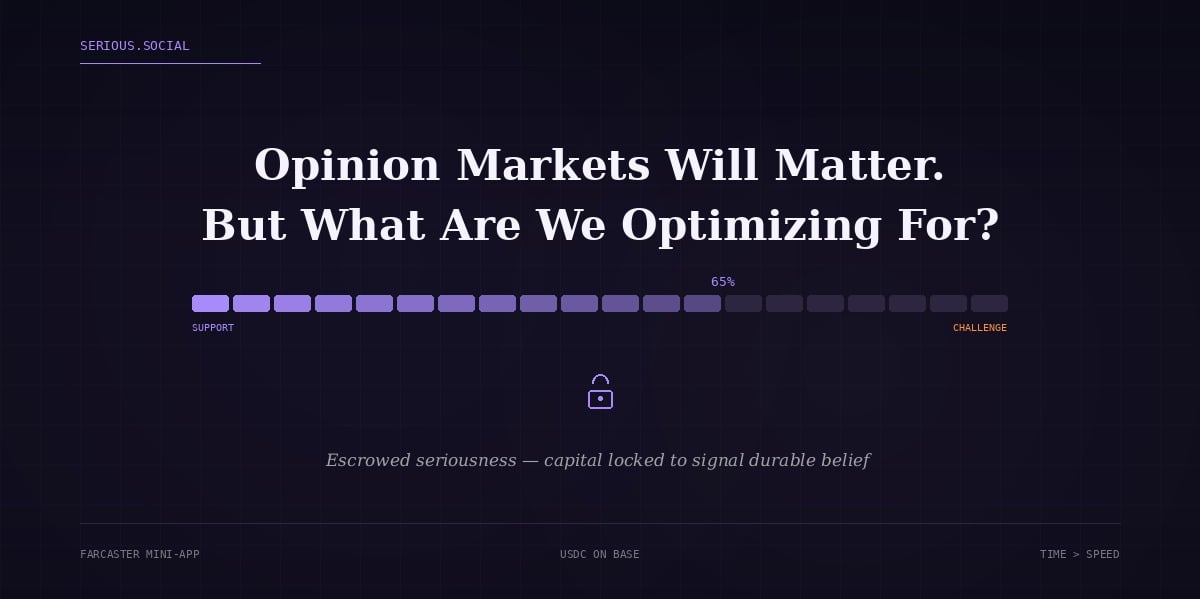
There's a thread forming across crypto-native social right now about "opinion markets." The basic pitch: prediction markets proved that money disciplines belief, but they only work for events that resolve — elections, rate cuts, sports outcomes. Most of the opinions that actually shape discourse don't resolve. They're evaluative, subjective, ongoing. So what if we built markets for those?
I think this is one of the most interesting design spaces in crypto right now. I also think we're about to repeat some familiar mistakes if we're not careful about what exactly we're building and why.
I posted about this on Farcaster recently, and I want to expand on it here, because the nuances matter and they don't fit in a cast.
Alex Mukhin (@alex__mcl) wrote a piece that I think frames the opportunity well. His argument, in short: prediction markets are powerful but they're being asked to do something they weren't designed for. Media doesn't primarily answer "what will happen?" — it answers "what is happening, who believes what, how strongly, and why should I care?" Prediction markets reduce everything to a future binary. Opinion markets, by contrast, could function as a real-time thermometer of collective evaluation.
I agree with most of this. The insight that money should be "the cost of conviction, not the price of attention" is exactly right. And the observation that prediction markets get forced into a media role they can't actually fill — that resonates with something I've been feeling for a while.
The questions that matter most in discourse — Is this person's analysis credible? Is this technology overhyped? Is this narrative honest or manufactured? — don't have resolution dates. You can't build an oracle for "was this a good take." If you try, you end up either with a committee deciding truth or with a market creator who can game their own resolution. Neither is serious.
So yes, I think opinion markets are going to be an important development. Not because they magically surface truth, but because they force people to care a little more about what they say. Money — used carefully — can turn a drive-by take into something closer to a conviction.
That's the part where the conversation gets interesting: what does "used carefully" actually mean?
Around the same time, Confetti put out their rebrand post. They're very clear about their model: opinion markets as a social game. You buy votes on your opinions, rally your friends, and if your side wins, you earn. The earlier you vote with conviction, the more you can earn. Creators get a cut of volume. It's gamified, adversarial, and designed to be fun.
There's nothing incoherent about this. In fact, it's probably the most legible way to get people to engage. Adversarial dynamics create energy. Price curves are intuitive. Winners and losers generate stories. Confetti knows exactly what they're building and they're building it well.
But I keep coming back to a question that I think deserves more attention than it's getting: what happens to discourse when conviction is primarily rewarded through being early and being right?
When the incentive is "vote early, pick the winner, earn," seriousness collapses into a familiar shape: speed, coordination, and capital efficiency. Attention flows toward outcomes that can resolve cleanly and dramatically. Over time, the claims that attract the most capital aren't the most important or most carefully considered — they're the most rally-able. The most memeable. The ones that lend themselves to clear sides and fast resolution.
That's fine for a game. It's less obviously good for long-form thinking, intellectual risk, or unpopular-but-carefully-held beliefs. The person who spends three weeks developing a nuanced position on AI governance doesn't benefit from a system that rewards the person who clicked "yes" fastest on a binary contest.
This is the tension I keep circling: the mechanisms that make opinion markets engaging are often the same mechanisms that make them converge toward the dynamics we were supposedly trying to escape.
I'm building Serious Social. It's a Farcaster mini-app. And the design philosophy starts from a different question than most opinion market projects.
Not "how do we let people earn from their opinions" but "how do we make opinions expensive enough to be meaningful?"
Think about what social media did to expression. It made it free. Costless to post, costless to like, costless to quote-tweet dunk. That was supposed to be liberating, and it was. But it also destroyed signal. When everything is free, nothing is distinguishable. A throwaway hot take looks identical to a deeply held conviction. The loudest voices dominate not because they're right but because volume is free and attention is scarce.
Serious Social introduces something I've been calling "escrowed seriousness." When you stake capital behind a claim, your USDC is locked for 30 days. Not invested. Not earning yield. Just locked — sitting there, being illiquid, proving that you meant what you said badly enough to make your capital unavailable.
You can withdraw early. You're never trapped. But early withdrawal costs a penalty, and your pending rewards are forfeited. The penalty goes into a reward pool for the people who stayed. Patience subsidizes patience. Impatience pays for it.
This is the core primitive, and everything else follows from it.
There's a design heuristic I use for every implementation decision: Does this reward patience and conviction, or speed and cleverness? If it rewards speed, it's probably wrong.
The belief curve in Serious Social — the aggregate signal of where conviction sits on a given claim — is calculated using time-weighted capital, not just capital. A dollar staked for 20 days counts for more than a dollar staked yesterday. You can't flash-stake money, jerk the signal, and leave. The curve is sticky. It requires duration. It accumulates.
Both sides — support and oppose — earn from the same reward pool, proportional to how long their capital has been committed. There is no settlement event. Nobody's principal gets transferred to the other side. You get your money back after the lock period regardless of which side you're on.
This is the part that confuses people who come from prediction market or DeFi backgrounds. Where's the alpha? Where's the edge? Why would anyone do this if they can't win?
The answer is that "winning" is the wrong frame. You're not here to win. You're here to stand behind something, publicly, at a cost. And the fact that you did — that you locked $200 for a month because you actually believed what you said — that's the signal. That's the product.
When someone posts a claim and stakes behind it, anyone else can counter-stake on the opposing side. This shifts the belief curve. It creates tension. Two sides, money on the line, a moving number — it looks a lot like betting.
So I've had to think carefully about what makes this different from a casino.
The answer is in what doesn't happen. There's no resolution. Nobody decides who was right. No principal transfers from losers to winners. Both sides get their money back. Both sides earn proportional rewards for providing durable signal. The point of counter-staking isn't to profit from being right — it's to register disagreement at a cost. When nobody counter-stakes a claim, that's information: nobody thought it was worth five bucks to push back. When someone does, that's also information.
This is what I mean by "bounded adversariality." Enough economic tension to make disagreement meaningful. Never enough to make it feel like someone's getting wrecked.
Confetti's model — and I want to be fair about this, because I think what they're doing is internally consistent — is explicitly adversarial. Winners take from the pool. Losers lose their stake. That's the game, and the energy it produces is real. But I think there's a version of opinion markets that preserves the discipline of money without importing the zero-sum dynamics that, over time, tend to select for speed and coordination over depth and conviction.
It would be irresponsible not to address the obvious question: isn't this just another SocialFi experiment that's going to spike and die?
Friend.tech, Stars Arena, all the creator token projects — they launched, they spiked, the insiders extracted, everyone else held bags. The pattern is relentless.
But I think the failure mode of those projects is instructive. Creator tokens financialize people. You buy shares of a person's social capital. The incentive is pure attention economy: pump the person, attract more buyers, exit before the music stops.
Serious Social financializes claims, not people. You're not buying shares of someone. You're locking capital behind a specific thing they said. If they post ten claims and you think nine are wrong, you can challenge nine and support one. The unit of analysis is the idea, not the individual.
This matters because it decouples the mechanism from the popularity contest. There's no token that goes up when someone gets more followers. There's no secondary market for stakes. There's no way to speculate on a person's future clout. You just commit to a position and wait.
I want to be precise about what I think Serious Social produces, because I'm not claiming it produces truth.
It produces a legible representation of costly conviction. When you look at a belief market and see $12,000 staked on the support side with an average hold of 18 days, and $3,000 on oppose with an average hold of 4 days — that tells you something specific. Not who's right. But who's willing to be illiquid over this, for how long, and at what cost.
That signal is valuable because it's expensive to produce. You can't bot it (minimum stake). You can't game it cheaply (time-weighting dampens flash moves). You can't farm it (rewards have a minimum accrual period before they're claimable). You actually have to commit and wait.
Alex's piece talks about opinion markets as "a continuously updating thermometer of collective meaning." I like that framing. But I'd push it further: the thermometer is only useful if the readings are costly. A thermometer anyone can manipulate by breathing on it isn't measuring anything. The cost of participation is the calibration.
Some things about Serious Social that are going to annoy the DeFi-brained:
No leverage. You can't 10x your stake. Leverage rewards risk tolerance and speed, not conviction. A leveraged belief market becomes a trading venue overnight, and traders crowd out earnest stakers.
Max stake caps. You can't put $100k behind a claim. Whale dominance makes the signal meaningless. If one wallet can move the belief curve alone, it stops representing collective conviction.
Modest returns. The reward pool is funded by entry fees and early withdrawal penalties, not by token emissions or external subsidies. The APY, if you want to think of it that way, is not going to show up on any yield aggregator. Good. That's the filter. If you're here for the yield, you're in the wrong place.
Sliding entry fees. The first staker pays nothing. Fees scale with total capital in the market. This rewards the people who showed up early and unproven, not the people who piled in after consensus formed.
These are not features that optimize for growth. They're features that optimize for signal quality. The entire design is oriented around a single question: is the information this system produces trustworthy? If it is, the rest follows. If it isn't, nothing else matters.
I'm going to be honest: I don't know if this works. The entire thesis rests on a bet — yes, I appreciate the irony — that people will voluntarily lock up capital to prove they mean what they say, and that other humans will find this signal valuable enough to change how they evaluate claims in their feed.
The v0 is deliberately minimal. Binary belief only — support or oppose. One market per post. No governance, no token, no composability promises. Just USDC on Base, a lock period, and a belief curve. The goal isn't to maximize growth. It's to validate one question: Will people pay for seriousness?
If the answer is no, the thesis is wrong and I'll have learned something expensive.
But I keep meeting people — researchers, analysts, writers, founders — who are desperate for some way to distinguish between "I kind of think this" and "I will make my capital illiquid for a month over this." That distinction doesn't exist on any social platform today. Likes don't carry it. Follower counts don't carry it. Even long threads don't carry it, because they're still free to write.
The only thing that carries it is cost. And the only cost that's legible on-chain is capital and time.
I think opinion markets are going to be one of the defining design spaces of the next year. But there's a fork coming, and it's worth being explicit about it now.
One path leads to opinion markets as social games — gamified, adversarial, optimized for engagement and virality. Confetti is building this. Others will follow. It will be popular. It will generate volume. Some version of it will probably work.
The other path leads to opinion markets as infrastructure for serious discourse — non-zero-sum, time-weighted, optimized for signal quality over engagement metrics. This is where Serious Social sits. It will be less popular. It will generate less volume. It might not work at all.
But if it does work, the thing it produces — a durable, legible, costly signal of what people actually believe — is something that doesn't exist anywhere right now. Not on social media, not in prediction markets, not in polling, not in any mechanism I'm aware of.
I'm not here to argue that Confetti's approach is wrong. I think there's room for both. What I do want to argue is that the choice between these models isn't just a product decision — it's a statement about what we think discourse should be. Whether we want louder discourse or better discourse. Whether money in social contexts should be a game mechanic or a commitment device.
I've made my choice. I think we need more systems that surface commitment, not correctness. More systems where time beats speed. More systems where the most interesting signal isn't who moved fastest, but who stayed longest.
That's escrowed seriousness. That's what I'm building. And if you disagree, I'd love to see you put some capital behind it.