
Where you sleep in Mexico City matters more than you think. The city is huge: 1,485 square kilometers inside the city limits, around 22 million people across the metro area, and you cannot easily commute across it. Pick the wrong neighborhood and you'll spend an hour in traffic to get to dinner. Pick a good one and the rest of the city opens up around you. Some neighborhoods will suit you better than others depending on what you came for, and the rest of this is about figuring out which one.
Here's how to think about your base. I'm assuming you're here for the World Cup, you'll be in town for at least a week, and you want to see more than the stadium.
A note before the list. None of these neighborhoods is "the real Mexico City." That's a phrase tourist marketing made up. The city is a federation of villages stitched together over centuries, and every neighborhood is real in its own way. The question is which version of the city you want to wake up in for the next ten days.
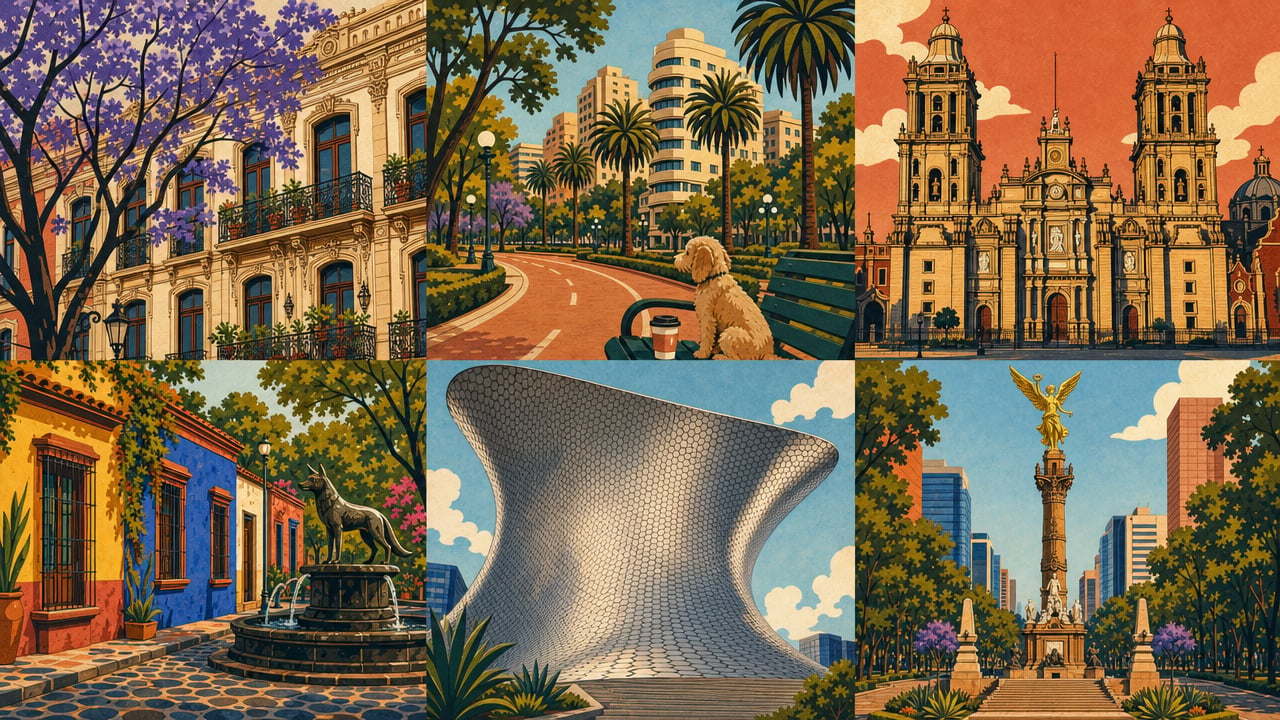
If this is your first trip and you have no specific reason to be somewhere else, stay in Roma Norte. Tree-lined streets in the "Porfiriato" style, with early-1900s mansions and art-deco apartment buildings, sit next to coffee bars, natural-wine restaurants, "taquerías", and bookstores. It's safe to walk at midnight. Three metro stations sit on its edges. English shows up on enough menus to lower the stress of week one without flattening the experience.
What fills the streets: Plaza Río de Janeiro with its 8-meter David replica, the OMR and Kurimanzutto-adjacent gallery scene, Cine Tonalá for late films and mezcal, the Sunday "tianguis" on Cibeles, the Mercado Roma food hall, and Librería Pendulo on Álvaro Obregón. The restaurants people fly in for — Rosetta, Máximo Bistrot, Meroma, Lardo, Contramar a few blocks west — all live within a 15-minute walk. The bars are the same story: Licorería Limantour on Álvaro Obregón has been in the World's 50 Best list for a decade, and Hanky Panky still pretends to be a secret.
The honest part. Roma Norte has gentrified hard since 2020. Remote workers and short-term rentals have pushed rents up year over year, and the families who gave the neighborhood its character have been moving out to make room for the cafés you're going to like. The graffiti on the walls a block from those cafés — "gringo go home", "fuera Airbnb", "esta no es tu casa" — is not aimed at any one traveler, but it is a real grievance and you should know the conversation you're walking into. Be a good guest: tip in cash, learn enough Spanish to greet the doorman and the "fondera", and "no te hagas el occiso" — don't play dumb about why a one-bedroom now costs what it costs.
The neighborhood next door, half a degree quieter, and built for a different kind of day. Two parks anchor it: Parque México, where the city's dogs and their humans gather at 7am and 8pm, and the smaller Parque España. Avenida Amsterdam loops in a perfect oval because it was a horse-racing track a century ago, and joggers still trace its shape every morning. The buildings are art-deco rounded corners and old palm trees that survived the 1985 earthquake.
What fills the streets: the Sunday "tianguis" on Pacífico, Pan Comido and Maque for breakfast, Merotoro and Azul Condesa for dinner, Baltra and Felina for late drinks, and a quiet density of pet stores, yoga studios, and independent cinemas (Cinema Olimpia, Foro Shakespeare for plays). Less restaurant churn than Roma, which means easier reservations and older waiters who remember their regulars. The Mercado Michoacán handles the produce side.
Roma Norte buzzes harder, Condesa pulls you out for walks. Either one puts you twenty minutes from Centro by metro and about an hour from Estadio Azteca by Tren Ligero.
Same gentrification story as Roma, a few years deeper. The "vecindades" that filled these blocks are mostly gone, and the families who stayed are watching the rent climb around them. You'll see the same graffiti and hear the same conversations. Same advice: tip in cash, speak the language you can, and "agárrale el modo" to the neighborhood before you decide what it is.
This is where the city started, and where the country's center of gravity has lived since 1521. Templo Mayor, the Catedral Metropolitana built on top of an Aztec ceremonial precinct, the Zócalo where the FIFA Fan Festival lives from June 11 to July 19. The Palacio Nacional on the Zócalo's east side houses Diego Rivera's most ambitious murals — go in the morning, the line builds by noon. The Palacio de Bellas Artes sits at the northwestern edge with Rivera, Orozco, and Siqueiros on its upper floors.
What fills the streets: Calle Madero, the pedestrian spine that connects Bellas Artes to the Zócalo, full of "neverías", street performers, and the original Sanborns Casa de los Azulejos. Calle de Donceles for used bookshops two stories deep. Plaza Garibaldi for mariachi after 9pm and the Museo del Tequila y el Mezcal next door. Mercado de San Juan for ingredients you won't see again — "escamoles", "gusanos", "huitlacoche", whole boar. The cantinas are the city's oldest: La Ópera on Cinco de Mayo (1876, the bullet hole in the ceiling is Pancho Villa's), Salón Tenampa on Garibaldi (1925), and Bar La Faena for the bullfighting murals.
Centro is louder than Roma or Condesa during the day — church bells, organ grinders, taxi horns — and quieter than you'd expect after 9pm, when the office crowd thins and some streets feel emptier than they should. The new wave of Roma-style restaurants hasn't fully arrived here. You'll eat at "fondas" that close at 6pm and "cantinas" that have been pouring since the 1930s, which depending on what you want is either a feature or a bug.
The hotel scene has had a quiet renaissance in the last five years. Círculo Mexicano, Umbral, and Downtown sit inside restored colonial buildings and run cheaper than their Roma equivalents. Centro rewards travelers who like a city to be a city.
Twelve kilometers south of Centro, and a different speed. Coyoacán was a separate town until the city sprawled to meet it in the twentieth century, and it still feels like one. Cobblestone streets, two old plazas — Jardín Centenario with the bronze coyote fountain, Plaza Hidalgo with the parish church — and a market that's been running since 1921.
What fills the streets: the Casa Azul where Frida Kahlo lived and painted (book the ticket two weeks ahead), the Museo Casa de León Trotsky four blocks away with the bullet holes still in the walls, the Museo Diego Rivera Anahuacalli at the southern edge in a black-stone pyramid Rivera designed for his pre-Hispanic collection. The Mercado de Coyoacán is famous for "tostadas" — Tostadas Coyoacán inside the market has a queue at 1pm every day. Café Avellaneda turns out some of the best espresso in the city out of a 4-meter-wide storefront. Los Danzantes on Jardín Centenario for mezcal and a long lunch, La Bipo for late nights. Viveros de Coyoacán is the nursery-turned-park where the rest of the city comes to jog among the cypress trees.
People who stay here tend to stay longer. They cook at home, read in the park, walk to the market for breakfast. The pace is slower, the air feels cleaner (it isn't, but the trees help), and it costs less. The trade-off is the commute. You're forty minutes from Roma by Uber on a good day and over an hour at rush hour. The metro reaches Coyoacán but the closest station sits a fifteen-minute walk from the cobblestone center.
Honest read: stay here if you want a quiet week of writing, eating, and Frida Kahlo, and you don't mind that nightlife means a 9pm dinner instead of a 1am cocktail. If you came for the matches, base yourself further north.
Where the city keeps its embassies, its luxury hotels, its top-end restaurants, and the museums that don't fit anywhere else. The Museo Soumaya's silver wing looks like a piece of crumpled foil and houses Carlos Slim's Rodin collection (free entry, six floors). Next door, the Museo Jumex shows contemporary work in a Chipperfield-designed concrete box. The Acuario Inbursa sits in the same complex if you're traveling with kids.
What fills the streets: Avenida Presidente Masaryk, the luxury shopping spine where Hermès, Cartier, Louis Vuitton, and Tiffany sit in a row that locals call "el Rodeo Drive chilango", though no "chilango" who lives there says that out loud. Pujol, Quintonil, and Anatol — three of the most Michelin-starred kitchens in the country — sit within a kilometer of each other off Tennyson and Aristóteles. Parque Lincoln has a clock tower and a duck pond and feels like Madrid on purpose. The southern edge of the neighborhood opens onto Bosque de Chapultepec, and the Museo Nacional de Antropología sits a 15-minute walk away on the park's other side.
Polanco works if you're traveling on an expense account and want to be inside a known frame. The St. Regis, the Four Seasons, Las Alcobas, Pug Seal — all the big names sit on Masaryk. It's safe and well-served by Metro Line 7.
What it's not: a representative slice of Mexico City. You can stay here for ten days and barely interact with the city the rest of us live in. Some travelers want exactly that and there's no shame in it. Others find they spent a fortune on a neighborhood that could have been Madrid.
Between Roma and Centro, anchored on Paseo de la Reforma. The Angel of Independence and the Diana Cazadora sit on Reforma roundabouts a few blocks apart — the Angel is where the city gathers when the national team wins anything, so plan to be near it on June 11 even if you don't sleep here.
What fills the streets: Niddo for breakfast (the best "chilaquiles" in this part of the city, and they know it), Casa Pani for natural wine, Maximo Bistrot's second location, and the Mercado Cuauhtémoc food hall for "tortas" and "aguachiles". Juárez has been quietly becoming the next Roma for five years now — design hotels (Brick, Hotel Carlota), queer-owned wine bars, the kind of coffee shop with a single grinder and a hand-written menu. Zona Rosa, inside Juárez, is the city's main LGBTQ+ neighborhood and has been since the 1970s; it's also the city's Koreatown, with Korean BBQ and karaoke "norebangs" on Calle Hamburgo and Florencia.
If you want easy walks to both Reforma's monuments and Roma's restaurants, Juárez is geographically perfect. The streets get rougher at the eastern edge near Insurgentes, which is also where most of the nightlife lives. Stay west of Insurgentes if you want quieter mornings.
Estadio Azteca sits in the south of the city, about an hour by Tren Ligero from anywhere central. Where you sleep doesn't change that math much. Roma, Condesa, Centro, Juárez: all of them route you to Tasqueña station the same way. Coyoacán is fifteen minutes closer to the stadium but the rest of the city is further. Polanco is the slowest match-day commute of the bunch.
The post on getting to Azteca on match day is coming this week. The short version: take the Tren Ligero, leave earlier than you think, and don't drive.
If you want one answer: Roma Norte for a first trip, Condesa if you want the same with less noise. They're the best balance of food, transit, safety, walkability, and proximity to everything else worth doing. They're also where the gentrification conversation is loudest, which is part of the trade and worth carrying with you.
Centro if history is the reason you came. Coyoacán if you want a quiet week and don't mind the commute. Polanco if someone else is paying. Juárez if you want what Roma will be in three years and can handle a slightly rougher edge for it.
Wherever you land, walk the neighborhood your first morning. There's a saying "chilangos" pull out when somebody hesitates before getting started on something: "a darle, que es mole de olla" — get on with it, the soup's getting cold. Pick a "fonda" for lunch, find a café you want to come back to, and figure out which corner has the taco "trompo" turning at night. The apartment search is done in five blocks.
Tomorrow: the metro is your friend, and the "micros" are not, yet.