
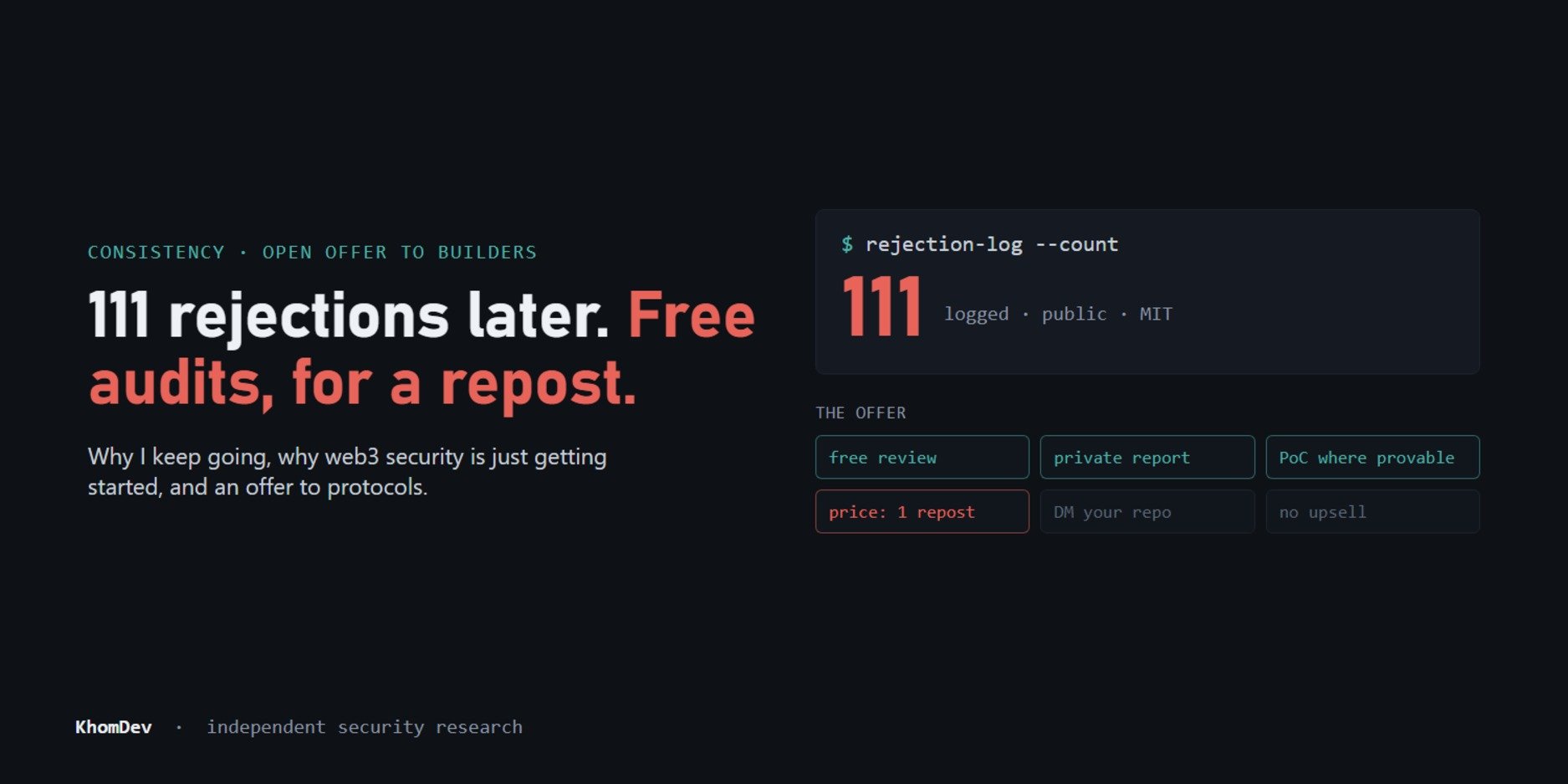
Most security write-ups you read are about wins: the critical, the payout, the clever exploit chain. I write about those when I have them. But the most important number on my desk is not my payouts. It is the length of my rejection log.
111 rejected reports. Each one is classified by the earliest point at which I could have caught my own mistake. The whole dataset is public, MIT-licensed and reproducible. It includes the duplicates, the out-of-scope closes, the findings that were real but paid nothing, and the one report I am least proud of: the one where the impact I claimed was not real.
Next to it sits a smaller number I am proud of: 18 findings accepted and marked paid on my platform profile, 2 of them High.
And next to that sits the number that keeps me honest. When I started publishing this work, my total earnings were two cents. One High-severity finding was split across 61 reporters, and three more were confirmed valid and paid nothing because the program had no payout tier at that severity.
If you only look at the ratios, it looks bad. I think the ratios are the wrong way to look at it, and this article is about why.
Motivation is what you feel on day one. Consistency is what you do on day forty, when the last six reports came back as duplicates and the program you spent a week on turned out to have its contracts undeployed.
Here is what consistency has looked like for me in practice. It is less inspiring than a quote on a sunset background, and much more useful:
I write down every failure, the same way, every time. Not "got a dupe, oh well" but a structured row: what I submitted, why it was closed and the earliest gate that would have caught it. After about thirty rows, patterns appear that no amount of reflection would have shown. After a hundred, the patterns become tools. More than half of my rejections were answerable from a public record, the program's own pages, audits or tests, before I read a single line of code. I would never have believed that number if I had not counted it.
I turn every pattern into a check, and every check into code. A lesson I have to remember is a lesson I will forget at 2 a.m. A lesson that blocks my own tooling from marking a report ready cannot be forgotten. The deployed-state gate exists because of a duplicate, the realism gate because of three findings that were real but unpayable, and the archive gate because program pages change while reports sit in review.
I publish the process, not just the results. Writing an article a week forces me to understand my own methods well enough to explain them. Every article so far has made my process better, usually because writing it exposed a gap. Some of my published numbers turned out to be wrong when I recomputed them, and I corrected them in public. That hurt, and it was worth it.
I show up when it is boring. Most days in this work are reading. Reading code, reading audit reports, reading program rules, reading my own logs. No dopamine, no leaderboard movement. The days that produce a finding are built on the days that did not.
None of this is talent. It is repetition with a feedback loop. Anyone reading this can do it, starting today, with a spreadsheet.
I am betting years of my life on this industry, so here is the honest version of why.
Value keeps moving on chain, and the code holding it keeps getting more complex. Lending markets, vaults, bridges, intent systems, restaking layers, cross-chain messaging: each one composes with the others. Every new composition is a new set of assumptions about how the other side behaves. Security bugs live in those assumptions. The attack surface is not shrinking. It is compounding.
The tooling is getting better on both sides. AI-assisted auditing is real. I use it every day, with a lot of guardrails, and it makes me faster. But faster tools for defenders are also faster tools for attackers. The researcher who understands why a finding is real, under real conditions with a real attacker, becomes more valuable as the volume of machine-generated noise grows, not less.
The economics are still being invented. Bug bounties, audit contests, retainer reviews, on-chain insurance and security councils are all young. The norms on what to pay for, how to judge severity and how to settle disputes are still forming. Researchers who document their work in public get to shape those norms. That is a rare opportunity in any industry, and it will not stay open forever.
Trust is the actual product. Every protocol is ultimately asking users to trust code with their money. Security researchers are part of how that trust gets earned honestly. I find that worth doing, beyond the payouts.
I do not know which protocols will be around in five years. I am fairly sure the need for people who can read hostile code carefully will be.
Here is the part where I put my time where my mouth is.
I am offering free security reviews of smart contract code to protocols and builders. The only thing I ask in return is a repost of this article or my announcement post, so more builders see it.
What you get:
A manual review by me, an independent security researcher, focused on the contracts you point me at. I hunt for the bugs that cost money: access control, accounting and share math, oracle and price handling, reentrancy and external-call assumptions, upgrade and initialisation paths, and economic edge cases.
A private written report: each issue with its root cause, an attack path, the impact and a recommended fix. A proof of concept where I can prove one locally.
Private disclosure only. Findings go to you and nowhere else. Nothing about your code gets published without your permission, before or after a fix.
What I ask:
A repost of this article or my announcement post on X.
A scope I can actually cover: point me at the contracts that hold or move value. If a codebase is too large for a free pass, I will tell you upfront and propose what to focus on.
Patience. I review requests in the order they arrive, around my existing work, and I will give you a realistic date before I start.
What this is not:
Not a guarantee. No review, paid or free, proves the absence of bugs. A clean report means I did not find anything in the time I spent, nothing more.
Not a replacement for a full audit if you are about to hold serious value. It is a strong second pair of eyes, and I will tell you honestly if I think you need more.
Not a sales funnel. There is no paid tier waiting at the end. If you want more work later, ask, but the free review stands on its own.
How to apply: send me a DM on X with a link to your repository (or the commit you want reviewed), a sentence about what the protocol does and which contracts matter most. Then repost. That is the whole process.
Three reasons, and I would rather be upfront about all of them.
It is the most direct way to help. Plenty of small teams ship contracts with no review because an audit costs more than their runway. Those are exactly the contracts that get drained, and the money lost is usually users' money, not the team's.
It makes me better. Every new codebase is a new set of assumptions to break. Reviewing code nobody else is looking at is where I learn the most.
It builds the thing I am actually trying to build: a public track record. I want my name to mean "careful, honest, shows the work". The rejection log, the articles, the open tools and these reviews are all the same project.
If you are new to security research and reading this, here is the shortest version of everything above:
Keep a log of every report, and above all every rejection, in a structured format.
Every ten rows, look for a pattern. Turn each pattern into a check you run before you hunt.
Write about what you learn, in public, and correct yourself in public when you are wrong.
Show up on the boring days.
That is it. That is the whole secret, and it is not a secret.
The log is long because I kept going. That is the only reason it is long.