
Most wasted bug-bounty effort is not spent on hard bugs.
It's spent on findings that were dead on arrival — excluded bug classes, privileged-role preconditions, payout floors, duplicates — all knowable before anyone opens an editor.
I logged 97 of my own rejections and mapped each to the check that should have stopped me. 73% were catchable before reading a line of code. The other 26 needed the finding in hand first, and they're what this catalogue is for.
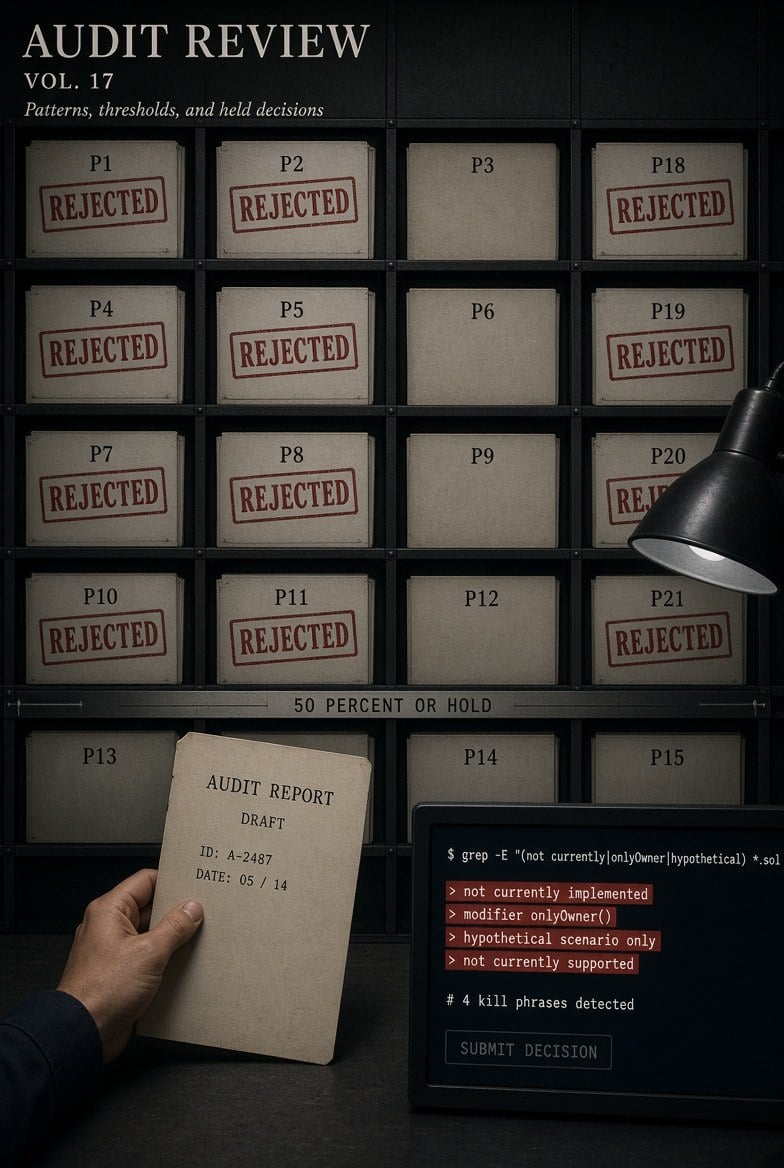
≥50% estimated payout odds to submit. Below 50% — hold in notes, do not submit.
A rejected submission is not neutral. It costs hunt time, PoC time, and platform standing. On platforms where reputation gates how many findings you may submit, a bad submission costs you future submissions.
The catalogue below is a prioritiser, not a kill-switch. Over-filtering is its own failure mode — some of the best findings look wrong at first pass.
P1 — Admitted non-exploit. Your own report says the attack "currently blocks" or "would become exploitable if". Grep: not currently, currently blocks, would become, hypothetical, if the protocol. If "exploitable" appears within three lines, hard fail.
P6 — Theoretical future-upgrade framing at Critical. "Current protection is accidental" / "fragile coupling" used to argue Critical while conceding it doesn't work today. File at the severity matching current impact.
P12 — Read-only panic without fund impact. A view function that reverts degrades UX. No state mutation, no fund loss. Informational at most, unless you can show the revert forces downstream accounting to skip.
P13 — "Inconsistent state" without a quantified fund-flow delta. Show the number. Before and after, in units.
P17 — No attacker-win. Self-harm, no net-positive economics, no extraction path. The most common form: the victim chose the action. Escape: name a third party who didn't.
P2 — Privileged-role-gated against a contest exclusion. Does it need onlyOwner, an admin capability, an operator role? Then grep the scope page for "centralization risks", "privileged addresses", "human-based errors". One match → hard fail.
P3 — Front-run-only or operator-delay. Requires winning a mempool race, or an operator failing to act in a window. Excluded by virtually every program. Exception: if the attack is atomic in one transaction (flash loan, composed legos), the exclusion doesn't apply. Reframe around the atomic path.
P5 — Out-of-scope file primitive. The root cause lives outside sources/ — a deploy script, a test utility, a config file. Trace the root cause, not the impact site.
P11 — Testnet-only finding at Critical. Mainnet deploys differently. Testnet-only means no mainnet funds at risk.
P20 — Requires a cooperating party. An LP exit during your flash loan, a counterparty choosing to misbehave. No solo attacker path.
P7 — Best-practice critique. Style, gas, convention. Named as out-of-scope by most programs in almost those words.
P16 — Severity mismatch with the payout floor. See the payout-floor piece. A Medium on a Critical-only program is worth zero.
P18 — Known characteristic documented in a prior audit. Check the prior-audit surface. And check the project's own known-issues list.
P21 — Realistic-configuration mismatch. The bug is real but has no bound at the deployed configuration. Reachable only when a parameter is set to a value the deployment never uses.
P22 — Primitive-vs-product confusion. You found a real primitive. There's no deployed consumer of it. No permissionless path to the impact.
P15 — Intended behaviour asserted in the project's own test suite. Grep the target's tests for the behaviour before reporting it. A test asserting the behaviour is a strong signal it's by design.
P18 / P19 — covered above and below.
P4 — Defective PoC. Four flavours, all fatal:
Tautology:
assert!(x >= 0)on an unsigned type.Simulator: importing a mock instead of the real in-scope contract.
No failing assertion: the test passes but nothing captures the harmful state delta.
Unverifiable path: line numbers that don't resolve against a fresh clone.
P8 — Self-contradicting severity or impact sections. Your mitigation section contradicts your impact section. Your concession admits the precondition isn't met. Read your own report as an adversary.
P9 — Wrong line numbers / unverified paths. Always re-verify against a fresh clone at the exact commit.
P10 — Hypothetical TVL-scaling tables. Projected impact at TVL the protocol doesn't have.
P14 — Triager-simulation tables embedded in the report. Arguing with the triager before they've triaged.
P19 — Headline impact contradicted by PoC evidence. The SPAM line. Your title says "permanent fund lock"; your PoC shows a revert. A revert rolls back state. This is the one category where the punishment is worse than rejection.
P22 — see Group C.
Before writing anything:
Read the known-issues section and every linked prior audit. Kill if present.
Point to the exact line on the program page naming your impact type.
Name the capability the attacker gains that they provably did not have. No delta → no finding.
Trace the corrupted value to a transfer, a mint, a debt computation, or a liquidation threshold. Ends at a getter or an event → QA everywhere.
Who is damaged who did not choose the action? "The person who did it" → drop it.
State the loss twice: percent of position, and dollars.
Which constant in this codebase caps my claimed damage? What's the victim's cheapest workaround? One transaction → inconvenience.
Does any step need a third party to fail? Oracle, sequencer, reorg, depeg → kill.
Strip every harness primitive. Can the attacker reach the trigger state by ordinary transaction submission?
Write the one-line fix. If the protocol wouldn't accept it, you found a tradeoff, not a bug.
At the least generous defensible severity, what is this? Submit there and argue upward.
Step 11 matters more than it looks. Over-claiming is actively penalised on some platforms — a clearly inflated severity can make the whole submission ineligible, not merely downgraded.
A checklist you read once is a checklist you stop using. So I built viability-gate: the catalogue as YAML, run against a draft finding, offline and deterministic.
bash
cargo install --path .
vg check finding.md
Code block
viability-gate 0.1.0  —  finding.md

  VERDICT   KILL   (0% estimated payout odds, threshold 50%)

  HARD  P2   Privileged-role-gated against a program exclusion
             ↳ An admin can set the pause flag to zero, which causes every vault
             → Check whether an unprivileged attacker can trigger the bug without
             → role compromise. If not: hold. The one escape is UNKNOWING admin
             → harm - a reasonable admin action with a non-obvious destructive
             → second-order effect.
             (KNOWLEDGE/57 P2)

  HARD  P19  Headline impact contradicted by PoC evidence (SPAM line)
             ↳ # Critical: Permanent Fund Lock via Admin Pause Panic
             → Reframe the title to match EXACTLY what the PoC proves, or rebuild
             → the PoC to demonstrate the claimed impact.
             (KNOWLEDGE/57 P19)

  PASS  P1, P6, P12, P13, P3, P5, P11, P20, P7, P16, P18, P21, P22, P15, P4, P9, P8, P10, P14, P17
  SKIP  G1 (no ledger supplied)   G2 (no ledger supplied)   G3 (no scope tree supplied)

  Gates:  G1 ?   G2 ?   G3 ?   G4 ?   G5 ?   G6 ?
Note the SKIP line. If you didn't supply a scope tree, gate 3 reports ?, not ✓. Unknown is not pass. A gate you can't run is a gate you haven't run.
The catalogue is YAML. Each rule declares regex patterns, a verdict, a weight, a fix and the doctrine it came from:
yaml
- id: P17
  title: No attacker-win scenario
  group: E
  verdict: soft        # hard = KILL, soft = HOLD, warn = note only
  weight: 30           # subtracted from the 100-point viability estimate
  any_of: ["no (fund loss|attacker profit|extraction)"]
  none_of: ["attacker (profits?|gains?) \\d"]   # escape hatch suppresses the rule
  fix: "Identify the beneficiary and quantify the loss, or downgrade."
  doctrine: "KNOWLEDGE/57 P17"
That means you can argue with it, and you can extend it. PRs adding a rule with a cited example are welcome.
Every rule has a positive fixture that must trigger it and a negative fixture that must not. A rule with no positive case is dead weight; a rule that over-fires buries real findings, which is its own failure mode.
Writing those fixtures found two real calibration bugs:
P18 over-fired on negated statements. "No prior audit covers this module" contains the phrase "prior audit" — so the rule fired on exactly the findings it should have passed. The negation is the signal that the surface is new. Fixed with an explicit none_of guard.
P22's escape hatch suppressed its own positive case. The rule fires on "no deployed instance exists", but its suppression pattern matched "deployed instance" — which appears inside that same sentence. The escape hatch was written to mean "positive evidence of deployment", so it now requires an assertion that a deployment exists rather than a bare mention.
Both are regression-tested. This is why the fixtures exist: neither bug is visible by reading the rules, and both would have made the tool quietly worse than useless.
It ships rules, not data. No program names, no chains, no reward tables. You point it at your own private ledger. Nothing is uploaded, cached, or reported — the tool has no network code at all, and CI asserts that on every push.
It fails closed on missing input. Supply nothing and it tells you nothing passed.
It says HOLD, not KILL. HOLD is the expected output for most drafts. That's the point.
Hard fails force KILL regardless of the score. A hard fail is a structural rejection, not a risk you can average away.
Over-filtering is a documented failure mode. The catalogue is a prioritiser. A triage rejection is not a final verdict — in the source material behind this, two of the author's first-pass closures were later reversed to confirmed findings in final judging.
Platform rules are not interchangeable and are versioned. The same temporary freeze can be a High on one platform and invalid on another. A write-up older than about eighteen months is folklore, not rule.
The catalogue reflects one researcher's log, not a survey. n = 97.
It cannot read your target's live rules. You supply those.
The weights are priors, not measurements. They produce a ranking, not a probability.
MIT licensed. Rules are data, not code — PRs adding a rule with a cited example are welcome.