
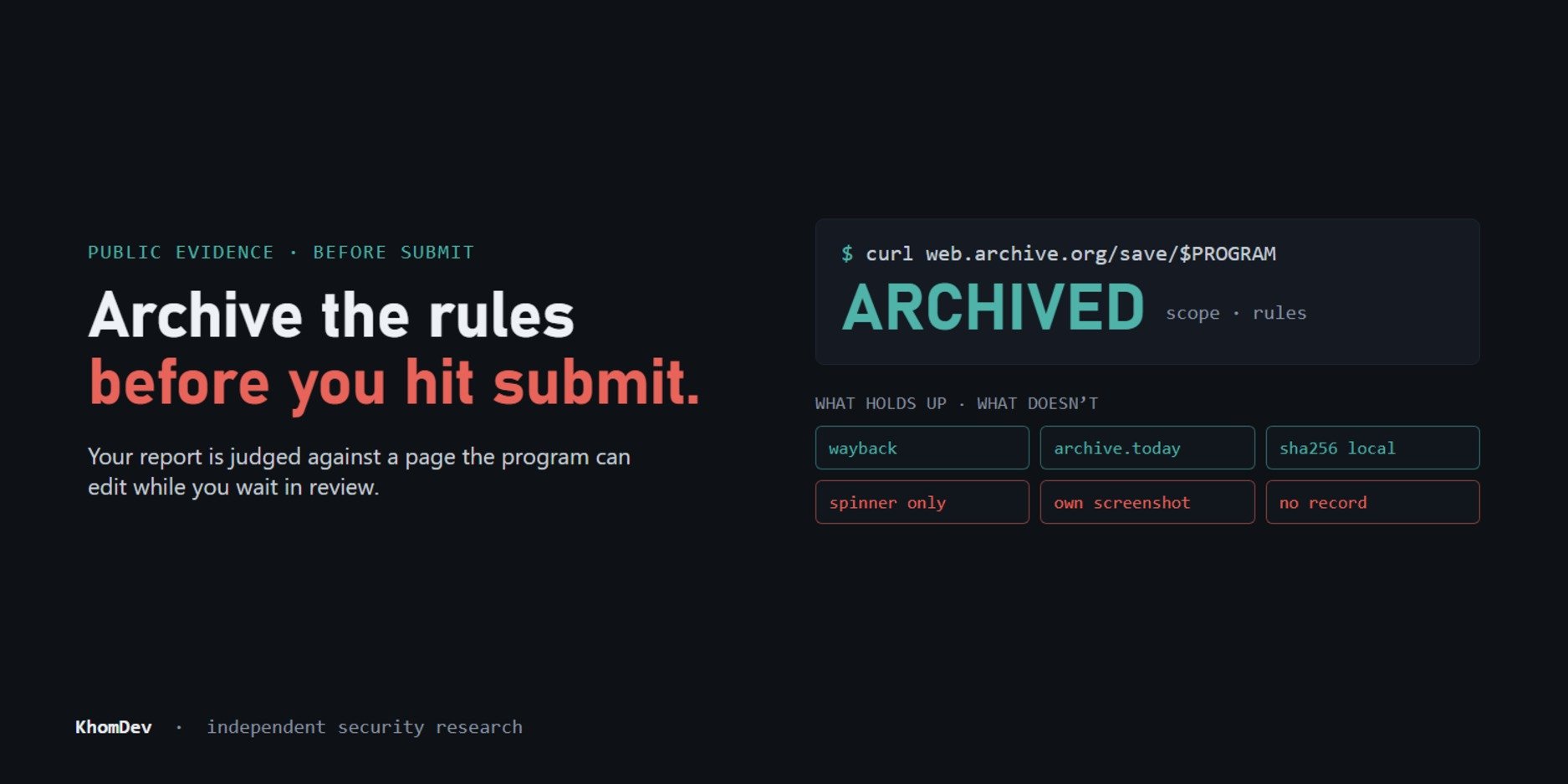
There is a bug bounty tip that gets passed around in hunter circles, usually with the words "learned the hard way" attached:
When you submit a report, save a Wayback Machine snapshot or similar public evidence of the program page. A program can sit on your report, add "out of scope" rules in the meantime, and close it against the new text. You need evidence to flip it.
The first time I read it, I nodded and did nothing. A week later I read it again and turned it into code: no finding of mine can now reach "ready for review" without an archived, timestamped copy of the program page as it stood at submission time.
This article covers why that gate exists, what it checks, how to take a snapshot that actually holds up, and what a snapshot cannot do for you.
When you submit a report, three documents decide its fate:
The scope list. Which assets, contracts, repositories and versions are covered.
The exclusion list. Which classes of issue are not paid, no matter how real.
The severity table. Which impact earns which tier, often in very specific words.
All three usually live on one web page that the program controls and can edit at any time. Your report, meanwhile, waits in a queue. Review windows of days are normal, weeks are common, and longer is not rare.
That leaves a gap. Your report was written against version A of the page. It is triaged against whatever the page says on the day someone opens it. Most of the time A and B are the same and none of this matters. But when they differ, the difference almost never runs in your favour. Pages gain exclusions over time: a new "known issues" entry, a new "out of scope: issues requiring X" bullet, a narrowed asset list after a migration.
None of this needs bad faith. Programs update pages for good reasons, often because of reports like yours. The result is the same either way. If your report gets closed as out of scope, and you believe it was in scope when you filed it, you are now in an argument. In that argument, "I'm sure it said that" carries no weight. A timestamped copy that a third party captured does.
My submission tooling refuses to mark a finding ready until at least one public-evidence record exists, and every record has to pass all of these:
PUBLIC-EVIDENCE GATE                                   [fail-closed]

  [ ] Source URL is an http(s) program page
  [ ] Snapshot lives on a recognised public archive
        web.archive.org · archive.today (archive.ph / .is / .li / .md / .vn)
        perma.cc · IPFS gateways · arweave.net
  [ ] Capture time is no later than the moment the record was written
  [ ] For Wayback: the 14-digit timestamp in the snapshot URL agrees
      with the recorded capture time (within a day)
  [ ] The archived bytes are saved locally and hash to the recorded SHA-256
Each line closes a specific hole I found in my own process.
Recognised public archives only. A screenshot in my own folder proves nothing to a triager: I could have edited it. What gives a snapshot its weight is that a third party captured it and stamped it with a time I do not control. So a self-hosted copy fails, and an archive service I have never heard of fails.
Capture time no later than the record. A snapshot cannot have been captured after the record that cites it was written. That ordering is the one fact the record can prove about itself, and it does not change as the clock moves, so a certified assessment never goes stale just because time passed.
The Wayback timestamp must agree. Wayback encodes the capture instant in the URL itself: /web/20261022101500/https://.... If the URL says one date and my record claims another, someone (probably me, tired) has pasted an old capture into a new report. An old capture proves what the page said then, not what it said when I submitted, and that is exactly the wrong evidence for this argument.
Local bytes plus a hash. Archives are not forever. Captures can be excluded later at a site owner's request, and services go down. I keep the archived page's bytes in my workspace with a SHA-256 next to the record, so the evidence survives even if the public copy does not. The public URL proves when, and the local bytes prove what.
No record blocks. The gate is fail-closed. Every draft starts without a snapshot, and "I didn't take one" must never read as "there was nothing to take".
The mechanics take two minutes. The checking afterwards is the part people skip.
PAGE="https://<platform>/programs/<program>"

# Wayback Machine: Save Page Now
curl -s -o /dev/null -w "%{http_code} %{redirect_url}\n" \
  "https://web.archive.org/save/$PAGE"

# Confirm the capture exists and get its timestamped URL
curl -s "https://archive.org/wayback/available?url=$PAGE" | jq .archived_snapshots.closest
Then capture the same page on archive.today through its web form. Two archives cost one extra minute and remove a single point of failure.
This is the step that matters. Many program pages are rendered client-side. An archive that stores the raw HTML of a single-page app can show you a perfect capture of a loading spinner, with the scope table nowhere in it.
Open the snapshot. Search it for:
one in-scope asset you rely on, word for word;
the exclusion bullet closest to your finding (to show it does not cover you);
the severity bullet you are claiming, word for word.
If any of the three is missing from the snapshot, the snapshot does not prove your case, however official it looks. Try the other archive. Archive services differ in how they render scripts, so one that failed may be beaten by the other.
The severity table is sometimes a separate page, and so is the known-issues list. Scope can live in a linked document or in a repository file at a commit. Capture each page your argument leans on. For a repository, a link to the exact commit is already immutable: record the commit hash, not the branch.
url: "https://<platform>/programs/<program>"
archive_service: wayback
snapshot_url: "https://web.archive.org/web/20261022101500/https://<platform>/programs/<program>"
captured_at: "2026-10-22T10:15:00Z"
evidence_source: evidence/program-page-20261022.html
evidence_hash: "<sha256 of that file>"
rationale: Scope table lists the vault module; exclusions do not mention the issue class; severity bullet for High quoted in the report.
The rationale line is for future me. Six weeks from now I will not remember why this page mattered, and the line tells me which three sentences to point at.
The submission snapshot proves what the rules said when the report went in. A snapshot taken when you start hunting proves what they said when you chose to spend your week there. If scope narrows mid-hunt, you want to know before you write the report, not after triage tells you.
Because it is a habit that only pays off in the rare case, and habits that rarely pay off decay.
Almost every time, nobody ever looks at the snapshot. The report gets triaged against the same page it was written against, and the snapshot sits in a folder. That is precisely why it gets skipped on the day it would have mattered: the day the report was finished at 2 a.m. and the submit button was right there.
A gate does not get tired. The tooling refuses to call a finding ready without the record, so the snapshot gets taken on the boring days too. That is the only way to have one on the interesting day.
It also cost almost nothing to add. My submission authority already required evidence files with hashes for deployed-state reads: an address, a block, a value, a file and its SHA-256. Program-page evidence is the same shape: a URL, a time, a file and its SHA-256. One new table, one new check, the same verification floor underneath.
It can:
turn "the rules changed after I submitted" from a claim into a document;
show exactly which words were on the page at filing time, so the conversation is about the words and not about your memory;
give a platform mediator something concrete to compare against, if your platform offers mediation.
It cannot:
make an out-of-scope finding in scope. If the exclusion was there when you submitted, the snapshot proves you were wrong. That is useful too, just not in the way you hoped. Read your own snapshot before you argue.
override a program's stated rules about rule changes. Some programs say updates apply to open reports, and some platforms say a report is judged by the rules in force when it was submitted. Read both your program's terms and your platform's terms. The snapshot is evidence inside whatever process those terms define. It is not a trump card.
replace a good report. A snapshot settles disputes about the rules. It does nothing for a finding with no attacker, no impact or a duplicate underneath it.
help if you archived the wrong thing. A spinner, a login wall or a cookie banner over the scope table is not evidence. Check step 2.
Every other gate in my process takes real work: deployed-state reads, attacker models, PoC privilege audits. This one takes two minutes and a curl. It is the only gate whose whole value lies in a future argument I hope never to have.
If you take one thing from this: before you click submit, open a second tab, archive the program page, and read the snapshot. If the words you rely on are in it, save the bytes and move on. If they are not, you have learned something important about your report before the triager does.
Your report is judged against a page you don't control. Keep a copy of the page you wrote it against.