
My lifetime bug-bounty earnings are $0.02.
Not a figure of speech. One High-severity finding, heavily duplicated, paid me two cents. Four
months of work, 179 engagement folders on disk, and one submission that ever paid anything.
I spent a long time assuming the problem was skill. Find harder bugs. Learn a second language.
Learn formal verification. So I built more tooling, and the number did not move.
Then I went back through every rejection and asked one question per row: **which check would have
caught this before I spent the time?**
The answer changed how I work, and it is more modest than I first wrote it. Below is the
checklist, then the evidence, then the parts of it I cannot yet defend.
---
## The checklist
Copy this if you want it. It is the whole article in one block.
```
S0 FORK NOVELTY [~1h]
[ ] Every in-scope contract tagged fork-body / integration-seam / custom
[ ] Fork-body contracts marked notes-only, not submission-eligible
[ ] Hunt re-aimed at seams and custom code
S1 SEVERITY FLOOR [~20 min]
[ ] Reward table read (not the impact table)
[ ] Lowest severity with a non-zero reward identified
[ ] My thesis can plausibly reach it
S2 EXCLUSIONS [~1h]
[ ] Every exclusion clause transcribed verbatim
[ ] Triggering pattern written for each
[ ] Candidate bug class tested against every pattern
S3 SCOPE TREE [~1h, after reading the code]
[ ] Exact in-scope file list generated
[ ] Root cause of each candidate traced into that list (not the impact site)
S4 PRIOR AUDITS [~2h]
[ ] Every published report located and read (findings, not titles)
[ ] Known/accepted/won't-fix list built, with audit references
[ ] Post-audit delta identified
S5 TEST INTENT [~30 min]
[ ] Test suite grepped for intent markers
[ ] Behaviours asserted as correct listed
[ ] Candidates cross-referenced before any PoC
S6 OWN HISTORY [~15 min, ongoing]
[ ] Every past submission logged, including rejected and unpaid ones
[ ] Candidate checked against my own prior bug families
[ ] My own prior findings loaded as a known-issues corpus
```
S1 is the twenty-minute gate. The others are not. S0, S3, S4 and S5 need real work — tagging
contracts, tracing root causes, reading every prior audit, grepping a test suite. The claim that
all of this takes twenty minutes was wrong when I wrote it, and it is the kind of wrong that
makes a reader distrust the rest.
What is true is the asymmetry: a program's scope page takes twenty minutes, and writing a proof
of concept takes hours or days. Checking terms before code is still the higher-return order even
when S4 alone costs an afternoon.
---
## What the numbers actually say
I logged 97 rejections and classified each by the gate that should have caught it. The
distribution:
| Why it was rejected | Rows | Share |
|---|---:|---:|
| Duplicate / previously reported | 36 | 37% |
| Out of scope — boundary or exclusion clause | 26 | 27% |
| Informational — no security impact | 16 | 17% |
| Intentional design | 15 | 15% |
| Below the payout floor | 3 | 3% |
| Fabricated impact | 1 | 1% |
The honest summary is three buckets, and they sum to 100%:
- 67% (65 rows) — duplicates, scope, or economics. The analysis was fine. I was pointed at the
wrong thing.
- 16.5% (16 rows) — the analysis did not hold up. Fifteen were behaviours the project intended
and its own record said so; one had a fabricated impact.
- 16.5% (16 rows) — valid findings judged too minor to pay. A severity misjudgement rather
than a wrong analysis. This is the largest bucket nothing in this checklist addresses, and I
have no gate for it.
An earlier draft said "only 4% of my rejections were about impact being wrong." That was wrong,
and instructively so: the 4% was the below-floor rows plus the fabricated one — and the
below-floor rows were findings the teams confirmed as valid. I had inverted the meaning of my
own category to make the story tidier.
### How much was actually preventable
This is the number I would check before quoting any checklist.
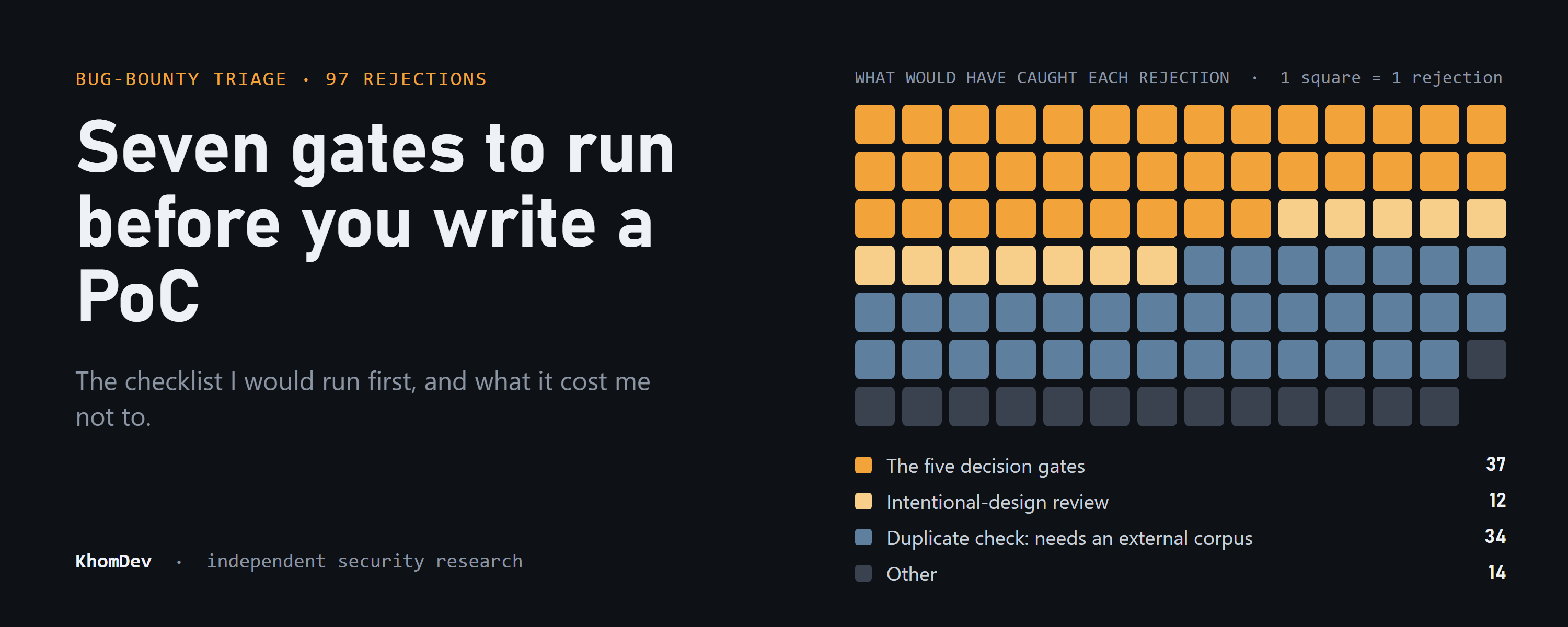
| What would have caught it | Rows | Share |
|---|---:|---:|
| The five decision gates in this article (S1–S5) | 37 | 38% |
| An intentional-design review | 12 | 12% |
| Duplicate / prior-art check — needs an external corpus | 34 | 35% |
| Other (no attacker-win, realism, floor, headline) | 14 | 14% |
A separate classification, using a different column, gives **53% preventable from the program's
public record and 28% not preventable by any pre-hunt check at all.** Both are defensible; they
answer slightly different questions and do not sum with the table above.
The 73% I first published is not one of them. It counted every row whose earliest catchable
gate was labelled pre-hunt — including the duplicate check, 34 rows on its own. Duplicates are
checkable only if you already have the external corpus: the program's known-issues list, its
prior audits, or your own submission history. They are not something you decide by reading a
scope page.
If you run the five decision gates and still get buried in duplicates, the checklist did not lie
to you. It just cannot see the thing that is killing you. That is why S6 exists — and why the
single most useful habit in this whole piece is logging your own outcomes.
---
## S6 — Own history
The question: Have I already found this, and did it pay?
Why it exists: This is the one gate my original checklist was missing, and my own data
indicts me for it. **12 of the 97 rejections — 12% — are repeats of a bug family I had already
submitted.** Eight of those were closed as duplicates of my own earlier work.
The mechanism is mundane and it is worth spelling out. An earlier submission is closed as
Informational or out of scope. You do not log it, because it did not pay and it feels like a
non-event. Three months later you find the same class of bug in a different target, run your
novelty sweep, and it comes back clean — because the prior art is your own unrecorded work.
The check. Keep a single file of every submission you have ever made: the bug family, the
outcome, the date. Then load it as a known-issues corpus and sweep candidates against it before
you write anything.
That is exactly what the `--known-issues` flag on the tool is for. In its intended use the corpus
holds a program's known issues. It works identically for your own history, and that is
arguably the higher-value use, because a program's known issues are public and someone else has
already read them.
Why this is not in the tool as a numbered gate yet. It is a corpus, not a rule, and it needs
you to have maintained the log. I am calling that out rather than pretending a checkbox does the
work.
---
## S0 — Fork novelty
The question: Is this in-scope code custom, or a verbatim fork of an exhaustively-audited
protocol?
Why it might exist: Verbatim forks inherit not only bugs but documented design decisions. A
behaviour that is novel in the fork but documented upstream is not a finding.
A caveat I owe you: I originally billed this as the highest-yield gate. **I cannot support
that.** My log contains no row attributed to it, which means I was not running it during the
period I am writing about. The fork advice below comes from a handful of experiences, not from
the 97-row dataset, and should be read that way.
The check. Tag every in-scope contract as one of three things:
| Tag | Meaning | Worth a submission? |
|---|---|---|
| `fork-body` | Recognisable fork, no meaningful local modification | Usually not |
| `integration-seam` | Custom glue where two components meet | Yes |
| `custom` | Bespoke logic written for this protocol | Yes |
What it is worth in practice. I spent real time on a target that turned out to be a fork of a
widely-used staking implementation with little local modification. Three submissions died there —
a state-ordering issue, an inherited reward-distribution path, and a cached-value deposit that
captured pending rewards. All three were accurate; all three were closed as inherited behaviour.
The lesson is not "forks are worthless." It is that **the fork body is documentation and the seam
is the product.** A fork project's novelty lives where custom code meets inherited code: reward
routing, fee routing, upgrade paths, cross-contract state handoff.
---
## S1 — The severity floor
The question: Does a payout tier exist for the severity this finding will land at?
Why it exists: A correct finding at an unpaid tier is unpaid work. It is the most expensive
category per row in my dataset — not because it is common (three rows), but because it is where
the work was done correctly and the program structure made it worthless.
The check. Two tests, and you need both:
1. Read the reward table, not the impact table. A program can list an impact class as in scope
and pay nothing for it. These are different tables and they do not always agree. Where they
conflict, the reward table governs.
2. Check the program's published outcomes. If its historical results top out below your
candidate's severity, expect no payout regardless of technical merit.
Then find the lowest severity carrying a non-zero reward — the floor — and ask whether your
thesis can reach it.
What it would have caught for me. Three findings were confirmed valid by the receiving teams.
Real bugs, working proofs, mechanisms that held up. I was paid nothing for any of them, because
the reward tables had no tier at the severity the bugs landed at. Two were assessed Medium; those
programs paid Critical and High only.
One program is the cleanest illustration: a track paying only at the top severity, where I found
three genuine bugs and had none of them paid. Two were confirmed technically accurate and
rejected purely because no payout bucket existed at that severity. The third was out of scope for
a different reason — its root cause was off-chain. Three real bugs, zero paid, and the severity
floor was knowable before I opened the code.
A trap that cost me time: some platforms publish an acknowledgement category that is not a
payout tier. A program's public results can show a hundred or more accepted findings, almost all
of them in that category, paying nothing. **Volume of accepted findings is not evidence that a
program pays.** Check the reward table, not the accepted-count.
The nuance that matters: a narrow floor does not mean skip the program. It means below-floor
discoveries are documentation, not submissions. You still hunt; you stop writing proofs for
findings that cannot pay.
---
## S2 — Full exclusion clause transcription
The question: What does this program exclude, word for word?
Why it exists: This was the largest single cause of my out-of-scope rejections, and the
clauses are usually on the same page as the reward table, in plain language.
The check. Copy every exclusion clause verbatim. For each, write down the *pattern of
finding* that would trigger it. Then test your intended bug class against each pattern before you
write anything.
The clauses are worded differently everywhere but mean one of about fourteen things. The ones that
killed the most of my submissions:
| Clause class | Typical wording |
|---|---|
| Privileged role | "attacks requiring access to privileged addresses" |
| Human error | "human-based errors and rogue privileged users" |
| DoS without extraction | "DoS without enabling direct fund extraction" |
| Best practice | "best-practice critiques and optimisation suggestions" |
| Design issue | "design issues that are not necessarily a security risk" |
What it would have caught for me. Five distinct clusters, all dead before the proof:
- A privileged-role exclusion on a finding whose only trigger was an owner-gated function.
- A front-running and human-error pair — the finding needed both an operator delay and a
mempool race, and the program excluded both, in writing, on a page I had read.
- A best-practice exclusion on a strict-versus-inclusive comparison operator. The argument
was "the canonical implementation does it the other way." That is a convention critique, and
the program said so.
- A DoS-without-extraction exclusion on a configuration value that made an operation revert.
- A design-issue exclusion on an intentional escape hatch.
The one genuinely useful escape hatch. The privileged-role clause reads broader than it is:
- A finding that requires an admin to act maliciously → out of scope, correctly.
- A finding where a reasonable admin action has a non-obvious destructive second-order effect
→ potentially in scope. The admin is not misbehaving; the code is.
That distinction is worth checking before you abandon a finding. It is not a loophole — it is the
difference between "the admin attacked the protocol" and "the protocol broke when the admin did
their job."
---
## S3 — The in-scope file tree
The question: Which exact files can be the root cause of a submitted finding?
Why it exists: A real bug whose root cause lives outside the scoped tree is out of scope
regardless of its impact.
The check. Generate the complete list of in-scope paths. Then, for every candidate, trace the
root cause — not the impact site — to a file on that list. If the root cause is outside it, or
the attack path depends on behaviour outside it, the finding is out of scope or needs
reframing.
This one cannot be done before reading the code. It needs a candidate first.
What it would have caught for me. Two cases:
- A finding whose root cause was deployment credentials committed to a public repository —
genuinely bad practice, in a file outside the scoped source directory. The program's scope was
explicit: only contracts under the sources folder.
- A finding whose root cause was in an off-chain node handler, with the in-scope contracts
acting only as executors after a privileged signature.
Both were accurate. Both were unpayable, and both were knowable quickly once I looked.
The trap: the impact site and the root cause are frequently in different files. It is easy to
find a loss that manifests in a scoped contract and miss that the defect originates in a
deployment script. Trace it back.
---
## S4 — Prior audit sweep
The question: What has already been found, reported, and accepted as design intent?
Why it exists: Prior audit findings are part of the public record. Submitting a known design
characteristic as a new finding signals that you did not read the prior audit — which is worse
than an informational finding, because it costs standing as well as time.
The check. Find every published report for the protocol, read them, and extract:
- Issues the team acknowledged and accepted as by design.
- Issues marked "won't fix" or "acknowledged."
- Anything classified as a known issue.
Build a list titled "Known / Accepted — Do Not Re-report," with the audit reference for each.
Then sweep your candidates against it.
And read the findings, not the titles. A prior audit naming a file is not the same as covering
your function. The most useful thing to extract is the post-audit delta — what changed after
the last audited commit. That is the richest surface, and where you are least likely to be
duplicating.
What it would have caught for me. A finding on a return-amount calculation that applied a
delayed-redemption bias favouring the protocol. Real observation. Previously identified by name
in a published audit and accepted by the team. The triager cited the reference directly.
And the case that produced S6: a finding that duplicated my own earlier report, filed two
months before and closed as informational. The earlier outcome was never logged, so it was
invisible to my own duplicate check — and the novelty sweeps came back clean because the prior
art was partly my own unrecorded work.
---
## S5 — Test-suite intention grep
The question: Does the protocol's own test suite assert that your candidate behaviour is
correct?
Why it exists: This is the cheapest gate and the most embarrassing to fail, because the
answer is in the repository you are already reading.
The check. Grep the test suite for intent markers:
```
"by design" "intended" "expected to survive"
"should preserve" "not penalised" "no free"
```
Then build a list of behaviours asserted as correct, and cross-reference every candidate against
it before writing a proof.
What it would have caught for me. A field that persisted across an unlock and re-lock cycle.
My finding was that this was stale state that should have been cleared. The project's own test
suite contained an assertion that the persisted value should survive that cycle.
The triager's reply was one sentence: this is intended behaviour, and it is asserted as such in
our public test suite.
A caveat worth holding: a test asserting a behaviour does not always mean the behaviour is
intended. Sometimes the test encodes the bug. But it raises the bar substantially — you now have
to argue the test itself is wrong, and that is a much harder report to write well.
---
## A failed gate is not "skip the program"
This is the part I got wrong for months, and it is why the gates took so long to become useful.
A failed gate does not mean the program is bad. It means **the program has constraints that change
what findings are valid.** The output of a failed gate is a filter, not "abandon":
- Narrow payout floor → hold below-floor findings in notes; spend proof time only on what can pay.
- Broad exclusions → reframe into a class the program does not exclude, or hold.
- Fork-heavy codebase → hunt the seams and the custom surface, not the fork body.
- Everything known → hunt the post-audit delta.
The gates narrow where you point the effort. They do not tell you to stop.
---
## What the gates do not do
Three honest warnings, because all three are failure modes I have hit.
Over-filtering is its own expensive mistake. If your gates kill everything, you have calibrated
them too aggressively, and you will miss real findings. **Two of my own first-pass closures were
later reversed** to confirmed findings in final judging. A first-pass triage decision is not a
final verdict.
That also means the gates have a false-kill rate I have not measured. I know of two reversals
in this dataset by accident, not by looking for them. Anyone quoting a "gates blocked N bad
submissions" number without a false-kill number next to it is quoting half a result.
The gates do not find bugs. They are a prioritiser, not a scanner. Passing all seven means
your target is worth hunting, not that it contains anything. The hard work starts after.
The gates do not replace the log. S6 is only available to you if you have been recording
outcomes, including the ones that paid nothing. If you take one habit from this piece, take that
one. An outcome you do not record is invisible to you — and so is one you recorded but never
looked up again.
---
## Running them
I turned this into three public repos, because rejection data is scarce and success stories are
commodity. Everyone writes "how to find a reentrancy." Nobody writes "here is why my last 97
submissions were closed."
[viability-gate](https://github.com/KhomDev/viability-gate) — a Rust CLI that runs six of
these gates and scores a draft finding against 22 documented rejection anti-patterns. Offline,
deterministic, no API key:
```bash
vg init my-target/ # scaffold the inputs, commented
vg gates --ledger my-target/ledger.yaml --scope my-target/scope.txt
vg check finding.md --known-issues my-target/known-issues.yaml
```
It fails closed on missing input: a gate you could not run reports `?`, never a pass. Unknown
is not pass.
*(Numbering: the CLI labels its six gates `G1`–`G6` in a different order, grouped by input cost
rather than by what I have written here, so fork-novelty is `G6` there and `S0` here. **S6, own
history, is not a numbered gate in the CLI** — it is served by `--known-issues`, loaded with your
own submission log.)*
[bounty-economics](https://github.com/KhomDev/bounty-economics) — the payout-tier and
exclusion-clause taxonomies as data, plus a schema and validator for your own private program
ledger. The validator rejects any uncited entry, because a guessed payout floor is worse than no
floor — you will act on it.
[rejection-taxonomy](https://github.com/KhomDev/rejection-taxonomy) — all 97 rejections,
each with its bug family, mechanism class, why it failed, which gate would have caught it, and
whether it was preventable from the public record. Machine-readable, with a query tool:
```bash
python scripts/query.py --prehunt
python scripts/query.py --gate G2_exclusion_clause
python scripts/query.py --triage duplicate
```
---
## Caveats
- n = 97, one researcher, four months, self-selected targets. A personal log, not a survey.
My own target-selection habits — including the bad ones — are baked into every number.
- The gate assignments are self-assessed. "Which gate would have caught this" is my own
post-hoc judgement. It is the most useful column and the least objective one.
- The preventable figure is 53%, not 73%. The higher number counted the duplicate check as a
pre-hunt gate. It needs an external corpus.
- The three summary buckets are groupings of my own categories. A different collapse gives a
different ratio. Earlier versions of these articles used a different collapse and therefore
published a different number, which is exactly the kind of drift this caveat exists to flag.
- S0 is not evidenced by this dataset. No row in my log is attributed to it. Read the fork
section as experience, not measurement.
- The false-kill rate is unmeasured. First-pass closures were reversed at least twice; I have
not gone looking for how often.
- 179 engagement folders are not 179 submissions. Most engagements produced no submitted
finding. The 97 rows are the submissions that were closed.
- Program rules change. A verdict reflects the rules in force at the time.
- No program names in this post, deliberately. The mechanisms generalise; the identities do
not.
*The data is CC-BY-4.0. The tooling is MIT. Corrections with a citation are the most valuable
contribution.*