
I classify every rejected report by the earliest point at which I could have caught my own mistake. When you do that for long enough, the rejections sort themselves into buckets, and one bucket is always the largest.
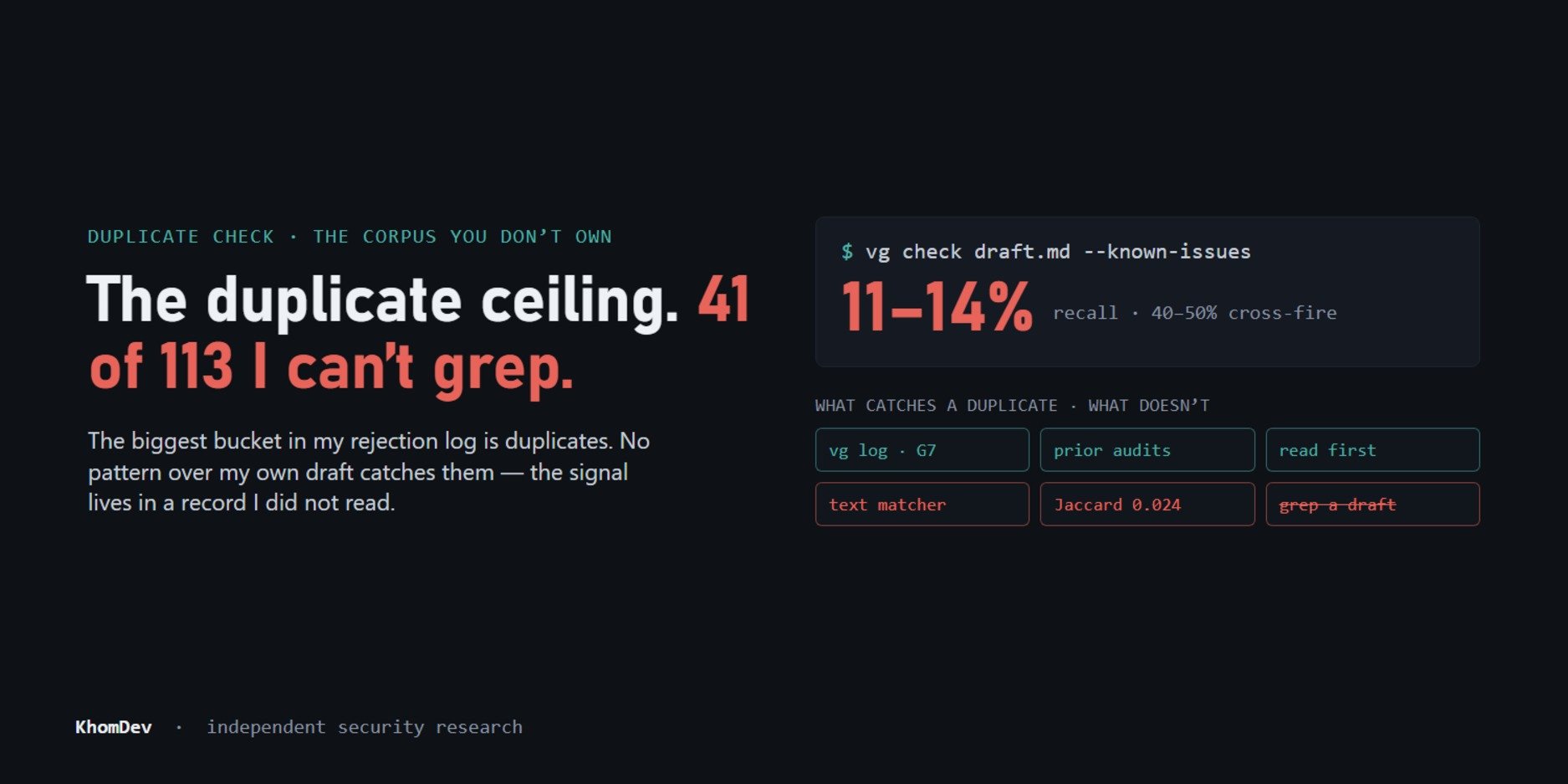
For me it is duplicates. 41 of my 113 logged rejections died at the duplicate check — a finding that was already known, already reported, or already closed somewhere I had not looked. Another two were closed as duplicates on grounds an earlier gate would have caught first, so 43 in total carry the duplicate label. Either way it is the biggest single reason my reports get closed, and it is bigger than out-of-scope, bigger than intentional-design, bigger than the one SPAM I am least proud of.
Here is the uncomfortable part. Every other bucket is something I can get better at by reading my own draft more carefully. The duplicate bucket is not. You cannot find a duplicate by looking harder at your own report, because the thing that makes it a duplicate is not in your report at all.
A severity-floor rejection is in the program's reward table. An exclusion-clause rejection is in the scope page. A no-attacker-win rejection is in my own impact section, if I am honest about reading it. All of those are catchable before I write a line of proof-of-concept, because the evidence is either in front of me or one page away.
A duplicate is different. The fact that makes my finding a duplicate lives in an external corpus: the program's known-issues list, a prior audit report, a contest result, a bounty that was already paid to someone else. My report can be perfectly written, the bug perfectly real, the proof-of-concept perfectly reproducible — and it is still worth zero, because somebody got there first and the record of that is somewhere I did not read.
No amount of pattern-matching over my own prose will surface that. The signal is not in the text I control. That is the ceiling, and it is structural: of the 113 rejections, my anti-pattern catalog can reach 72. The duplicate check is the largest part of what it cannot reach, by construction, because it is the one gate whose input is a corpus I do not own.
The obvious move is to supply the missing corpus. So I built it: a flag on my own pre-submission tool that takes a list of the program's known issues and prior-audit findings and matches a draft finding against them before I submit. If the draft looks like something already on the list, the tool fails the finding and tells me to go read.
Then I tested it, honestly, against the 28 duplicate pairs it was supposed to catch. The result is in the repository, because a tool that only reports its wins is a lie by omission:
A two-term proximity match caught 3 to 4 of the 28 pairs — 11 to 14 percent recall — and 40 to 50 percent of everything it flagged was the wrong finding.
Loosening to a single term reached 46 percent recall, but then 77 percent of its fires were false alarms, which trains you to ignore it within a day.
There is no useful operating point in that trade. The reason is measurable: the mean vocabulary overlap between my rejection description and the bug report it duplicated is a Jaccard of 0.024. The same bug, described by two different people, barely shares words. A matcher can only see what I transcribed, and two humans almost never transcribe the same finding the same way.
I am careful to call the result not validated rather than disproven, because the test was unfair to the approach in three specific ways — it used my rejection summaries instead of the program's own wording, auto-generated the patterns, and leaned on a rarest-term heuristic. A fairer test might do better. But I am not going to claim a fix I have not demonstrated. The tool ships with that failure printed next to it, and the honest instruction is to treat it as a hypothesis, not a solution.
If text matching cannot break the ceiling, two things can — and neither is a cleverer regex.
A local history of my own submissions. The cheapest duplicate to catch is the one I created myself. Across the log, 12 of my rows repeated a family I had already hit — a seam I had already been rejected on, resubmitted under a new headline weeks later because I had forgotten. That is not an external-corpus problem. That is a me problem, and it is fully solvable with a record. My tool keeps a running log of every family I have submitted and warns me the moment a new draft lands in one I have seen before. It is the one duplicate signal that lives in a corpus I do own, so it is the one I can actually automate to completion.
Reading the prior audits before I hunt, not after. Most of the external duplicates were not secret. They were sitting in a published audit report or a known-issues list that I could have read on day one and instead read on day eight, after I had the finding. Reading the program's prior audits first does two things: it removes whole families from my hunt before I spend time on them, and it teaches me the shape of what this particular program already considers known. That is slow, unglamorous, and the single highest-return hour in the whole process. It does not scale into a pattern, which is exactly why it works where the pattern does not.
It would be easy to publish the 72-of-113 number and quietly drop the 41 that my tooling cannot reach. I do the opposite. The duplicate check is listed, in the open, as the largest bucket the catalog cannot automate, with the reason written next to it: the signal lives outside the finding.
I think that honesty is the whole value of keeping the log. A tool that pretends to catch duplicates would be worse than no tool, because it would let me submit with false confidence into the exact bucket that already costs me the most. Admitting the ceiling tells me where the automation stops and the reading has to start. The 72 I can gate. The 41 I have to earn the old way: by reading what came before, on the program I am actually hunting, before I convince myself I found something new.
The duplicate bucket is the largest one in my log. It will probably stay that way, and I would rather say so than ship a matcher that lies about it.
You cannot grep your way out of a corpus you have not read. The only fix for the duplicate ceiling is to read first.