
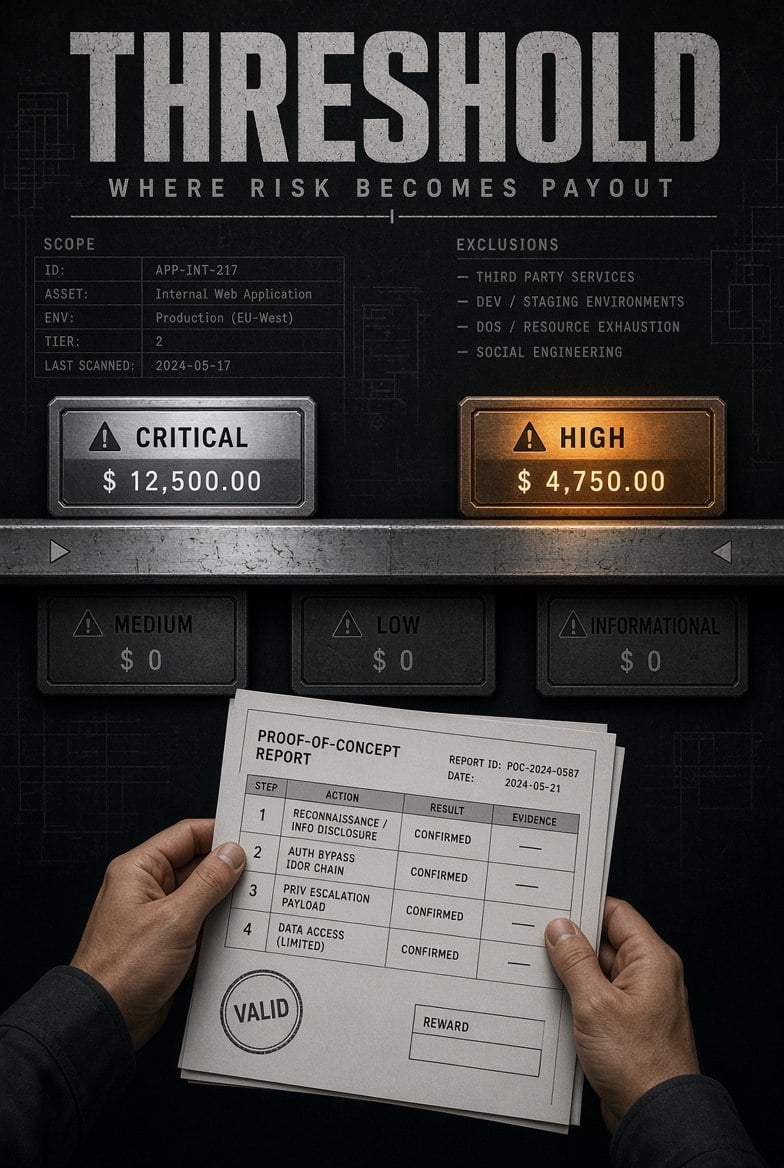
I have three findings that were confirmed valid by the teams that received them. Real bugs, working proofs of concept, mechanisms that held up under scrutiny.
I was paid nothing for any of them.
Not because the findings were wrong. Because the programs' reward tables had no tier at the severity the bugs landed at. Two of them were assessed Medium; the programs paid Critical and High only.
That experience is why I now check one number before I read a line of target code.
The payout floor: the lowest severity that carries a non-zero reward.
Every program's reward table resolves to one of six shapes:
Tier shape | Pays | What it means for you |
|---|---|---|
| Critical | Everything below Critical is worth $0. |
| Critical, High | Medium and below are unpaid. |
| Critical → Medium | The most common shape. |
| Critical → Low | Rare; almost everything valid pays something. |
| All tiers | Rare. |
| — | Not transcribed. Not permissive. |
That last row is the dangerous one. unknown does not mean "pays everything". It means you haven't read the page. Hunting an untranscribed program is an unhedged bet, and you will make it while believing you did your homework.
Consider the arithmetic. Suppose you spend forty hours on a target and find a genuine, PoC-backed Medium-class bug — a value misallocation between two counterparties, a griefing vector, a rounding drift that accumulates.
On a medium_and_above program, that's a real payout. On a critical_only program, it is exactly zero, and no amount of write-up quality changes that.
Now consider the reverse. You spend forty hours and find nothing. Also zero.
The second outcome feels worse. The first outcome is worse, because you also spent the hours, and you also believed you'd succeeded right up until the triage reply.
I have three rows in my rejection log for exactly this. I call them the most expensive rows in the dataset — not because they're the most common, but because they're the ones where I did everything right and the structure of the program made it worthless.
Many programs publish more than one figure, and they do not always agree. I've seen:
A prize pool total and a separate rewards figure for the same contest, differing by a factor of three, with no documentation of the difference.
A scope table labelling an asset
Criticalwhile the reward table pays it atHigh.
The reward table governs what you are paid. When two numbers disagree, record the conflict explicitly rather than resolving it silently — because the next time you look at the entry, you'll have forgotten which one you trusted and why.
The floor tells you whether the program can pay. The exclusion clauses tell you whether your bug class is written off in advance.
Almost every scope page carries a list of out-of-scope categories. They're worded differently everywhere and mean one of about fourteen things. The ones that killed the most of my submissions:
Clause class | Typical wording |
|---|---|
| "attacks requiring access to privileged addresses" |
| "human-based errors and rogue privileged users" |
| "DoS without enabling direct fund extraction" |
| "best-practice critiques and optimisation suggestions" |
| "design issues that are not necessarily a security risk" |
The first two are the killers. Industry-wide, "requires a privileged actor to misbehave" is the single largest category of wasted submissions, and it's the same in my own log: of 26 out-of-scope rejections, privileged-role exclusions were the biggest single sub-cause.
There's a distinction inside the privileged-role clause that is genuinely worth checking, and it has rescued findings for people:
A finding that requires an admin to act maliciously or carelessly → out of scope.
A finding where a reasonable admin action has a non-obvious destructive second-order effect → potentially in scope.
The difference is whether the admin is misbehaving or the code is. A fee parameter that silently breaks liquidations at a plausible value is a code problem, not an admin problem. The same parameter at an absurd value is an admin problem.
Check which one you have before you abandon the finding.
This is the part people ask about, so let me be direct: I could publish a table of which program pays what. I'm not going to, for two reasons.
It would go stale. Programs change reward tables without notice, sometimes without updating the page. A published floor that's three months old is worse than no floor, because you'll trust it and skip the check that would have caught the change.
It would name targets. A dataset of program names and their terms is a disclosure about those programs, assembled from their own materials but presented as my analysis. That's not mine to publish.
So bounty-economics ships the taxonomies and a schema, and you build the ledger yourself. Which is better anyway: you get a current answer, you get it cited, and you can't blame a stale file for a zero-payout submission.
Keep it private — it will contain real program names, and your judgement about them isn't something to publish. One entry per program:
yaml
- id: my-target-slug
  tier_shape: medium_and_above
  floor_severity: medium
  source_url: https://<the live rewards page>
  retrieved: 2026-10-08
  conflicts:
    - "Scope table says Critical; rewards table pays High. Rewards governs."
  exclusions:
    - class: privileged_role
      clause: "<verbatim from the scope page>"
      pattern: "(owner|admin|guardian|capability|role)\\b"
    - class: dos_no_extraction
      clause: "<verbatim>"
      pattern: "(dos|freeze|lock|liveness|grief)"
  prior_audits:
    - firm: <name>
      covers: ["sources/Vault.sol"]
      known_issues: ["<verbatim from the program's known-issues section>"]
  post_audit_delta: "<what changed after the audited commit>"
Two fields do most of the work. tier_shape tells you whether to hunt at all. exclusions gives you regexes to test against your own finding description before you write the PoC.
The repo ships a validator that enforces the schema and, more usefully, rejects any uncited entry. An uncited payout floor is a guess, and a guessed floor is worse than none because you will act on it. It also warns when retrieved is older than 180 days, because that's when a program is most likely to have moved the goalposts under you.
Before you spend an hour on a target:
Open the live rewards page.
Find the reward table. Record every severity row.
Identify the lowest severity with a non-zero reward.
Ask: can my thesis plausibly reach that severity? If not, stop.
Copy every exclusion clause verbatim. Classify each one.
Test your intended bug class against each clause.
Sweep the prior-audit surface — the findings, not the titles.
Note the post-audit delta.
That's maybe twenty minutes. It is the highest-return twenty minutes in bug bounty, and I learned it by wasting four months.
This is not legal or financial advice, and it is not a substitute for the program's own scope page, which always outranks anything here.
Program rules change without notice. Every entry you write is a snapshot with a date.
The clause classes are a starting vocabulary, not a closed set. Widen them as you find clauses that don't fit.
bounty-economics — the taxonomies of payout tiers and exclusion clauses, plus a schema and validator for building your own private program ledger.