



USV 2026 Fund GPs Rebecca, Fred, Mike, and me – last week at Leon’s, our home base right below USV.
Today we announced the latest vintage of USV Funds: $900mm across our early stage and opportunity strategies.
You can read more on the USV blog here.
You can see my interview on Bloomberg TV here:
https://www.youtube.com/embed/b667jLvF3sU?start=2
It’s a wildly exciting moment to be investing in technology. Uncertain for sure. But dynamic and expansive on a level I’m not sure we’ve ever experienced before. It feels great to be right in the middle of it – to have a fresh new fund and an A+ team to go after it with.
It’s been interesting to think about the speed & time as it relates to this current moment in AI deployment. I’ve been holding it as kind of a firm assumption that AI will deploy faster than any technology in history – given that we already have the major distribution rails in place (internet, computers, smartphones, etc). Whereas in previous generations of technology (not just digital but everything) there was a need to develop brand new distribution rails before adoption could occur. For example, roads needed to get built and cars sold before the transformation of the world by automobile (for better or worse) could take place. And similarly, people needed internet connections, and later smartphones, etc. etc. before previous generations of digital technology could deploy fully.
In AI, we already have all the distribution rails in place, at least for purely digital use cases. So it’s reasonable to assume that at least one type of distribution / proliferation will happen extremely quickly, maybe quicker than ever – deployment of AI through existing digital infrastructure (both commercial and consumer).
But it’s actually more complex than that, if you think both “down” and “up” from digital distribution:
Looking down, we have a massive physical infrastructure build-out (data centers and the energy to power them). This is a decades-long investment. Below that we have trillions in capital flowing into this system. This is relatively fast-moving.
Looking up: while digital distribution will be extremely fast (chatGPT has over 1bn DAUs, and now every Meta user has access to Muse), there’s a whole universe of change and transformation that AI will drive (again, both for better and worse) that will take a much longer time to proliferate; certainly years but more likely decades or maybe even generations. If we believe (as I do) that AI will fundamentally restructure many markets, industries, institutions and more, this is going to be extraordinarily complex and high friction.
I’ve recently been thinking of this overall dynamic as the “AI timescale lasagna” – a bunch of overlapping & interdependent layers with different timing considerations. Something like this:
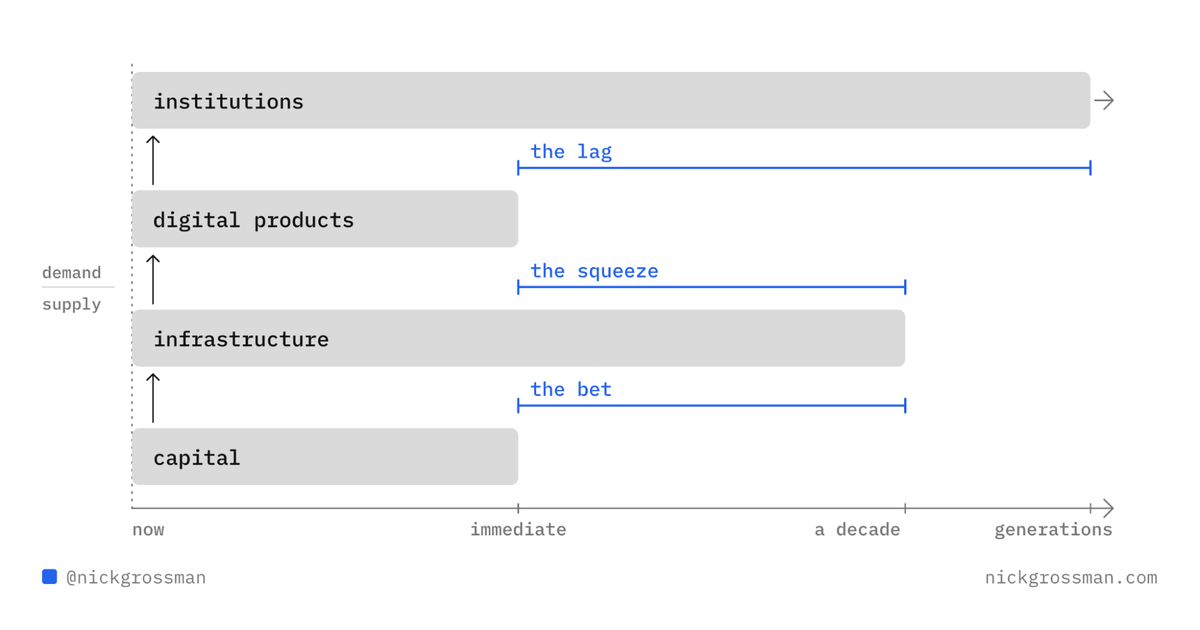
These overlapping timelines will undoubtedly cause tensions. One immediate one is the question of whether the near-term demand for AI product will support (on a revenue basis) the extent of the current infrastructure build-out. That buildout is consuming massive amounts of capital and that capital has all kinds of built-in dynamics in terms of debt ratios, covenants, interest rates, and other things. Clearly there's a lot of concern about whether we're in an AI bubble and if we prove to be, I think, a big driver of that will be misalignment in the adjacent timelines here.
In other words a big question is: will “real” demand show up fast enough to support the cost of this infrastructure, since you could argue that a lot of the current market demand is “circular” (industry players at various layers giving each other business via investor capital). How big is the TAM for “current” organic demand (digital AI), how long will the inorganic demand (investor capital, government capital, etc) support its own costs before problems occur, etc. Will a bubble pop if near-term demand doesn’t keep up with the costs of infra? Or will demand & revenue grow so fast on purely digital rails that we’ll skip the bubble-popping moment of this turn of the wheel?
I do not have answers to any of these questions, but just writing out some of the dynamics here is helping me think through it all.

One of my favorite "moves" is to give myself a day to process an important decision by "sleeping on it". While I feel like I generally tend to move quickly on things and I like being decisive, sometimes it's important to let a situation marinate and let some background processing happen.
This background processing is important. This article from MIT makes an interesting observation:
"as we enter a dreamlike state, the prefrontal cortex of the brain, responsible for keeping impulses in check, slowly grows less active. This is when there’s a spur in theta waves that leads to an unconstrained window of consciousness; there is little censorship from the mind, allowing for visceral dreams and creative thoughts."
(Why do we dream? by Shafaq Zia)
In other words, dreaming (sleeping on it) gives your brain a unique opportunity to process thinking, unbothered by your daily guard rails.
Interesitngly, AI systems are now forming up to do something similar. From the Anthropic / Claude docs on their dreaming feature:
"Agents write to their memory stores as they work, but these writes are local and incremental: over many sessions a memory store accumulates duplicates, contradictions, and stale entries.
Dreams let Claude clean that up. A dream reads an existing memory store alongside past session transcripts, then produces a new, reorganized memory store: duplicates merged, stale or contradicted entries replaced with the latest value, and new insights surfaced."
Both are a great reminder that some of your best thinking can happen when you're not even really trying. And, the more time / opportunity you can give yourself to sleep on it, the better. Clearly, this is core component of any Slow Hunch.