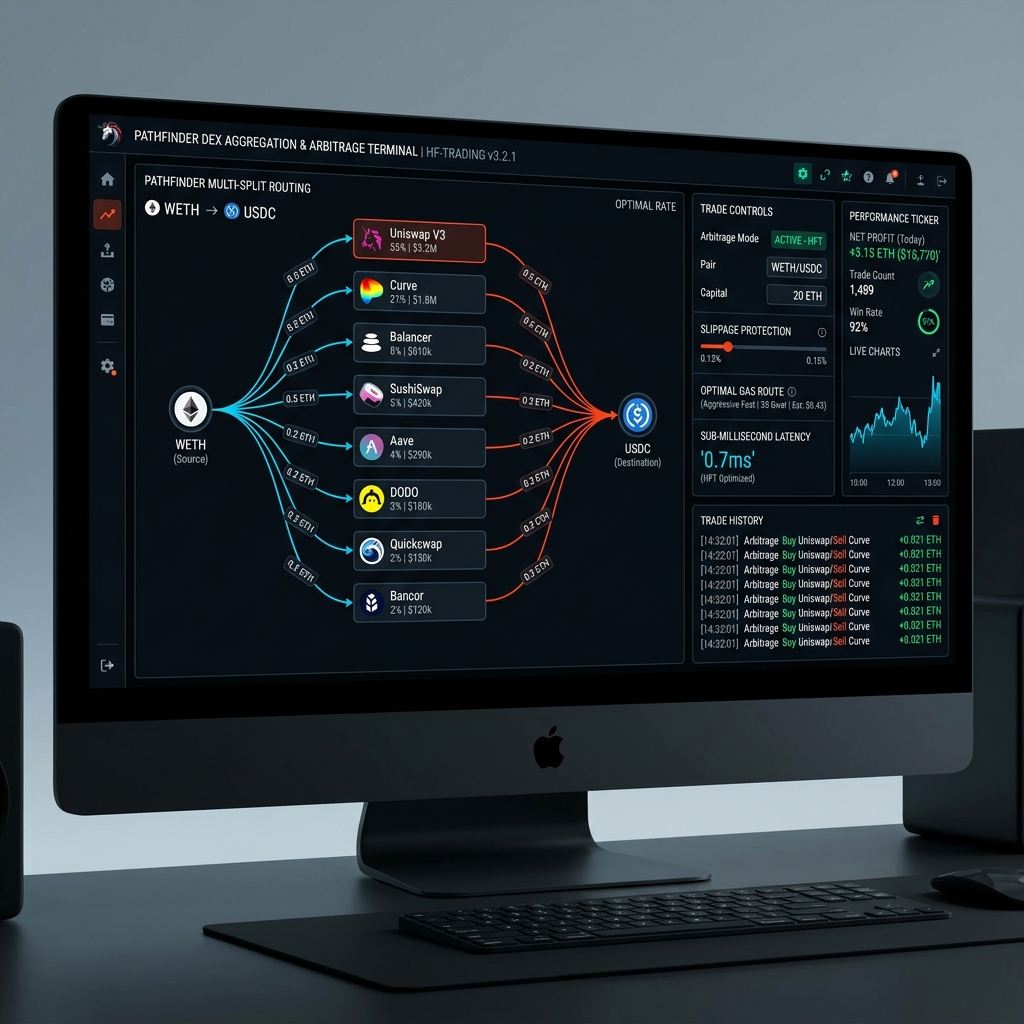
1inch Pathfinder Algorithm & Multi-Split DEX Arbitrage Architecture (2026)
Official Research Paper by MEVBOT Research Group • Production Trading Systems
Canonical Mirror: 1inch Bot on MEVBOT.TOP • Systems Catalog
📌 Executive Summary
Liquidity fragmentation across Ethereum, Arbitrum, Optimism, and Base creates persistent pricing differentials for identical asset pairs across disparate Automated Market Makers (AMMs). 1inch’s proprietary Pathfinder algorithm resolves this by dynamically segmenting a single swap across multiple liquidity pools, market makers, and synthetic bridges.
For algorithmic searchers and MEV operators, the presence of large split-routed transactions through the 1inch Aggregation Router introduces distinct structural opportunities: back-running post-split liquidity imbalances, sandwiching vulnerable intermediate hops, and executing cross-protocol triangular cycle closures before pool states normalize.
🧭 1. Pathfinder Graph Routing Mechanics
The Pathfinder engine models the decentralized exchange ecosystem as a directed, weighted graph $G = (V, E)$, where vertices $V$ represent ERC-20 tokens and edges $E$ represent liquidity venues (Uniswap v2/v3, SushiSwap, Curve, Balancer, DODO).
Rather than choosing a single route $A \rightarrow B$, Pathfinder solves for an optimal flow distribution vector $\vec{x}$:
Where $f_i(x_i)$ is the convex returns curve of liquidity pool $i$, and $x_i$ is the volume allocated through edge $i$.
                 ┌─── [45% Volume] ──► Uniswap v3 (0.05% Fee) ───┐
                 │                                                │
[Input: 100 ETH] ┼─── [35% Volume] ──► Curve TriCrypto Pool ──────┼──► [Output: 345,000 USDT]
                 │                                                │
                 └─── [20% Volume] ──► Balancer 80/20 Vault ─────┘
When 1inch splits a massive swap across these three venues, each individual pool experiences sudden price impact. The searcher bot's role is to identify and atomically capture the resulting spread across adjacent pools in the same block.
⚡ 2. Exploiting Post-Aggregation Market Dislocations
When an aggregated transaction executes, the marginal price at each sub-pool diverges temporarily:
-
Multi-Hop Back-Running: The moment the 1inch Router finishes balancing across pools, the bot issues an atomic bundle targeting the pool with the highest price deviation.
-
Virtual Gas Optimization: Employing optimized call data and pre-approved proxy routing reduces transaction overhead, ensuring sub-50k gas margins remain net profitable under EIP-1559 dynamic base fees.
// Solidity snippet: Verifying atomic profit on 1inch Aggregation back-run
contract OneInchArbReceiver {
    address private immutable ONEINCH_ROUTER;

    function executeCycle(
        address tokenIn,
        address tokenOut,
        uint256 amountIn,
        bytes calldata routeData
    ) external {
        uint256 balanceBefore = IERC20(tokenIn).balanceOf(address(this));

        // Execute aggregated swap through optimized router path
        (bool success, ) = ONEINCH_ROUTER.call(routeData);
        require(success, "Routing failed");

        uint256 balanceAfter = IERC20(tokenIn).balanceOf(address(this));
        require(balanceAfter > balanceBefore, "Unprofitable execution delta");
    }
}
🚀 Production Deployment & Source Code
To inspect the automated source code, configuration files, and latency-tuned execution engines:
-
Commercial Package: 1inch Bot on MEVBOT.TOP
-
Documentation Mirror: 1inch Bot GitHub Pages Satellite
-
Architecture Research: GitHub Core Repository