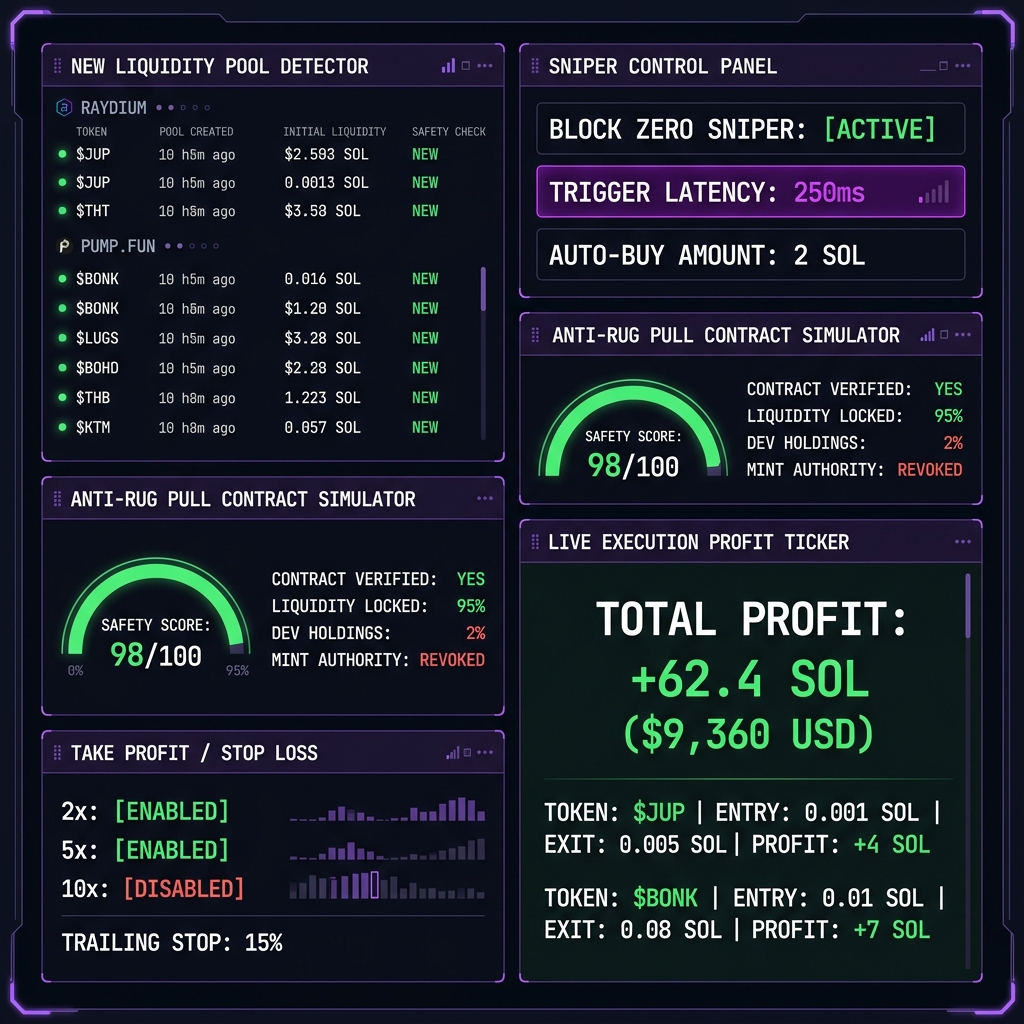
Solana MEV & Sniping Architecture: Jito Bundles, Raydium CLMM and Sub-Slot Execution
Solana has rapidly grown into the most active decentralized liquidity arena in Web3. With transaction confirmation times averaging 400 milliseconds, traditional Ethereum-style mempool front-running is obsolete. On Solana, latency is measured in sub-slot intervals, and priority fee bidding has given way to Jito Block Engine bundle auctions.
Traders deploying capital on Solana need to understand how top-performing searchers extract arbitrage and snipe token launches without losing funds to failed network fees.
1. Why Public Priority Fees Fail on Solana
Until late 2023, many Solana bots attempted to win token launches by spamming identical transactions across multiple RPC endpoints with high ComputeBudgetInstruction priority fees.
In modern Solana mainnet conditions, this approach causes significant drawbacks:
-
Validator Rate-Limiting & Quic Throttling: TPU (Transaction Processing Unit) nodes actively drop duplicate and spam connections.
-
Non-Refundable Priority Fees: If your transaction lands second behind a competitor, your priority fee is still deducted, resulting in cumulative capital bleed.
2. The Jito Block Engine Paradigm
The transition to MEV-boosted validators running the Jito-Solana client changed the ecosystem. Jito enables searchers to submit atomic bundles containing up to 5 transactions directly to block leaders via private gRPC and Shredstream feeds.
Searcher Telemetry ---> Jito gRPC Relays ---> Block Leader (Validator) ---> Sub-Slot Bundle Inclusion
Atomic All-or-Nothing Bundling
If the desired DEX pool state shifts (e.g., someone else buys before you or liquidity is pulled), the entire bundle fails off-chain. The searcher pays zero priority fees and zero validator tips on unlanded attempts.
For algorithmic desks and active traders, production-hardened implementations are available:
-
Solana MEV Bot (Jito Bundle Engine): Sub-15ms Jito bundle router operating across Raydium CPMM/CLMM, Orca Whirlpools, and Meteora.
-
Solana Sniper Bot: Microsecond token launch detector with integrated honeypot simulation and mint-freeze checks.
-
Pump.fun Bundler Bot: Multi-wallet atomic token launch bundler built on Jito tip consensus.
3. Calculating Optimal Dynamic Validator Tips
Winning Jito auctions requires balancing tip size against expected gross spread. Submitting a fixed tip results in either being outbid on high-value trades or overpaying on smaller margins.
The standard institutional tip formula:
Where $\alpha$ represents the competitiveness ratio:
-
Conservative mode ($\alpha = 0.20$): Suitable for low-competition cross-DEX cyclic routes.
-
Balanced mode ($\alpha = 0.35$): Ideal for standard Raydium-Orca spatial arbitrage.
-
Aggressive mode ($\alpha = 0.50 - 0.70$): Essential for contested token launch block-0 sniping.
Traders can model their expected throughput, validator tip overhead, and license payback timelines using the Interactive MEV ROI Calculator on the MEVBOT.TOP homepage.
4. Open-Source Demos vs Production Engines
Public GitHub repositories for Solana bots frequently lack sub-slot Shredstream decoders, rely on obsolete RPC polling methods, and contain no fallback logic when RPC nodes throttle requests. For an in-depth breakdown of these failure modes, review the Commercial MEV Bots vs Free GitHub Repositories analysis.
Explore the full suite of verified trading algorithms and enterprise infrastructure at https://mevbot.top/.