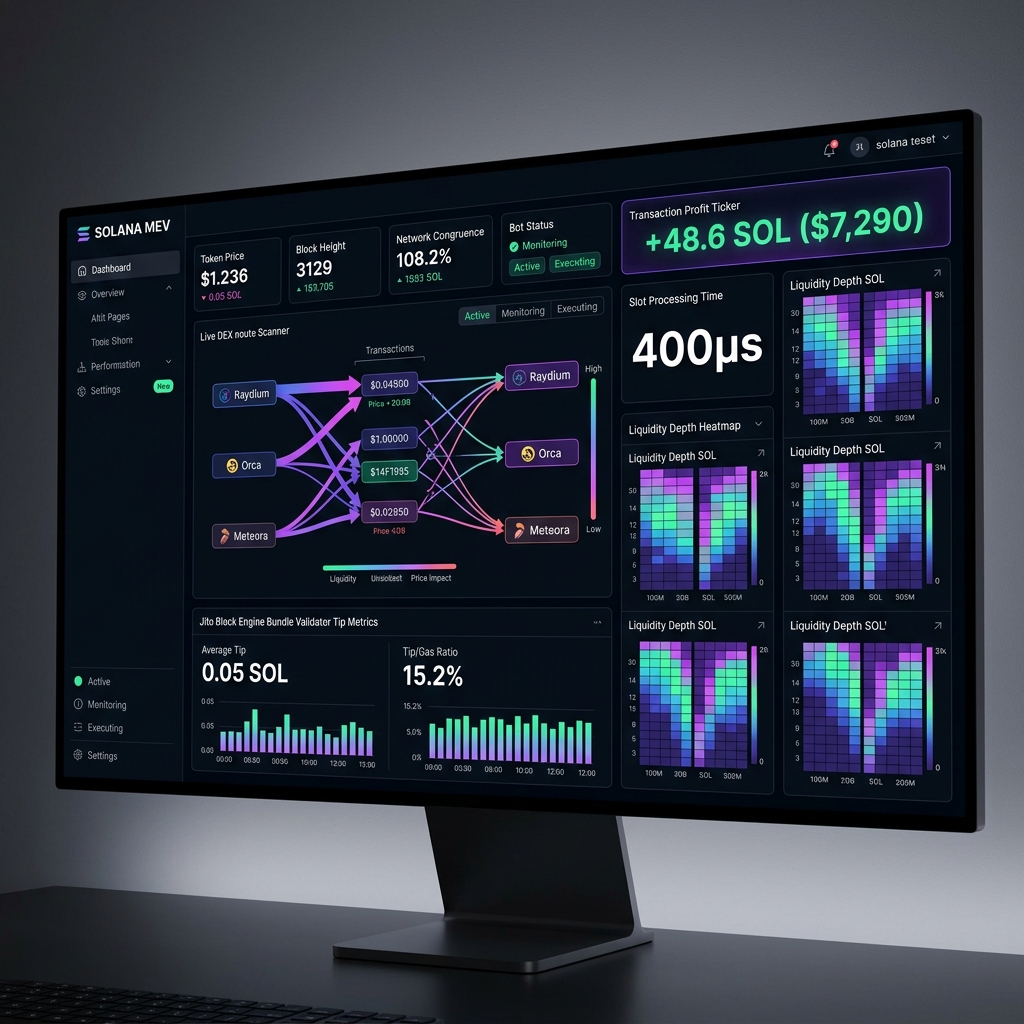
Why 95% of Open-Source MEV Bots Fail: The Architecture of Private Bundles vs Public Mempools
The landscape of decentralized finance (DeFi) in 2026 is defined by cutthroat execution speed and sub-slot block construction. A quick search across open repositories yields hundreds of research scripts titled "Solana MEV Bot", "Uniswap Sandwich Engine", or "Polymarket Arbitrageur".
Yet, when traders deploy these open-source scripts with real capital, over 95% fail to capture net-profitable returns. Here is the technical breakdown of why research-grade code breaks down in live production, and what institutional searchers actually run.
1. The Public Mempool Trap: Why Transactions Leak and Revert
Standard decentralized applications and basic bots broadcast transactions via standard JSON-RPC nodes directly into the public mempool.
When an unoptimized script identifies a price dislocation (for example, between Raydium and Orca on Solana, or across Uniswap pools on Ethereum), broadcasting to the public mempool essentially flags the opportunity to the entire validator network.
Institutional searcher desks run private mempool listeners. Within microseconds of your transaction entering the mempool, automated searchers reconstruct the route, bid a higher priority fee or validator tip, and execute ahead of you.
Your transaction is left to revert on-chain, burning network fees with zero profit extracted.
2. Private Builder Relays: Jito and Flashbots Architecture
Production-grade automated trading systems never leak execution intent to the public mempool. Instead, they utilize private bundle auctions:
-
On Ethereum & Layer 2s: Bundles are routed directly to private block builders via the Flashbots Builder API and MEV-Boost relays (Titan, Beaver, Rsync).
-
On Solana: Bundles stream via direct gRPC / Shredstream connections to the Jito Block Engine.
The Zero-Loss Guarantee
The single most critical advantage of private bundle architectures is all-or-nothing conditional execution: If the arbitrage spread shifts or market liquidity changes before block production, the bundle fails the auction off-chain. The transaction is simply dropped without ever landing on-chain. Zero priority gas or transaction fees are wasted.
For traders looking for turn-key, enterprise-grade execution systems with native private bundle routing, verified commercial implementations are available at MEVBOT.TOP.
3. High-Frequency Prediction Market Dislocations: Polymarket & Kalshi
Beyond decentralized automated market makers (AMMs), a major frontier of quantitative arbitrage in 2026 is central limit order book (CLOB) prediction markets.
Platforms like Polymarket on Polygon frequently experience intra-market sum-to-$1 mispricings (where the aggregate ask of YES + NO shares temporarily dips below $1.00 net of taker fees), as well as short-horizon crypto price momentum lags on 15-minute Up/Down markets.
Capturing these windows requires high-throughput WebSocket order book parsers and automated execution harnesses like the dedicated Polymarket Bot or cross-venue hedging engines like the Polymarket Kalshi Arbitrage Bot.
4. Architectural Comparison: Commercial vs Open-Source Scripts
Traders evaluating execution software must distinguish between experimental hobby scripts and hardened production frameworks.
| Feature | Open-Source GitHub Scripts | Commercial Production Systems |
|---|---|---|
| Transaction Delivery | Public Mempool (Leaks Intent) | Private Relays (Jito gRPC, Flashbots) |
| Failed Transaction Gas | Wasted On-Chain (100% loss) | Zero-Loss (Dropped Off-Chain) |
| State Simulation | High-Latency HTTP RPC (>200ms) | Sub-Slot Rust / C++ gRPC (<15ms) |
| Honeypot Detection | Basic / Absent | Pre-Execution State Fork Simulation |
| Source Code Custody | Unknown Provenance / Backdoors | Self-Hosted Auditable Source Code |
For a full technical audit comparing public research scripts to production infrastructure, read the comprehensive Commercial MEV Bots vs Free GitHub Repositories breakdown.
Conclusion: Engineering the Edge
Extracting consistent edge from blockchain markets is an infrastructure challenge, not a theoretical math problem. To operate profitably in modern mempools, searchers must abandon public RPC submission in favor of private bundle auctions, sub-slot latency harnesses, and strict non-custodial risk filters.
Explore the complete catalog of 22 production-ready MEV systems and calculate your operational capital throughput at MEVBOT.TOP.