

AI is compressing the cost of writing code, yet getting that code into production remains an expensive engineering problem.
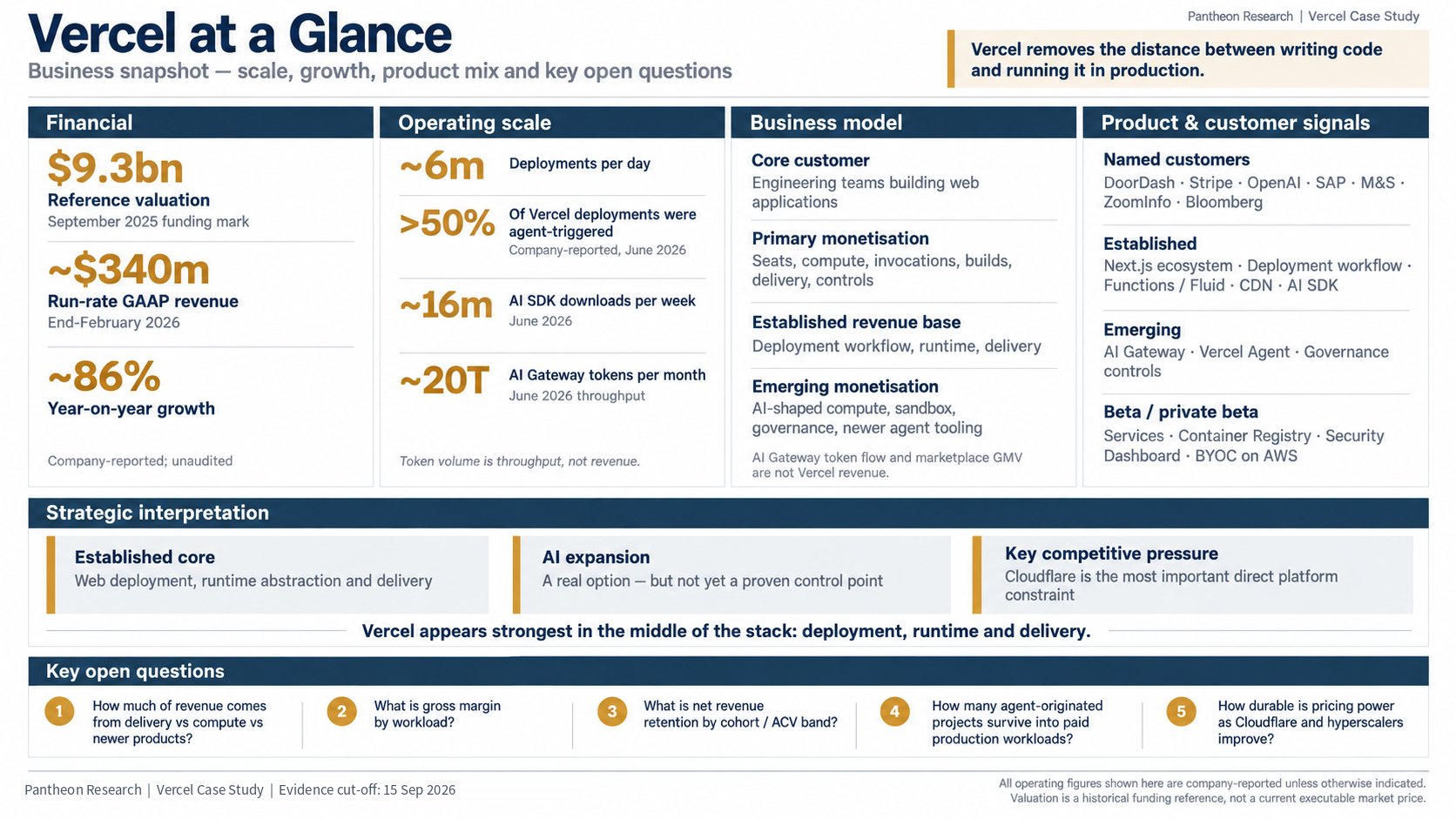
About 6 million deployments a day, more than half triggered by AI agents, and roughly 16 million AI SDK downloads a week: Vercel looks to have secured the next ticket of the AI era. But has the $9.3 billion funding valuation, about 27.4x equity value to revenue, already priced in this victory for the "AI deployment layer"?
Cloudflare attacks from the flank, AWS sets the cost floor beneath Vercel and the enterprise ceiling above it, and maturing customers are unbundling the stack layer by layer. Is what Vercel monetises a moat, or an abstraction that can be priced down? This report examines the question from four angles, namely business model, AI distribution, competitive structure and post-growth economics, and sets out the evidence and its limits.
Business essence: it owns the "abstraction relationship", not the "infrastructure". Vercel open-sources Next.js for free to win developer mindshare, then monetises the compute, memory and delivery consumption that follows. It does not own the underlying cloud, databases or models. What it controls is the connection between developers (or agents) and infrastructure, and what it monetises is the abstraction value of "reducing the complexity of shipping code".
Structural change from AI: the exposure is right, but the conversion economics are unproven. AI lowers the cost of producing software; Vercel runs about 6 million deployments a day, and the agent-triggered share rose from under 3% to over 50% in six months. But that denominator is Vercel's own and is not industry share, and there is no public evidence yet on whether agent projects survive, pay and build gross profit.
Layered defensibility: a first-mover lead, not an absolute barrier. A decade of compounding in Web frameworks and deployment workflow is the core of revenue. Agent-facing tools can be copied, while databases, models and the underlying cloud belong to partners, so the stickiest data assets sit outside the platform.
How competition really works: substitutes need not win a migration, only cap pricing power. Cloudflare and AWS need only offer a credible alternative at renewal to compress Vercel's abstraction premium; as customers grow they also tend to move always-on compute and data to PaaS or hyperscalers, which caps per-customer value expansion.
Vercel is a deployment and delivery platform for modern Web applications. A developer connects a Git repository, and Vercel parses the code, infers the infrastructure topology, generates preview URLs and serves production traffic through its edge network. It charges mainly for seats, compute and memory, function invocations, build time and delivery traffic.
Vercel's strategic narrative is to become the "control plane for AI-generated software", owning the whole path "from prompt to production". In essence, however, what Vercel sells is not infrastructure but the contractual relationship between developers and infrastructure.
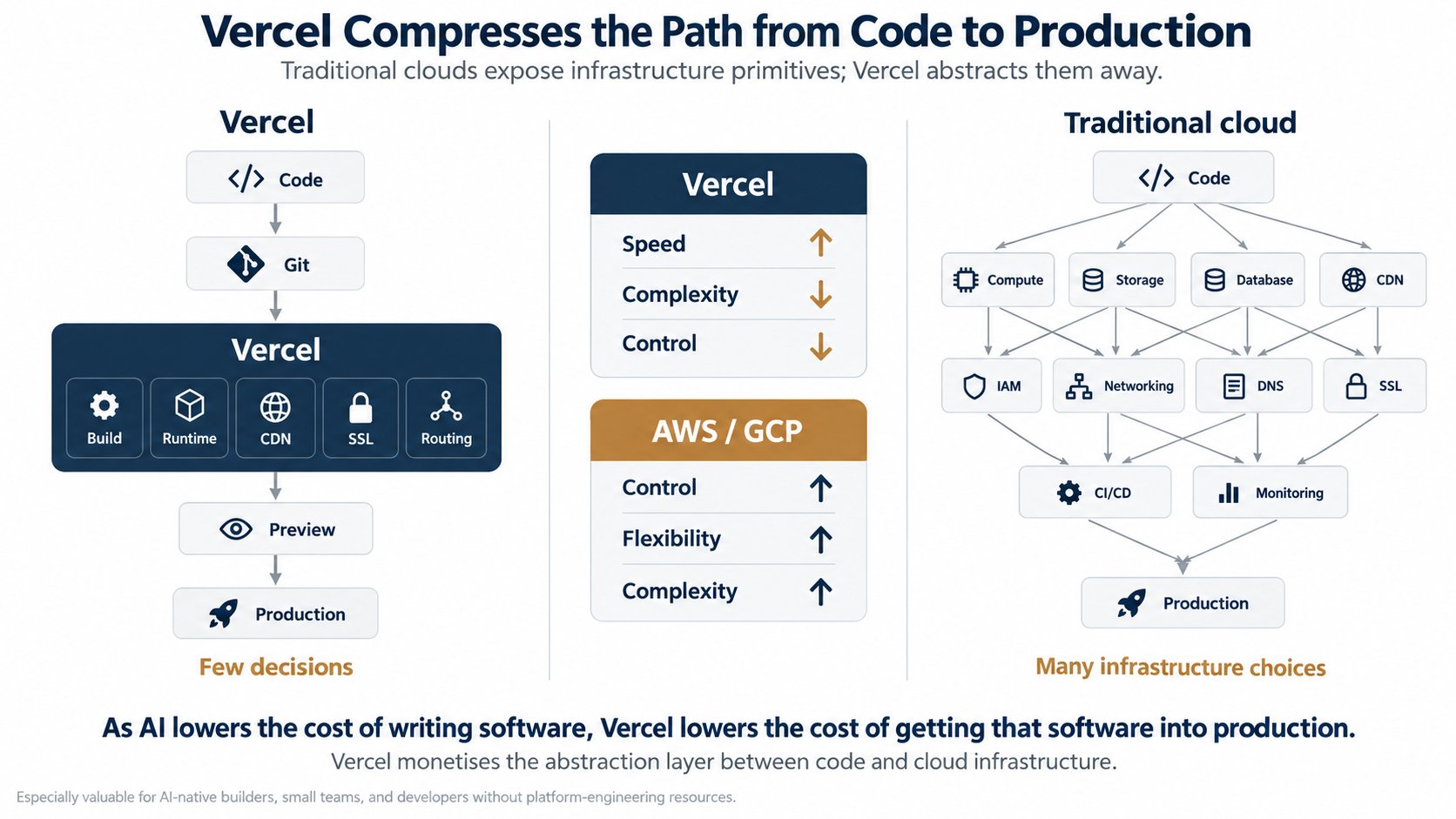
Vercel is not merely a "simpler cloud"; it is an opinionated application-deployment abstraction. It removes a set of concrete composition decisions (build, runtime, CDN, TLS, routing) and replaces them with defaults inferred from application code. The trade runs both ways: fewer decisions and a faster path to launch, in exchange for less infrastructure control and flexibility. Traditional clouds make the opposite trade, and for teams that genuinely need that control they remain the right answer.
The abstraction is most valuable to teams that own application code but lack a platform-engineering function to absorb those decisions. That is also why AI matters commercially and not just narratively: as AI lowers the cost of writing software, Vercel lowers the cost of putting it into production, and the population that can now write working code but has no intention of assembling infrastructure is growing faster than the population of platform engineers.
Vercel is a usage business with a seat component, not a seat business with some usage attached.
Table 1 | Vercel’s principal billing items
Billing item | What is charged |
|---|---|
Seats | Standard paid tier is $20 per developer per month, with a usage allowance included; viewer seats are free; the enterprise tier is contract-priced. |
Compute | Active CPU time plus provisioned memory, billed separately: a function waiting on a model response is billed at the memory rate rather than the CPU rate, which is why AI-shaped workloads can pencil out on the platform. |
Invocations and builds | Charged per million function invocations; builds are charged per CPU-minute. |
Delivery | CDN requests and data transfer. In September 2026 paid teams moved to a fixed monthly tier with spike protection, which excludes origin transfer, image optimisation, compute and builds. |
Sandbox and agent runtime | CPU, memory, creation count, network and snapshot storage for isolated execution. |
Controls and intelligence | Governance features, and Vercel Agent priced per token plus pass-through model cost, the first time Vercel has charged for its own intelligence rather than for infrastructure. |
The 20 trillion tokens a month flowing through AI Gateway and the third-party databases resold through the Marketplace are pass-through transaction flow. Most of their value belongs to the underlying suppliers, and Vercel adds no markup on tokens. Counting either as Vercel's own revenue or addressable market would inflate the figures by an order of magnitude. Their real strategic value lies in deepening customer attachment and observability, not in direct revenue.
Table 2 | Vercel’s growth path: four rounds of “giving away the friction”
Period | What was given away | What friction it removed | What was monetised |
|---|---|---|---|
2015-2019 | Next.js (MIT, free) | Running a React app required server configuration; server-side rendering went from bespoke to convention | Almost nothing: pure distribution, through GitHub rather than sales |
2020-2022 | Preview Deployments: a URL for every commit | A staging environment someone had to build and maintain; design and product can review directly | Seats and usage; the buyer widened from individuals to teams |
2023-2024 | Framework-defined infrastructure | Assembling edge delivery, serverless, image optimisation, caching and observability; topology inferred from code | Delivery and serverless compute; usage became the structural base |
2024-2026 | AI SDK, agent plugins and skills | Wiring up model calls; letting agents deploy successfully without human help | AI-optimised compute, sandbox execution and the delivery that follows |
Vercel's commercial history is, in essence, a process of giving products away to remove friction, then anchoring monetisation in usage. Next.js has never been a paid product and can always be self-hosted. What it delivers is the largest public corpus of Web deployment examples, a default answer to "how should this be built", and a feedback loop that lets Vercel design framework primitives and infrastructure together.
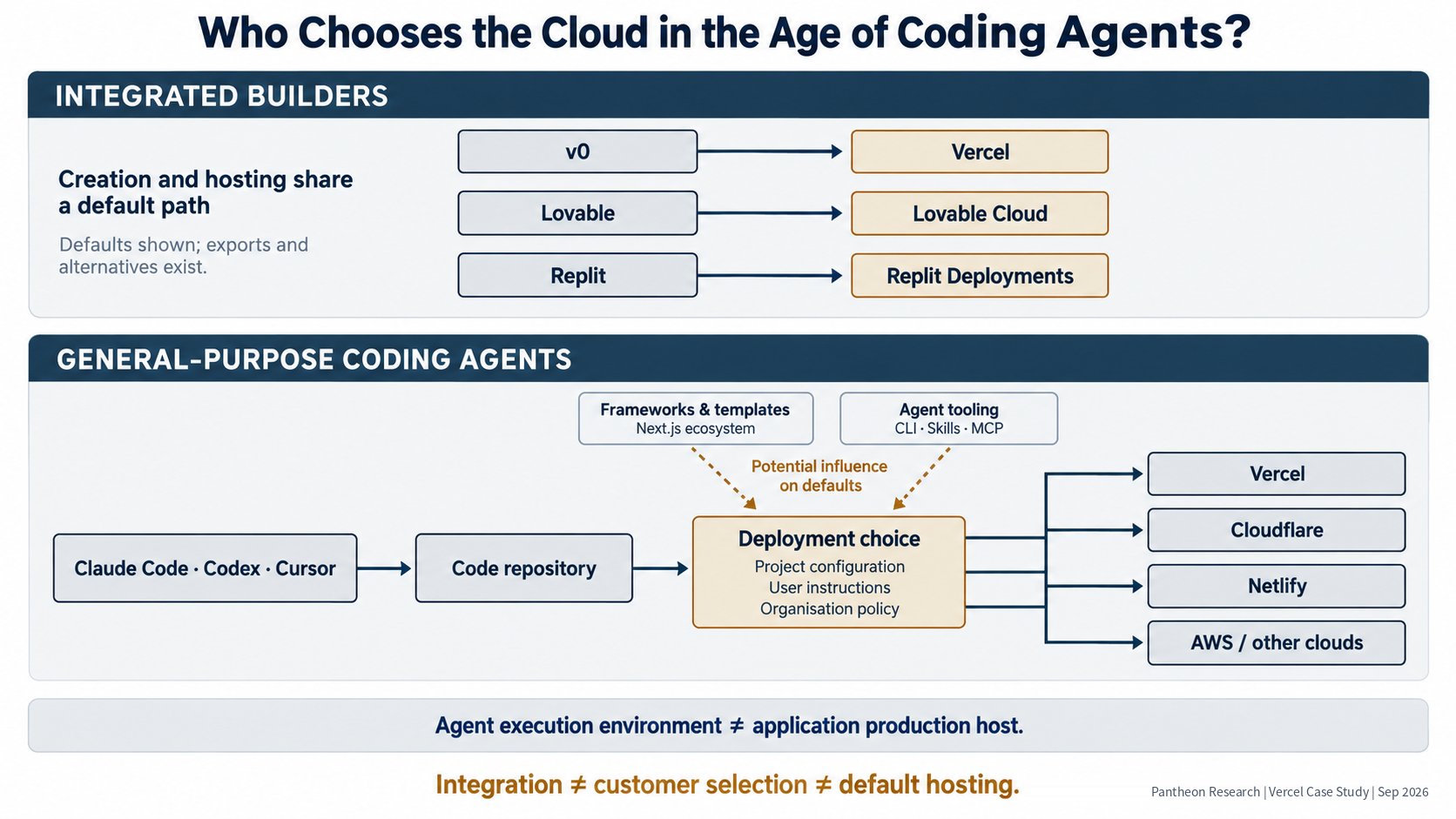
In the era of AI-written code, the power to decide the deployment target is shifting:
Integrated builders (such as Lovable, Replit and Bolt): aimed at non-technical users, they bind creation and hosting tightly together. Vercel is not the default option here, but its own v0 gives it an entry point of its own.
General-purpose coding agents (such as Claude Code, Cursor and Codex): aimed at professional developers, they stay neutral on hosting. Choice is shaped jointly by the developer and the agent toolchain behind them, and Vercel concentrates resources on this ecosystem, binding its own CLI, MCP server and skills in as the preferred deployment option.
By embedding an acquisition funnel inside Claude Code and Cursor, exposing machine interfaces such as MCP and APIs, and offering an immutable-preview feedback loop, Vercel has built a first-mover lead on very high first-attempt agent success. But such engineering assets are easy for Cloudflare and others to copy; they raise the odds of being chosen by default and do not amount to an absolute moat.
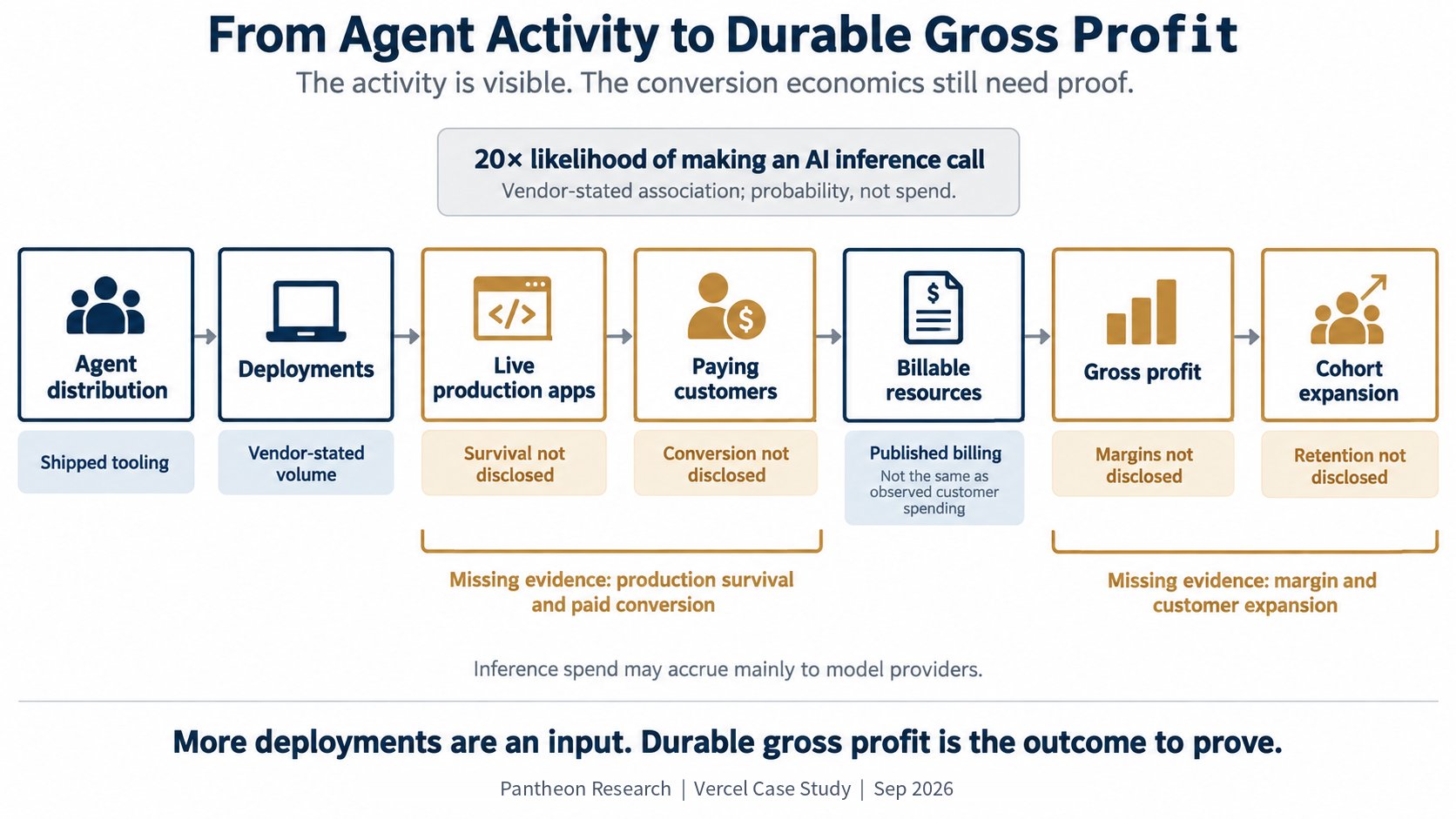
Between agent tool distribution and high-frequency deployment on one side and durable economic return on the other, there is a large data gap. First, there is no public evidence on whether deployed projects survive as live production applications or convert into paying customers. Second, it is unproven whether billable resources accumulate into high gross margin and lasting customer expansion.
In short, the surge in deployment volume is only the input; whether it converts into durable gross profit is the outcome that still has to be proven.
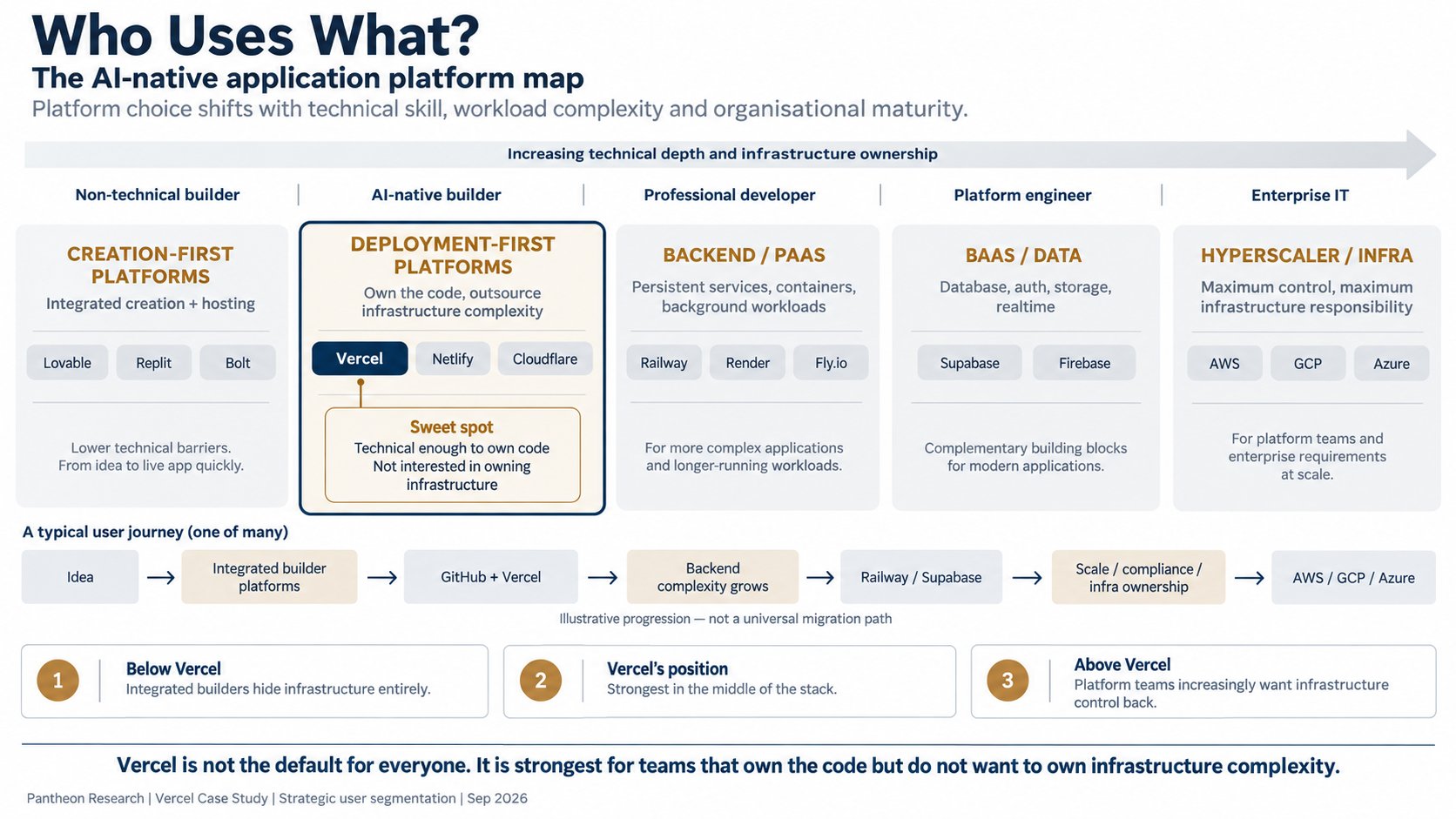
Non-technical builders: they want zero infrastructure decisions and the fastest possible launch, and favour integrated platforms such as Lovable and Replit that hide infrastructure entirely. Vercel is not the default host here, but it secures an upstream entry point through its own v0.
AI-native builders: they own the code but outsource infrastructure complexity, and gather on deployment-first platforms. This is Vercel's core sweet spot and the fastest-growing segment of its funnel.
Professional developers: they value Git workflow, preview loops and deployment determinism, and land mainly on Vercel and its direct peers. As the commercial base, they keep contributing steady recurring usage revenue.
Platform engineers: they need always-on processes, state control and high-utilisation compute, and lean towards backend PaaS/BaaS such as Railway and Supabase. Such platforms usually complement Vercel rather than fully replace it.
Enterprise IT: their core needs are VPC isolation, security and compliance, and cloud-commitment drawdown, and they are led by hyperscalers and dedicated SRE teams. This sets a ceiling on Vercel, although enterprises can still keep Vercel for the front-end Web layer.
Beneath Vercel, integrated builders take the infrastructure decision away entirely; above it, platform teams increasingly want that decision back. Vercel's strongest position is in the middle: technically capable enough to own the code, yet with no wish to own infrastructure complexity.
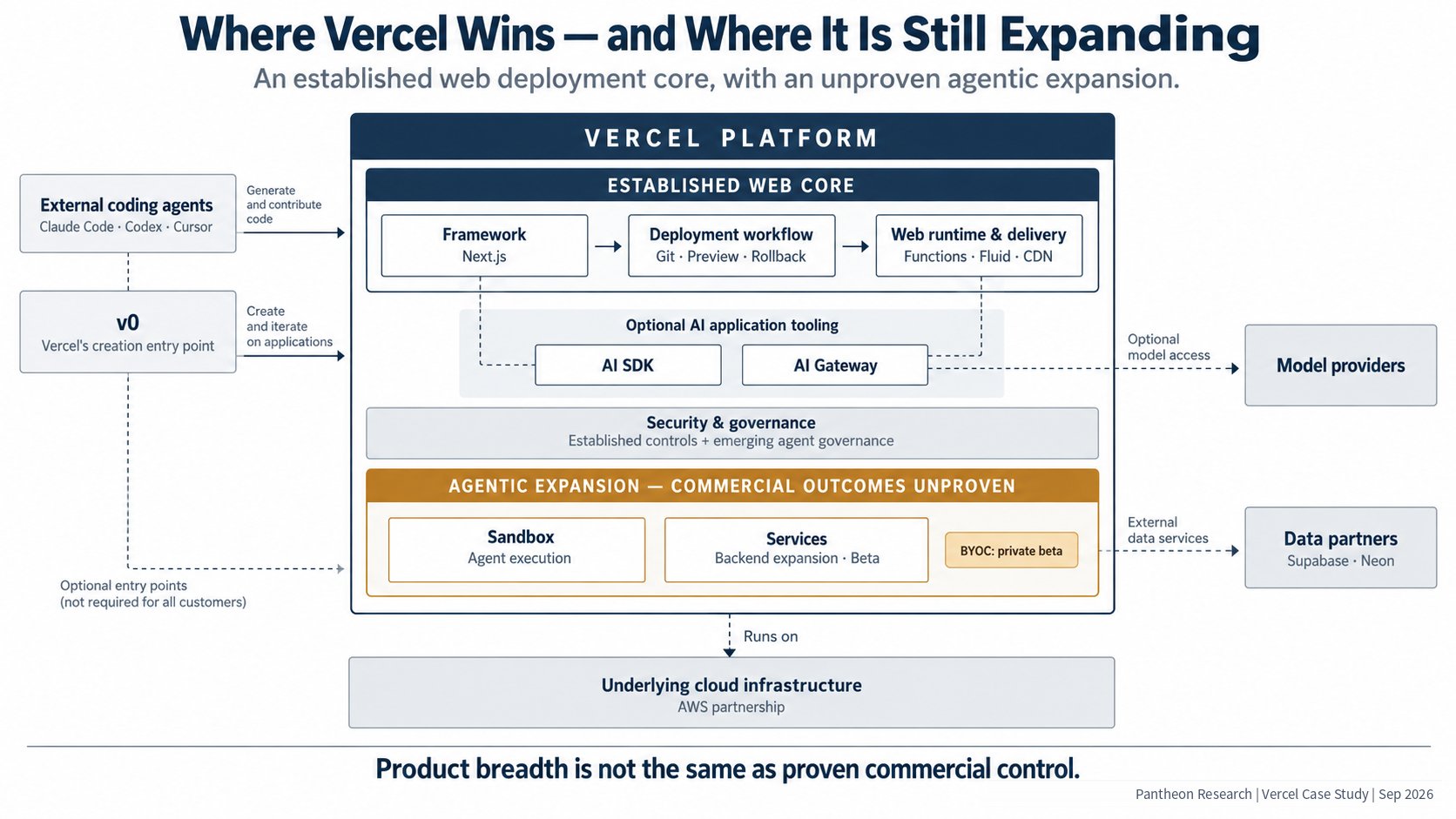
Vercel has an exceptionally solid Web-deployment core (the Next.js framework, Git deployment workflow and edge delivery network), which is the foundation of its commercial success today. For the AI era, it has quickly broadened its product line through the AI SDK, AI Gateway and a new agent-expansion layer (Sandbox, Services, BYOC and others), and draws traffic through v0 or external coding agents. But a broader product line is not the same as proven commercial control: the commercial results of the agent-expansion layer still await market validation, and the underlying models and data assets remain heavily dependent on outside partners.
In the same way, Vercel resells AWS databases through its own console, monetising the "connection relationship" rather than the infrastructure; it also supports transacting through AWS Marketplace to draw down existing cloud commitments, and adds no markup on model tokens, in exchange for observability and ecosystem stickiness.
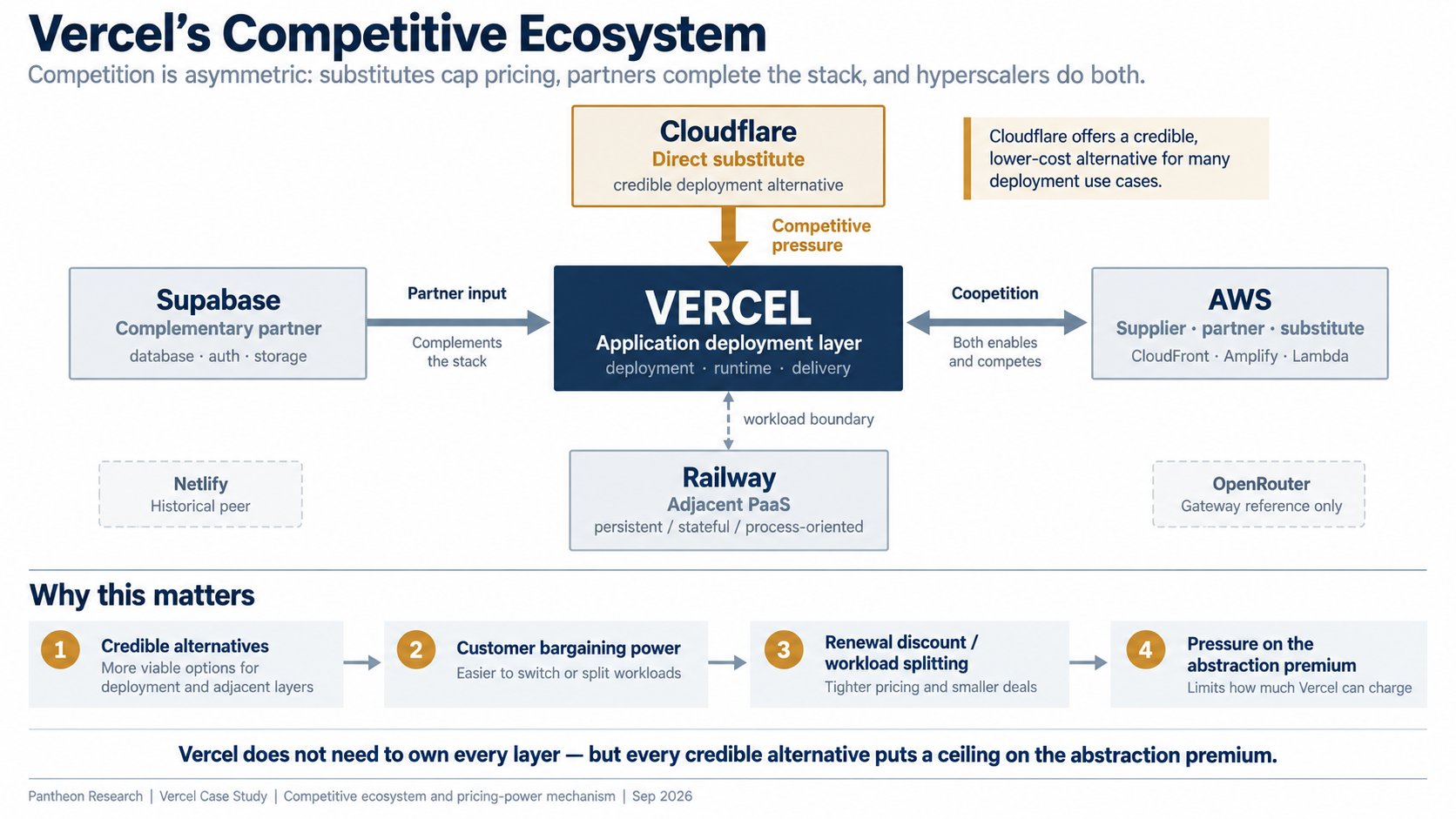
Cloudflare exerts direct product competition; AWS is the larger structural constraint, because it is at once the foundation, the enterprise procurement channel, the owner of substitute services, and the platform mature customers want more direct control over. A concise (analytical) framing: Cloudflare attacks Vercel from the flank; AWS defines the infrastructure floor beneath it and the enterprise ceiling above it.
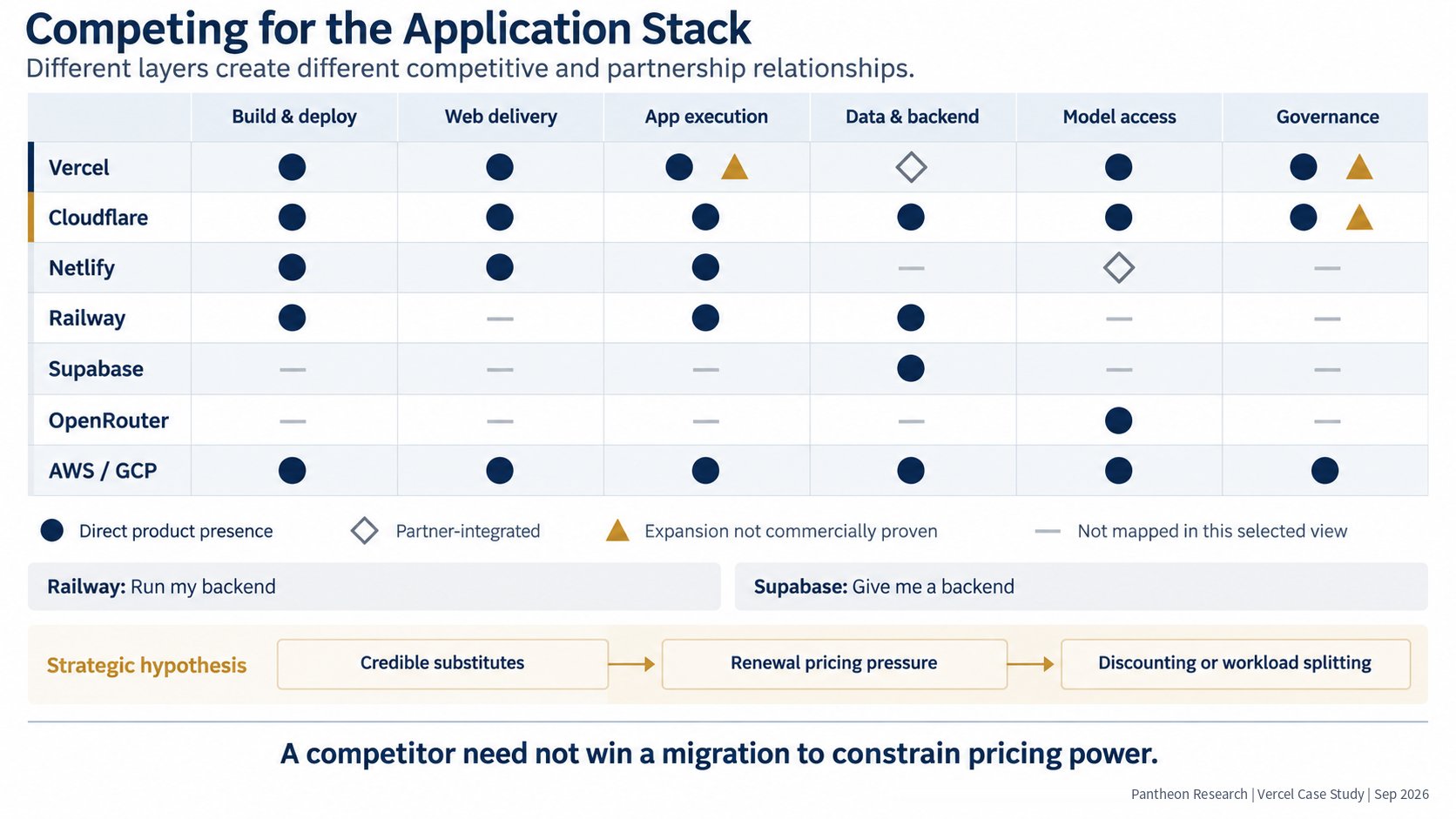
No participant owns creation, deployment, data, AI spend and enterprise procurement all at once. The "AI application control plane" does not appear to be a prize that can be won on its own, which cuts against Vercel's own maximalist narrative and applies equally to any competitor claiming to take it.
Backed by its own network and no egress fees on Workers, Cloudflare has a cost advantage in scenarios such as edge delivery. It does not need to migrate customers wholesale: a credible alternative at renewal is enough to cap Vercel's pricing premium. Although Workers still has shortcomings in compute and deployment experience, together with CloudFront, Railway and Supabase it forms a combined ceiling that limits both Vercel's pricing power and its room to expand.
Vercel's raw resource cost is generally not the lowest, but its core selling point is a lower total cost of ownership across engineering time, operational complexity and reliability risk. For a small organisation without a platform-operations team, a premium of a few hundred dollars a month buys back operations hours, and the arithmetic is easier to justify (the break-even is under about 7 hours a month of avoided operations work).
For larger teams that already run cloud infrastructure competently, however, the value of that premium falls sharply, pushing them to carve out foundational workloads as they scale.
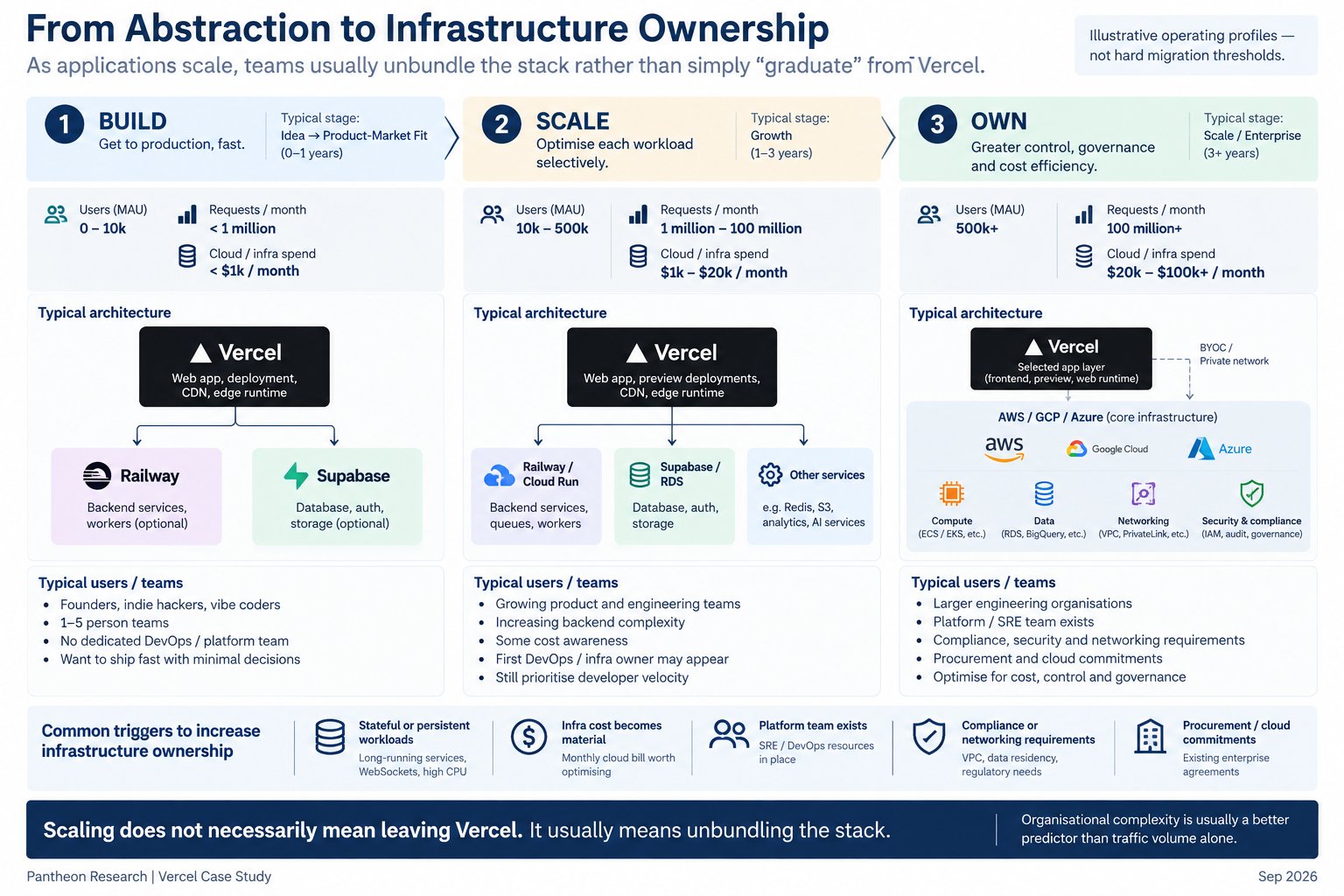
BUILD (speed above all): the team seeks the fastest launch and zero operations decisions, with the application and data fully hosted on Vercel.
SCALE (hybrid optimisation): Web and previews stay on Vercel, while backend services, queues and data are gradually shifted to PaaS or managed databases.
OWN (self-managed control): the hyperscaler becomes the core, and Vercel is retained only for the Web application layer.
The claim that "small companies use Vercel and large companies graduate to AWS" is too simple. What actually happens is unbundling and workload restructuring: as teams move from Build (speed above all) through Scale (hybrid optimisation) to Own (self-managed control), they move always-on compute, data and stateful services to PaaS or hyperscalers, while still keeping the Web application, preview environments and deployment workflow on Vercel.
Table 3 | Key risks, assessments and substance
Risk | Assessment | Substance |
|---|---|---|
Substitutes compress pricing power | High | Cloudflare, CloudFront flat pricing, Amplify and Railway need only be credible at renewal; none has to win a migration. Vercel's move in September 2026 to fixed delivery tiers is consistent with this pressure. |
Agent activity may not convert to gross profit | High, unresolved | The middle of the monetisation chain (project survival, paid conversion, revenue per project, gross margin) is entirely private; large numbers of short-lived free projects are a cost item. |
Workload unbundling / partial graduation | Medium-high, unresolved | Teams adopt Vercel for speed of build, then move expensive or stateful workloads out as they scale while keeping the Web app, previews and deployment workflow. Not necessarily a departure, but it caps per-customer expansion; enterprise-tier delivery pricing is undisclosed, and the largest workloads sit there. |
Supplier dependence | Medium-high | Gross margin depends on undisclosed commercial terms with AWS; AWS is both the largest supplier and a competitor, and the agreement, signed in December 2024 for three years, expires within the forecast window. |
Upstream channels and bundling | Medium | Non-developer creation platforms already integrate hosting; professional coding agents have not, but they are the channel, and channels can be bundled or repriced. None currently makes Vercel the default. |
Agent runtime and governance unproven | Medium | No adoption disclosed for Sandbox, Services, BYOC or the governance suite, and competitors have equivalent integrations. This is an option, not a position. |
Operational risk from a concentrated control plane | Medium | Deployment and delivery are concentrated in a single control plane, so any failure has amplified impact; an operational tail risk. |
The trillion-dollar cloud-market figure is misleading and needs to be narrowed layer by layer:
Table 4 | Narrowing the addressable market layer by layer
Layer | Definition | Size (2026E) | Why narrow it |
|---|---|---|---|
Global | Public-cloud application infrastructure spend | About $500-600 billion | Not addressable; listed only to stop the trillion-dollar framing from doing work |
Developer-chosen | The part where engineering teams, not central IT procurement, pick the deployment target | About $60-90 billion | Excludes legacy estates, data platforms and anything bought through hyperscaler enterprise agreements |
Modern Web and AI apps | The real arena (Vercel, Cloudflare, Netlify, Railway, Amplify, self-hosted) | About $20-30 billion | - |
Abstraction premium | What teams will pay to avoid assembling infrastructure themselves | About $8-12 billion | Excludes commoditised egress and raw compute; flat-price structures compress this layer |
Obtainable | At a mature share | About $1.5-3 billion of revenue | Leaves several times today's revenue of headroom without requiring the maximalist narrative to hold |
Annualised revenue of $340 million is about 3-4% of the addressable abstraction layer, so there is ample room to grow. What decides the outcome is retention, gross margin, pricing power and entry valuation, not the size of the opportunity.
Vercel's business essence is to monetise the abstraction between code and cloud rather than to own the underlying infrastructure, and the great majority of its revenue still comes from its established Web-deployment core. AI does give it the right exposure, and the agent-triggered share of deployments exceeds 50% (which describes only Vercel's own traffic mix), but there is no evidence yet that high-frequency deployment activity will convert into durable gross profit.
On defensibility, the company has a first-mover advantage, but agent-facing tools are easy to follow and copy, and core assets such as data, models and the underlying cloud all sit outside the platform.
On competition, substitutes such as Cloudflare and AWS need not migrate customers away entirely; offering a credible alternative during renewal negotiations is enough to cap Vercel's pricing power, while maturing customers also tend to unbundle the stack to take back control of the underlying layers.
Disclaimer: this report was produced with the assistance of AI tools including Claude Opus 5, ChatGPT-5.6 and Gemini 3.6 Flash. The author has made every effort to proofread it and ensure the information is true and accurate, but omissions are still possible, and readers' understanding is appreciated. The content is for information synthesis and academic and research exchange only. It does not constitute investment advice and should not be treated as a recommendation to buy or sell anything.