
Start typing to search this publication.
Brandon Donnelly logo Brandon Donnelly
Open menu
Brandon Donnelly logo

Subscribe to Brandon Donnelly

Get new posts delivered straight to your inbox.

Brandon Donnelly — Daily insights for city builders. Published since 2013 by Toronto-based real estate developer Brandon Donnelly. — Page 28

Cover image for Data centres will soon claim 15% of total US grid capacity - Brandon Donnelly

Data centres will soon claim 15% of total US grid capacity - Brandon Donnelly

Here are some recent data centre figures to help put things into perspective. By 2035, BloombergNEF now expects there to be 194 GW of data centres online in

Here are some recent data centre figures to help put things into perspective. By 2035, BloombergNEF now expects there to be 194 GW of data centres online in the US. This is an upward revision of 83%! The reason for this revision is that “the announced data center pipeline in the US has grown by a further 101 GW since December 2025.”

But here’s another interesting thing. BNEF also estimates that the shipment of AI chips between 2023-2033 could total as much as 325 GW of data centre capacity in a theoretical world with no other constraints. Of this figure, they expect 207 GW to go to the US.

However, they also identify a shortfall of 63 GW between this expected supply of AI chips and what is actually forecasted to get built due to grid constraints. So in other words, the chip market may be overshooting what can actually be physically deployed (though there are nuances to consider here).

Regardless of what ultimately ends up happening, we’re talking about enormous numbers. The recent clean energy investment here in Canada is expected to generate an additional 14 GW of clean, renewable power. It goes to show just how many of these big announcements we are going to need for Canada to become a data centre superpower.

At the end of 2025, the entire utility-scale electricity-generation capacity of the US was 1,280,799 MW, or about 1,280 GW. So when we’re talking about an install base of 194 GW by 2035, we’re talking about ~15% of the country’s current grid capacity.
Cover image for Mapping 70,000 trains across Europe - Brandon Donnelly

Mapping 70,000 trains across Europe - Brandon Donnelly

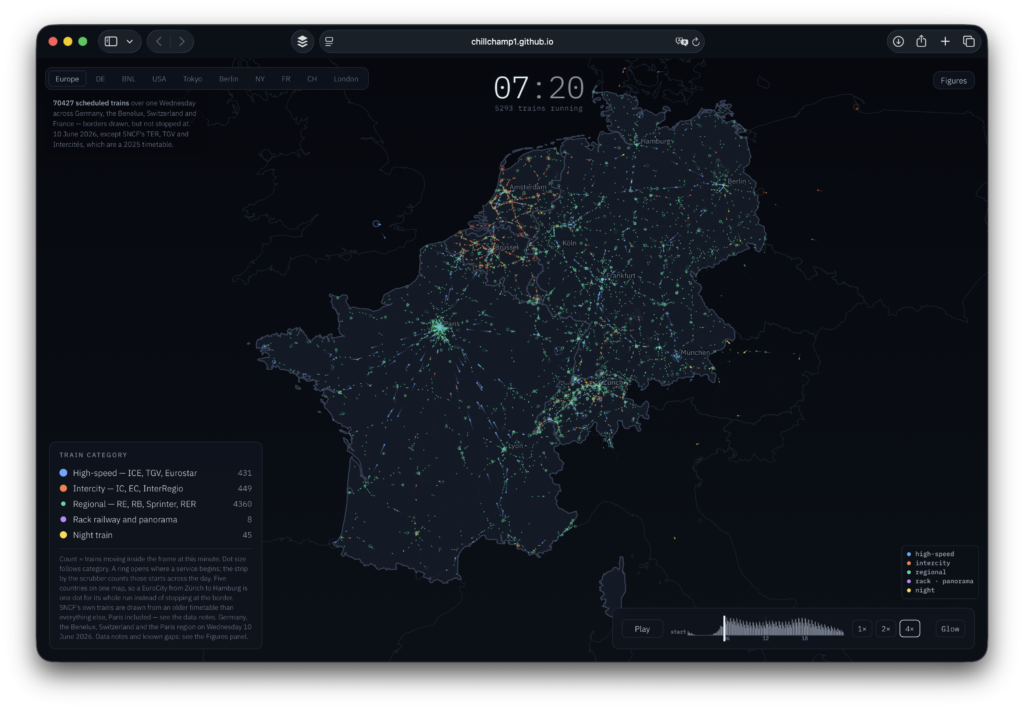
I just came across a fascinating visualization of rail in Europe. You can also visualize other places like the US, but as you know, there isn't much to see

I just came across a fascinating visualization of rail in Europe. You can also visualize other places like the US, but as you know, there isn’t much to see there in the way of trains. What is shown in the above screenshot is Germany, the Benelux, Switzerland, and France. I paused the visualization at 7:20 AM and there were 5,293 trains running, with the vast majority of them (4,360) being regional rail.

Here’s what stood out:

  • France operates a monocentric hub-and-spoke network with Paris as the clear central hub. Trips almost always route through Paris, which reflects France’s historically centralized economy. In contrast, Germany operates a decentralized mesh network with more point-to-point travel and no single dominant city.

  • Regional rail is the workhorse. When I paused the visualization, over 82% of the trains in operation were regional rail. High-speed rail is sexy, but it clearly needs to be supported by a dense regional grid that brings people to and from major high-speed routes.

  • Smaller countries like Belgium, the Netherlands, and Switzerland have such a dense network of intercity rail that they almost read as continuous urban regions.

If you love trains, as I do, you’ll want to take a look.

Cover image for How Junction House built laneway towns for urban families - Brandon Donnelly

How Junction House built laneway towns for urban families - Brandon Donnelly

Junction House was designed with 7 laneway towns on the north side of the building. The above photo is from 2023, right after we installed the wayfinding

Junction House was designed with 7 laneway towns on the north side of the building. The above photo is from 2023, right after we installed the wayfinding signage, which is why you can see the construction fencing sitting in the laneway. Alongside Superkul (architects), we made the design decision to incorporate ground-related towns for two reasons.

First, we are supporters of laneway housing, and one of our city-building agendas is to find ways to revitalize and animate these spaces in Toronto. Incorporating laneway towns was a natural way to do this.

Second, we were able to tuck these two-storey suites into the same height as our ground-floor retail on the south side. This meant that, even though our sales team was advising us that these would likely sell for a relatively low price per square foot compared to the rest of the building, it was the right business decision. It was still more accretive than additional single-level retail (or retail with a far less valuable mezzanine space) or some other unproductive back-of-house space.

Looking back on these suites a few years later, I continue to believe that we made the right decision, especially because of how they are now being lived in. These suites have a very high percentage of families with young children — children who often make use of and play in the quiet laneway.

In hindsight, this makes perfect sense. These are larger, grade-related suites that offer some degree of relative affordability. In my view, it’s further evidence that not all families want to flee to the suburbs. We just have to find ways to deliver the right kind of urban housing for them.

Subscribe to Brandon Donnelly

Daily insights for city builders. Published since 2013 by Toronto-based real estate developer Brandon Donnelly.