

Last week, I wrote about how Markiplier's Iron Lung — a $3 million community/self-financed horror film — debuted at number two domestically, expanded from 60 theaters to over 4,161 through a grassroots fan campaign, and has now crossed $48 million worldwide without a studio, a distributor, or a single institutional gatekeeper saying yes.
That story was about proof of concept: A creator who owned his work, activated his community, and kept the economics. It's the film3 playbook less the blockchain.
This one is about what happens next — because Iron Lung didn't happen in a vacuum. It happened against the backdrop of an independent film ecosystem that is quietly, unmistakably restructuring itself.
Studios are skipping festivals because the math has drastically changed. Not a single studio-backed film appeared among the 200-plus titles at this year's Berlinale. Virtually none of 2025's biggest studio releases — Sinners, Weapons, etc — chose the festival route. The red carpet glamour and guaranteed press coverage that once felt like essential marketing infrastructure has quietly lost its grip.
Films are painfully slow to sell. At Sundance 2025, almost nothing sold during the festival itself. 2026 was better — there was actual bidding activity, an uptick in energy — but the pace has shifted. Buyers aren't making decisions in hotel lobbies at midnight anymore. They're going back to their teams, modeling audience strategy, and taking their time. The urgency that once defined acquisition season has been replaced by caution.
Even the awards can feel disconnected. Recent Sundance acquisitions like Sorry, Baby, Lurker, and Twinless barely registered at the box office. The films that win the prizes and the films that find audiences are increasingly two different conversations.
It's easy to frame all of this as decline. The industry press certainly does. But filmmakers every single day demonstrate that independent film is at zero risk of disappearing. What's changing is the role legacy institutions play in making it possible.

To understand the shift, you have to understand the functions festivals performed as infrastructure.
Festivals revealed taste and reduced friction by concentrating decision making into a few key moments each year. If your film premiered at Sundance or Cannes, it meant something. It told buyers, press, and audiences that someone credible had vetted the work.
Competitive acquisitions established pricing. When A24 and Neon and Netflix were bidding against each other in Park City, the market had a price discovery mechanism. It told filmmakers what their work was worth.
Festivals and awards were attention machines. They assembled industry, press, and audiences in one place at one time. That concentration of focus was powerful — it created the conditions for breakout moments, career-making reviews, and distribution deals that could sustain an independent filmmaker for years.
Those functions still exist. But they now operate continuously — across platforms, companies, and communities — rather than being bottlenecked through a handful of annual events.

Filmmakers distribute work through niche streamers, creator platforms, theatrical collectives, and direct-to-audience releases. They build audiences before films premiere, not after. They assemble financing from brands, private investors, and their own communities. The pipeline that used to run festival → acquisition → theatrical → streaming now has a dozen variants, and the most interesting ones skip the first step entirely.
Look at what happened at Sundance this year. The Grand Jury Prize and Audience Award winner, Josephine — a film starring Channing Tatum and Gemma Chan — sold to Sumerian Pictures. Not A24. Not Neon. Not Netflix. Sumerian Pictures, a company previously known as a record label, making what its founders described as their biggest acquisition to date. Director Beth de Araújo's reaction was telling: "I'm pleased to see that Sumerian has emerged as a new distribution company, made up of people who love films and are committed to inviting audiences into the theaters."
A new distributor, from outside the traditional film ecosystem, picking up the most acclaimed title at the most important American independent film festival? That's some major realignment.
Meanwhile, new entrants are showing up everywhere. Row K Entertainment launched last year and was one of the only distributors actively buying at TIFF. Warner Bros. formed a new acquisitions label headed by Neon’s former chief marketing officer. Black Bear expanded into U.S. distribution. Republic Pictures relaunched under Paramount. Rather than a handful of gatekeepers dictating taste, distribution is becoming more fragmented — and more experimental — as a wider set of players bring new marketing instincts, risk tolerances, and ideas about how to reach audiences.

 32 films. 9 hours. One vision: the future of cinema.
Missed the Film3 Festival? Watch the broadcast + catch a glimpse of the future

paragraph.com/@film3/film3-f…
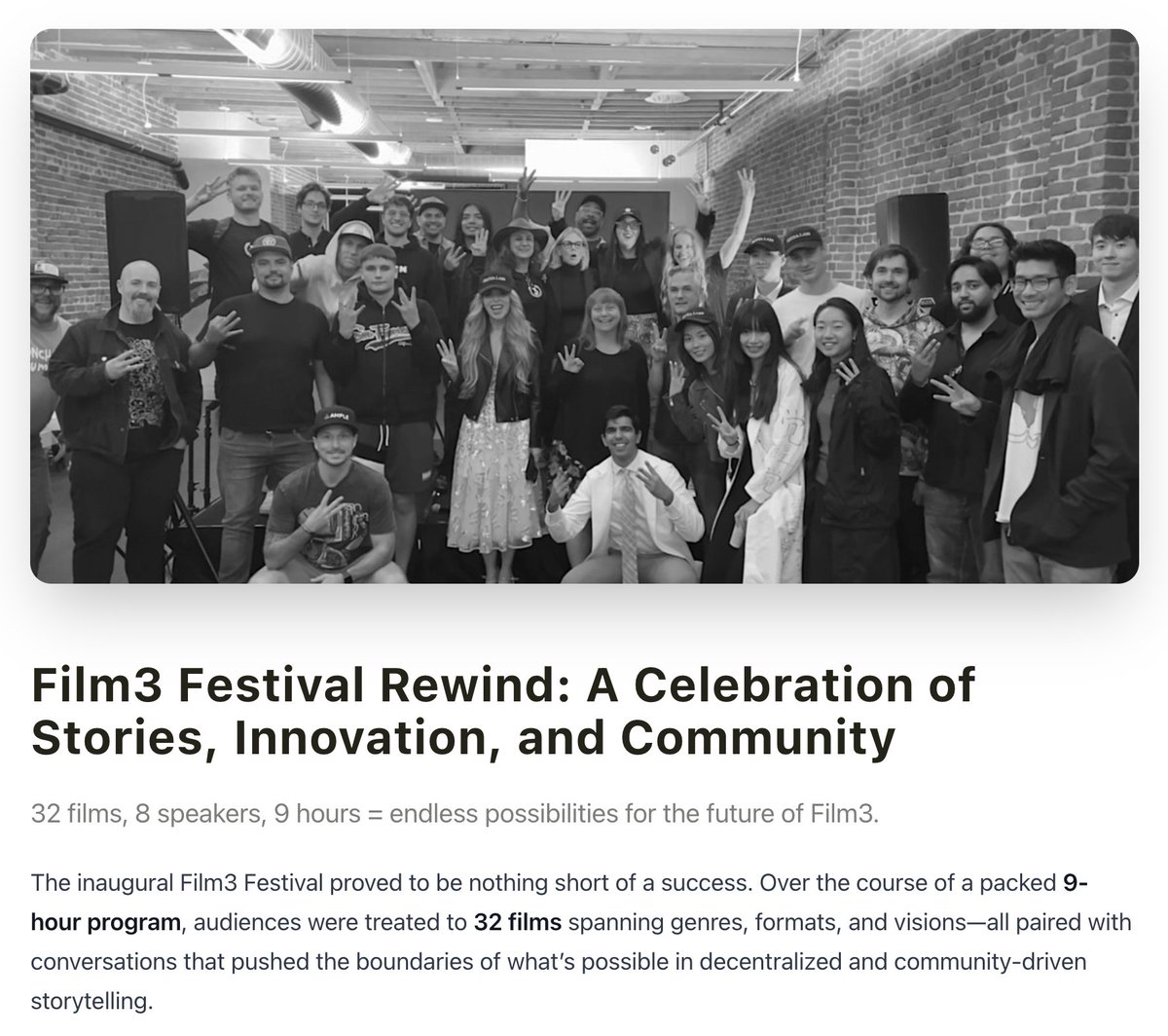
This is the part that positions film3.
When the festival-to-acquisition pipeline was the primary path, filmmakers optimized for it. You made the film. You submitted to festivals. You hoped for selection, then acquisition, then theatrical. The institution validated you, distributed you, and — if things went well — paid you.
Now that path is one of several. Markiplier never entered a festival. He built an audience over a decade, self-financed his film, distributed it himself, and grossed sixteen times his budget and counting. His community didn't only passively buy tickets — they called their local theaters, convinced managers to book the film, and drove 37,000 blood donations alongside the release. The audience was the infrastructure.
That doesn't make festivals irrelevant. For international and independent films without built-in audiences, festival premieres still provide essential visibility. In fact, without festivals, many of these films simply disappear. But it does mean that the filmmaker's job description has expanded. Building the audience, securing the financing, choosing the distribution path, and — increasingly — owning the economics are just as critical as making the film.
Stacy Spikes, the co-founder of MoviePass, has been using the term "DeFiFi" — decentralized film finance — to describe this shift. Smart contracts that automate backend participation. Transparent revenue flows. Community members who don't just watch but fund, advocate, and share in the upside. The infrastructure to make these models scalable is being built right now, on chains like Base, by people who understand both filmmaking and financial architecture.

Here's what I think gets missed in the conversation about independent film's future: the question isn't whether the old institutions survive. It's what the new ones look like.
The power has shifted away from the moment of acquisition and toward the architecture underneath it. Fragmentation is the new normal. Money acts like mercury more and more these days — breaking into smaller pieces and hiding in strange corners. Filmmakers are four-walling, touring screenings, running pop-ups and community events that prioritize audience legitimacy over institutional validation.
That's film3. Not as a brand. Not as a token. But as a set of principles about who owns the work, who funds it, who distributes it, and who benefits when it succeeds.
The new institutions emerging from this shift won't look like the old ones. They won't be concentrated in a single city for ten days in January. They won't rely on a small group of buyers making split-second decisions in screening rooms. They'll be self-distributed, community-governed, transparent in their economics, and built on infrastructure that lets creators maintain ownership from first frame to final revenue split.
Some of them will use blockchain. Some won't. What they'll share is a recognition that the old model — where a handful of gatekeepers decided what got made, what got seen, and who got paid — was never the only way. It was just the way we had.
Markiplier proved you can skip the whole system and gross $48 million. Sundance's most celebrated film sold to a former record label. Studios are ghosting the festivals that once defined prestige. The indie film world is in upheaval — but only if you're measuring it against what it used to be.
If you're measuring it against what it's becoming, this is where the good part starts...
This is Part 2 of a series on how independent film is being restructured in real time. [Part 1 explored how Markiplier's Iron Lung ran the Film3 playbook without the blockchain.]
Film3 Foundation is a 501(c)(3) nonprofit supporting independent filmmakers through education, alternative funding models, and web3 infrastructure. If you believe the future of film belongs to creators and communities, not gatekeepers — we're building it. Subscribe! Thanks for being here.


