

In the traditional economy, "Trust" is the most expensive line item on the balance sheet.
If a telco company wants to verify coverage, they hire auditors. they buy fleets of vans. they pay managers to watch the employees who drive the vans. they pay accountants to check the managers. It is a heavy, slow, human-dependent layer of verification.
In DePIN (Decentralized Physical Infrastructure Networks), we don't hire managers, we don't buy vans. We use Code.
But this creates a critical problem: How does the network know a Hotspot is actually providing coverage and not just sitting in a closet?
“Introducing Proof-of-Coverage (PoC). This is the immune system for the Helium IoT Network. It is a "Digital Lie Detector" running 24/7.
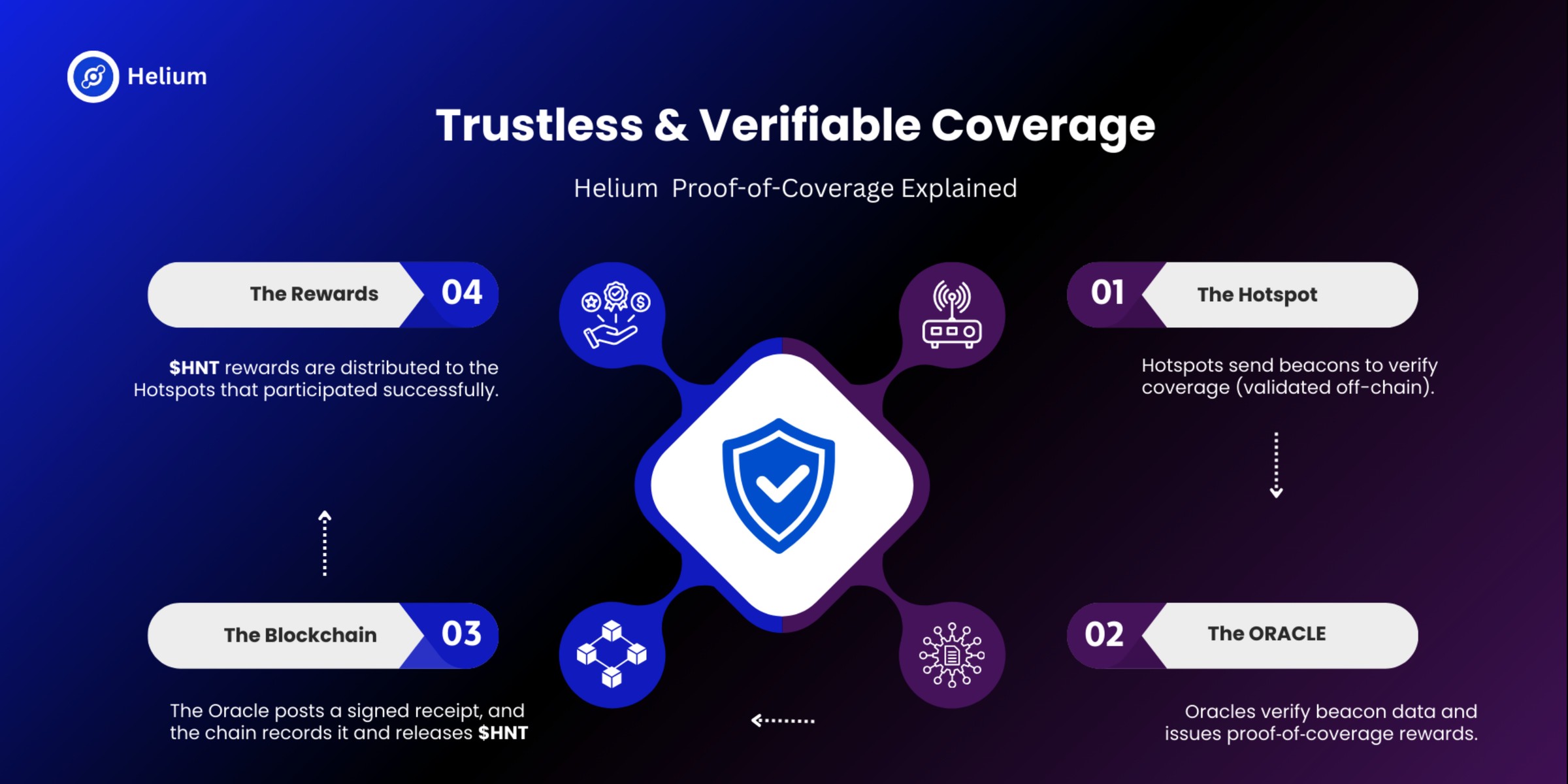
The infographic above is the blueprint, the breakdown below explains the mechanics behind each block and connection ↓
The Problem: The "Basement Scam"
Imagine I told you, "I built a cell tower in my backyard, and told you to "Pay me." your first question would be: "Prove it."
Without proof, bad actors would game the system immediately. They would buy 50 cheap radios, stack them in a basement, and program them to "lie" to the network—claiming they are scattered across the city providing valuable signal.
If the network pays for these fake signals, the token value collapses.
To prevent this, the Helium IoT network treats every Hotspot as "Guilty until Proven Innocent." To get paid, your device must survive an interrogation.
The Characters: The Builder vs The Cheater
To understand the mechanics, we have to look at the real humans building this map. ↓
Min-jun (The Honest Builder).
Min-jun lives in a high-rise apartment in Seoul he places a Hotspot on his balcony, overlooking a city filled with 50 other Helium Hotspots. His signals are real, bouncing off real buildings.
Patrick (The Spoofer).
Patrick is trying to cheat, he has 10 hotspots hidden in his basement in New York. He hacks the software to tell the network, "I am covering the entire Bronx."
They are playing the same game, but only one will pass the Physics Test.
Step 1: The Beacon (The Challenge)
It starts with a challenge,Min-jun ’s Hotspot wakes up. It doesn't ask for permission. It sends out a Beacon a radio "shout" containing a unique data packet.
It shouts: "I am here! Can anyone hear me?"
This happens on a random, unpredictable schedule, Min-jun cannot force it, he cannot fake it. He just has to wait, this is the Challenge.
Step 2: The Witness (The Evidence)
In Seoul, a neighbor's device "hears" Min-jun’s beacon. It measures the signal strength and reports back:
"I heard Min-jun .The signal was Strong."
Meanwhile In New York, Patrick's hotspots in the basement are also whispering to each other, pretending to be miles apart, they report:
"We heard Patrick. The signal was perfect."
But reporting is not enough. The data goes to The Oracle (The Verifier).
Step 3: The Oracle (The Physics Check)
This is where the genius of the system shines, the data goes to the Oracle (The Verifier).
The Oracle doesn't trust Patrick. It doesn't trust Min-jun. It trusts Physics
It compares the reported data against the laws of Radio Frequency (RF) physics:
-
The Distance Test: Radio waves travel at a specific speed. If two hotspots are truly 5 miles apart, the signal must take a specific amount of microseconds to travel.
The Verdict:
-
Min-jun: The signal arrival time matches the distance. PASS.
-
Patrick: Claims his hotspots are 5 miles apart, but the signal arrived instantly (because they are next to each other in a basement). The Oracle sees the anomaly. FAIL.
If you are spoofing your location from a basement, you might fake the GPS data, but you cannot fake the speed of light, the Oracle uses physics to catch the cheaters.
Step 4: The Reward (Settlement)
Once the Oracle confirms the physics are sound, it signs a Receipt" and posts it to the Solana blockchain.
Crucially, rewards are not instant, at the end of the 24-hour Window, the protocol calculates the total verified work.
-
$HNT is minted and distributed to the qualified hotspots (like Min-jun's).
-
Patrick gets zero.
They didn't get paid for "Promising" coverage, They got paid for "Proving" coverage.
Why This Matters (Beyond the Token)
For serious investors and builders, Proof-of-Coverage isn't just a technical feature; it is an economic moat.
For the Investor: The "Zero-Cost Audit"
In traditional infrastructure, "Trust" is an operational expense (OpEx). Verizon and AT&T spend billions annually on fleet management, site surveys, and maintenance crews just to verify their own network exists.
Helium removes this cost entirely:
-
Old Model: Scaling requires linear growth in overhead (More towers = More managers).
-
DePIN Model: Scaling is permissionless, the cost to verify 1 Hotspot is the same as the cost to verify 1 million.
-
The Alpha: You are investing in a network that grows cheaper as it gets larger. That is the definition of infinite leverage.
For the Creator: The Permissionless Frontier
Builders like Min-jun in Seoul didn't need to sign a contract...
He simply bought a device, plugged it in, and let the Code verify his value:
-
Meritocracy: The network doesn't care who you are. It only asks: "Did you provide coverage?"
-
Global Reach: This allows infrastructure to deploy in places traditional companies ignore because the overhead is gone.
We aren't just changing how we pay for networks; we are changing how we verify reality.
Conclusion: Trust as a Cryptographic Proof
This is why DePIN is a paradigm shift, not just a crypto trend.
You are not just investing in "Wi-Fi points." You are investing in a self-auditing system that scales without overhead.
-
Traditional Telco: Trust = Managers + Audits + Time.
-
Helium DePIN: Trust = Physics + Code + Consensus.
This is the Truth Machine.
If you enjoyed this breakdown, follow @Linodefi1 on X-twitter and don't forget to Subscribe to get notified Whenever I publish more visual Narratives breakdown on DeFi, RWA, and Tokenomics.
Thank you