
Crypto 101 is an educational series designed to make complex blockchain and decentralized infrastructure concepts accessible to everyone. Each edition explores a specific topic in depth, combining foundational knowledge with practical implementation examples from the Nodle ecosystem.
Crypto 101 e41 made a necessary distinction: a file can be cryptographically signed, carry verifiable provenance, and still require human judgment about what it means.
That point is easy to agree with in theory. It is harder in practice, because once a signed file starts moving across apps, timelines, headlines, and group chats, people stop asking only whether it is authentic. They start asking what happened before, what changed after, who is named, who is omitted, and whether the proof tells the whole story.
That is where the next layer begins.
Proof can show that a file has a history. Context shows how to read that history.
A signed file solves an important problem: it can prove that a piece of media is bound to a specific cryptographic record and that later tampering becomes detectable. That is already far better than the current default condition of anonymous, infinitely copyable files circulating without any durable provenance at all.
But a checkmark is still not an interpretation engine. A viewer may know that a file was signed, yet still need to understand whether it was cropped, color corrected, redacted, re-exported, translated, excerpted, or embedded into a new context. The C2PA standard was built with this reality in mind, which is why Content Credentials can include assertions about edits, creation, opening actions, ingredients, and later redactions rather than pretending a media file has only one meaningful moment in its life.
The real question is not only "Was this file signed?" It is "What happened to it on the way here?"
One common misunderstanding is that provenance only works for untouched originals. In reality, C2PA is designed to preserve a chain of assertions across transformations, including edits and redactions, as long as those changes are properly recorded in later manifests. That matters because real media almost always changes. Journalists crop. Designers resize. Activists remove identifying details. Teams translate documents. Editors clip a longer video into a shorter excerpt.
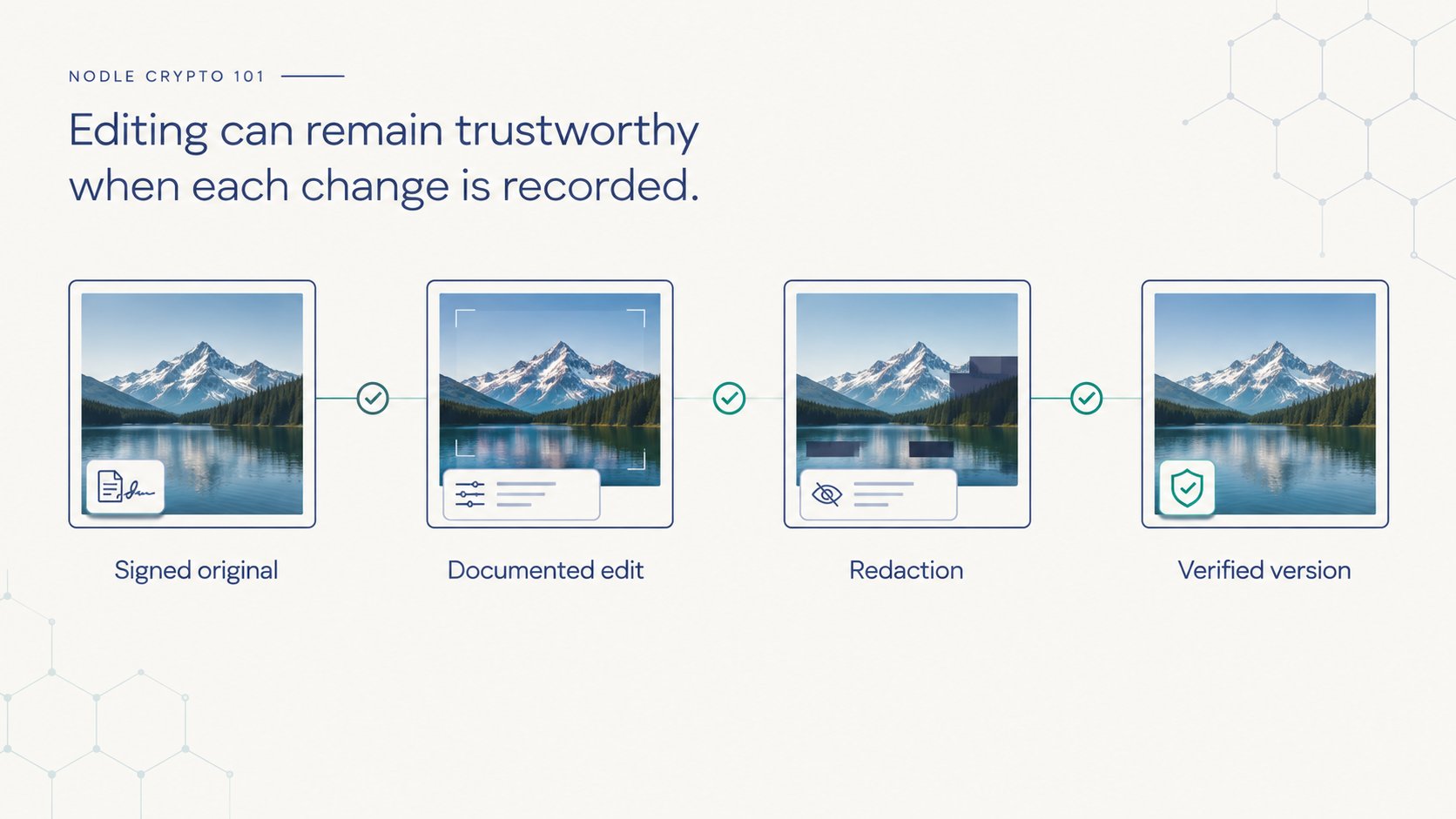
This is especially important for Nodle's Click and Click Pro model. Beyond the Filter explained the first trust step clearly: capture live in the app, swipe to sign, then share a verifiable object tied to a blockchain record. e41 then extended that logic to larger files and documents through Click Pro and ContentSign. e42 naturally asks what comes next: once content is signed and starts moving through the world, how should legitimate edits, privacy-preserving removals, and downstream reuse be handled without breaking trust altogether?
A trustworthy system should not force a choice between integrity and normal human editing.
Not every piece of provenance should always be public. The C2PA explainer explicitly notes that signers control which assertions are included, and that later redaction can remove particular assertions while preserving the rest of the provenance chain. That is not a loophole. It is a feature.
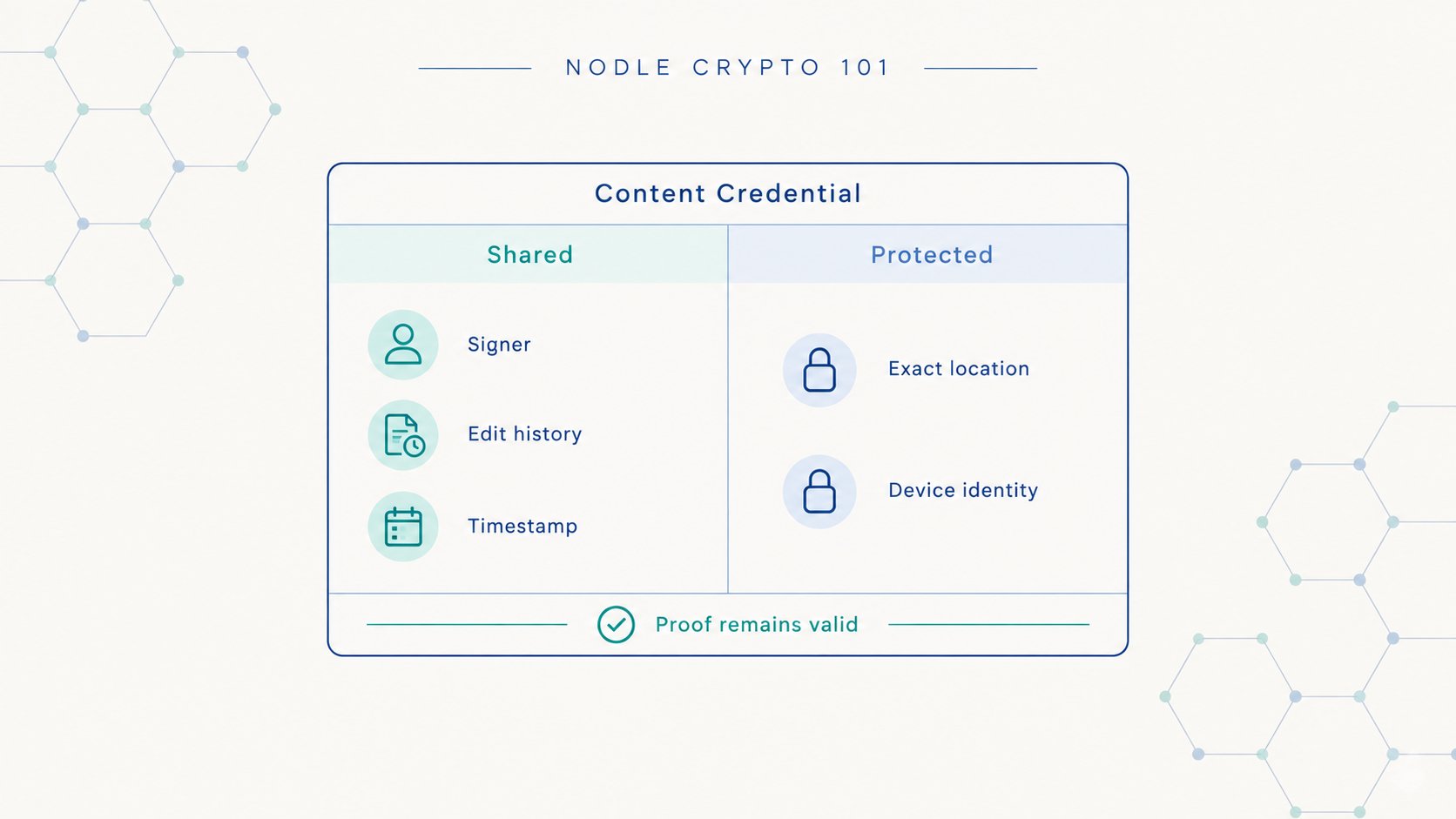
There are many good reasons to disclose only part of a media history. A journalist may want to remove device details before publishing sensitive field footage. A human rights group may need to redact the name of a photographer while preserving proof that the content is authentic. A company may want to prove that a statement is official without exposing unnecessary internal metadata. Selective disclosure helps people preserve privacy and safety without discarding provenance entirely.
This connects directly back to the earlier arc of the series. e37 argued that not everything that can be public should be public. e38 and e39 applied that idea to proximity and connection. e40 extended it to coordination. e41 applied it to media integrity. e42 brings the principle into sharper focus: a trust system is only useful if it can reveal what matters while still protecting what does not need to be exposed.
Good provenance is not maximal disclosure. It is intentional disclosure.
If provenance is going to help ordinary people, its interface matters as much as its cryptography. Most viewers will never read a manifest specification. They need a simple answer to a few practical questions:
Question | What a good provenance interface should show |
|---|---|
Who signed this? | The signer or publisher identity, if disclosed. |
Has it changed? | Whether the current file still matches the signed record or includes later, documented edits. |
What kind of changes happened? | Actions such as crop, color correction, export, redaction, or ingredient relationships when included. |
What is missing? | Whether identifying assertions were withheld or later removed, without pretending they never existed. |
What still requires judgment? | The meaning, framing, and factual interpretation of the content, which provenance alone cannot settle. |
This is where the "seeing stops being believing" idea matures. The goal is no longer only to attach proof. It is to help people read proof correctly.
Once a signed file leaves its point of origin, it moves through social platforms, messaging apps, and community channels that may or may not preserve its credential. Nodle's broader product direction already points toward a useful answer: the same ecosystem now includes private XMTP messaging, group chats, and community coordination in the Nodle app, which creates a path for signed content to circulate in user-controlled channels instead of depending entirely on centralized feeds.
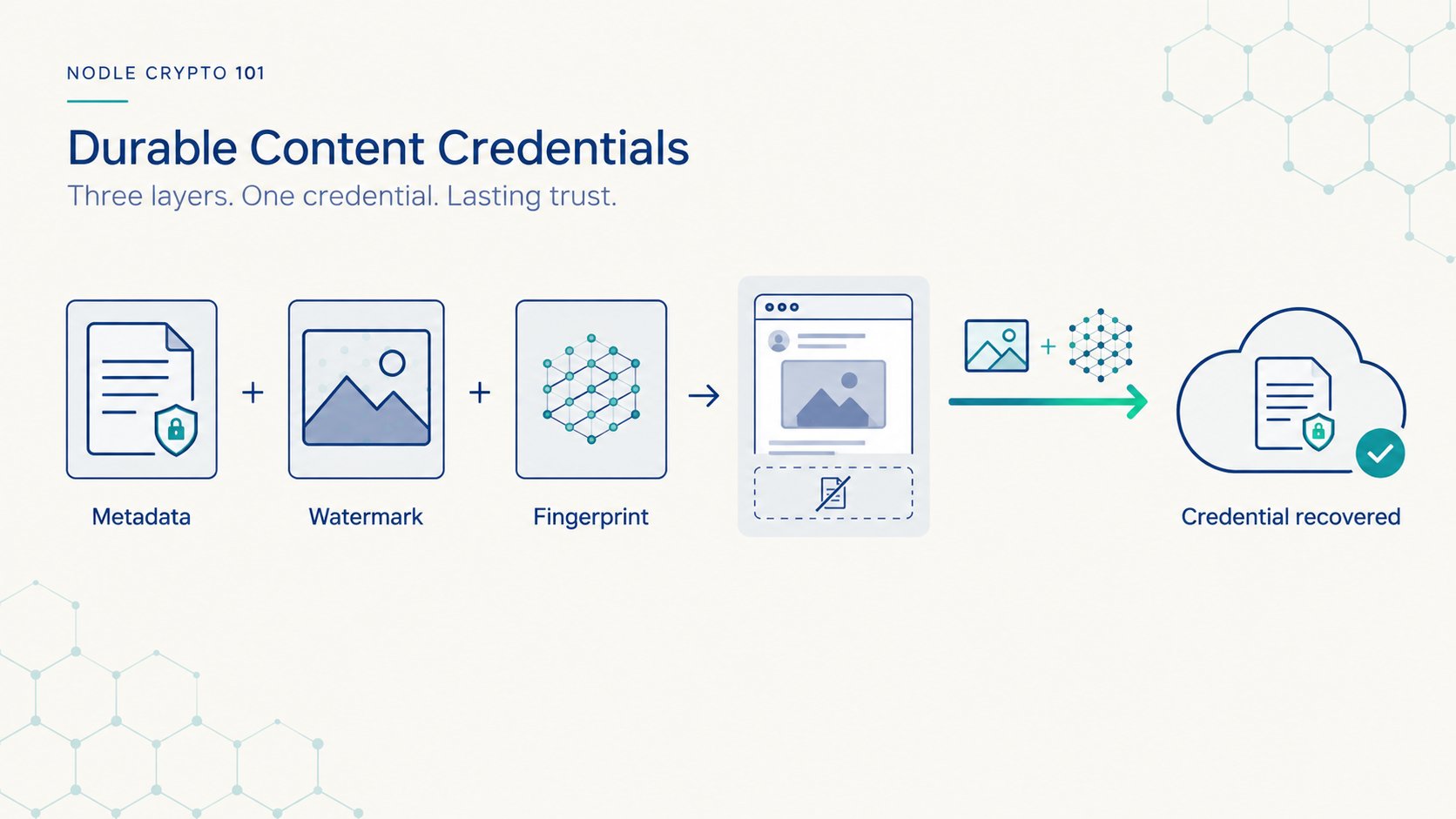
That does not mean every messaging app becomes a verification interface overnight. It means the long-term architecture can become more coherent. Media can be signed through Click or Click Pro, shared as verifiable assets, discussed inside encrypted chats, and interpreted inside communities that can inspect the evidence for themselves rather than forwarding a screenshot detached from its origin.
This is a subtle but important shift. Trust is not only about the moment of creation. It is also about the conditions of circulation.
A file is easiest to distort after it leaves its source. That is why provenance has to survive distribution, not just creation.
The arc from e37 to e41 has gradually assembled a user-controlled stack:
Edition | Core question | Layer |
|---|---|---|
What should be public? | Identity boundary | |
Can people cross paths privately? | Proximity | |
Can an encounter become a conversation consensually? | Connection | |
Can consensual connections become communities? | Coordination | |
Can media carry proof of origin? | Provenance | |
e42 | How should people read proof once content starts moving? | Context |
That last step matters because the internet's trust problem is no longer just a creation problem. It is a reading problem. People are flooded with media, signals, captions, fragments, edits, and reposts. The systems that will matter most are the ones that can preserve evidence without flattening meaning.
The strongest version of digital trust is not a world where everyone blindly obeys verification badges. It is a world where provenance remains available, edits remain legible, redactions remain accountable, and people keep the freedom to interpret what they see.
The future of trust is not proof without people. It is proof that people can still read, question, and use.
Provenance - The recorded history of a digital file, including where it came from and what happened to it over time.
Content Credential - A standardized package of signed provenance data attached to or associated with digital media under the C2PA model.
Assertion - A statement inside a Content Credential about an asset, such as how it was created, edited, or bound to its content.
Hard binding - A cryptographic binding between a manifest and the exact content of a file, typically through a hash assertion.
Redaction - The deliberate removal of selected assertions from provenance data while preserving the rest of the chain and recording that the removal happened.
Ingredient - A referenced source asset used in or related to another asset within a provenance chain.
Selective disclosure - The practice of revealing only the provenance information needed for a given context, rather than exposing every available detail.
Context layer - The practical and interpretive layer that helps people understand what a proof means once signed media begins circulating across apps, communities, and platforms.
This article is for educational purposes only and does not constitute financial, legal, or investment advice. Cryptocurrency and blockchain technologies carry inherent risks. Always do your own research and consult a qualified professional before making financial decisions.