
Crypto 101 is Nodle's educational series about blockchain, digital trust, content provenance, and the technologies shaping Web3.
In e45, "Who Signed the Proof?", the focus moved from the signature itself to the identity behind it. That leads to the next practical question: what should someone do when a verification tool displays a result?
A green check can feel final. It is not. A verification result answers a defined set of technical questions, and its meaning depends on what was checked, which trust framework was used, whether the credential remains available, and what evidence the viewer can inspect.
"Verified" is not a universal verdict. It is a report about specific checks performed on specific evidence.
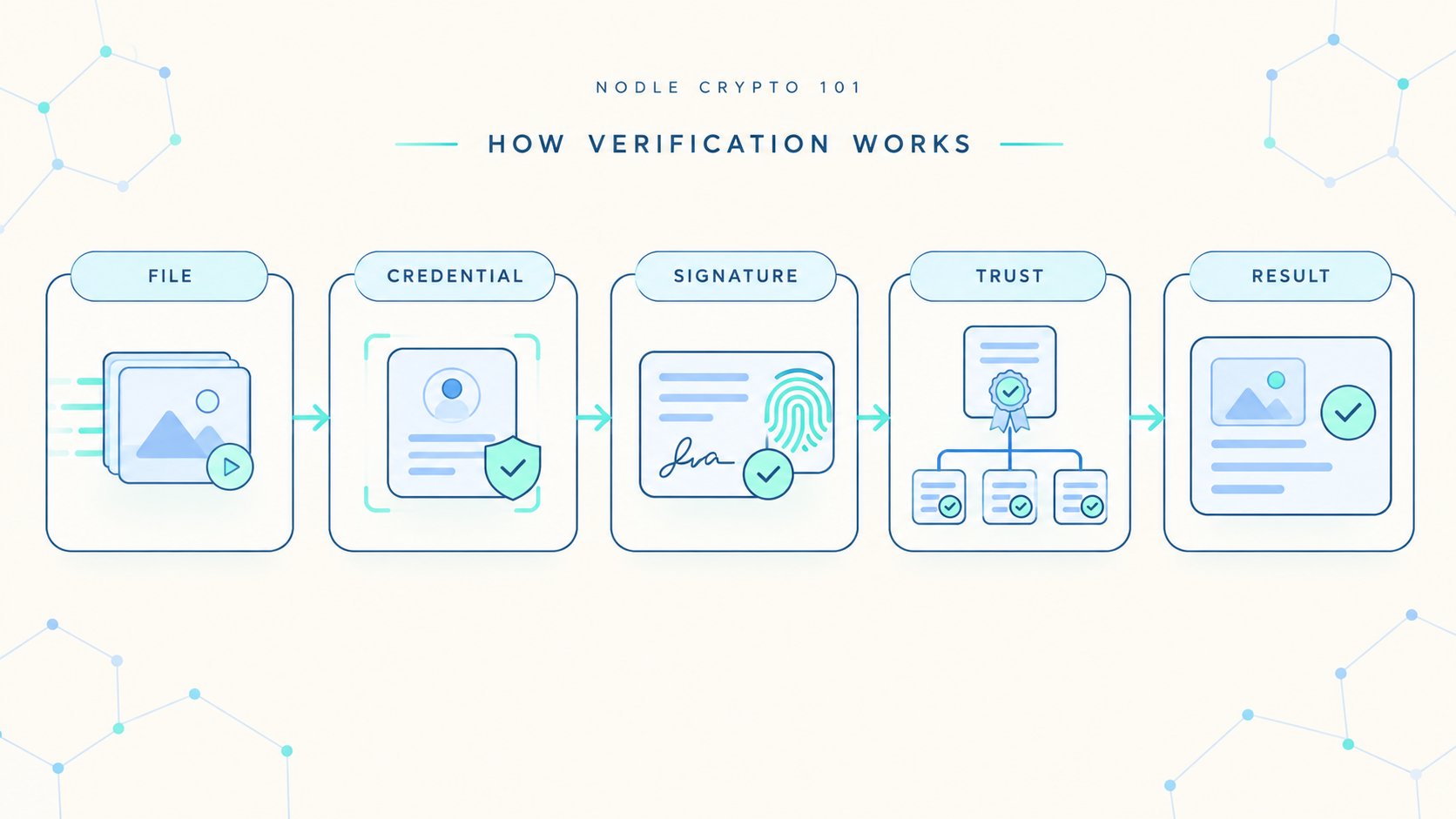
A Content Credential is a cryptographically signed provenance record that can contain information about an asset's origin, edits, tools, signer, and use of AI. A validator examines the credential, its relationship to the media, the signature, the certificate chain, timestamps, assertions, and other required structures. The C2PA Conformance Program includes signature validation, timestamp validation, assertion validation, cryptographic hash validation, and result reporting among the expected capabilities of validator products.
This means verification is not a single comparison. It is a sequence of checks that asks whether the available evidence is internally consistent and whether the signer connects to a recognized trust framework.
Verification does not ask, "Is this believable?" It asks, "Does the available evidence pass the checks this validator knows how to perform?"
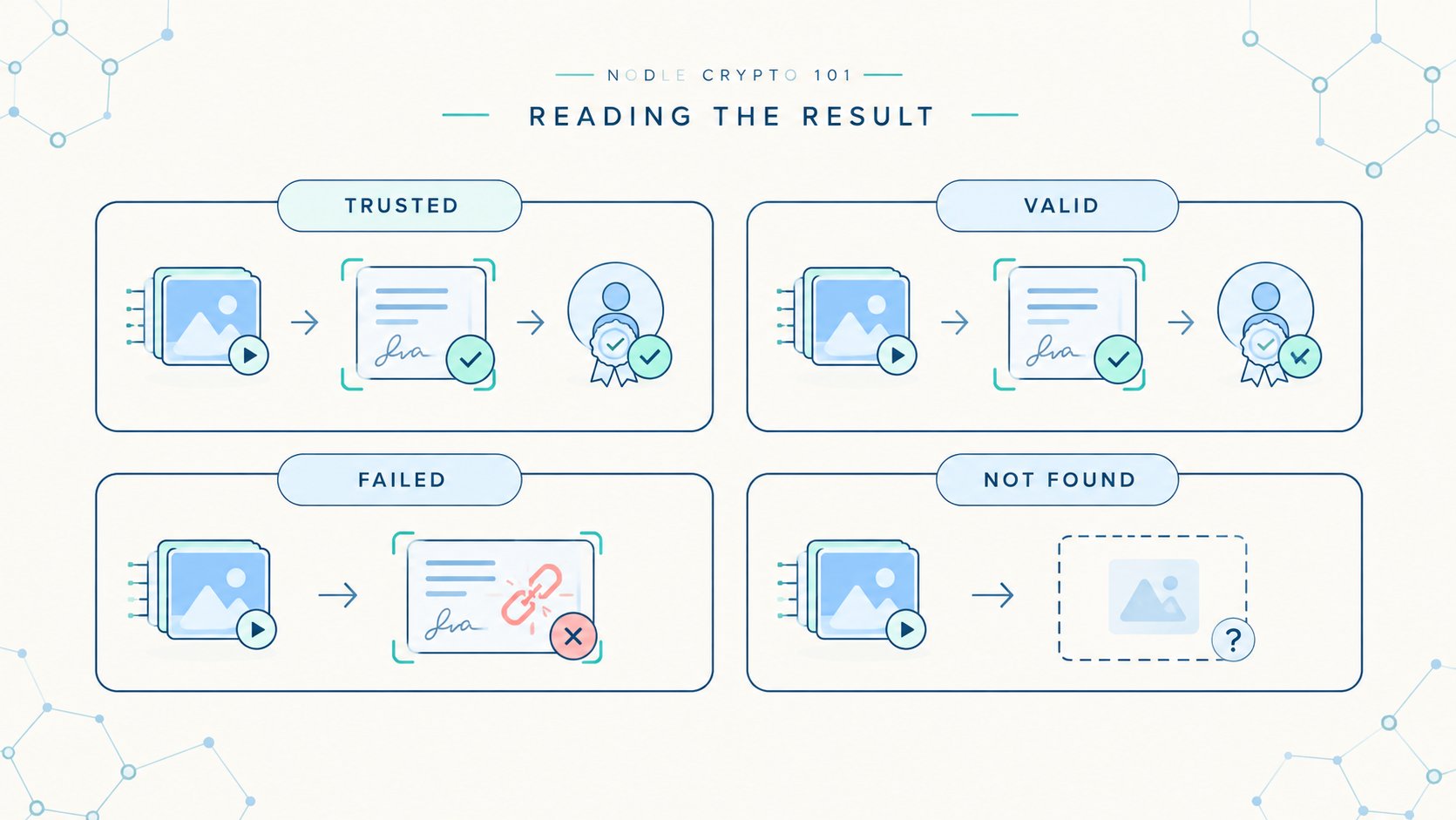
A trusted result generally means that the credential is cryptographically intact, the protected content matches, and the signing certificate connects to a trust list recognized by the validator. C2PA's deployment guidance distinguishes a technically valid credential from one whose signer is also trusted by the validator.
That is strong evidence of provenance and integrity. It can help a viewer understand who signed the content, when it was signed, and what declared actions form part of its history. It still does not establish that every scene, caption, statement, or claim inside the media is factually correct. C2PA describes Content Credentials as provenance evidence rather than a value judgment about whether the recorded information is true.
Trusted provenance strengthens a decision. It does not make the decision for you.
A valid result can mean that the signature and content binding pass technical checks while the signer does not connect to the validator's recognized trust list. This is not proof of deception. It means the cryptography may be intact, but the validator cannot provide the same level of assurance about the identity behind the signing certificate.
The next step is to inspect the signer, certificate issuer, timestamp, product, and available context. An unfamiliar credential may belong to a legitimate creator, a private workflow, a test system, or an unrecognized source. It may also deserve extra caution.
"Not trusted" often means "not recognized by this trust framework," not automatically "malicious."
A failed or invalid result can appear when the media no longer matches its protected hash, the signature cannot be validated, required structures are malformed, or another validation rule fails. With Nodle ContentSign, modifying signed content changes its hash, so the recomputed hash no longer matches the value bound into the manifest.
Failure is a warning that the available credential should not be treated as intact proof for the file being inspected. It does not always reveal intent. A file may have been maliciously altered, but it may also have been resized, transcoded, recompressed, or processed by software that did not preserve the signed data.
Validation failure tells you that the proof no longer matches. It does not tell you why the mismatch happened.
When a tool finds no Content Credential, the safest conclusion is simply that no credential was available to that tool. Content Credentials are still being adopted, so many legitimate files have none. The public Content Credentials Verify tool also warns that inspected content may not contain information to display.
Credentials can also become detached when a platform strips metadata or transforms a file. Durable Content Credentials address this risk by combining a hard binding, such as a cryptographic hash, with soft-binding methods such as invisible watermarking or fingerprint lookup, which can help rediscover an externally stored manifest.
No credential does not mean fake. It means provenance could not be established from the evidence the verifier found.
A useful verification experience should not stop at a badge. It should show enough information for a person to understand the result and decide what to inspect next.
At minimum, look for:
Credential status: Was a credential found, and did it pass validation?
Signer: Who or what signed the asset?
Trust status: Does the signer chain to a trust list recognized by the validator?
Time: When was the content signed, and is there a trusted timestamp?
Actions: What creation or editing steps were declared?
Binding: Does the credential still match the asset being viewed?
Warnings: Did any part of the signature, certificate, manifest, or asset relationship fail?
The free Content Credentials Verify tool lets users upload or drag supported media into an inspector and review available Content Credentials and changes over time. The C2PA Conformance Explorer provides a separate way to examine conforming products and relevant trust information.
A badge is the beginning of verification. The details are where informed trust begins.
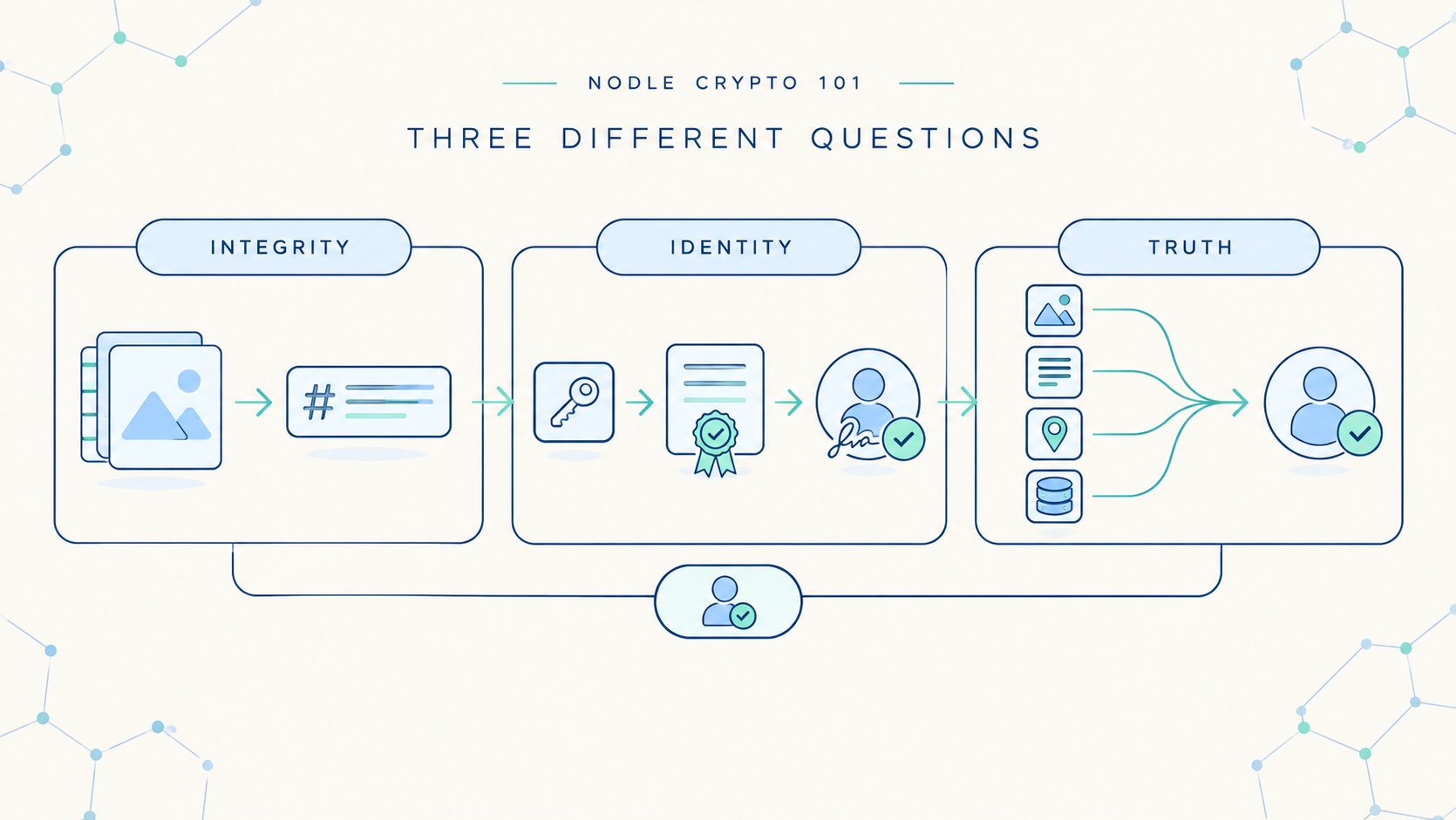
Three ideas are often collapsed into one:
Integrity asks whether the protected content or provenance data changed.
Identity asks who or what controlled the signing credential and how that signer connects to a trust framework.
Truth asks whether the claims and events represented by the content are accurate in the real world.
A validator can provide strong evidence about integrity and signer identity. Truth requires broader context, corroboration, and human judgment. This distinction is why proof should inform a decision rather than replace it.
Cryptography can verify a relationship between data and a signer. It cannot independently verify every claim depicted in the file.
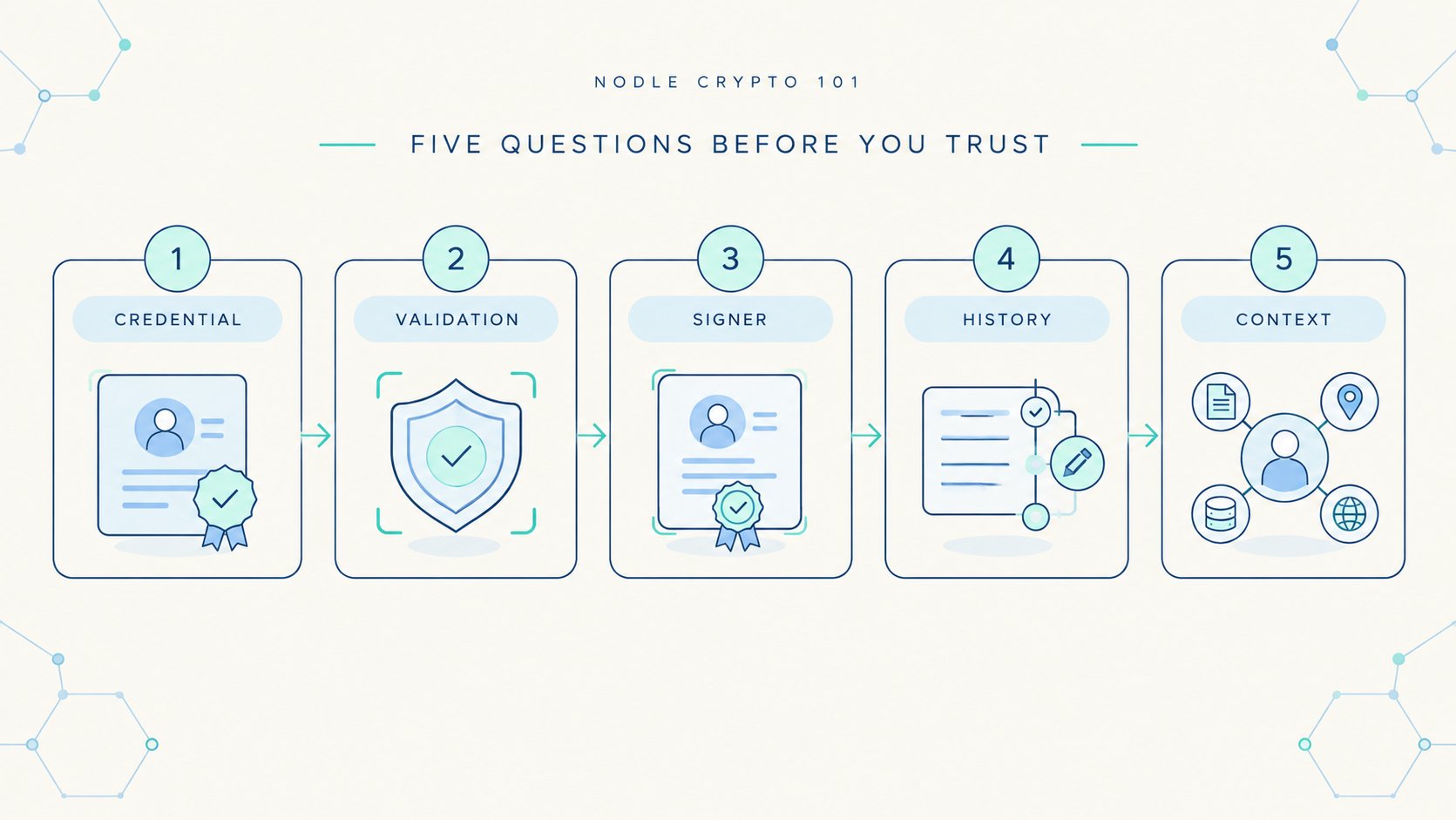
When inspecting digital content, use this five-question check:
Was a credential found? If not, avoid concluding that the content is either genuine or fake.
Did the credential validate? If it failed, identify which check failed before relying on it.
Who signed it? Review the signer and the authority that issued the signing certificate.
What does the history say? Examine declared edits, tools, timestamps, and AI-related assertions.
Does the surrounding evidence agree? Compare the credential with the publisher, original source, reporting, and real-world context.
This workflow gives readers a repeatable way to move from a badge to an informed decision.
Do not stop at the status. Check the signer, history, timing, and surrounding evidence.
Nodle ContentSign creates a C2PA manifest that binds signer identity, timestamp information, and a content hash to an image, video, or document. A recipient can inspect the standard C2PA data with compatible tools without needing Nodle software.
Nodle also describes an on-chain fingerprint as an independent record that can remain available if a platform strips the file's embedded manifest. Across Nodle's Trust Network, this provides an additional anchoring layer while keeping the credential compatible with the open C2PA ecosystem.
This layered design matters because no single transport path is perfect. Embedded metadata can travel with a file, soft bindings can help rediscover missing credentials, and public anchoring can provide an additional record for comparison.
Open verification works best when proof can survive beyond the app, platform, or company that created it.
The ecosystem around Content Credentials is moving from specifications toward broader implementation. C2PA launched Content Credentials 2.3 with support for live video, more file types, clearer edit histories, cloud-linked information, and updated validation protections. Its Conformance Program and official Trust List add public governance for products and certificate authorities that create or validate C2PA data.
Recent announcements also show how provenance is becoming part of platform and creator workflows. TikTok joined the C2PA Steering Committee in July 2026 after implementing Content Credentials alongside complementary labeling methods. C2PA also published practical guidance for identifying AI-generated, AI-modified, and non-synthetic content through signed, machine-readable manifests.
For ongoing developments, readers can follow C2PA announcements, the Content Authenticity Initiative, and Nodle on X. Nodle's recent posts reinforce the arc's central message: a signature supports verification, while context and judgment remain essential.
Better standards do not remove the need for judgment. They give judgment better evidence.
The goal of content provenance is not to reduce every piece of media to a green or red symbol. It is to make important evidence visible, portable, and testable.
A trusted result can provide strong confidence that a recognized signer approved a particular asset and that the protected content remains intact. A valid but untrusted result asks the viewer to investigate the signer. A failure warns that the proof no longer matches. A missing credential leaves the provenance question open.
The best habit is not "trust the badge." It is "read the result".
Assertion: A structured statement inside a Content Credential describing information such as creation, edits, tools, or AI use.
Certificate chain: The linked sequence of digital certificates that connects a signing certificate to a recognized root authority.
Content binding: The cryptographic relationship that associates a Content Credential with a specific digital asset.
Content Credential: A cryptographically signed provenance record that can describe the origin and history of digital content.
C2PA: The Coalition for Content Provenance and Authenticity, which maintains an open technical standard for content provenance.
Durable Content Credential: A credential designed to remain discoverable through a combination of hard and soft bindings even when embedded metadata is removed.
Hard binding: A cryptographic link, commonly based on hashing, that tightly associates a manifest with a particular asset.
Hash: A fixed-length cryptographic fingerprint that changes when the protected data changes.
Integrity: Confidence that protected content and provenance data have not changed since signing.
Manifest: The signed data structure that stores a Content Credential's claims, assertions, ingredients, and related provenance information.
Provenance: Information about a digital asset's origin and recorded history.
Signer: The person, organization, device, or service that controls the key used to sign a credential.
Soft binding: A discoverability method, such as watermarking or fingerprint lookup, that can reconnect an asset with an externally stored credential.
Timestamp: Cryptographic or recorded evidence indicating when a signature or related event occurred.
Trust list: A maintained set of recognized certificate authorities or trust anchors used by validators when making trust decisions.
Validation: The technical process of checking a credential's structure, signature, assertions, timestamps, and relationship to the asset.
Validator: Software that reads a Content Credential, performs required checks, and reports the results.
Valid: A result indicating that required technical checks passed, even if the signer is not recognized as trusted.
Trusted: A result indicating that validation passed and the signer connects to a trust framework recognized by the validator.
Content Credentials Verify lets readers inspect Content Credentials and review available provenance details.
C2PA Conformance Explorer lists conforming products and trust-related records.
C2PA Conformance Program explains how generators, validators, and certificate authorities are evaluated.
C2PA FAQ explains signing certificates, certificate authorities, trust lists, and conformance.
C2PA Content Credentials 2.3 announcement summarizes the standard's recent additions.
C2PA implementation guide explains how AI-generated, AI-modified, and non-synthetic media can be described.
Nodle ContentSign explains Nodle's C2PA-compatible signing and verification flow.
Nodle technology explains how signed content moves and verifies across Nodle's Trust Network.
Nodle Crypto 101 e41 thread introduces cryptographic signing, Content Credentials, and decentralized proof.
Nodle's watermark and provenance post distinguishes watermark signals from signed provenance.
Nodle's proof and judgment post explains why verification should inform rather than replace judgment.
This article is for educational purposes only and does not constitute financial, legal, or investment advice. Cryptocurrency and blockchain technologies carry inherent risks. Always do your own research and consult a qualified professional before making financial decisions.