

Written by Sasorivirgil
Traditional telecom giants have quietly profited off their users for decades—monetizing metadata, tracking behavior, and selling private communications to governments and covert networks, all while delivering mediocre service. By 2024, nearly 5 billion people had unknowingly become products in a surveillance-first world as global demand for connectivity skyrocketed. But that era is finally collapsing thanks to the DEWI (Decentralized Wireless) movement—a decentralized, blockchain-powered revolution that puts control back into the hands of the users.
What makes DeWi operations different?
DeWi has created a system that reverses users' traditional role in the data distribution chain. Rather than relying on telecom companies to own rooftop antennas and 4G LTE towers, DeWi empowers users to become infrastructure providers themselves.
Users now install and operate their wireless hardware—Helium hotspots, Andrena routers, or XNET nodes—which provide real coverage for 5G, WiFi, or LoRaWAN networks. In return, they’re rewarded with crypto tokens like $HNT, $AND, and $XNET, which are earned based on their devices' actual usage and uptime. These tokens have real-world value—they can be traded, used within the ecosystem, or exchanged for money, making the entire system self-sustaining and community-driven.
This model is called token-incentivized deployment. The network grows because people are rewarded for contributing to it. Each device installed isn’t just passively running; it actively proves its functionality through blockchain algorithms known as Proof-of-Coverage (PoC). These algorithms confirm that the device provides legitimate service by verifying its activity on-chain, making the system transparent and efficient.
The more your device contributes to real traffic and network quality, the more tokens you earn. Whether you're covering rural areas with LoRaWAN or extending 5G in dense urban zones, you're not just helping people connect—you're getting paid to do it.
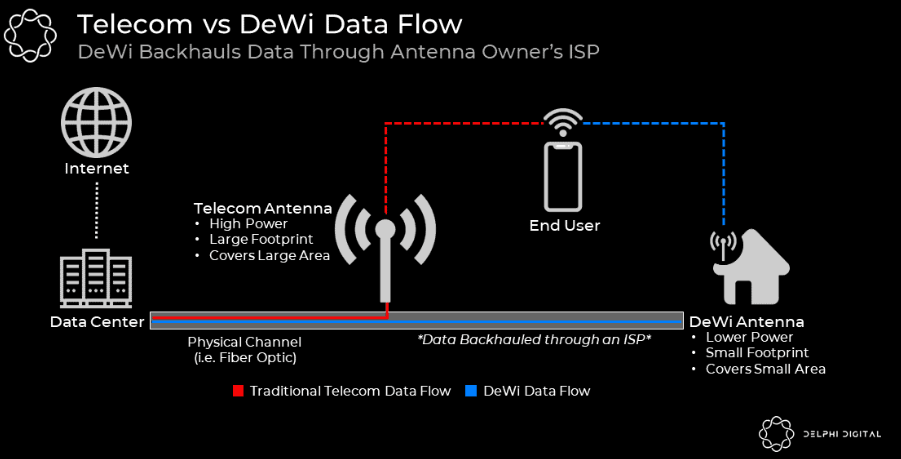
Source: Telecom vs DeWi Data Flow via DelphiDigital
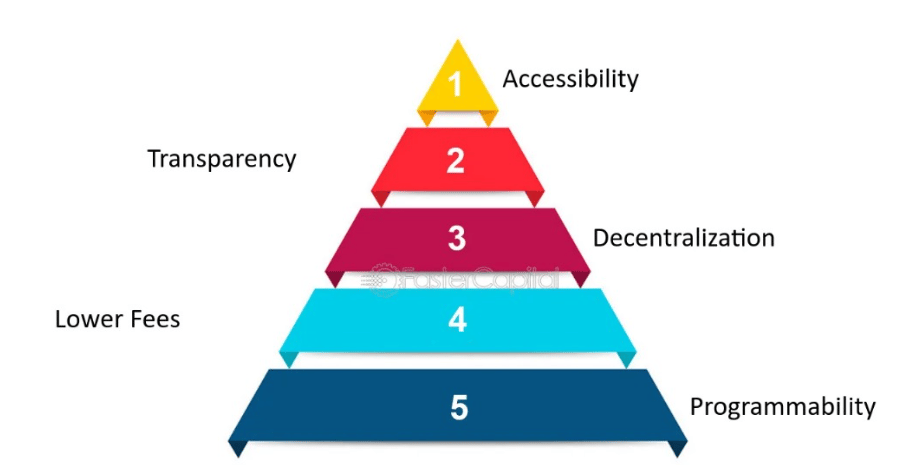
Presently, the Solana blockchain is the go-to infrastructure layer for DeWi projects. Why this blockchain?
Solana’s architecture is built for speed, scalability, and efficiency. It can process over 50,000 transactions per second, which allows it to verify Proof-of-Coverage data and distribute rewards in real time. Its ultra-low fees—around $0.0001 per transaction—make it ideal for handling the micro-payments that keep DeWi networks running smoothly. There's no bottleneck, lag, or excessive costs to slow things down.
Solana’s composability is also a significant advantage. Its users can seamlessly integrate their tokens into Solana’s DeFi tools, such as Jupiter, KaminoFinance, and Jito.
The financial opportunities within DeWi on Solana are just the tip of the iceberg. DeWi has unlocked a wide range of groundbreaking use cases that were once beyond reach by decentralising control from traditional telecom giants.
A significant contribution of DeWi projects is their role in laying the foundation for the Internet of Things (IoT). By building low-power, wide-area networks (LPWANs), these projects are supporting the billions of devices that make up the IoT.
DeWi already has a Total Addressable Market (TAM) of $650 billion in this sector. From farmers remotely monitoring soil health to logistics companies tracking shipments across continents, these decentralized networks enable smarter and more connected operations.
DeWi initiatives are also democratizing Wi-Fi access, particularly in underserved regions. By incentivising individuals and businesses to share internet connections or deploy new hotspots, these projects are creating a more distributed and affordable web of Wi-Fi access.
With a TAM of $25 billion, these networks also provide privacy-first solutions that operate without reliance on Internet Service Providers (ISPs).
Looking at specific sectors, DeWi is making impressive strides in decentralized 5G. The total addressable market (TAM) for decentralized 5G is estimated to reach $250 billion by 2030. DeWi projects are replacing centralized cell towers with community-operated small cells. For example, the Helium Mobile network already has 25,000 radios offering mobile data at $0.10/GB, much cheaper than traditional carriers like Verizon, which charge $2.05/GB.
Additionally, DeWi is at the forefront of combining decentralized wireless connectivity with edge computing, bringing intelligence closer to the data source. This integration enables ultra-low-latency applications and more efficient data processing, essential for sectors like autonomous vehicles and augmented reality, where real-time data processing is crucial for safety and functionality.
Surprisingly, thousands have earned over four figures since DeWi networks began gaining prominence around 2019. So, who are the key players in the DeWi ecosystem?

Source: Helium(@helium) via X.com
When discussing DeWi, Helium is often the first name that comes to mind. Founded in 2013 as Helium Inc. and later rebranded to Nova Labs in 2022, the company has evolved from a pioneer into the foundational force of the decentralized wireless movement.
In 2023, Helium migrated its blockchain infrastructure to Solana, unlocking faster transactions, lower fees, and a more scalable ecosystem for DePIN.
The network primarily operates on the Business-to-Business (B2B) and Business-to-Consumer models that selling directly to consumers and organizations. This enables businesses and individuals to build and operate decentralized wireless networks through its DePIN model. Helium provides the infrastructure, like IoT hotspots and 5G nodes, to businesses and developers who utilize them for various use cases, such as IoT applications or expanding 5G coverage.
Today, the network has built an impressive global footprint, deploying over 1.2 million IoT hotspots and over 375,000 active hotspots across 182 countries. Its 5G network is rapidly expanding, with over 3,000 active nodes, primarily located in the United States. This growth is supported by roaming partnerships with major carriers like T-Mobile, Movistar, DISH. Leveraging operation within FCC Part 15-certified unlicensed spectrum, which allows for regulatory flexibility and faster deployment.
The Helium network currently runs on a three-token model. The first is the HNT (Helium Network Token), the ecosystem's core utility and governance token. Then there are the IOT tokens that power the LoRaWAN-based IoT infrastructure, while MOBILE tokens are used to incentivize and reward 5G network deployment.
As of April 2025, Helium is the largest Decentralized Physical Infrastructure Network (DePIN) project on the Solana blockchain, with a market capitalization exceeding $600 million. The network generates approximately $12 million in monthly revenue from the sale of data credits. Helium also features a deflationary token model, with token halvings occurring every two years—the next one is scheduled for later this year.
Users deploy compact, plug-and-play miners such as the Bobcat Miner 300, SenseCAP M1, and RAK Hotspot Miner for the Helium IoT network. These devices provide low-power, long-range wireless coverage ideal for sensors and trackers, and users earn IOT tokens for their contributions. These miners typically cost around $299 and can yield a return on investment in as little as eight months, depending on location and activity.
Helium uses more robust hardware for its decentralized 5G network. The core of this setup is the FreedomFi Gateway, which connects to certified CBRS radios like the Baicells Nova 430H and MosoLabs Outdoor units. These setups enable users to deliver 5G coverage and earn MOBILE tokens in return. A complete 5G configuration can cost around $1,999, with ROI expected in about 18 months under optimal conditions.

Source: Andrena (@andrena_wifi) via X.com
Founded in 2016 and launching operations in 2019, Andrena is a U.S.-based internet company that, like Helium, primarily follows a B2B model. It partners with property managers, building owners, and local governments to deliver broadband internet, focusing on multi-unit buildings in urban areas across the United States. To increase accessibility and reduce reliance on traditional infrastructure, Andrena deploys wireless equipment directly on rooftops, bypassing underground wiring.
In late 2023, Andrena began developing its decentralized broadband protocol, DAWN, built on the Solana blockchain. Still in its testing phase, DAWN aims to decentralize internet delivery by turning everyday users into network participants. A key feature is its innovative "proof of backhaul" system—developed with a Princeton professor—which verifies that each node is correctly connected to the broader internet. This model allows users to access and support the network, earning token-based rewards for their contributions.
Participation in DAWN is affordable using $89 Raspberry Pi-based routers, which serve as the network's backbone. Andrena also plans to introduce more user-friendly home devices, making it even easier for individuals to connect to and help power the system.
As of April 2025, Andrena operates solely within the United States, with active service in 10 states, including New York, New Jersey, Pennsylvania, Florida, Tennessee, and Texas. However, DAWN's decentralized nature has sparked international growth. The protocol now supports over 2,400 nodes in Iran, and there has been a 400% spike in node deployment in Turkey following the country’s recent currency collapse, showing the appeal of DAWN in unstable or underserved regions.
The company aims to connect over 3 million households through DAWN at launch. While U.S. node counts haven’t been detailed, the platform already supports over 100,000 verified users, showing strong early adoption—particularly among those seeking alternatives to traditional ISPs.
Andrena has also established multiple revenue streams. Users can subscribe for $4.99/month to access ad-free WiFi, while anonymized usage data is sold for research purposes, with strict privacy protections in place.
What is this privacy protocol? Andrena prioritizes network integrity through regular audits by third-party firms and maintains a bug bounty program for responsible vulnerability disclosure.
Regarding funding, the company recently closed an $18 million Series A extension, bringing the total investment to $38 million. While official revenue and market cap figures have not been disclosed, the financial backing and growing user base position Andrena as a rising force in the DeWi and DePIN space.
The upcoming token, DAWN, will be central to the ecosystem. It will be used to pay for internet access and reward users who share bandwidth, refer others, or run validator nodes. A user-friendly mobile app and connected hardware will make earning, managing, and spending DAWN tokens easy.

Source: XNET(XNET_Mobile) via X.com
This U.S.-based decentralized mobile carrier was founded in 2021 by former Google executive Richard DeVaul. The company combines blockchain incentives with enterprise-grade Wi-Fi and CBRS (Citizens Broadband Radio Service) technologies to build its network. Running on the Solana blockchain, the platform uses the $XNET token to reward partners for deploying and maintaining critical infrastructure.
As of April 2025, XNET has deployed approximately 1,000 active Wi-Fi hotspots across the United States, with plans to expand to 15,000 sites by next year. Thanks to the network's growing reach and adoption, these hotspots have facilitated connections for around 9 million users.
XNET primarily operates on a B2B model, selling specialized Passpoint Wi-Fi hotspots to businesses and venues. Passpoint, or Hotspot 2.0, enables seamless and secure Wi-Fi roaming, automatically connecting users without repeated logins. This technology enhances user experience in business and public settings.
The company generates revenue through data offloading services, charging mobile network operators (MNOs) and mobile virtual network operators (MVNOs) to transfer customers' data traffic onto XNET's network. Hotspot operators earn approximately $4 in XNET tokens for every gigabyte of data offloaded, providing a tangible incentive for network expansion.
A significant milestone for XNET is its partnership with AT&T, one of the largest telecom operators in the U.S, to enhance its network scalability and reach.
XNET's enterprise-grade hardware includes durable IP67-rated radios designed for extreme conditions and certified for industrial compliance. Notable clients include BMW, Shell, and Cisco. For instance, BMW's Munich plant reported a 92% reduction in latency compared to traditional Wi-Fi, showing the effectiveness of XNET's technology in demanding industrial environments.
Each XNET site contributes approximately $1,200 in recurring revenue per month. Additionally, the company employs AI-driven predictive maintenance data to enhance operational efficiency and reduce client downtime.
According to various sources, XNET Mobile's market capitalisation varies between $1.76 million and $3.77 million as of April 2025. CoinMarketCap reports a market cap of $1.76 million, while LCX lists it at $3.77 million. The circulating supply is approximately 64.12 million to 108 million XNET tokens, with a maximum supply capped at 2.4 billion tokens.
The fully diluted valuation (FDV), representing the market cap assuming all tokens are in circulation, is approximately $66.12 million.
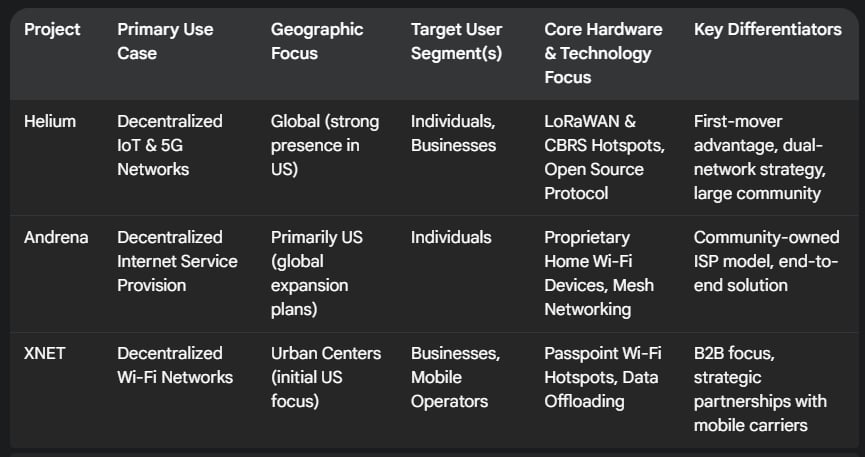
Visual Taxonomy
Helium, Andrena, and XNET are the most prominent and visible players in the DeWi space, but how big are they? What is DeWi's total market size, and what is the market forecast for the future?
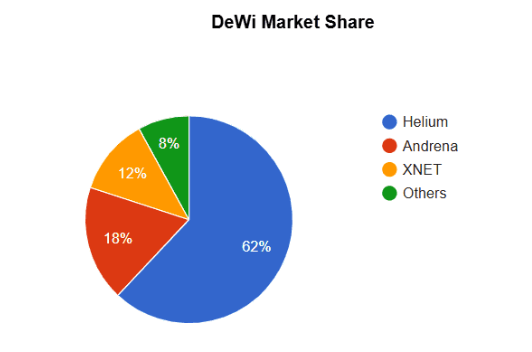
As of 2025, Helium leads the DeWi market with a dominant 62% market share, followed by Andrena at 18% and XNET at 12%. The remaining 8% is distributed among smaller players such as Pollen and Foam.
As mentioned earlier, the DeWi market is experiencing rapid growth, and there are significant projections for the next few years. In 2024, there were about 2.1 million hotspots, serving 8 million users and having a market cap of $2.4 billion. However, by 2026, these figures are set to expand to 7.5 million hotspots, 45 million users, and a market cap of $12 billion.
Projections for 2030 estimate 25 million hotspots, 300 million users, and a market cap of $85 billion, showing the tremendous growth potential of DeWi networks.
Helium will also become one of the top five U.S. network providers by 2030. With its expanding network of hotspots and increasing presence in the telecom industry, Helium is set to compete with traditional providers by offering affordable, decentralized connectivity.
Leveraging its decentralized model, Andrena is expected to bypass internet restrictions in three or more countries by 2020. By overcoming government-imposed internet bans and offering unfiltered access, especially in regions with heavy censorship, Andrena is poised to strengthen its market presence in areas where traditional ISPs fall short.
XNET, which focuses on edge computing and low-latency data processing, is projected to power 20% of private industrial networks by 2030. As demand for real-time data services grows in industrial and urban settings, XNET's decentralized wireless network will enable businesses to meet these needs efficiently.
Solana will also handle 40% of global DeWi transactions by 2030. The adoption of DeWi will revolutionize the Internet of Things (IoT) sector. It’s projected that 60% of legacy IoT networks will transition to decentralized wireless models by 2030.
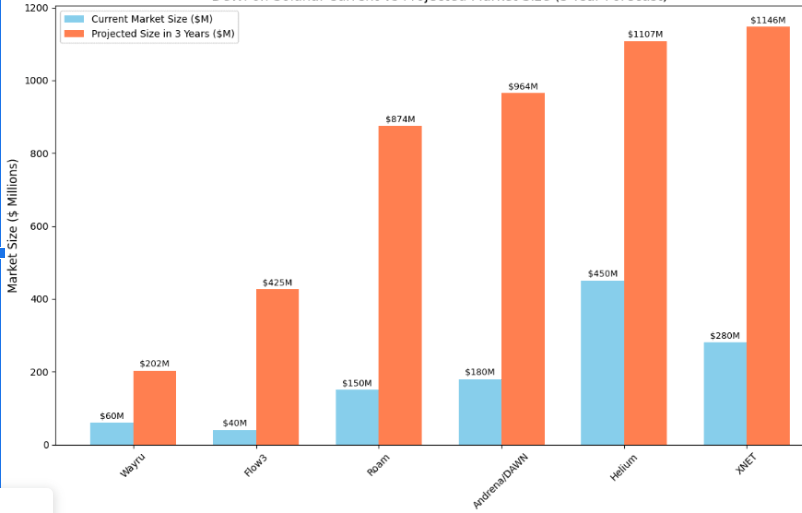
Source: DeWi on Solana via Medium
As DeWi offers more affordable and scalable solutions, businesses will increasingly move away from traditional IoT infrastructure, paving the way for broader integration of decentralized wireless technologies in IoT applications. During this radical development, what should users expect in the future?
As the market grows, emerging trends will further shape the future of decentralized wireless. Integrating artificial intelligence (AI) into DeWi networks is one of the most impactful trends. AI will be crucial in optimizing network performance, predicting maintenance needs, and enhancing security.
Helium’s Proof of Coverage (PoC) v3, which uses AI to predict outages and adjust tokenomics in real time, is an example of how AI can improve the reliability and efficiency of decentralized networks. Similarly, Andrena’s use of GPT-4 for hyper-local privacy ads shows how AI can drive new revenue models and improve user experiences.
Another important trend is the regulatory landscape. As DeWi networks grow, regulatory clarity around spectrum allocation, roaming interoperability, and crypto token treatments will be critical for fostering innovation. The FCC’s expected 2025 ruling on open access and the EU’s Data Act, which mandates neutrality for public infrastructure, could provide the regulatory framework needed to expand networks and gain greater market acceptance.
The evolution of connectivity hardware is also a key factor driving DeWi's growth. Advances in hardware technology will lower costs, improve efficiency, and increase scalability. As more affordable routers and network equipment become available, such as Andrena’s $89 Raspberry Pi-based devices, the barrier to entry for decentralized networks will lower, encouraging greater participation from both individual users and businesses.
Better tokenomics and incentive mechanisms are crucial for attracting and retaining participants in DeWi networks. Companies like Helium, Andrena, and XNET must design sustainable token models that incentivize users to contribute their resources, whether bandwidth, coverage, or infrastructure. The success of these models will play a significant role in the long-term viability of DeWi networks.
Finally, interoperability across different DePIN (Decentralized Physical Infrastructure Networks) verticals, such as decentralized storage and computing, will unlock new possibilities for DeWi networks. The collaboration between different decentralized services will create a more comprehensive and robust decentralized infrastructure, paving the way for a fully integrated and decentralized digital ecosystem.
The following 24 months will be critical for the telecommunication sector, as the age of user-owned internet is here and will only get bigger.
