Web3 has spent years asking what comes next.
More chains. More throughput. Better wallets. New token standards. New narratives. New cycles.
But perhaps the more important question is no longer what Web3 can technically build.
It is what Web3 still needs to become useful enough that people outside the crypto bubble actually want to use it.
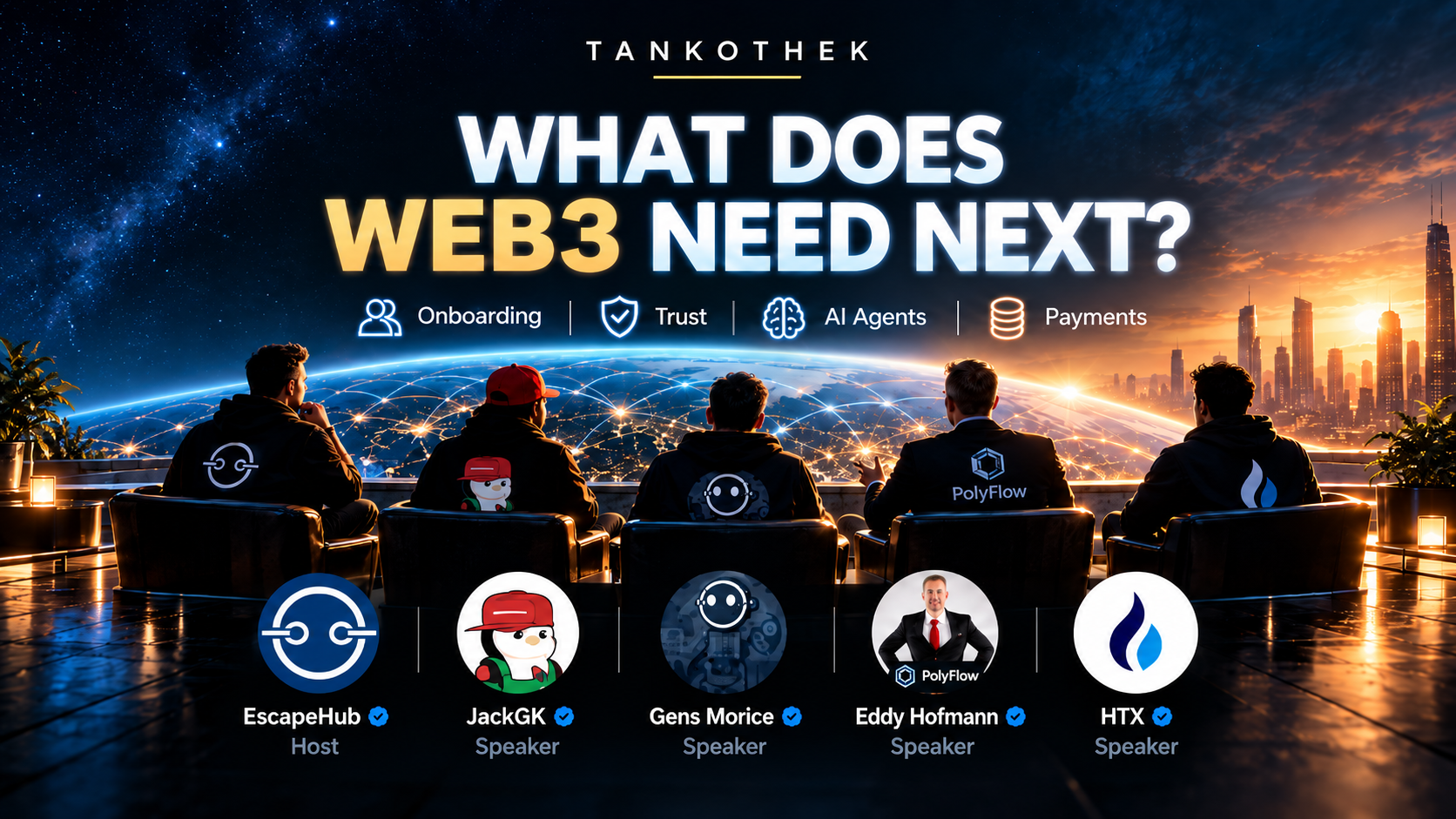
That was the central question behind a recent X Space hosted by EscapeHub, titled “What does Web3 need next?”
The discussion brought together Gens Morice, CCO at EscapeHub; JackGK; Eddy Hofmann, CMO at PolyFlow; and HTX.
I listened to the full conversation because many of the topics connect directly with what I have been observing while testing EscapeHub over the past several months.
But the discussion went far beyond one launchpad.
It moved through onboarding, trust, reputation, artificial intelligence, autonomous agents, payments, digital ownership, trading infrastructure and even the changing role of work itself.
And despite the different perspectives, one idea kept returning throughout the conversation:
Web3 probably does not need to become more complicated. It needs to remove complexity.
The people behind the discussion
JackGK
Moderator of the discussion and host of the JackGK Podcast.
Gens Morice
CCO at EscapeHub.
Eddy Hofmann
CMO at PolyFlow.
HTX
Crypto exchange and trading platform.
The Space itself was hosted through the EscapeHub X account.
What stood out immediately was that the conversation did not turn into the usual discussion about which blockchain will win.
Instead, it quickly became a discussion about what users actually need.
And that is probably the more useful question.
Web3’s biggest problem may still be onboarding
Gens started with one of the most obvious answers: onboarding.
But the important part was how he framed it.
Web3 already has an enormous amount of infrastructure. The problem is that users still need to understand too much of that infrastructure before they can actually use it.
Which chain am I on?
Which wallet do I need?
Do I need to bridge?
Which token pays the gas fee?
Why does this application work on one network but not another?
For experienced crypto users, these questions eventually become normal.
For everyone else, they are friction.
Gens argued that Web3 needs to become easier to use across chains and more accessible to people who are accustomed to opening Safari or Chrome and simply expecting a service to work.
That directly connects with what I have seen during my own EscapeHub testing.
A user should not need to understand the technical architecture before understanding the product.
People do not normally open an application because they want to interact with infrastructure.
They want to accomplish something.
Create something.
Buy something.
Trade something.
Send money.
Use a service.
If blockchain technology is the best infrastructure underneath that experience, then ideally the user should not have to constantly think about which blockchain is doing the work.
That may be one of the clearest paths toward mainstream adoption.
Crypto has a reputation problem
Jack then moved the conversation from onboarding toward reputation.
One of his points was that crypto is often judged differently from other technologies when people misuse it.
If someone uses AI to make scam calls, people usually describe it as someone misusing AI.
When someone uses cryptocurrency for fraud, the conclusion is still often:
Crypto is a scam.
That distinction has followed the industry for years.
Gens made a related argument.
Fraud, money laundering and deception did not suddenly appear when Bitcoin was invented.
Technology changes the tools people use.
It does not remove human behaviour.
For Web3, the larger challenge therefore becomes distinguishing legitimate builders from projects that exist only long enough to extract money from users.
And that brings accountability into the discussion.
Real people.
Real names.
Teams that can be contacted.
Companies that can be identified.
Builders who are prepared to publicly stand behind what they are creating.
Web3 has spent years celebrating anonymity, and there are legitimate reasons why anonymity can matter.
But decentralised technology does not automatically require invisible responsibility.
If the goal is to onboard people outside crypto, trust becomes part of the product itself.
AI makes the trust problem much bigger
This was where the conversation moved into one of the strongest themes of the Space.
HTX raised the idea of combining blockchain-based reputation with AI.
We increasingly rely on AI systems for information, yet the origin of that information is often difficult to evaluate.
Was something created by a person?
Was it generated by AI?
Which model produced it?
What information did that model use?
Where did the original claim come from?
Has the source historically been reliable?
Those questions become more important as generated images, text, audio and video become harder to distinguish from human-created content.
Jack described blockchain as something that could potentially form part of an information provenance layer.
That does not mean putting the entire internet on-chain.
It could instead mean using cryptographic proof for specific facts about digital information.
Who created something.
When it was created.
Which identity published it.
Whether it has been changed.
Whether it came from a verified person or an automated system.
For me, this is where the discussion around AI and blockchain becomes far more substantial than simply attaching “AI” to another crypto product.
AI increases the amount of content that can be created almost without limit.
That makes proving origin and authenticity more valuable.
One technology produces abundance.
The other may help establish provenance.
AI does not only create an information problem
The conversation then moved from AI-generated information toward the effect of AI on work.
Gens argued that current AI remains a powerful tool rather than a complete replacement for human expertise.
He referred to situations where inexperienced developers used AI-generated code without fully understanding what they were deploying, sometimes exposing configuration files, API credentials or other sensitive information.
That point is relevant beyond programming.
AI can significantly accelerate someone who understands what they are doing.
But acceleration is not the same as expertise.
Jack pushed the conversation in another direction.
His view was that AI-related restructuring of employment may already be happening, particularly around entry-level work and corporate efficiency.
Eddy approached it from a historical perspective.
Previous technologies eliminated some jobs while creating entirely new categories of work.
Cars transformed transport.
Industrial machinery transformed manufacturing.
Computers transformed offices.
AI may create another major transition — potentially across both cognitive work and, eventually through robotics, physical work.
I do not think the exact timeline is the most important part of that debate.
The more important question comes afterwards.
If AI increasingly performs tasks for us, how does that AI interact economically with the world?
That takes the discussion directly back to Web3.
AI agents eventually need money
An AI that can answer questions is useful.
An AI that can perform actions is something fundamentally different.
Imagine an agent that knows your calendar.
It knows when you are home.
It knows which products you regularly buy.
Instead of reminding you that you are almost out of something, it orders it.
Now extend that idea to business.
An agent could purchase cloud services.
Pay for software.
Execute trades.
Move funds.
Buy digital services.
Settle invoices.
At that point, intelligence is no longer the biggest bottleneck.
Payments are.
Traditional banking infrastructure was built around human authorization.
Credit cards, PINs, transaction verification, fraud checks and banking controls generally assume that a person is performing the transaction.
Autonomous software introduces an entirely different model.
Crypto infrastructure already works differently.
Wallets, smart contracts and programmable assets allow software to execute transactions based on predefined rules.
That does not remove the security risk.
Giving autonomous agents access to money could create entirely new categories of security problems.
But technically, the architecture is already much closer to what autonomous agents would require.
HTX discussed the possibility of AI agents eventually trading for users through verifiable execution systems.
Eddy approached the same subject from payments.
PolyFlow is developing payment infrastructure including cross-border payments and, eventually, agentic payments.
His argument was that if AI agents need global payment infrastructure, crypto and stablecoins may be far more natural tools than legacy card systems.
And this creates a very different type of crypto adoption.
The user may never consciously decide:
“I want to use blockchain.”
Their AI agent may simply use stablecoins because they are the most practical settlement mechanism available.
Maybe successful Web3 becomes invisible
For me, this is one of the central conclusions from the entire conversation.
Web3 may become more successful when users have to think about Web3 less.
People do not think about TCP/IP when they open Instagram.
They do not think about cloud computing while watching Netflix.
Most users do not know which database their favourite online store uses.
Successful infrastructure disappears behind the experience.
Blockchain may eventually do the same.
A user could have one account.
One wallet in the background.
Assets across multiple networks.
Payments settled using stablecoins.
Digital ownership verified on-chain.
AI agents executing transactions.
And the experience does not begin with:
Choose your network.
That would be a major shift from the crypto experience most of us know today.
And it would probably be a healthy one.
Gaming could normalize digital ownership
Gaming also entered the discussion.
Jack used GTA VI as an example of how digital identity and digital possessions could become increasingly meaningful.
Imagine buying a physical luxury item and receiving a verifiable digital counterpart that can be used inside virtual environments.
Or owning a car whose digital equivalent exists inside a game.
The idea itself is not new.
NFTs attempted to introduce digital ownership to a mainstream audience years ago.
The problem was that much of the market focused on speculation before users had a compelling reason to care about the ownership layer.
Gaming could approach the same concept from the opposite direction.
Players already understand virtual assets.
Skins.
Weapons.
Cars.
Characters.
Collectibles.
What they usually do not have is ownership that extends beyond one company’s closed database.
Blockchain could eventually become useful here not because players suddenly want to buy “NFTs,” but because they want digital property that is actually portable and provable.
The experience needs to create the demand first.
The technology should come second.
Traditional finance is moving toward crypto infrastructure too
HTX also discussed another area where the distinction between crypto and traditional finance is becoming less clear.
Stocks, commodities and other traditional assets are increasingly being represented or traded through crypto-native infrastructure.
HTX has been expanding stock- and commodity-linked markets through its futures platform, with trading available outside the normal operating hours of traditional markets.
The broader development is more important than one particular exchange.
Crypto established the expectation that markets can operate 24/7.
Traditional finance still operates around exchange hours, settlement windows and legacy infrastructure.
As more traditional financial exposure moves toward blockchain-based systems, the separation between TradFi and DeFi may gradually become less meaningful.
Just as users may eventually stop thinking about Web2 versus Web3, they may stop thinking about traditional versus crypto-native financial infrastructure.
They may simply use whichever system provides the better product.
Where EscapeHub fits into the conversation
Near the end of the Space, Gens brought the discussion back to EscapeHub.
His description of what the team is trying to build closely matches several things I have observed during the beta.
The goal is not simply to build another place where someone can create a token.
The larger challenge is removing the friction around the process.
Multi-chain access.
Simpler onboarding.
Less wallet fragmentation.
A more unified interface.
And a team willing to publicly attach names and faces to what it is building.
That final point matters more than it may initially appear.
Web3 products compete not only on technology.
They also compete on trust.
A technically impressive application that users do not trust still has an adoption problem.
During my time testing EscapeHub, I have spent a lot of time looking at small interface decisions, bugs, platform differences and changes that are barely visible from the outside.
The Space added another layer to that experience.
It provided more context around why some of those design decisions matter.
Making multi-chain interaction simpler is not merely a UI improvement.
It connects directly to the larger onboarding problem discussed throughout the Space.
My takeaway
After listening to the entire conversation, I do not think Web3’s next major breakthrough necessarily comes from another blockchain being marginally faster than the previous one.
The infrastructure is already remarkably capable.
The larger opportunities seem to sit above it.
Make chains less visible.
Make identity and provenance more verifiable.
Give AI agents usable transaction infrastructure.
Make digital ownership practical rather than speculative.
Connect traditional markets to always-on settlement systems.
And build products that ordinary users can understand without first becoming crypto experts.
Perhaps that is the strange endgame for Web3.
The technology succeeds when users stop having to think about the technology.
For years, the industry has asked:
How do we bring more people into Web3?
After listening to this discussion, I think the more useful question may be:
How do we bring Web3 into everything else?
Listen to the original X Space
This article reflects my personal notes and interpretation of the X Space “What does Web3 need next?”. Statements, examples and predictions discussed during the Space belong to the respective speakers and should not be interpreted as independently verified claims or financial advice.
About Tankothek
Tankothek started as a place for me to document what I was actually seeing while testing products in Web3.
That remains at the core of what I do.
But testing a product is not only about finding bugs or comparing features.
It also means understanding what the people behind those products are trying to solve — and then seeing how those ideas hold up when they meet real users.
That is why conversations like this belong here as well.
They provide context for the products I test and for the direction in which the wider Web3 ecosystem is moving.