
The Ultimate Web3 Security Starter Pack
Werner Vermaak distills a decade of Web3 failures into 10 major risk categories and a three-layer defense model spanning wallet/key hygiene, safer on‑chain interactions, and security mindset. The guide leans on cold storage, multisig, transaction simulation, and real‑time monitoring tools like Kerberus to keep users “rekt‑free” while acknowledging that automation is needed to catch sophisticated threats. (Kerberus)
Why Web3 Security in 2026 Needs AI Threat Intelligence
Paul argues that with $3.35 billion lost in 2025 and attack operations becoming more targeted, defense must shift from static audits to continuous, AI‑driven threat intelligence. The piece highlights AI’s role in scaling social engineering and exploit discovery, then makes the case for systems that prioritize signal over noise by linking code changes, deployments, and on‑chain behavior into actionable, evidence‑backed alerts. (Cantina)
Chainalysis–BVNK Tighten Compliance for Self‑Hosted Payments
Chainalysis’ team outlines an expanded partnership with BVNK that embeds Chainalysis KYT directly into BVNK’s Layer1 self‑hosted payments stack. The integration lets businesses “bring their own key” and run real‑time risk screening, address monitoring, and freezing workflows from within Layer1, while Sentinel extends monitoring across secondary markets for token issuers seeking end‑to‑end compliance coverage. (Chainalysis)
A few notable hacks from Rekt and other sources…
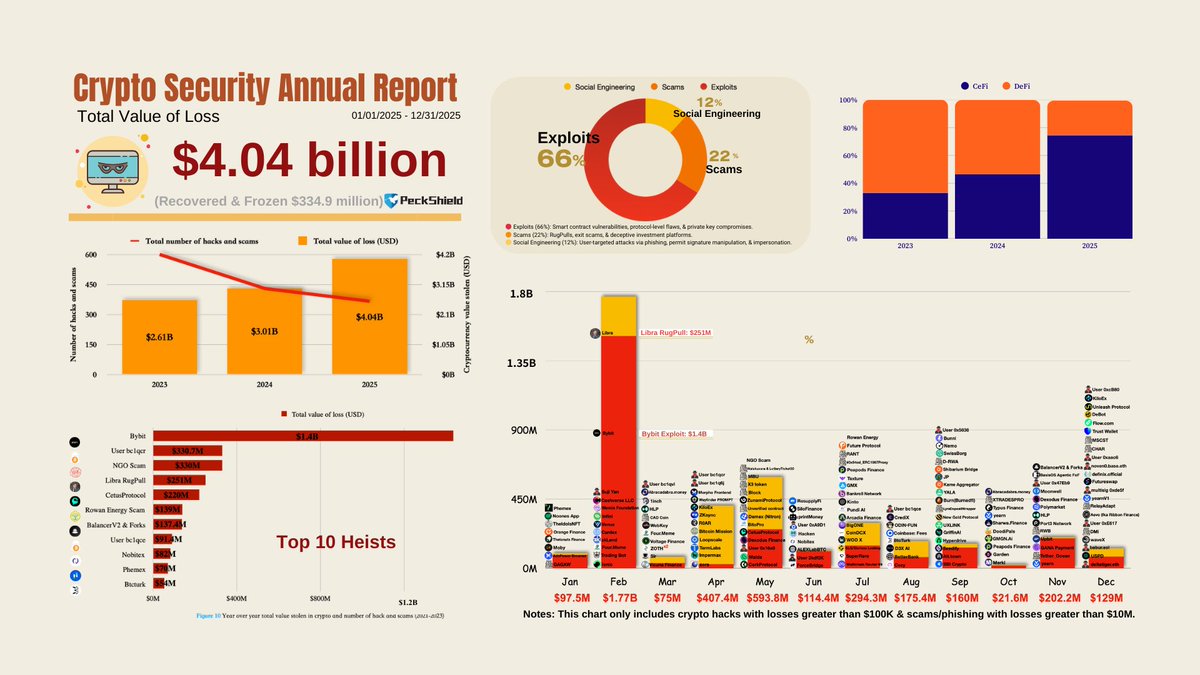
2025 saw $4B in Losses up 34% from 2024

The total loss in 2025 exceeded $4.04B, reflecting a ~34.2%
Truebit’s Overflow Bug Triggers First Major DeFi Hack of 2026
Rekt’s analysis details how an unchecked integer overflow in Truebit’s purchase‑price logic let an attacker mint hundreds of millions of TRU for near‑zero cost, burn them for ETH at a fixed buyback rate, and drain 8,535 ETH—about 26.2 million USD—via five atomic mint‑burn cycles. The exploit wiped TRU’s value to near‑zero and underscored the lingering danger of unverified, legacy contracts. (Rekt)
Total 2026 hack events: 10
The total amount of money lost by blockchain hackers is about:
$30,043,400
Getting to CLARITY
Coinbase CEO Brian Armstrong posted on X that the company cannot support the Senate Banking Committee's draft of the CLARITY Act, calling it "materially worse than the current status quo" and stating "we'd rather have no bill than a bad bill." Armstrong cited four key concerns: a de facto ban on tokenized equities, expanded government access to DeFi user data, provisions that weaken CFTC authority while expanding SEC control, and restrictions on stablecoin rewards that would allow banks to block crypto competition. The post came just hours before the Senate Banking Committee's scheduled markup on January 15, which was subsequently postponed.

There are too many issues, including:
- A defacto ban on tokenized equities
- DeFi prohibitions, giving the government unlimited access to your financial
The Digital Asset Market Structure & Investor Protection Act (CLARITY Act) is stalled in the Senate Banking Committee after Coinbase's withdrawal of support forced Chairman Tim Scott to postpone the January 15 markup. The bill, which passed the House in July 2025, faces uncertain prospects with Polymarket odds of passage dropping from 80% to 52% following Armstrong's announcement.
CLARITY at Stake
Regulatory Authority: The bill would divide oversight between SEC (for ancillary assets) and CFTC (for digital commodities), but critics argue the Senate draft gives SEC excessive power while weakening CFTC's role.
Stablecoin Rewards: Banking groups pushed to eliminate yield on stablecoins, fearing deposit flight from traditional banks. Coinbase's USDC rewards program generated an estimated $1.3 billion in 2025 revenue, making this a critical business issue.
DeFi Privacy: Provisions would bring decentralized protocols under Bank Secrecy Act requirements, potentially giving government unlimited access to financial records and eliminating privacy rights, according to Armstrong.
Tokenized Equities: The draft effectively bans blockchain-based stocks, threatening Coinbase's plans to introduce tokenized securities and limiting innovation in digital asset markets.
Industry Division: While Coinbase demands a "better draft," other firms like a16z Crypto and Kraken favor moving forward with amendments, creating a split in crypto industry lobbying strategy. (Blockbeats)
Autonomous Agents on Blockchains: Security Architecture and Threat Models
This comprehensive survey maps security considerations for AI agents operating on blockchains, detailing five defensive layers: input validation, reasoning constraints, transaction simulation, execution controls, and monitoring. The authors analyze attack vectors including prompt injection via malicious contract metadata, MEV extraction from agent transactions, and social engineering of human approvers. The paper concludes with a safety checklist and emphasizes the need for hardened custody architectures using threshold and multi‑party signing to reduce single‑point key compromise. (arXiv)
Decentralized Firmware Integrity Verification Using Ethereum
A team proposes a framework that stores SHA‑256 firmware hashes on Ethereum Sepolia testnet smart contracts, enabling tamper‑proof, trustless validation for cyber‑physical systems. The Python prototype uses web3.py and Infura to compute hashes, deploy contracts, and perform runtime verification, demonstrating gas costs of 0.0044 ETH per hash storage and 0.00014 ETH per verification. The work highlights trade‑offs in latency, cost, and scalability while offering a transparent alternative to centralized hash servers. (arXiv)
Blockchain Verifiable Proof of Quantum Supremacy as a Trigger for Quantum‑Secure Signatures
Papadopoulos introduces a smart‑contract mechanism that generates classically intractable puzzles to detect when quantum computers achieve cryptographic supremacy. Upon detection, the contract triggers quantum‑secure fallback protocols on Ethereum, allowing assets to remain under current standards until a quantum threat materializes. The design minimizes premature migration costs while providing a trustless, unbiased trigger for post‑quantum transitions. (arXiv)