

Subscribe to Airdrop Alert Daily
Subscribe to Airdrop Alert Daily
Share Dialog
Share Dialog
<100 subscribers
<100 subscribers
Etherscore’s Soulbound Tokens / NFT Badges Deliver On-Chain Proof of Experience
What are ETS tokens? ETS tokens are used to access Etherscore services and participate in governance

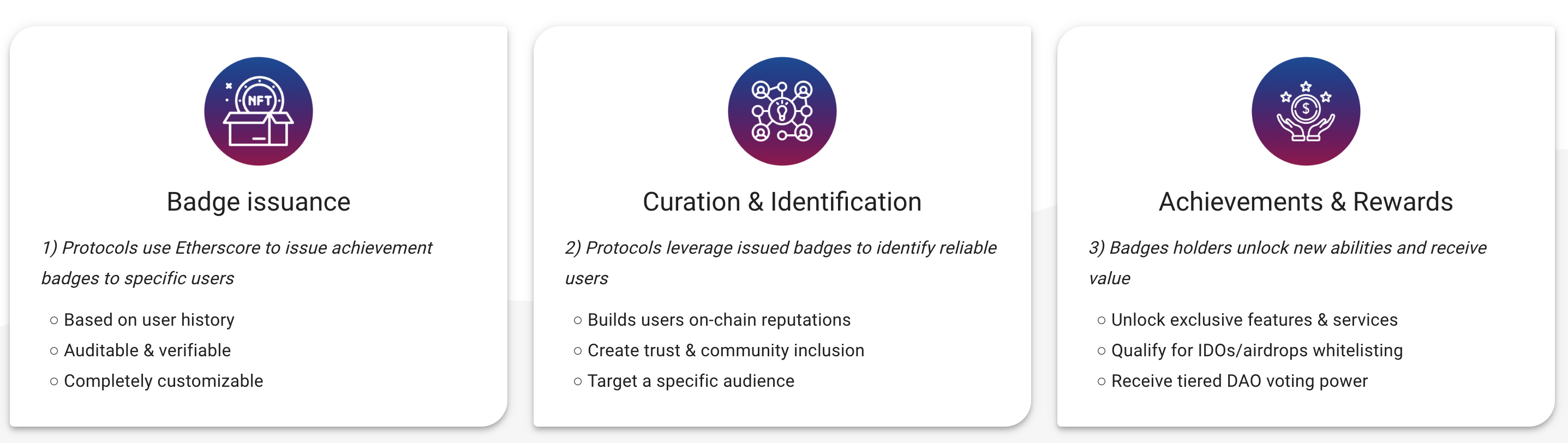
EtherScore creates NFT badges based on a user’s on-chain actions. They are indelible and can be used to certify experiences, provide proof of an accomplishment, or distribute incentives to certain classes of users.
User actions can include anything involving a blockchain, such as interacting with a DeFi platform in a particular way, belonging to a DAO, GameFi, or using a DApp. EtherScore’s Badge Factory allows developers to easily deploy customizable badges with parameters such as transferability, burnability, dynamicity, or supply.
Any user fulfilling the conditions set by the developers can mint or receive an airdropped NFT EthScore badge and enjoy the benefits.
Almost all blockchain projects experiment with an incentive mechanism to reward or encourage their users. Uniswap airdropped tokens, Coinlist deposited Karma, and UMA gave KPI options. They all relied on whitelists, often generated by third parties and off-chain data.
A whitelist is a blunt instrument. They can make sense when a single factor is considered, but each new variable makes a list much more difficult to assemble and unwieldy to use, particularly at scale. Whitelists lack the transparency and auditability that the crypto-community values, and can encourage free-riders and bad actors.
EtherScore solves a basic problem for blockchain organizations: how to find, recognize, and reward users over time. It provides a decentralized reputation system that can be completely customized to a developer’s needs. An EtherScore NFT badge places the onus for meeting the developer’s standards on the user.
EtherScore’s composability and the persistence of its NFT badges will allow a new class of reputation-based blockchain DApps such as curated social networks, DeSci, DeFi, GameFi and gaming achievements, fidelity programs, DAOs, and many more.
EtherScore Badges are NFTs representing users' achievements. As explained before, those badges can be used as an assessment of users’ experiences. Such assessments, being available on-chain, become accessible to Dapps and smart contracts which can implement access conditions based on it. Dapps can trust the authenticity of badges as they contain all information required for their verification. Badges can be used as a brick to build user profiles that are interoperable across the entire Ethereum ecosystem (pushing the concept of Ethereum Single Sign-On) and as a complementary tool to existing decentralized identity approaches such as Ethereum Name Service, Proof of Humanity or any blockchain identity-focused project.
Badges are composed of one or several minting conditions which represent the achievements required to be able to mint the NFT. A condition example could be "has already swapped on Uniswap" (some other badges examples are in part X). Conditions can be none (using the badge factory as traditional NFT airdrop) or multiple (conditions A and B). Various types of badges will then co-exist such as single-metric, multi-metric, evolutive (multi-threshold), blacklisters, and a lot of other features.
Here is non-exhaustive list of metrics that can be used to issue EtherScore badges (note that any metrics available in our data sources can also be used):
Base layer usage (such as Ethereum usage)
First transaction’s timestamp ("member since")
Gas burned amount
Mean transactions gas price
Max holding time, number of ETH hold
Miners / Stakers (blocks mined, reward received)
DeFi
Early participants in protocol / airdrop recipient / airdrop holder
DEXs: number of swaps, LP provided, trade price etc.
Lending: lent value, borrowed value, flash loans, liquidations etc
Communities / DAOs
Participants in DAO proposals (voters, delegators, proposal creators)
First holders
Official devs / contributors
Grants or Bounties recipient / Testnet participant / Gitcoin donator or recipient
Gaming / Metaverse
Money spent in game
Number of items owned (or bought/sold) / having all items of a collection
First to complete a game / level
Various user profile statistics (winrate etc)
Any game specific achievement
Social Networks
Number of posts
Number of likes
Number of followers
Amount received / donated in tips
Vouched by x person (if vouching)
Art NFT Marketplace
Number of items bought / sold
Number of different collection bought
Number of NFTs / collections issued
Thanks Dont for forget to collect this Articles.
Etherscore’s Soulbound Tokens / NFT Badges Deliver On-Chain Proof of Experience

What are ETS tokens? ETS tokens are used to access Etherscore services and participate in governance
EtherScore creates NFT badges based on a user’s on-chain actions. They are indelible and can be used to certify experiences, provide proof of an accomplishment, or distribute incentives to certain classes of users.
User actions can include anything involving a blockchain, such as interacting with a DeFi platform in a particular way, belonging to a DAO, GameFi, or using a DApp. EtherScore’s Badge Factory allows developers to easily deploy customizable badges with parameters such as transferability, burnability, dynamicity, or supply.
Any user fulfilling the conditions set by the developers can mint or receive an airdropped NFT EthScore badge and enjoy the benefits.
Almost all blockchain projects experiment with an incentive mechanism to reward or encourage their users. Uniswap airdropped tokens, Coinlist deposited Karma, and UMA gave KPI options. They all relied on whitelists, often generated by third parties and off-chain data.
A whitelist is a blunt instrument. They can make sense when a single factor is considered, but each new variable makes a list much more difficult to assemble and unwieldy to use, particularly at scale. Whitelists lack the transparency and auditability that the crypto-community values, and can encourage free-riders and bad actors.
EtherScore solves a basic problem for blockchain organizations: how to find, recognize, and reward users over time. It provides a decentralized reputation system that can be completely customized to a developer’s needs. An EtherScore NFT badge places the onus for meeting the developer’s standards on the user.
EtherScore’s composability and the persistence of its NFT badges will allow a new class of reputation-based blockchain DApps such as curated social networks, DeSci, DeFi, GameFi and gaming achievements, fidelity programs, DAOs, and many more.
EtherScore Badges are NFTs representing users' achievements. As explained before, those badges can be used as an assessment of users’ experiences. Such assessments, being available on-chain, become accessible to Dapps and smart contracts which can implement access conditions based on it. Dapps can trust the authenticity of badges as they contain all information required for their verification. Badges can be used as a brick to build user profiles that are interoperable across the entire Ethereum ecosystem (pushing the concept of Ethereum Single Sign-On) and as a complementary tool to existing decentralized identity approaches such as Ethereum Name Service, Proof of Humanity or any blockchain identity-focused project.
Badges are composed of one or several minting conditions which represent the achievements required to be able to mint the NFT. A condition example could be "has already swapped on Uniswap" (some other badges examples are in part X). Conditions can be none (using the badge factory as traditional NFT airdrop) or multiple (conditions A and B). Various types of badges will then co-exist such as single-metric, multi-metric, evolutive (multi-threshold), blacklisters, and a lot of other features.
Here is non-exhaustive list of metrics that can be used to issue EtherScore badges (note that any metrics available in our data sources can also be used):
Base layer usage (such as Ethereum usage)
First transaction’s timestamp ("member since")
Gas burned amount
Mean transactions gas price
Max holding time, number of ETH hold
Miners / Stakers (blocks mined, reward received)
DeFi
Early participants in protocol / airdrop recipient / airdrop holder
DEXs: number of swaps, LP provided, trade price etc.
Lending: lent value, borrowed value, flash loans, liquidations etc
Communities / DAOs
Participants in DAO proposals (voters, delegators, proposal creators)
First holders
Official devs / contributors
Grants or Bounties recipient / Testnet participant / Gitcoin donator or recipient
Gaming / Metaverse
Money spent in game
Number of items owned (or bought/sold) / having all items of a collection
First to complete a game / level
Various user profile statistics (winrate etc)
Any game specific achievement
Social Networks
Number of posts
Number of likes
Number of followers
Amount received / donated in tips
Vouched by x person (if vouching)
Art NFT Marketplace
Number of items bought / sold
Number of different collection bought
Number of NFTs / collections issued
Thanks Dont for forget to collect this Articles.



No activity yet