Just a gal trying to make sense of the world
Just a gal trying to make sense of the world
Subscribe to Mosaic of thoughts
Subscribe to Mosaic of thoughts
>200 subscribers
>200 subscribers
Share Dialog
Share Dialog

i do remember you.
I've been thinking about memory a lot these past two months and finally got around to turn it into a cohesive whole. I find it scary that it's becoming yet another are that tech wants to control, without ever asking: should we ever go down the route of perfect memory?
Naomi (@naomiii) examines the push for perfect memory and its costs: memory’s meaning, the pain of forgetting, and the risk of surveillance-driven recall eroding intimacy, forgiveness, and selfhood.
The balcony of a rented Airbnb near the Thames on a cold winter evening. The wind racing through the gaps between the soulless glass and steel rises of Canary Wharf. A couple stands near the edge, leaning over the railing, looking at the black water. Behind them, through the half-closed terrace door, scraps of the conversation inside waft out. Neither the cold nor the wind matters to them as they turn to face each other and their lips meet for the first time.
Another winter evening in another town with a lot of water and wind. A couple steps out of a bar, wrapped in layers of clothing, hands in gloves and pockets, skin slightly red from the sudden exposure to the weather, or perhaps it’s blushing at the thought of what could be. In the LED light of the Irish Pub’s sign opposite, he leans down to find her mouth, tasting the leftover sweetness of her cocktail.
From the outside, these moments from memory look like the start of very similar stories. If I had worn an all-tracking recording device on my neck, it might have stored them with the same label. I have no way of knowing, but biomechanical readings could be the same, but in my mind, the experience was all but alike.
The first was the start of a short, intense romantic relationship that was ripped apart by the pandemic. The second was a bumble date where the kiss felt more like checking off another box on my to-do list, leading me to decline an invitation to his hotel. A few minutes later, I stood in the freezing cold, trying to survive the 40 minutes until my next train. The next day, he’d blocked and deleted our chats - the anticlimactic end to a week-long exchange.
Anyway, why bring this up here? Because memory isn’t just data, it’s meaning and deeply personal. Still, it has become yet another realm that tech bros want to get into without ever pondering the consequences.
For tech bros, a dream come true. Surveillance once again sold as a supposed fix for a human shortcoming: our memory’s inaccuracy and incompleteness. Never lose a memory again; go back to the highlights of your life later as a spectator with a front-row seat. Direct access to your memory that’d otherwise require a Proustian flashback, notoriously hard to trigger intentionally. What is outside our control = worth eradicating.

When a friend sent me a deck to a startup in the realm of recording all your memories so you don’t have to use your own brain space - this I read in the subtext, it was not actually there - the humanist in me wanted to smash her face against a concrete wall.
Does the Black Mirror-esque vision not give them a creeping sense of doubt? Apparently not in a world where we sell AI-avatars of deceased ones, so we will never have to deal with real loss again, wrapped in a blanket of denial, fuelled by a replication of the deceased we continue talking to in a semblance of love.
Is this not more about us than them? A lil narcissistic to force our elders to spend their last days speaking their thoughts into a machine?

Is that real love? Kierkegaard would like a word. In his view, our relation to the deceased is the purest form of it, as it does not evoke any reciprocity. Once we have AI avatars of the dead, this idea crumbles.
Whether it’s honoring or disgracing the dead’s memory does not factor into the calculation of such startups. Neither does the question of: What does it say about your view of humans?
Isn’t memory one of the most intimate things we have? Isn’t it up to us to keep our loved ones alive, to remember them, to rely on other humans to continue keeping us alive in their stories?
Perhaps these builders never once considered that forgetting is human and that their desire to outsource and control certain things is yet another flimsy attempt at grasping the metaphysical, which might forever transcend their pathetic minds.

In a world where all of us record every single moment, and certain people are already damn close to it, what happens to us?
Biography might not be identity, but memory sure contributes a large chunk to how we view ourselves, the narrative we have of who we are and how we got here.
Remembering is an inward process, as the German word for it, er-innern, suggests. What happens to us if it becomes a process of consumption instead? Wouldn’t that rob us of a fundamental piece of ourselves?
If I were to be presented with an accurate depiction of all the horrible experiences I went through in relationships with the wrong men, I’d likely never go on a date again. I’d never experience the sweet anguish of falling for someone without knowing whether it’s reciprocated again. I might turn into a version of the underground man, pushing away all that could hurt, justifying it with the past pain.
We forget the hardship of new beginnings, the hurt caused by past relationships, and the awkwardness of learning something from scratch. We view the past through rose-tinted glasses, so much so that even months of heightened financial distress suddenly take on a glow. The glow reminds us of how far we’ve come, strengthening our resilience.
Not good enough for the tech elite. They want to dominate it all, root out the seeming imperfections in pursuit of “perfect memory”.

A Faustaian bargain.
The more fleeting the moment, the bigger the drive to capture it. Ironically, the endeavor usually fails, leaving you with a failed picture and no actual memory thereof, since you were busy trying to take a pic or video instead of just using your eyes and ears to experience. A quixotic quest.
From there, the assumption isn’t too far off that the more we archive, the less we might actually be able to actively recall. What a device that constantly surveils us would do for this, unsure. The lingering sense that someone else does the documenting might simply lead to even more scattered attention. After all, anything is archived no matter what.
The next logical step: we just stop bother remembering altogether. After all, the machine can do it for us, right? What’s that if not forgetting?
We amputate our cognitive functions, we lock ourselves in the glass cage of technology, and delight at our own brain rot.
What if forgetting happens at collective levels, though?
In her 1994 book Memory Police, Yoko Ogawa asks: What would happen if things disappeared from the memories of a large part of society?
Looking forward to reading memory police in its original language. 😍
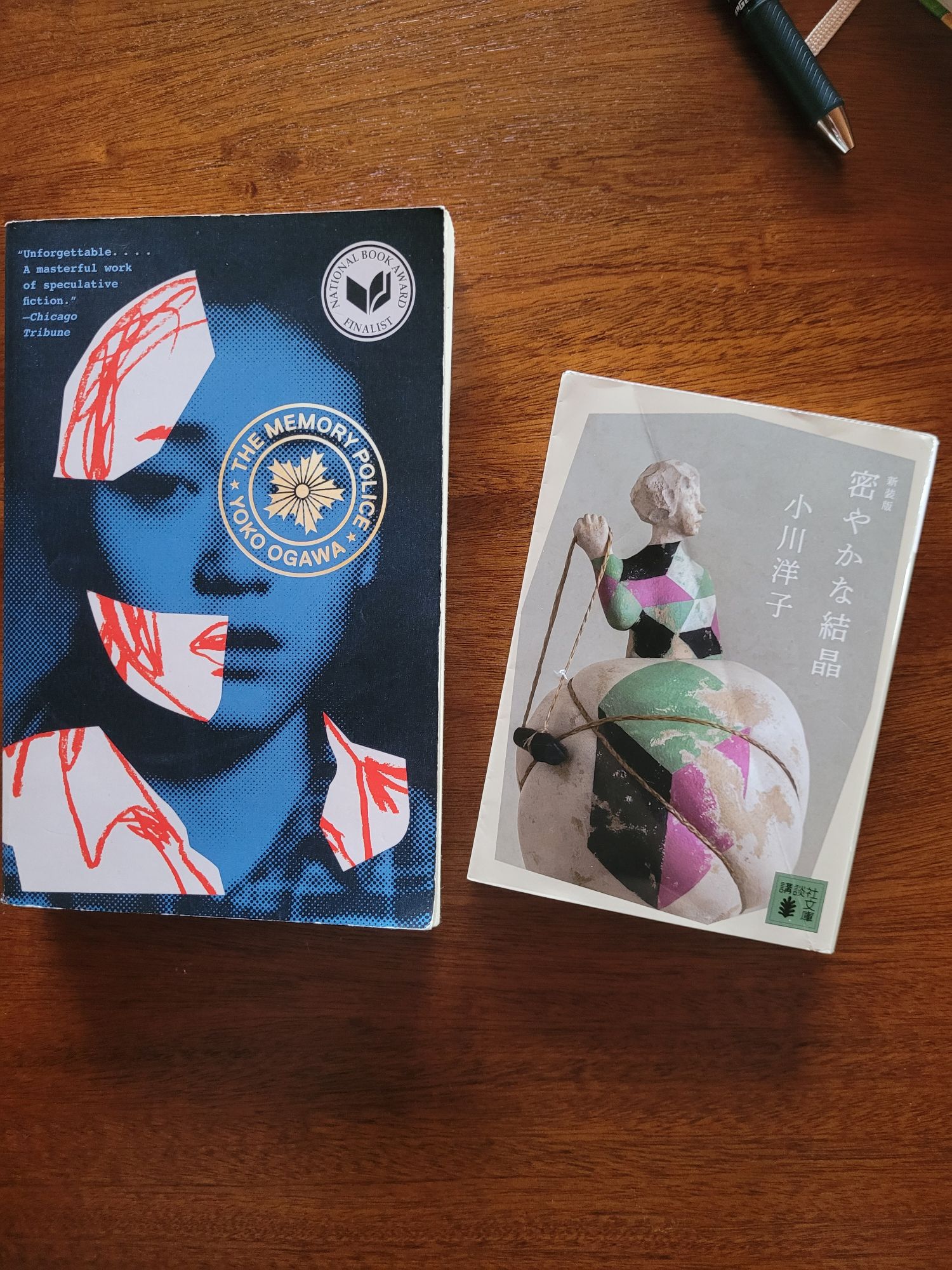
The protagonist, a novelist, lives on an island where exactly that happens. Her mother, we learn early on, had been taken by the memory police because she retained the ability to remember. This hasn’t been passed on to her daughter, who goes on living her life, facing the disappearances stoically, as just another fact of life.
“It’s a shame that the people who live here haven’t been able to hold such marvelous things in their hearts and minds, but that’s just the way it is on this island. Things go on disappearing one by one.”
Yoko Ogawa - Memory Police
Eventually, she decides to hide her editor R. (who also remembers) at her house in a small, hidden room she built with an old friend. Over the course of the book, more and more things disappear, and the editor tries to halt the impoverishment of the lead characters’ souls through talking to them about items that have been lost.
“I was sure that any memories that remained inside him would be very much alive, so different from my own, which were few in number and very pale-sodden flower petals sinking into the waves of the ashes at the bottom of the incinerator.”
Yoko Ogawa - Memory Police
Throughout the entire novel, we never learn why things disappear. We never learn whether any overarching ideology exists or what drives the memory police. We can only guess.
One of the most puzzling elements is that… It’s never clarified whether things actually disappear or whether they’ve just lost their meaning. In one scene, the protagonist sees a woman wearing an item on her head, which she correctly identifies as a hat… even though hats have technically disappeared. She also recognizes a bird-like creature after its supposed disappearance years ago.
“But they’re invisible, aren’t they? And no matter how wonderful the memory, it vanishes if you leave it alone, if no one pays attention to it. They leave no trace, no evidence that they ever existed.”
Yoko Ogawa - Memory Police
Things don’t have to actually disappear; we just have to lose relation to them, and they become obsolete for our brains. An increase in blind spots until we’re cornered by darkness.
Not so dissimilar from the way the rage economy is short-circuiting people’s brains. Heightened stress over time shrinks the hippocampus, thereby worsening memory, focus, and concentration.
Ogawa’s book is often pitched as a dystopia up there with Orwell’s 1984, but it feels very different in its emphasis on the mundane, the fabric that makes up our lives, which remains least prominent in our minds. It’s this dedication to the calm, everyday life that feels so inappropriate in the face of the disappearances.

As you scour the internet for different people’s analyses of it, you’ll often come across those interpreting it as a fable of living under totalitarianism. Others view the disappearances as a reminder of wartime, the slow fading of what makes us us.
It’s hard to dismiss the similarities between the hiding of the editor, R., and Ogawa’s professed temporary obsession with the story of Ann Frank. Yet, totalitarianism and war don’t entirely explain it all either.
Another line of thought relies on Shinto, the Japanese nature religion, not far from animism, which views the natural world as inhabited by very much alive spirits, an idea familiar to anyone who’s ever seen a Ghibli movie.
This life force assumes that we’re all connected and should move toward creating. In her fable, the disappearances outpace new creations, destroying any equilibrium. But unlike in Princess Mononoke, there’s not even a good reason for the destruction (Lady Eboshi is not an entirely evil person, providing homes and protection to outcasts, and the complexity of Ghibli antagonists)
I reckon there’s a direct line one can draw from this dynamic of destruction and creation to our own memories. If we do not experience things ourselves, we rob ourselves of future memories, eventually draining ourselves of the ability to creatively use them.

There’s an episode of Mushishi that explores memory and draws a parallel to this. It follows Ginko, the protagonist who deals with Mushi (parasites that are invisible to most, a different life form, very shinto) as he comes upon a young boy, Kaji, consulting him on his mother, Sayo’s, memory loss.
After Ginko observes the mother for a while, he identifies the Mushi as Kagedama. A mushi that eats memories, starting with the least important ones, which explains her forgetting distant relatives’ names or what a sneeze was.
Unfortunately, there’s no way to rid herself of the Mushi, so Ginko suggests that the best she can do is continue making new memories every day, to keep as much as possible of her current memories alive.
A few years later, Ginko checks in on them. After discovering that her husband had started a new family in a nearby town, Sayo fell into a deep slumber, leaving her with barely any memories. She’s now making new memories every day, but waking without them the next.
In a sense, she has reached a state of blissful happiness. The happiness of Nietzsche’s beast.

“Observe the herd which is grazing beside you. It does not know what yesterday or today is. It springs around, eats, digests, jumps up again, and so from morning to night and from day to day with its likes and dislikes closely tied to the peg of the moment, and thus neither melancholy nor weary. To witness this is hard for man, because he boasts to himself that his human race is better than any beast and yet looks with jealousy at its happiness.
F. Nietzsche - On the use and abuse of the history of life
The happiness some chase by drinking themselves to oblivion, taking drugs, in an attempt to reach a sense of freedom, freed from one’s own self-awareness, and memories. Yet, we all know the saying that “I drink to drown my bad memories, but those mfers know how to swim.”
This shows that memory is messy, and the quest to store it all accurately is another tech bro utopia.
It’s also highly questionable whether any tech would really catch all there is to a memory…as any musician can tell you, there’s a moment when you learn a piece by heart, and it flows automatically, but stops to do so the second your cognition kicks in, asking, what’s next. Such muscle memory probably won’t be part of the archive of it all.
Even if it were, wouldn’t having everything and all stored for easy retrieval paralyze us?
In the teeming world of Funes, there were only details, almost immediate in their presence.[…] He reasoned, that his immobility was a minimum price to pay. Now his perception and his memory were infallible.
Jorge Borges, Funes the Memorious
Funes, the character of Borges's short story, spends much of his time sitting in a dark room to avoid information overload. He’s incapable of getting up to much, immobilized, struggling to sleep, as “to sleep is to turn one’s mind from the world.”
With a memory so stuffed with details, a “garbage heap” as he calls it, he’s not achieved a perfect state for a human. Quite the opposite. As the narrator concludes his recollection of encountering this man, he postulates that Funes was likely incapable of thought.
“To think is to forget differences, generalize, make abstractions.”
Borges gets to something that eludes the AI startups building perfect memory-capture machines. The necessity for us not to get tied up in too many details, to paint with rosy colors the hardships of the past, the forgetting of what didn’t matter, because the brain isn’t about quantity.
It’s about quality. Our memories carry what we need, not all we’ve ever experienced. The paralyzing effects Funes experiences aren’t too dissimilar from our frenzy to gather more and more information before taking action ahead of a big decision.
It feels good to do so; it suggests we’re moving toward the thing we want, but at the same time, it might mean we just never actually start doing the thing because we get so enamoured with the process of envisioning ourselves doing so and preparing.
The lack of perfect memory isn’t a bug; it’s a feature. It allows us to creatively draw from what we’ve seen to use experiences in meaningful ways to guide our future. This wouldn’t be possible if what we had were a perfect collection of it all, perhaps with an AI to provide an interpretation on top.
Perhaps all of this storing personal history outside of our brains movement is another attempt to face the inevitability of death. The twisted desire to live on, not in the stories we tell each other, the ones passed on among humans, the narratives that slip even through the cracks of oppressive regimes, the small tokens we hold onto to remind us of another we cared for.
"He has always said that we exist as long as someone remembers us."
Carlos Ruiz Zafon, Shadow of the Wind
But how do you want to be remembered? As a digital garbage heap of the stuff you once posted online? As an archive of what an AI pendant might capture in your body’s reaction data, and with its sensors?
I doubt it. I’ll go out on a limb and assume that what we want to be remembered as isn’t any of that. It’s way more human, more on the emotional level, the impact we’ve had, and the way we’ve been there for others. It’s not necessarily the highest high of superficial success we want to remain. It’s our essence.
This too shines through in one of the saddest Arias ever written: Dido’s Lament, in which she asks her lover to “remember me, but forget my fate,” as she is about to burn herself to death in despair, while Aeneas, her lover, sails away, unlikely to hear her plea, making the scene ever more harrowing to watch.

She doesn’t want him to remember the burning blaze her last cry is underlined by; she wants to be recalled as a lover, as a whole person, not as all the little things she did accurately retained.
She wants him to care because what is remembering another than to exercise our capacity to go beyond our own selfish bubble and use our mental capacity to keep the memory of someone else alive.
Now we’re to outsource that? No thanks.
It’s not just a question of yet another very human (supposedly flawed) act becoming mechanized; it’s also a potential hazard for living our lives unburdened by the shackles of the past archive.
Already now, they say what’s been uploaded to the internet will always be there, a silly joke from the past might at any point resurface to haunt us, completely negating the possibility that - god forbid - a person has changed.
In self-reliance, the American naturalist Emerson wrote that “a foolish consistency is the hobgoblin of small minds,” condemning our tendency to judge others based on whether they’ve stayed consistent in judgment. Why hold ourselves to what we said in the past when today is a new day, and we’re not the same; we’ve learned a thing or two, leading us to revise.

It doesn’t help that, when a prominent figure backtracks on what they stood for, outrage often ensues. The mob is unforgiving of the signs of betrayal by a beloved popculture icon.
And if you still do, you risk angering or losing your audience.
In German history, there’s one prominent author illustrating this conundrum: Thomas Mann. During World War 1, he excelled as a writer in the service of the nationalist cause, going so far as to describe the war as a necessary cleansing act that would lead to a great German renaissance.
The longer the war lasted, the more soldiers fell, the more he had to re-interpret his previous ideas. Eventually, Mann would become an outspoken advocate for democracy.
The inner fight he must have gone through is captured in his monumental work, Magic Mountain, in the shape of two characters in a mental asylum trying to convince the protagonist, Hans Castorp, of their political leanings. In the beginning, he’s a staunch opponent of the world laid out by Lodovico Settembrini, who speaks in favor of democracy.

By the time this feud reaches its climax in a direct duel with the opposing worldview embodied by the nationalist Leo Napta, our protagonist - and, we suspect, the author himself - has come around to favor democracy, not least because the character has better arguments and is more likable.
During World War 2, Mann emigrated to the US, from where he supported the Allies’ cause by recording speeches to his fellow Germans appealing to their better senses, and arguing that the destruction even of his beloved Lübck was something they’d brought onto themselves, and was to be welcome if it meant ending the barbarities.
When Mann visited Germany after the war, his welcome ranged from cold reserve to outright hostility. One did not appreciate his referring to the Germans as a crowd of “senseless killers” who, amidst the depravities they committed, shouldn’t be surprised that Western civilization had no recourse but harsh measures.
It was a direct attack on the consciousness of a people who found solace in viewing themselves as having been seduced and suffered in consequence. Needless to say, they had little to counter, and their frustration led them to lash out at the one who delivered it.
It took many decades for Thomas Mann’s work and political deeds to be fully appreciated back home. Only in the last 10, 15 years has the affect-driven dislike been disappearing, giving way to a newfound appreciation for a great author. Perhaps we’ve finally forgiven his ruthless reckoning, or perhaps we’ve just forgotten why the dislike existed in the first place.
Either way, in time for his 150th anniversary, we were ready to embrace the whole, republishing many of his novels, and re-evaluating his political messages, the speeches he delivered from exile, which did not stay abstract but were deeply personal, delivered by someone who loved his country, afraid of what it had turned into.
The lesson here? We need distance at times to reinterpret our memories and revise how we view others and ourselves. For a person in the public eye, changing what they stand for might mean losing their standing, and they might not live long enough to witness their own re-establishment. Unmistakeably, it was the right thing to do for Mann, even if the German public didn’t appreciate it back then.
50 years forward, and we celebrate him. Our memory hasn’t vanished; we’ve just retold it, gained distance, and let go of the resentment.

I wonder how many like Mann are afraid of doing what he did, changing their political leanings publicly in the internet age, because it means ostracism. Even without perfect recording devices, the internet mob is ruthless.
Imagine if we kept an immaculate track record of all we did in the past, and all that others said. They sell it to us as "freedom,” but to me it seems just another form of locking ourselves into ever-narrower cages.
If there’s no more forgetting, no more re-interpreting, we might find ourselves stuck in a glass cage that keeps us from transforming. A glass cage that makes forgiveness near impossible, as it constantly reminds us of what others did, how we felt back then, and that there’s really no point in reversing course now.
For Hannah Arendt, forgiveness was the foundation of action, as it is the only tool that alleviates the burden of the irreversibility of consequences. A world of perfectly captured memories with no leeway for human re-interpretation is an unforgiving, unfree world.
To be remembered is to be loved.
Why would we want to give that up?
Thanks for reading 💚
The balcony of a rented Airbnb near the Thames on a cold winter evening. The wind racing through the gaps between the soulless glass and steel rises of Canary Wharf. A couple stands near the edge, leaning over the railing, looking at the black water. Behind them, through the half-closed terrace door, scraps of the conversation inside waft out. Neither the cold nor the wind matters to them as they turn to face each other and their lips meet for the first time.
Another winter evening in another town with a lot of water and wind. A couple steps out of a bar, wrapped in layers of clothing, hands in gloves and pockets, skin slightly red from the sudden exposure to the weather, or perhaps it’s blushing at the thought of what could be. In the LED light of the Irish Pub’s sign opposite, he leans down to find her mouth, tasting the leftover sweetness of her cocktail.
From the outside, these moments from memory look like the start of very similar stories. If I had worn an all-tracking recording device on my neck, it might have stored them with the same label. I have no way of knowing, but biomechanical readings could be the same, but in my mind, the experience was all but alike.
The first was the start of a short, intense romantic relationship that was ripped apart by the pandemic. The second was a bumble date where the kiss felt more like checking off another box on my to-do list, leading me to decline an invitation to his hotel. A few minutes later, I stood in the freezing cold, trying to survive the 40 minutes until my next train. The next day, he’d blocked and deleted our chats - the anticlimactic end to a week-long exchange.
Anyway, why bring this up here? Because memory isn’t just data, it’s meaning and deeply personal. Still, it has become yet another realm that tech bros want to get into without ever pondering the consequences.
For tech bros, a dream come true. Surveillance once again sold as a supposed fix for a human shortcoming: our memory’s inaccuracy and incompleteness. Never lose a memory again; go back to the highlights of your life later as a spectator with a front-row seat. Direct access to your memory that’d otherwise require a Proustian flashback, notoriously hard to trigger intentionally. What is outside our control = worth eradicating.
When a friend sent me a deck to a startup in the realm of recording all your memories so you don’t have to use your own brain space - this I read in the subtext, it was not actually there - the humanist in me wanted to smash her face against a concrete wall.
Does the Black Mirror-esque vision not give them a creeping sense of doubt? Apparently not in a world where we sell AI-avatars of deceased ones, so we will never have to deal with real loss again, wrapped in a blanket of denial, fuelled by a replication of the deceased we continue talking to in a semblance of love.
Is this not more about us than them? A lil narcissistic to force our elders to spend their last days speaking their thoughts into a machine?
Is that real love? Kierkegaard would like a word. In his view, our relation to the deceased is the purest form of it, as it does not evoke any reciprocity. Once we have AI avatars of the dead, this idea crumbles.
Whether it’s honoring or disgracing the dead’s memory does not factor into the calculation of such startups. Neither does the question of: What does it say about your view of humans?
Isn’t memory one of the most intimate things we have? Isn’t it up to us to keep our loved ones alive, to remember them, to rely on other humans to continue keeping us alive in their stories?
Perhaps these builders never once considered that forgetting is human and that their desire to outsource and control certain things is yet another flimsy attempt at grasping the metaphysical, which might forever transcend their pathetic minds.
In a world where all of us record every single moment, and certain people are already damn close to it, what happens to us?
Biography might not be identity, but memory sure contributes a large chunk to how we view ourselves, the narrative we have of who we are and how we got here.
Remembering is an inward process, as the German word for it, er-innern, suggests. What happens to us if it becomes a process of consumption instead? Wouldn’t that rob us of a fundamental piece of ourselves?
If I were to be presented with an accurate depiction of all the horrible experiences I went through in relationships with the wrong men, I’d likely never go on a date again. I’d never experience the sweet anguish of falling for someone without knowing whether it’s reciprocated again. I might turn into a version of the underground man, pushing away all that could hurt, justifying it with the past pain.
We forget the hardship of new beginnings, the hurt caused by past relationships, and the awkwardness of learning something from scratch. We view the past through rose-tinted glasses, so much so that even months of heightened financial distress suddenly take on a glow. The glow reminds us of how far we’ve come, strengthening our resilience.
Not good enough for the tech elite. They want to dominate it all, root out the seeming imperfections in pursuit of “perfect memory”.
A Faustaian bargain.
The more fleeting the moment, the bigger the drive to capture it. Ironically, the endeavor usually fails, leaving you with a failed picture and no actual memory thereof, since you were busy trying to take a pic or video instead of just using your eyes and ears to experience. A quixotic quest.
From there, the assumption isn’t too far off that the more we archive, the less we might actually be able to actively recall. What a device that constantly surveils us would do for this, unsure. The lingering sense that someone else does the documenting might simply lead to even more scattered attention. After all, anything is archived no matter what.
The next logical step: we just stop bother remembering altogether. After all, the machine can do it for us, right? What’s that if not forgetting?
We amputate our cognitive functions, we lock ourselves in the glass cage of technology, and delight at our own brain rot.
What if forgetting happens at collective levels, though?
In her 1994 book Memory Police, Yoko Ogawa asks: What would happen if things disappeared from the memories of a large part of society?
Looking forward to reading memory police in its original language. 😍
The protagonist, a novelist, lives on an island where exactly that happens. Her mother, we learn early on, had been taken by the memory police because she retained the ability to remember. This hasn’t been passed on to her daughter, who goes on living her life, facing the disappearances stoically, as just another fact of life.
“It’s a shame that the people who live here haven’t been able to hold such marvelous things in their hearts and minds, but that’s just the way it is on this island. Things go on disappearing one by one.”
Yoko Ogawa - Memory Police
Eventually, she decides to hide her editor R. (who also remembers) at her house in a small, hidden room she built with an old friend. Over the course of the book, more and more things disappear, and the editor tries to halt the impoverishment of the lead characters’ souls through talking to them about items that have been lost.
“I was sure that any memories that remained inside him would be very much alive, so different from my own, which were few in number and very pale-sodden flower petals sinking into the waves of the ashes at the bottom of the incinerator.”
Yoko Ogawa - Memory Police
Throughout the entire novel, we never learn why things disappear. We never learn whether any overarching ideology exists or what drives the memory police. We can only guess.
One of the most puzzling elements is that… It’s never clarified whether things actually disappear or whether they’ve just lost their meaning. In one scene, the protagonist sees a woman wearing an item on her head, which she correctly identifies as a hat… even though hats have technically disappeared. She also recognizes a bird-like creature after its supposed disappearance years ago.
“But they’re invisible, aren’t they? And no matter how wonderful the memory, it vanishes if you leave it alone, if no one pays attention to it. They leave no trace, no evidence that they ever existed.”
Yoko Ogawa - Memory Police
Things don’t have to actually disappear; we just have to lose relation to them, and they become obsolete for our brains. An increase in blind spots until we’re cornered by darkness.
Not so dissimilar from the way the rage economy is short-circuiting people’s brains. Heightened stress over time shrinks the hippocampus, thereby worsening memory, focus, and concentration.
Ogawa’s book is often pitched as a dystopia up there with Orwell’s 1984, but it feels very different in its emphasis on the mundane, the fabric that makes up our lives, which remains least prominent in our minds. It’s this dedication to the calm, everyday life that feels so inappropriate in the face of the disappearances.
As you scour the internet for different people’s analyses of it, you’ll often come across those interpreting it as a fable of living under totalitarianism. Others view the disappearances as a reminder of wartime, the slow fading of what makes us us.
It’s hard to dismiss the similarities between the hiding of the editor, R., and Ogawa’s professed temporary obsession with the story of Ann Frank. Yet, totalitarianism and war don’t entirely explain it all either.
Another line of thought relies on Shinto, the Japanese nature religion, not far from animism, which views the natural world as inhabited by very much alive spirits, an idea familiar to anyone who’s ever seen a Ghibli movie.
This life force assumes that we’re all connected and should move toward creating. In her fable, the disappearances outpace new creations, destroying any equilibrium. But unlike in Princess Mononoke, there’s not even a good reason for the destruction (Lady Eboshi is not an entirely evil person, providing homes and protection to outcasts, and the complexity of Ghibli antagonists)
I reckon there’s a direct line one can draw from this dynamic of destruction and creation to our own memories. If we do not experience things ourselves, we rob ourselves of future memories, eventually draining ourselves of the ability to creatively use them.
There’s an episode of Mushishi that explores memory and draws a parallel to this. It follows Ginko, the protagonist who deals with Mushi (parasites that are invisible to most, a different life form, very shinto) as he comes upon a young boy, Kaji, consulting him on his mother, Sayo’s, memory loss.
After Ginko observes the mother for a while, he identifies the Mushi as Kagedama. A mushi that eats memories, starting with the least important ones, which explains her forgetting distant relatives’ names or what a sneeze was.
Unfortunately, there’s no way to rid herself of the Mushi, so Ginko suggests that the best she can do is continue making new memories every day, to keep as much as possible of her current memories alive.
A few years later, Ginko checks in on them. After discovering that her husband had started a new family in a nearby town, Sayo fell into a deep slumber, leaving her with barely any memories. She’s now making new memories every day, but waking without them the next.
In a sense, she has reached a state of blissful happiness. The happiness of Nietzsche’s beast.
“Observe the herd which is grazing beside you. It does not know what yesterday or today is. It springs around, eats, digests, jumps up again, and so from morning to night and from day to day with its likes and dislikes closely tied to the peg of the moment, and thus neither melancholy nor weary. To witness this is hard for man, because he boasts to himself that his human race is better than any beast and yet looks with jealousy at its happiness.
F. Nietzsche - On the use and abuse of the history of life
The happiness some chase by drinking themselves to oblivion, taking drugs, in an attempt to reach a sense of freedom, freed from one’s own self-awareness, and memories. Yet, we all know the saying that “I drink to drown my bad memories, but those mfers know how to swim.”
This shows that memory is messy, and the quest to store it all accurately is another tech bro utopia.
It’s also highly questionable whether any tech would really catch all there is to a memory…as any musician can tell you, there’s a moment when you learn a piece by heart, and it flows automatically, but stops to do so the second your cognition kicks in, asking, what’s next. Such muscle memory probably won’t be part of the archive of it all.
Even if it were, wouldn’t having everything and all stored for easy retrieval paralyze us?
In the teeming world of Funes, there were only details, almost immediate in their presence.[…] He reasoned, that his immobility was a minimum price to pay. Now his perception and his memory were infallible.
Jorge Borges, Funes the Memorious
Funes, the character of Borges's short story, spends much of his time sitting in a dark room to avoid information overload. He’s incapable of getting up to much, immobilized, struggling to sleep, as “to sleep is to turn one’s mind from the world.”
With a memory so stuffed with details, a “garbage heap” as he calls it, he’s not achieved a perfect state for a human. Quite the opposite. As the narrator concludes his recollection of encountering this man, he postulates that Funes was likely incapable of thought.
“To think is to forget differences, generalize, make abstractions.”
Borges gets to something that eludes the AI startups building perfect memory-capture machines. The necessity for us not to get tied up in too many details, to paint with rosy colors the hardships of the past, the forgetting of what didn’t matter, because the brain isn’t about quantity.
It’s about quality. Our memories carry what we need, not all we’ve ever experienced. The paralyzing effects Funes experiences aren’t too dissimilar from our frenzy to gather more and more information before taking action ahead of a big decision.
It feels good to do so; it suggests we’re moving toward the thing we want, but at the same time, it might mean we just never actually start doing the thing because we get so enamoured with the process of envisioning ourselves doing so and preparing.
The lack of perfect memory isn’t a bug; it’s a feature. It allows us to creatively draw from what we’ve seen to use experiences in meaningful ways to guide our future. This wouldn’t be possible if what we had were a perfect collection of it all, perhaps with an AI to provide an interpretation on top.
Perhaps all of this storing personal history outside of our brains movement is another attempt to face the inevitability of death. The twisted desire to live on, not in the stories we tell each other, the ones passed on among humans, the narratives that slip even through the cracks of oppressive regimes, the small tokens we hold onto to remind us of another we cared for.
"He has always said that we exist as long as someone remembers us."
Carlos Ruiz Zafon, Shadow of the Wind
But how do you want to be remembered? As a digital garbage heap of the stuff you once posted online? As an archive of what an AI pendant might capture in your body’s reaction data, and with its sensors?
I doubt it. I’ll go out on a limb and assume that what we want to be remembered as isn’t any of that. It’s way more human, more on the emotional level, the impact we’ve had, and the way we’ve been there for others. It’s not necessarily the highest high of superficial success we want to remain. It’s our essence.
This too shines through in one of the saddest Arias ever written: Dido’s Lament, in which she asks her lover to “remember me, but forget my fate,” as she is about to burn herself to death in despair, while Aeneas, her lover, sails away, unlikely to hear her plea, making the scene ever more harrowing to watch.
She doesn’t want him to remember the burning blaze her last cry is underlined by; she wants to be recalled as a lover, as a whole person, not as all the little things she did accurately retained.
She wants him to care because what is remembering another than to exercise our capacity to go beyond our own selfish bubble and use our mental capacity to keep the memory of someone else alive.
Now we’re to outsource that? No thanks.
It’s not just a question of yet another very human (supposedly flawed) act becoming mechanized; it’s also a potential hazard for living our lives unburdened by the shackles of the past archive.
Already now, they say what’s been uploaded to the internet will always be there, a silly joke from the past might at any point resurface to haunt us, completely negating the possibility that - god forbid - a person has changed.
In self-reliance, the American naturalist Emerson wrote that “a foolish consistency is the hobgoblin of small minds,” condemning our tendency to judge others based on whether they’ve stayed consistent in judgment. Why hold ourselves to what we said in the past when today is a new day, and we’re not the same; we’ve learned a thing or two, leading us to revise.
It doesn’t help that, when a prominent figure backtracks on what they stood for, outrage often ensues. The mob is unforgiving of the signs of betrayal by a beloved popculture icon.
And if you still do, you risk angering or losing your audience.
In German history, there’s one prominent author illustrating this conundrum: Thomas Mann. During World War 1, he excelled as a writer in the service of the nationalist cause, going so far as to describe the war as a necessary cleansing act that would lead to a great German renaissance.
The longer the war lasted, the more soldiers fell, the more he had to re-interpret his previous ideas. Eventually, Mann would become an outspoken advocate for democracy.
The inner fight he must have gone through is captured in his monumental work, Magic Mountain, in the shape of two characters in a mental asylum trying to convince the protagonist, Hans Castorp, of their political leanings. In the beginning, he’s a staunch opponent of the world laid out by Lodovico Settembrini, who speaks in favor of democracy.
By the time this feud reaches its climax in a direct duel with the opposing worldview embodied by the nationalist Leo Napta, our protagonist - and, we suspect, the author himself - has come around to favor democracy, not least because the character has better arguments and is more likable.
During World War 2, Mann emigrated to the US, from where he supported the Allies’ cause by recording speeches to his fellow Germans appealing to their better senses, and arguing that the destruction even of his beloved Lübck was something they’d brought onto themselves, and was to be welcome if it meant ending the barbarities.
When Mann visited Germany after the war, his welcome ranged from cold reserve to outright hostility. One did not appreciate his referring to the Germans as a crowd of “senseless killers” who, amidst the depravities they committed, shouldn’t be surprised that Western civilization had no recourse but harsh measures.
It was a direct attack on the consciousness of a people who found solace in viewing themselves as having been seduced and suffered in consequence. Needless to say, they had little to counter, and their frustration led them to lash out at the one who delivered it.
It took many decades for Thomas Mann’s work and political deeds to be fully appreciated back home. Only in the last 10, 15 years has the affect-driven dislike been disappearing, giving way to a newfound appreciation for a great author. Perhaps we’ve finally forgiven his ruthless reckoning, or perhaps we’ve just forgotten why the dislike existed in the first place.
Either way, in time for his 150th anniversary, we were ready to embrace the whole, republishing many of his novels, and re-evaluating his political messages, the speeches he delivered from exile, which did not stay abstract but were deeply personal, delivered by someone who loved his country, afraid of what it had turned into.
The lesson here? We need distance at times to reinterpret our memories and revise how we view others and ourselves. For a person in the public eye, changing what they stand for might mean losing their standing, and they might not live long enough to witness their own re-establishment. Unmistakeably, it was the right thing to do for Mann, even if the German public didn’t appreciate it back then.
50 years forward, and we celebrate him. Our memory hasn’t vanished; we’ve just retold it, gained distance, and let go of the resentment.
I wonder how many like Mann are afraid of doing what he did, changing their political leanings publicly in the internet age, because it means ostracism. Even without perfect recording devices, the internet mob is ruthless.
Imagine if we kept an immaculate track record of all we did in the past, and all that others said. They sell it to us as "freedom,” but to me it seems just another form of locking ourselves into ever-narrower cages.
If there’s no more forgetting, no more re-interpreting, we might find ourselves stuck in a glass cage that keeps us from transforming. A glass cage that makes forgiveness near impossible, as it constantly reminds us of what others did, how we felt back then, and that there’s really no point in reversing course now.
For Hannah Arendt, forgiveness was the foundation of action, as it is the only tool that alleviates the burden of the irreversibility of consequences. A world of perfectly captured memories with no leeway for human re-interpretation is an unforgiving, unfree world.
To be remembered is to be loved.
Why would we want to give that up?
Thanks for reading 💚



i do remember you.
I've been thinking about memory a lot these past two months and finally got around to turn it into a cohesive whole. I find it scary that it's becoming yet another are that tech wants to control, without ever asking: should we ever go down the route of perfect memory?
Naomi (@naomiii) examines the push for perfect memory and its costs: memory’s meaning, the pain of forgetting, and the risk of surveillance-driven recall eroding intimacy, forgiveness, and selfhood.