
A Guide To Navigating The Post Apocalyptic Future

Subscribe to digitalprofitz

Subscribe to digitalprofitz
<100 subscribers
<100 subscribers
Share Dialog
Share Dialog
When I was 10 years old the movie Terminator 2 hit the theaters and forever altered my perception of the future.
It has been 32 years since that amazing theatrical release and now a quick glance at the world headlines of any news repository may cause you to think the movie was not actually a work of fiction, but a documentary of what was to come.
*******************************
“At 2:14 am Eastern Time, on August 29th, 1997, Skynet becomes "self-aware ``, the Terminator (Arnold Schwarzenegger) tells us in his trademark Austrian drawl. After that, humans panic and try to pull the plug, so Skynet fights back. Naturally, this leads to a post-apocalyptic wasteland in which humans are hunted down, and robots run the world.

And in today's news, Google placed an engineer on paid leave recently after dismissing his claim that its artificial intelligence is sentient, surfacing yet another fracas about the company’s most advanced technology. Blake Lemoine, a senior software engineer in Google’s Responsible AI organization, said in an interview that he was put on leave last Monday.

There are many other movies that have somewhat accurately portrayed, when compared to recent headlines, a dire future of destruction, famine,war and every other horror the human mind can conjure up. My intention with this publication, which is a compilation of knowledge I have acquired over the years, is to inspire the hope and creativity needed to build a parallel society that defies these predictions and goes against this current system of top down greed, oppression and exploitation.

We are currently connected by the internet in ways we have yet to fully exploit using technology that is readily available. Although we have only had this ability for a couple decades it is evolving rapidly and the younger generations are growing up in a world of screens that is all they have ever known. Massive amounts of data and information are being exchanged right now, by all ages, races and countries. We are all communicating with each other in the forms of tik-tok clips, youtube videos, social media posts etc…
Some of my favorite friends that I communicate with online live in villages in Africa, South America,the Middle East, areas I would never have had access to prior without taking a trip and fully immersing myself into their society. So my question has always been, what if we took all of this tech a little more seriously and used it to alter the course of the world in ways that we can all control and contribute towards?
The ramifications of what I am trying to express are so enormous that there is a story in the Bible of God being so worried about our absolute potential that he negotiates a deal with himself to sabotage our plans!
But the Lord came down to look at the city and the tower the people were building. “Look!” he said. “The people are united, and they all speak the same language. After this, nothing they set out to do will be impossible for them! Come, let’s go down and confuse the people with different languages. Then they won’t be able to understand each other.”

I read a magazine on a flight from Minneapolis to Reno in 2005 that would ultimately alter my future path in ways I would not have been able to comprehend at the time.
I was currently living the American dream. Beautiful wife, a solid job as a carpenter,we just sold our first home and purchased a duplex that almost paid for itself using the rent from our tenants. Life was looking up but I did not want to spend the rest of my good years working in the field relying on my body to provide an income so I began searching for alternative options. When I read the December 2005 edition of Business 2.0 while flying to visit family I began to find the options I was searching for.
There were two articles that captivated me and impressed upon my imagination the most, the first one was about domainers. They were making their living buying and selling website domain names and turning their Web traffic into cash--lots of it.
This is a piece from that article.
The man behind the conference, Rick Schwartz, couldn't be happier--and he isn't even around when midnight strikes and bikini-clad women take to the dance floor to raffle off prizes and peel off their tops. Schwartz, 52, began buying up domain names 10 years ago. Like many early players, he gravitated to where the money was: porn. He snapped up names like Ass.com, Makeout.com, and Porno.com, to name a few. It was a quick path to riches: Adult sites were paying handsomely for the traffic; mainstream sites were not--at least not yet.
Today, Schwartz owns about 5,000 names, with less than a third falling into the "adult" category. He's the industry's biggest promoter, preaching the power of domains to anyone who will listen and bringing domainers together with moneymen and execs from the likes of Google and Yahoo. He sports a $65,000 Rolex on his left wrist, a $32,000 diamond bracelet on his right, and is astounded that he--a community college dropout--is living like a king in a waterfront house in Boca Raton.
"I don't like to work," Schwartz says, almost yelling as if to convince everyone within earshot that they're fools if they do. "I figure any moron in the world can generate work for themselves and tie up their time. I have one laptop, no employees, and no product whatsoever--none! This is magic." Magic, he claims, that's earning him $2 million a year.

The second and even more interesting article was about a lady that was a virtual real estate agent.
Anshe Chung is an avatar (online personality) of Ailin Graef in the online world Second Life. Referred to as the "Rockefeller of Second Life" by CNN, Graef has built an online business that engages in development, brokerage, and arbitrage of virtual land, items, and currencies.
To understand the lucrative real estate empire Anshe Chung has created, it helps to spend some time with her "in world." There, she might teleport you to one of her islands, on the continent she's named Dreamland. You can stroll through the floating city she built 700 feet above a desert, walk through elegant Arabian-style homes on land she leases, strike up a conversation in Japanese amid her Asian gardens, or shop for a grand piano in one of her 600 boutiques.
It's all virtual, of course--part of a flourishing online universe called Second Life. And if it sounds absurd, consider this: While Anshe won't talk about how much money she's making ("I'm careful not to stir animosity," she says), Philip Rosedale, the founder and CEO of Linden Lab, which runs Second Life, estimates that she's bringing in around $150,000 a year--in real, hard cash.
First, a primer. About 70,000 people "play" Second Life, though it's not really fair to call it a game. People don't rise through the ranks by slaughtering sinister beasties, for example. No score is kept. Linden Lab, based in real-world San Francisco, simply sets up computer servers and creates a limited supply of undeveloped land. Then it auctions off parcels, typically to developers like Anshe. Rosedale, who launched his virtual universe more than two years ago, characterizes Anshe as the "Rockefeller of Second Life."
She has many schemes, but here's one basic play: Anshe buys up Second Life land, paying Linden Lab roughly $200 a month for each 16-acre plot, plus a one-time fee of $1,250. Then she develops the land, using Photoshop to add rivers, mountains, and forests. Sometimes she hires subcontractors to improve the acreage by designing or building houses. Then she sells or rents to other Second Lifers, who pay good money to inhabit her creations. As in the real world, prices vary by location. But often someone will pay Anshe $100 up front to buy a one-acre plot, plus $20 a month in land tax. In a case like that, Anshe makes $112 in her first year. She's done more than 10,000 various real estate deals. "I'm like Wal-Mart," she says. "The margins are small, but the volume isn't."

So after digesting two very foreign concepts regarding the accumulation of wealth, my brain would not stop thinking. I became a bit of an insomniac from an over-stimulated excitement that at the time I did not even understand. I just knew these were avenues I could pursue if I wanted without spending thousands of dollars on a degree.
Prior to the “plane ride” my only familiarity with the internet and computers was buying tools on ebay, browsing the news for sports scores and posting blogs using blogger.. That next winter as I was wearing five layers of clothing while framing a house in northern Minnesota during sub zero temperatures I decided to buy a laptop and learn how to use it.

The obsession was real and it became hard to sleep as my brain contemplated all these new ways to create income streams. I used the internet to learn how to acquire domain names, set up web hosting, create web sites and then how to market those digital assets.


In 2008 my eyes were once again opened to another facet of reality.
The financial crisis of 2008, or Global Financial Crisis, was a severe worldwide economic crisis that occurred in the early 21st century. It was the most serious financial crisis since the Great Depression (1929). Predatory lending targeting low-income homebuyers, excessive risk-taking by global financial institutions, and the bursting of the United States housing bubble culminated in a "perfect storm." Mortgage-backed securities (MBS) tied to American real estate, as well as a vast web of derivatives linked to those MBS, collapsed in value. Financial institutions worldwide suffered severe damage, reaching a climax with the bankruptcy of Lehman Brothers on September 15, 2008, and a subsequent international banking crisis.

Although I did not discover bitcoin until 2011 things were taking place that would again, alter the course of my future. On January 3,2009 Satoshi Nakomoto released the Bitcoin genesis block - block 0. Embedded in it was a quote,
The Times 03/Jan/2009 Chancellor on brink of second bailout for banks

“At the end of the day, bitcoin is programmable money. When you have programmable money, the possibilities are truly endless. We can take many of the basic concepts of the current system that depend on legal contracts, and we can convert these into algorithmic contracts, into mathematical transactions that can be enforced on the bitcoin network. As I’ve said, there is no third party, there is no counter party. If I choose to send value from one part of the network to another, it is peer-to-peer with no one in between. If I invent a new form of money, I can deploy it to the entire world and invite others to come and join me. Bitcoin is not just money for the internet. Yes, it’s perfect money for the internet. It’s instant, it’s safe, it’s free. Yes, it is money for the internet, but it’s so much more. Bitcoin is the internet of money. Currency is only the first application. If you grasp that, you can look beyond the price, you can look beyond the volatility, you can look beyond the fad. At its core, bitcoin is a revolutionary technology that will change the world forever. Join”
― Andreas M. Antonopoulos, The Internet of Money
While studying bitcoin and all that blockchain technology was capable of I stumbled upon another game changing set of skills dealing with sustainable energy and food production.
Jean Pain (12 December 1928 – 30 July 1981) was a Swiss-born French inventor and innovator who developed the compost heater, a compost-based bio-energy system, that produced 100% of his energy needs. He spent his entire short-lived life studying brush land and forest protection, specifically fire prevention, alongside his wife Ida. These studies led to an enormous amount of practical knowledge for composting, heating water, as well as harvesting methane, all of which are by-products of maintaining a forest or brush land with fire prevention techniques. While this knowledge is applicable in many instances, it is worth remembering that the root of all of this knowledge lies in forest preservation.

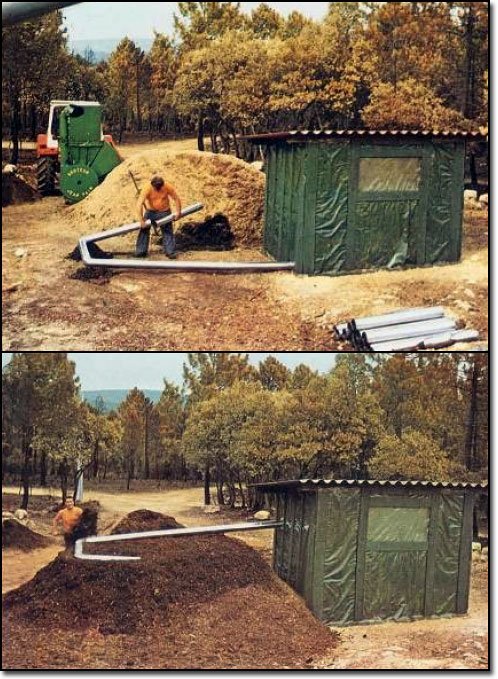
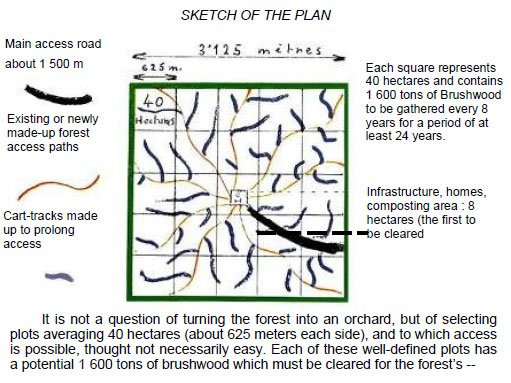
Jean Pain goes into great detail over the economics of such an operation. The system provides a safety measure against forest fire, provides jobs, methane, humus, and is a sustainable practice. Once the initial operation is underway, 12% of the methane harvested by the site will go back into the site. Overall 26% of the total caloric output of the operation will be reinvested to maintain the operation and keep it under way.

To give some perspective of how large a resource is not being taken advantage of, Jean Pain illustrates the outputs of some of the world’s forests. The Var Forest includes 400,000 usable hectares. This would annually produce 2.4 million tons of humus, 192 million liters of petrol equivalent in methane gas, and create 6,400 jobs, not including any created downstream of the resource generation. These numbers pale in comparison to those that would be created from the Belgian Forests 192,000 hectares, the French Forest’s 14.5 million hectares, or the California Forest’s 17 million hectares. Just these forests add up to 42,000,000 hectares of exploitable land. It is also worth mentioning again that the management of these forests will result in controlling wildfire. This responsible management will lower costs associated with fire prevention and damage repair as well as providing new sustainable resources and jobs.

Around the same time I discovered the amazing works of Jean Pain I was also turned on to another genius by the name of Marcin Jakubowski.
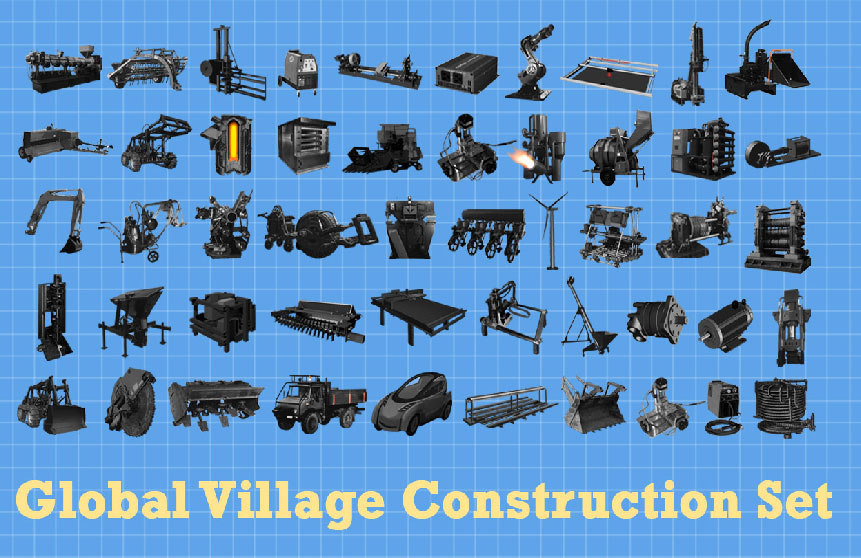
** **Marcin Jakubowski is the founder of Open Source Ecology, an open collaborative of engineers, producers, and builders developing the Global Village Construction Set (GVCS). The GVCS is a set of 50 most important machines that it takes for modern life to exist – everything from a tractor, to an oven, to a circuit maker. Marcin and his team are producing open source blueprints – so that anyone can build and maintain machines at a fraction of what it costs today. His goal is to create a life size LEGO set of powerful, self-replicating production tools – that can decentralize production – to build modern prosperity in local economies. He imagines the raw power this gives to people – to tap autonomy, mastery, and purpose – towards rebuilding their communities and solving wicked problems. Marcin believes that true freedom – the most essential type of freedom – starts with peoples’ individual ability to use natural resources to free themselves from material constraints – to unleash human potential.
As excited as I was when I discovered bitcoin, I was even more so when I learned of ethereum.
Ethereum is a technology that's home to digital money, global payments, and applications. The community has built a booming digital economy, bold new ways for creators to earn online, and so much more. It's open to everyone, wherever you are in the world – all you need is the internet.
Today, billions of people can’t open bank accounts, others have their payments blocked. Ethereum's decentralized finance (DeFi) system never sleeps or discriminates. With just an internet connection, you can send, receive, borrow, earn interest, and even stream funds anywhere in the world.
Ethereum isn't just for digital money. Anything you can own can be represented, traded and put to use as non-fungible tokens (NFTs). You can tokenize your art and get royalties automatically every time it's re-sold. Or use a token for something you own to take out a loan. The possibilities are growing all the time.
Today, we gain access to 'free' internet services by giving up control of our personal data. Ethereum services are open by default – you just need a wallet. These are free and easy to set up, controlled by you, and work without any personal info.
Ethereum and its apps are transparent and open source. You can fork code and re-use functionality others have already built. If you don't want to learn a new language you can just interact with open-sourced code using JavaScript and other existing languages.
A billion people are about to use crypto, El Salvador is pioneering this movement.


As just mentioned, crypto is far more than just monetary transactions. Web3 is the next step of technological evolution and the fact that we are all able to develop together in real time without corporate overlords censoring our work is mind blowing to me.
Organization is all we need and we become unstoppable.
I am currently watching a video about El Salvador’s plan to build a bitcoin mining system that is powered by a volcano. That's just cracking the shell of what we could do to create a realistic financial system that everyone can partake in one day.

I have set up a DAO for digitalprofitz that can be used once the Ethereum merger occurs and transactions become reasonable.
A decentralized autonomous organization (DAO) is an emerging form of legal structure. With no central governing body, every member within a DAO typically shares a common goal and attempts to act in the best interest of the entity. Popularized through cryptocurrency enthusiasts and blockchain technology, DAOs are used to make decisions in a bottoms-up management approach.
Masters of their domains Business 2.0 article: https://archive.fortune.com/magazines/business2/business2_archive/2005/12/01/8364591/index.htm
The Virtual Rockefeller, Business 2.0 article: https://archive.fortune.com/magazines/business2/business2_archive/2005/12/01/8364581/index.htm
Bitcoin whitepaper: https://bitcoin.org/bitcoin.pdf
Story about Jean Pain: http://journeytoforever.org/biofuel_library/methane_pain.html
Opensource Ecology: https://www.opensourceecology.org/
DigitalProfitz DAO: https://client.aragon.org/#/digitalprofitz/
When I was 10 years old the movie Terminator 2 hit the theaters and forever altered my perception of the future.
It has been 32 years since that amazing theatrical release and now a quick glance at the world headlines of any news repository may cause you to think the movie was not actually a work of fiction, but a documentary of what was to come.
*******************************
“At 2:14 am Eastern Time, on August 29th, 1997, Skynet becomes "self-aware ``, the Terminator (Arnold Schwarzenegger) tells us in his trademark Austrian drawl. After that, humans panic and try to pull the plug, so Skynet fights back. Naturally, this leads to a post-apocalyptic wasteland in which humans are hunted down, and robots run the world.

And in today's news, Google placed an engineer on paid leave recently after dismissing his claim that its artificial intelligence is sentient, surfacing yet another fracas about the company’s most advanced technology. Blake Lemoine, a senior software engineer in Google’s Responsible AI organization, said in an interview that he was put on leave last Monday.

There are many other movies that have somewhat accurately portrayed, when compared to recent headlines, a dire future of destruction, famine,war and every other horror the human mind can conjure up. My intention with this publication, which is a compilation of knowledge I have acquired over the years, is to inspire the hope and creativity needed to build a parallel society that defies these predictions and goes against this current system of top down greed, oppression and exploitation.

We are currently connected by the internet in ways we have yet to fully exploit using technology that is readily available. Although we have only had this ability for a couple decades it is evolving rapidly and the younger generations are growing up in a world of screens that is all they have ever known. Massive amounts of data and information are being exchanged right now, by all ages, races and countries. We are all communicating with each other in the forms of tik-tok clips, youtube videos, social media posts etc…
Some of my favorite friends that I communicate with online live in villages in Africa, South America,the Middle East, areas I would never have had access to prior without taking a trip and fully immersing myself into their society. So my question has always been, what if we took all of this tech a little more seriously and used it to alter the course of the world in ways that we can all control and contribute towards?
The ramifications of what I am trying to express are so enormous that there is a story in the Bible of God being so worried about our absolute potential that he negotiates a deal with himself to sabotage our plans!
But the Lord came down to look at the city and the tower the people were building. “Look!” he said. “The people are united, and they all speak the same language. After this, nothing they set out to do will be impossible for them! Come, let’s go down and confuse the people with different languages. Then they won’t be able to understand each other.”

I read a magazine on a flight from Minneapolis to Reno in 2005 that would ultimately alter my future path in ways I would not have been able to comprehend at the time.
I was currently living the American dream. Beautiful wife, a solid job as a carpenter,we just sold our first home and purchased a duplex that almost paid for itself using the rent from our tenants. Life was looking up but I did not want to spend the rest of my good years working in the field relying on my body to provide an income so I began searching for alternative options. When I read the December 2005 edition of Business 2.0 while flying to visit family I began to find the options I was searching for.
There were two articles that captivated me and impressed upon my imagination the most, the first one was about domainers. They were making their living buying and selling website domain names and turning their Web traffic into cash--lots of it.
This is a piece from that article.
The man behind the conference, Rick Schwartz, couldn't be happier--and he isn't even around when midnight strikes and bikini-clad women take to the dance floor to raffle off prizes and peel off their tops. Schwartz, 52, began buying up domain names 10 years ago. Like many early players, he gravitated to where the money was: porn. He snapped up names like Ass.com, Makeout.com, and Porno.com, to name a few. It was a quick path to riches: Adult sites were paying handsomely for the traffic; mainstream sites were not--at least not yet.
Today, Schwartz owns about 5,000 names, with less than a third falling into the "adult" category. He's the industry's biggest promoter, preaching the power of domains to anyone who will listen and bringing domainers together with moneymen and execs from the likes of Google and Yahoo. He sports a $65,000 Rolex on his left wrist, a $32,000 diamond bracelet on his right, and is astounded that he--a community college dropout--is living like a king in a waterfront house in Boca Raton.
"I don't like to work," Schwartz says, almost yelling as if to convince everyone within earshot that they're fools if they do. "I figure any moron in the world can generate work for themselves and tie up their time. I have one laptop, no employees, and no product whatsoever--none! This is magic." Magic, he claims, that's earning him $2 million a year.

The second and even more interesting article was about a lady that was a virtual real estate agent.
Anshe Chung is an avatar (online personality) of Ailin Graef in the online world Second Life. Referred to as the "Rockefeller of Second Life" by CNN, Graef has built an online business that engages in development, brokerage, and arbitrage of virtual land, items, and currencies.
To understand the lucrative real estate empire Anshe Chung has created, it helps to spend some time with her "in world." There, she might teleport you to one of her islands, on the continent she's named Dreamland. You can stroll through the floating city she built 700 feet above a desert, walk through elegant Arabian-style homes on land she leases, strike up a conversation in Japanese amid her Asian gardens, or shop for a grand piano in one of her 600 boutiques.
It's all virtual, of course--part of a flourishing online universe called Second Life. And if it sounds absurd, consider this: While Anshe won't talk about how much money she's making ("I'm careful not to stir animosity," she says), Philip Rosedale, the founder and CEO of Linden Lab, which runs Second Life, estimates that she's bringing in around $150,000 a year--in real, hard cash.
First, a primer. About 70,000 people "play" Second Life, though it's not really fair to call it a game. People don't rise through the ranks by slaughtering sinister beasties, for example. No score is kept. Linden Lab, based in real-world San Francisco, simply sets up computer servers and creates a limited supply of undeveloped land. Then it auctions off parcels, typically to developers like Anshe. Rosedale, who launched his virtual universe more than two years ago, characterizes Anshe as the "Rockefeller of Second Life."
She has many schemes, but here's one basic play: Anshe buys up Second Life land, paying Linden Lab roughly $200 a month for each 16-acre plot, plus a one-time fee of $1,250. Then she develops the land, using Photoshop to add rivers, mountains, and forests. Sometimes she hires subcontractors to improve the acreage by designing or building houses. Then she sells or rents to other Second Lifers, who pay good money to inhabit her creations. As in the real world, prices vary by location. But often someone will pay Anshe $100 up front to buy a one-acre plot, plus $20 a month in land tax. In a case like that, Anshe makes $112 in her first year. She's done more than 10,000 various real estate deals. "I'm like Wal-Mart," she says. "The margins are small, but the volume isn't."

So after digesting two very foreign concepts regarding the accumulation of wealth, my brain would not stop thinking. I became a bit of an insomniac from an over-stimulated excitement that at the time I did not even understand. I just knew these were avenues I could pursue if I wanted without spending thousands of dollars on a degree.
Prior to the “plane ride” my only familiarity with the internet and computers was buying tools on ebay, browsing the news for sports scores and posting blogs using blogger.. That next winter as I was wearing five layers of clothing while framing a house in northern Minnesota during sub zero temperatures I decided to buy a laptop and learn how to use it.

The obsession was real and it became hard to sleep as my brain contemplated all these new ways to create income streams. I used the internet to learn how to acquire domain names, set up web hosting, create web sites and then how to market those digital assets.


In 2008 my eyes were once again opened to another facet of reality.
The financial crisis of 2008, or Global Financial Crisis, was a severe worldwide economic crisis that occurred in the early 21st century. It was the most serious financial crisis since the Great Depression (1929). Predatory lending targeting low-income homebuyers, excessive risk-taking by global financial institutions, and the bursting of the United States housing bubble culminated in a "perfect storm." Mortgage-backed securities (MBS) tied to American real estate, as well as a vast web of derivatives linked to those MBS, collapsed in value. Financial institutions worldwide suffered severe damage, reaching a climax with the bankruptcy of Lehman Brothers on September 15, 2008, and a subsequent international banking crisis.

Although I did not discover bitcoin until 2011 things were taking place that would again, alter the course of my future. On January 3,2009 Satoshi Nakomoto released the Bitcoin genesis block - block 0. Embedded in it was a quote,
The Times 03/Jan/2009 Chancellor on brink of second bailout for banks

“At the end of the day, bitcoin is programmable money. When you have programmable money, the possibilities are truly endless. We can take many of the basic concepts of the current system that depend on legal contracts, and we can convert these into algorithmic contracts, into mathematical transactions that can be enforced on the bitcoin network. As I’ve said, there is no third party, there is no counter party. If I choose to send value from one part of the network to another, it is peer-to-peer with no one in between. If I invent a new form of money, I can deploy it to the entire world and invite others to come and join me. Bitcoin is not just money for the internet. Yes, it’s perfect money for the internet. It’s instant, it’s safe, it’s free. Yes, it is money for the internet, but it’s so much more. Bitcoin is the internet of money. Currency is only the first application. If you grasp that, you can look beyond the price, you can look beyond the volatility, you can look beyond the fad. At its core, bitcoin is a revolutionary technology that will change the world forever. Join”
― Andreas M. Antonopoulos, The Internet of Money
While studying bitcoin and all that blockchain technology was capable of I stumbled upon another game changing set of skills dealing with sustainable energy and food production.
Jean Pain (12 December 1928 – 30 July 1981) was a Swiss-born French inventor and innovator who developed the compost heater, a compost-based bio-energy system, that produced 100% of his energy needs. He spent his entire short-lived life studying brush land and forest protection, specifically fire prevention, alongside his wife Ida. These studies led to an enormous amount of practical knowledge for composting, heating water, as well as harvesting methane, all of which are by-products of maintaining a forest or brush land with fire prevention techniques. While this knowledge is applicable in many instances, it is worth remembering that the root of all of this knowledge lies in forest preservation.


Jean Pain goes into great detail over the economics of such an operation. The system provides a safety measure against forest fire, provides jobs, methane, humus, and is a sustainable practice. Once the initial operation is underway, 12% of the methane harvested by the site will go back into the site. Overall 26% of the total caloric output of the operation will be reinvested to maintain the operation and keep it under way.

To give some perspective of how large a resource is not being taken advantage of, Jean Pain illustrates the outputs of some of the world’s forests. The Var Forest includes 400,000 usable hectares. This would annually produce 2.4 million tons of humus, 192 million liters of petrol equivalent in methane gas, and create 6,400 jobs, not including any created downstream of the resource generation. These numbers pale in comparison to those that would be created from the Belgian Forests 192,000 hectares, the French Forest’s 14.5 million hectares, or the California Forest’s 17 million hectares. Just these forests add up to 42,000,000 hectares of exploitable land. It is also worth mentioning again that the management of these forests will result in controlling wildfire. This responsible management will lower costs associated with fire prevention and damage repair as well as providing new sustainable resources and jobs.

Around the same time I discovered the amazing works of Jean Pain I was also turned on to another genius by the name of Marcin Jakubowski.
** **Marcin Jakubowski is the founder of Open Source Ecology, an open collaborative of engineers, producers, and builders developing the Global Village Construction Set (GVCS). The GVCS is a set of 50 most important machines that it takes for modern life to exist – everything from a tractor, to an oven, to a circuit maker. Marcin and his team are producing open source blueprints – so that anyone can build and maintain machines at a fraction of what it costs today. His goal is to create a life size LEGO set of powerful, self-replicating production tools – that can decentralize production – to build modern prosperity in local economies. He imagines the raw power this gives to people – to tap autonomy, mastery, and purpose – towards rebuilding their communities and solving wicked problems. Marcin believes that true freedom – the most essential type of freedom – starts with peoples’ individual ability to use natural resources to free themselves from material constraints – to unleash human potential.

As excited as I was when I discovered bitcoin, I was even more so when I learned of ethereum.
Ethereum is a technology that's home to digital money, global payments, and applications. The community has built a booming digital economy, bold new ways for creators to earn online, and so much more. It's open to everyone, wherever you are in the world – all you need is the internet.
Today, billions of people can’t open bank accounts, others have their payments blocked. Ethereum's decentralized finance (DeFi) system never sleeps or discriminates. With just an internet connection, you can send, receive, borrow, earn interest, and even stream funds anywhere in the world.
Ethereum isn't just for digital money. Anything you can own can be represented, traded and put to use as non-fungible tokens (NFTs). You can tokenize your art and get royalties automatically every time it's re-sold. Or use a token for something you own to take out a loan. The possibilities are growing all the time.
Today, we gain access to 'free' internet services by giving up control of our personal data. Ethereum services are open by default – you just need a wallet. These are free and easy to set up, controlled by you, and work without any personal info.
Ethereum and its apps are transparent and open source. You can fork code and re-use functionality others have already built. If you don't want to learn a new language you can just interact with open-sourced code using JavaScript and other existing languages.
A billion people are about to use crypto, El Salvador is pioneering this movement.


As just mentioned, crypto is far more than just monetary transactions. Web3 is the next step of technological evolution and the fact that we are all able to develop together in real time without corporate overlords censoring our work is mind blowing to me.
Organization is all we need and we become unstoppable.
I am currently watching a video about El Salvador’s plan to build a bitcoin mining system that is powered by a volcano. That's just cracking the shell of what we could do to create a realistic financial system that everyone can partake in one day.

I have set up a DAO for digitalprofitz that can be used once the Ethereum merger occurs and transactions become reasonable.
A decentralized autonomous organization (DAO) is an emerging form of legal structure. With no central governing body, every member within a DAO typically shares a common goal and attempts to act in the best interest of the entity. Popularized through cryptocurrency enthusiasts and blockchain technology, DAOs are used to make decisions in a bottoms-up management approach.
Masters of their domains Business 2.0 article: https://archive.fortune.com/magazines/business2/business2_archive/2005/12/01/8364591/index.htm
The Virtual Rockefeller, Business 2.0 article: https://archive.fortune.com/magazines/business2/business2_archive/2005/12/01/8364581/index.htm
Bitcoin whitepaper: https://bitcoin.org/bitcoin.pdf
Story about Jean Pain: http://journeytoforever.org/biofuel_library/methane_pain.html
Opensource Ecology: https://www.opensourceecology.org/
DigitalProfitz DAO: https://client.aragon.org/#/digitalprofitz/
No activity yet