
 Fuel Labs
Introducing Fuel Season 1 (FS-1) and Phase 2 Genesis Drop
Today marks the conclusion of Phase 2 and with it the Fuel Points Program. We want to thank all participants who helped bootstrap Ignition, and now turn our focus to building Fuel into a fully integrated liquidity hub. As we mark the end of the Fuel Points program, we are excited to unveil two initiatives: Phase 2 of the Genesis Drop and the start of Fuel Season 1 (FS-1).Genesis Drop: Phase 2 - 150,000,000 FUEL1.5% of FUEL total supply.Rewards for participation in Phase 2 of the Points Progra...
 Fuel Labs
Announcing Phase 2 of the Fuel Points Program
We are excited to announce the final phase in the Fuel Points Program, now live with Fuel Ignition. With Phase 2, you can continue earning points while supporting the growth of the Fuel ecosystem. With Phase 2 of Fuel Points, we’re ensuring that the network grows in a way that is positive sum for points program participants, the Fuel ecosystem projects and the broader Fuel community. Qualifying users can participate in the program, while earning rewards for meaningfully engaging with the ecos...
 Fuel Labs
Sway: The Next-Generation Language for Smart Contracts
As blockchain applications become more complex, there is a strong need for safe and smart contract languages. Many platforms today rely on languages and virtual machines (VMs) that weren't originally designed to handle the unique constraints and requirements of blockchain execution. It’s no secret that the architectural decisions made in 2014 for Solidity and the EVM now show clear signs of age. Among these is their susceptibility to vulnerabilities that make writing secure Ethereum smar...
Fuel Ignition is a high-performance Ethereum L2.

Subscribe to Fuel Labs
Subscribe to Fuel Labs
Fuel Ignition is a high-performance Ethereum L2.
Fuel LabsIntroducing Fuel Season 1 (FS-1) and Phase 2 Genesis Drop
Today marks the conclusion of Phase 2 and with it the Fuel Points Program. We want to thank all participants who helped bootstrap Ignition, and now turn our focus to building Fuel into a fully integrated liquidity hub. As we mark the end of the Fuel Points program, we are excited to unveil two initiatives: Phase 2 of the Genesis Drop and the start of Fuel Season 1 (FS-1).Genesis Drop: Phase 2 - 150,000,000 FUEL1.5% of FUEL total supply.Rewards for participation in Phase 2 of the Points Progra...
Fuel LabsAnnouncing Phase 2 of the Fuel Points Program
We are excited to announce the final phase in the Fuel Points Program, now live with Fuel Ignition. With Phase 2, you can continue earning points while supporting the growth of the Fuel ecosystem. With Phase 2 of Fuel Points, we’re ensuring that the network grows in a way that is positive sum for points program participants, the Fuel ecosystem projects and the broader Fuel community. Qualifying users can participate in the program, while earning rewards for meaningfully engaging with the ecos...
Fuel LabsSway: The Next-Generation Language for Smart Contracts
As blockchain applications become more complex, there is a strong need for safe and smart contract languages. Many platforms today rely on languages and virtual machines (VMs) that weren't originally designed to handle the unique constraints and requirements of blockchain execution. It’s no secret that the architectural decisions made in 2014 for Solidity and the EVM now show clear signs of age. Among these is their susceptibility to vulnerabilities that make writing secure Ethereum smar...
Share Dialog
Share Dialog
>2.8K subscribers
>2.8K subscribers
Welcome to Inside Fuel, our monthly review on all technical-related things on the Fuel Network. Take a moment to catch up with all the latest developments and more...
Implicitly import the standard library, so it no longer needs to be manually specified (https://github.com/FuelLabs/sway/pull/1137);
Add support for forc CLI plugins (https://github.com/FuelLabs/sway/pull/1178);
Implementation of our first plugin “forc-gm” (https://github.com/FuelLabs/sway/pull/1373);
Update of forc init to include a test and contract skeleton, and allow template initialization;
"Is reference type" compiler intrinsic, which can be used for generic logic that must be different between copy and reference types (https://github.com/FuelLabs/sway/pull/1121);
Stdlib: runtime reentrancy guard without storage (https://github.com/FuelLabs/sway/pull/1115);
Use new IR pipeline by default (https://github.com/FuelLabs/sway/pull/1130);
Stdlib: ec recover returns Result (https://github.com/FuelLabs/sway/pull/1171);
New custom parser (https://github.com/FuelLabs/sway/pull/1286);
Sway is a domain-specific language (DSL) targeting the Fuel Virtual Machine (FuelVM), a blockchain-optimized VM designed for the Fuel blockchain. It is heavily inspired by Rust and aims to bring modern language development and performance to the blockchain ecosystem.
Start learning the Sway Language today with the Sway Book and the FuelVM Bootcamp.
JNZI opcode is now supported;
Balances API;
Improved transaction receipt structure;
DevOps improvements;
Various stabilization improvements and bug fixes.
Simplified imports: now you only need the new fuels crate and the fuels-abigen-macro crate to use the SDK;
Support for the tuple type in input/output to/from contract calls, you can now use the Result type from Sway;
Many bug fixes and technical debt paid:
Fixed major drift between the Sway compiler, the VM, and the SDK;
Improved the SDK CI pipeline, now catching bugs much earlier on;
Supporting more expressive input/output types (nested structs, enums inside structs, and vice-versa);
And many smaller bug fixes and QoL improvements.
Full UTXO validation is now enabled and supported;
New wallet manager API;
Improved support for more complex types (structs, enums, etc.);
New support for Fuel native types.
According to the Rust In Blockchain monthly review, Fuel is still one of the most active Rust-based projects. Fuel ranked 4th, right behind Solana, Parity, and Near projects, with 213 merged Pull Requests, 145 closed issues, and 134 opened issues in April 2022.
The Fastest Modular Execution Layer has been everywhere this month. We made public appearances and sponsored some of the most significant blockchain events of the year in Amsterdam:


You're a hacker that wants to make an impact with your skills? From May 27th till May 30th, 2022, be a part of the next generation of blockchain by building dapps using the Sway smart contract language on Fuel, the Fastest Modular Execution Layer, for a chance to win up to $100,000 in prizes!
Register here.
If you don’t want to miss any update of the Fuel Network, simply follow us and activate the notification bell:
Fuel* is the fastest execution layer for the modular blockchain stack. Powerful and sleek, the technology enables parallel transaction execution, empowering developers with the highest flexible throughput and maximum security required to scale. Developers choose the FuelVM for its superior developer experience and the ability to go beyond the limitations of the EVM.*
If you want to join us in this journey, here are our current job openings.
Welcome to Inside Fuel, our monthly review on all technical-related things on the Fuel Network. Take a moment to catch up with all the latest developments and more...
Implicitly import the standard library, so it no longer needs to be manually specified (https://github.com/FuelLabs/sway/pull/1137);
Add support for forc CLI plugins (https://github.com/FuelLabs/sway/pull/1178);
Implementation of our first plugin “forc-gm” (https://github.com/FuelLabs/sway/pull/1373);
Update of forc init to include a test and contract skeleton, and allow template initialization;
"Is reference type" compiler intrinsic, which can be used for generic logic that must be different between copy and reference types (https://github.com/FuelLabs/sway/pull/1121);
Stdlib: runtime reentrancy guard without storage (https://github.com/FuelLabs/sway/pull/1115);
Use new IR pipeline by default (https://github.com/FuelLabs/sway/pull/1130);
Stdlib: ec recover returns Result (https://github.com/FuelLabs/sway/pull/1171);
New custom parser (https://github.com/FuelLabs/sway/pull/1286);
Sway is a domain-specific language (DSL) targeting the Fuel Virtual Machine (FuelVM), a blockchain-optimized VM designed for the Fuel blockchain. It is heavily inspired by Rust and aims to bring modern language development and performance to the blockchain ecosystem.
Start learning the Sway Language today with the Sway Book and the FuelVM Bootcamp.
JNZI opcode is now supported;
Balances API;
Improved transaction receipt structure;
DevOps improvements;
Various stabilization improvements and bug fixes.
Simplified imports: now you only need the new fuels crate and the fuels-abigen-macro crate to use the SDK;
Support for the tuple type in input/output to/from contract calls, you can now use the Result type from Sway;
Many bug fixes and technical debt paid:
Fixed major drift between the Sway compiler, the VM, and the SDK;
Improved the SDK CI pipeline, now catching bugs much earlier on;
Supporting more expressive input/output types (nested structs, enums inside structs, and vice-versa);
And many smaller bug fixes and QoL improvements.
Full UTXO validation is now enabled and supported;
New wallet manager API;
Improved support for more complex types (structs, enums, etc.);
New support for Fuel native types.
According to the Rust In Blockchain monthly review, Fuel is still one of the most active Rust-based projects. Fuel ranked 4th, right behind Solana, Parity, and Near projects, with 213 merged Pull Requests, 145 closed issues, and 134 opened issues in April 2022.
The Fastest Modular Execution Layer has been everywhere this month. We made public appearances and sponsored some of the most significant blockchain events of the year in Amsterdam:
You're a hacker that wants to make an impact with your skills? From May 27th till May 30th, 2022, be a part of the next generation of blockchain by building dapps using the Sway smart contract language on Fuel, the Fastest Modular Execution Layer, for a chance to win up to $100,000 in prizes!
Register here.
If you don’t want to miss any update of the Fuel Network, simply follow us and activate the notification bell:
Fuel* is the fastest execution layer for the modular blockchain stack. Powerful and sleek, the technology enables parallel transaction execution, empowering developers with the highest flexible throughput and maximum security required to scale. Developers choose the FuelVM for its superior developer experience and the ability to go beyond the limitations of the EVM.*
If you want to join us in this journey, here are our current job openings.


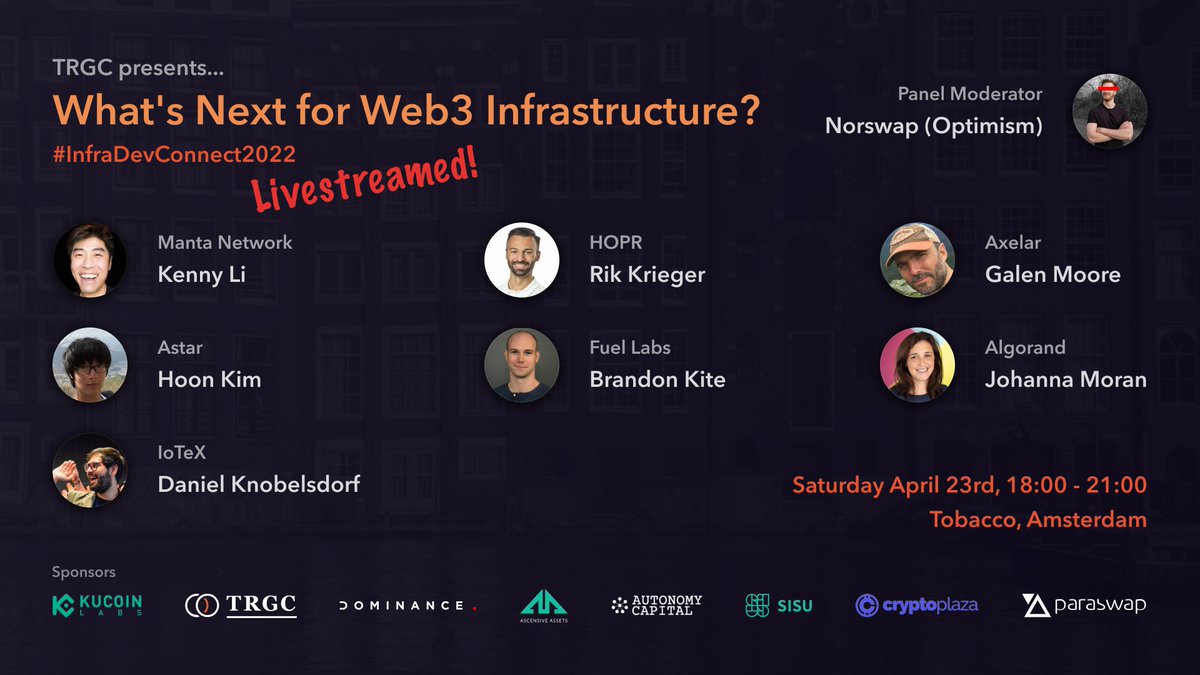
 You can watch the talk on our livestream youtube.com/watch?v=35_rr8…
  You can watch the talk on our livestream youtube.com/watch?v=35_rr8…



No activity yet