
Why Ethereum Could Hit $15,800 by 2028
The Most Important ETH Report You WANA Read

How to Build Intellectual Capital in Any Emerging Ecosystem
most people look at tokens and immediate short term rewards wen entering new ecosystems but if that’s all you see, you’re already missing on the bigger play.

Why Ethereum Could Hit $15,800 by 2028
The Most Important ETH Report You WANA Read
How to Build Intellectual Capital in Any Emerging Ecosystem
most people look at tokens and immediate short term rewards wen entering new ecosystems but if that’s all you see, you’re already missing on the bigger play.
Share Dialog
Share Dialog
Subscribe to Conscious Writings
Subscribe to Conscious Writings
<100 subscribers
<100 subscribers
the goal isn't to make you leave crypto. it's to make sure you stop being the exit.
once you see the pattern, you get to choose which side of the trade you're on.
there's a pattern emerging that should make you angry.
not concerned. angry.
because the playbook crypto is running right now? it's the same one that trapped diamond buyers for a century.
artificial scarcity. manufactured demand. opaque pricing. insiders exiting into retail.
you're not early. you're the exit.
and the parallels are too brutal to ignore.
the american enterprise institute called it "the biggest marketing scam in history orchestrated by the most successful cartel ever."
they weren't exaggerating.
for nearly a century, de beers controlled 80-90% of the global diamond supply. when cecil rhodes died in 1902, de beers owned 90% of the world's diamond production and distribution.
they invented "a diamond is forever."
they created artificial scarcity.
they built an $80 billion industry on a carefully constructed lie.
then the smart money figured it out — and left.
the numbers are devastating:
de beers valuation: $8.5B (2022) → $4.1B (2025)
52% collapse in 3 years.
h1 2025 ebitda: -$189 million vs +$300 million in h1 2024
q1 2025 sales: down 44% yoy
production cut 33%
anglo american has taken $4.4 billion in writedowns.
the parent company is desperately trying to sell. botswana wants control. angola wants in.
but nobody with serious capital wants to touch it.
sound familiar?
artificial scarcity got exposed.
lab-grown diamonds now account for 52% of u.s. engagement rings. up from just 3% in 2018.
when consumers realized they could buy a visually identical 2-carat lab-grown for less than a 1-carat natural — the illusion shattered.
as the curious economist put it: "diamonds are not that scarce. but thanks to de beers, the supply of them is. and when you control supply, you can control demand. and most importantly; price."
decades of "diamonds are rare" marketing. exposed overnight.
market manipulation became impossible to hide.
de beers was caught selling at 10-20% discounts while maintaining official prices 25% higher.
they thought nobody would notice. everyone noticed.
when the market maker is this desperate, confidence doesn't decline. it evaporates.
no fundamental floor.
here's the brutal truth from priceonomics, cited by the american enterprise institute:
"a diamond is a depreciating asset masquerading as an investment. the market for them is neither liquid nor are they fungible."
sound familiar?
the entire value proposition was marketing. and younger consumers stopped buying the story.

bitcoin is digital diamond. not gold.
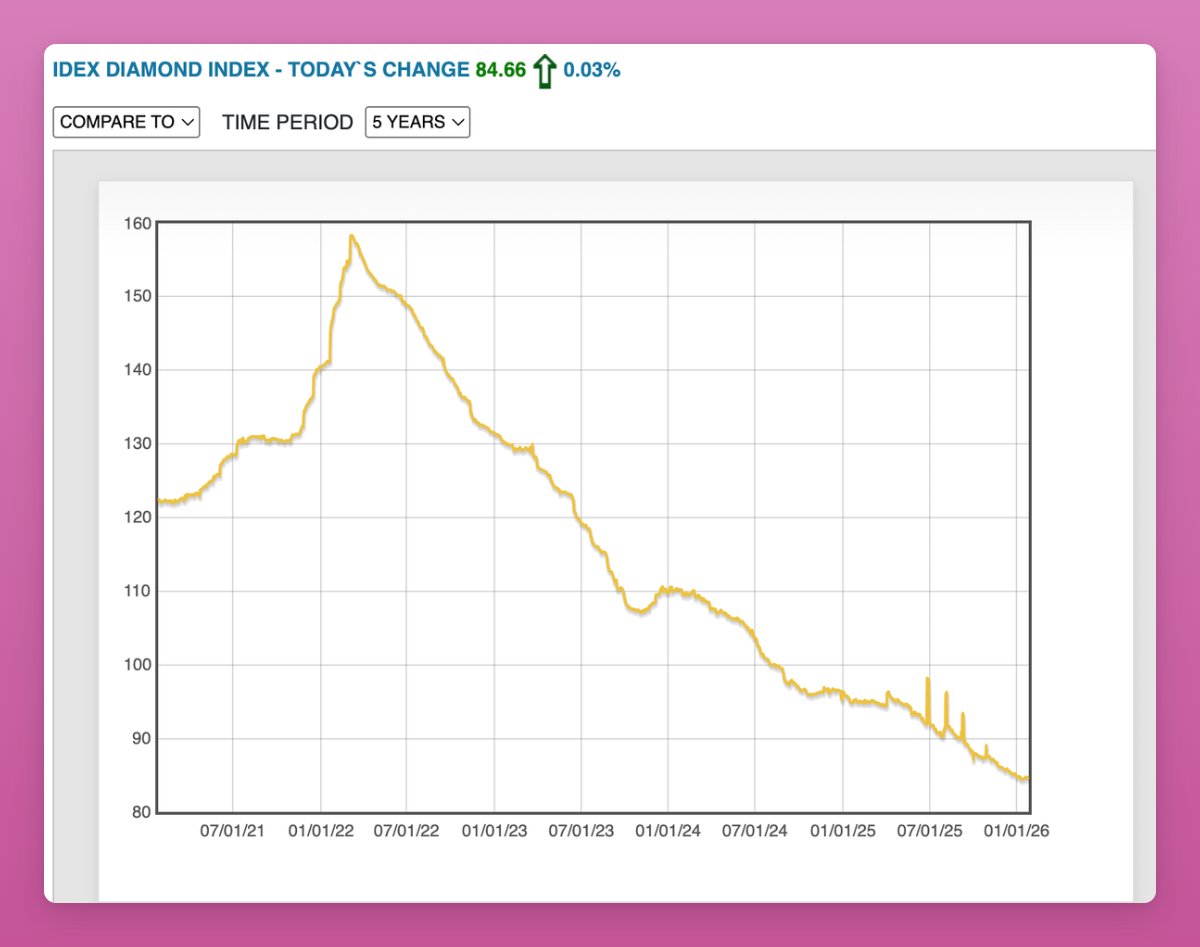
btc down 30% from ath. diamond index down 46%.
the chart shows diamonds falling from ~160 in 2021 to ~85 in 2026.
5-year collapse. and nobody saw it coming until it was too late.
here's what most people don't know.
americans exchange diamond rings as part of the engagement process because in 1938 de beers decided they would like us to.
that's it. that's the whole story.
prior to that marketing campaign, diamond engagement rings weren't a thing. de beers invented the tradition. then convinced the world that the size of a diamond equaled how much a man loved his fiancé.
as the american enterprise institute noted: "this obligation only exists because the company that stands to profit from it willed it into existence."
de beers executed the most effective monopoly of the 20th century.
crypto is executing the most effective wealth transfer of the 21st.
the crypto market in 2025 looks eerily similar.
and if you're retail, the data should terrify you.
despite bitcoin etfs launching with massive fanfare — the institutional story is darker than headlines suggest.
bitcoin institutional inflows dropped 31% in 2025.
$41.69B (2024) → $26.98B (2025)
ethereum saw 137% increase. solana 500%. xrp 1,066%.
but don't celebrate. these are speculative rotations, not conviction plays.
the smart money is repositioning. not accumulating.
the preference shift should scare you.
fidelity digital assets survey:
→ 37% of institutions invest in spot crypto today
→ only 32% plan to invest 2-3 years out
→ compare to 2022: 52% expected to invest
read that again.
institutional appetite is declining, not growing. while retail keeps buying.
who do you think is selling to you?
november 2025: $3.79 billion in etf outflows.
the largest monthly outflow on record.
coincided with bitcoin's retreat from $125,000 to $82,000.
when institutions want out, they don't announce it. they just leave.
and retail holds the bag wondering what happened.
fidelity's institutional investor study:
price volatility: 48%
security concerns: 40%
market manipulation: 40%
regulatory classification: 39%
lack of fundamentals to gauge value: 37%
lack of regulatory clarity: 28%
these are the exact same concerns that kept institutions out of diamonds.
the smart money saw the trap. they stayed out.
retail didn't. retail never does.
manufactured scarcity
diamonds: de beers stockpiled rough gems and released strategically. when control broke, so did the market.
crypto: bitcoin's 21 million cap is algorithmically enforced. sounds bulletproof, right?
except:
→ 19.6 million btc already mined (93.3%)
→ etfs hold 7% of circulating supply in few hands
→ whale wallets can move markets with single transactions
the scarcity narrative works until someone bigger than you decides to sell.
then you find out how "scarce" it really was.
"as btc competes with alts, lab-grown alt-diamonds now account for 52% of the engagement ring market."
"these alt-diamonds are down even more than real diamonds — by ~74% since ath 2020."
bitcoin is holding value better than the hardest substance on earth.
but "better than a collapsing market" isn't the flex you think it is.
opaque pricing
diamonds: de beers' "sightholder" system — ~70 approved buyers at controlled prices. when secret discounts emerged, the system collapsed.
crypto: despite blockchain transparency, markets remain rigged:
→ 40% of institutions cite manipulation
→ whale wallets control significant supply
→ over 70% of volume on unregulated exchanges is wash trading
you think you're trading against other retail. you're trading against algorithms and whales who see your orders before you do.
lack of fundamentals
diamonds: no cash flow. no yield. value depends entirely on finding a bigger fool.
remember: "a diamond is a depreciating asset masquerading as an investment. the market for them is neither liquid nor are they fungible."
crypto: 37% of institutions say "lack of fundamentals to gauge value."
bitcoin has no earnings. no dividends. no balance sheet.
the "network effect" argument is circular —it's valuable because people think it's valuable.
that's not an investment thesis. that's a hope.
and like diamonds, the crypto market is neither liquid nor fungible when you actually try to exit at scale.
defi was supposed to change this. it didn't.
defi tvl grew just 1.73% in 2025.
the utility narrative failed. but the marketing didn't.
manufactured desire
diamonds: de beers convinced the world that diamond engagement rings were tradition. they weren't. the company invented that tradition in 1938 because they wanted to sell more diamonds.
crypto: the industry convinced the world that tokens represent "the future of finance" and "digital ownership." but most tokens have no utility beyond speculation. the narrative was manufactured to create demand for something that otherwise wouldn't exist.
in both cases: "the obligation only exists because the company that stands to profit from it willed it into existence."
here's where retail gets destroyed. every single cycle.
2025 token data:
→ 84.7% of new tokens trade below tge price
→ median fdv decline: -77%
→ projects launching above $1B fdv: 0% green
→ median drawdown for big launches: 81%
let that sink in. zero percent.
cex listings are exit events disguised as opportunities:
→ 89% of tokens dump after listing
→ average decline: 52%
→ 98% of binance-listed tokens eventually dump
→ average drop from listing: 70%
→ only 5.5% of 2024 binance listings green after 6 months
you see "binance listing" and think opportunity.
insiders see "binance listing" and think exit.
guess who's right more often?
jeff dorman, cio of arca:
"i don't know a single liquid fund that has bought a new token on tge in over two years."
read that again.
professional investors stopped buying new tokens two years ago.
but retail keeps lining up. every single launch.
"this is what happens when you saturate the crypto space with newbies and small accounts that know nothing but to celebrate small wins and sell at every chance they get."
"we need more diamond hands"
btc: $83,898 (-5,898) bnb: $863 (-40) sol: $117 (-9)
the irony is painful.
asking for "diamond hands" in an industry running the diamond playbook.
the diamonds weren't worth holding either. that was the whole point.
the pattern never changes:
vcs buy at seed for $0.01
token launches at $10
retail buys "dip" at $8
unlocks begin
vcs sell
token goes to $0.50
retail holds the bag
repeat
you're not investing. you're providing exit liquidity.
examples
1. celestia:
→ polychain bought tia at ~$0.01
→ peaked at $20.85
→ polychain sold $62.5M to the foundation alone
→ now trades at ~$0.40
→ 98% down from top
vcs made 2000x+. retail lost 98%.
same token. same timeframe. completely different outcomes.
guess which side you're on.
2. worldcoin:
→ private vc price: $0.30
→ peak public price: $11.78
→ current price: ~$0.46
→ down 96% from peak
→ top 10 addresses hold 91% of supply
→ top 100 hold 99%
this isn't a decentralized network. it's a wealth extraction mechanism with good marketing.
59% of americans lack confidence in crypto security.
16% of crypto owners have experienced access issues — forgotten passwords, lost keys, exchange outages, frozen accounts.
1 in 6 owners with significant failures.
diamonds have vaults, insurance, armed guards.
crypto has seed phrases, exchange hacks, and "sorry, funds are safu."
for institutions managing other people's money, this is unacceptable risk.
for retail? we just call it "part of the game."
it shouldn't be.
the comparison that should haunt you

genuine utility
defi's 1.73% growth proves current use cases aren't compelling. need tokenized securities, settlement infrastructure, yield from real economic activity — not ponzi token emissions.
market reform
surveillance-sharing for spot markets. regulated exchanges with actual oversight. transparency into whale movements before they dump on you.
regulatory clarity
definitive rules on classification, custody, accounting, taxation. until then, institutions stay out and retail stays target practice.
security standards
qualified custody with insurance. recovery mechanisms beyond "hope you wrote down 24 words correctly." audit standards that actually matter.
the diamond industry was an $80 billion market built on a century of marketing.
the american enterprise institute called it "the biggest marketing scam in history."
when fundamentals cracked — artificial scarcity exposed, manipulation revealed — institutional capital fled.
de beers went from controlling 90% of supply to desperately seeking a buyer while taking billions in writedowns.
crypto is speedrunning the same collapse.
retail speculation doesn't create sustainable markets.
institutional conviction does.
and right now, the institutions are telling us exactly what they think.
they're selling. we're buying. the data is clear.
we just don't want to see it.
the diamond industry ran this playbook for 100 years before people caught on.
crypto is running it in months.
different asset. same game. same ending.
unless you decide to stop being exit liquidity.
this isn't fud. it's pattern recognition.
dyor doesn't mean watch "youtube videos or trust the founder."
it means understanding who's selling to you. and why.
because right now, you're not the customer.
you're the product.
at last the builders who survive aren't the ones who ignore the game - they're the ones who see it clearly and play it differently.
knowing the playbook is the first step to not being a pawn in it.
the goal isn't to make you leave crypto. it's to make sure you stop being the exit.
once you see the pattern, you get to choose which side of the trade you're on.
there's a pattern emerging that should make you angry.
not concerned. angry.
because the playbook crypto is running right now? it's the same one that trapped diamond buyers for a century.
artificial scarcity. manufactured demand. opaque pricing. insiders exiting into retail.
you're not early. you're the exit.
and the parallels are too brutal to ignore.
the american enterprise institute called it "the biggest marketing scam in history orchestrated by the most successful cartel ever."
they weren't exaggerating.
for nearly a century, de beers controlled 80-90% of the global diamond supply. when cecil rhodes died in 1902, de beers owned 90% of the world's diamond production and distribution.
they invented "a diamond is forever."
they created artificial scarcity.
they built an $80 billion industry on a carefully constructed lie.
then the smart money figured it out — and left.
the numbers are devastating:
de beers valuation: $8.5B (2022) → $4.1B (2025)
52% collapse in 3 years.
h1 2025 ebitda: -$189 million vs +$300 million in h1 2024
q1 2025 sales: down 44% yoy
production cut 33%
anglo american has taken $4.4 billion in writedowns.
the parent company is desperately trying to sell. botswana wants control. angola wants in.
but nobody with serious capital wants to touch it.
sound familiar?
artificial scarcity got exposed.
lab-grown diamonds now account for 52% of u.s. engagement rings. up from just 3% in 2018.
when consumers realized they could buy a visually identical 2-carat lab-grown for less than a 1-carat natural — the illusion shattered.
as the curious economist put it: "diamonds are not that scarce. but thanks to de beers, the supply of them is. and when you control supply, you can control demand. and most importantly; price."
decades of "diamonds are rare" marketing. exposed overnight.
market manipulation became impossible to hide.
de beers was caught selling at 10-20% discounts while maintaining official prices 25% higher.
they thought nobody would notice. everyone noticed.
when the market maker is this desperate, confidence doesn't decline. it evaporates.
no fundamental floor.
here's the brutal truth from priceonomics, cited by the american enterprise institute:
"a diamond is a depreciating asset masquerading as an investment. the market for them is neither liquid nor are they fungible."
sound familiar?
the entire value proposition was marketing. and younger consumers stopped buying the story.
bitcoin is digital diamond. not gold.
btc down 30% from ath. diamond index down 46%.
the chart shows diamonds falling from ~160 in 2021 to ~85 in 2026.
5-year collapse. and nobody saw it coming until it was too late.
here's what most people don't know.
americans exchange diamond rings as part of the engagement process because in 1938 de beers decided they would like us to.
that's it. that's the whole story.
prior to that marketing campaign, diamond engagement rings weren't a thing. de beers invented the tradition. then convinced the world that the size of a diamond equaled how much a man loved his fiancé.
as the american enterprise institute noted: "this obligation only exists because the company that stands to profit from it willed it into existence."
de beers executed the most effective monopoly of the 20th century.
crypto is executing the most effective wealth transfer of the 21st.
the crypto market in 2025 looks eerily similar.
and if you're retail, the data should terrify you.
despite bitcoin etfs launching with massive fanfare — the institutional story is darker than headlines suggest.
bitcoin institutional inflows dropped 31% in 2025.
$41.69B (2024) → $26.98B (2025)
ethereum saw 137% increase. solana 500%. xrp 1,066%.
but don't celebrate. these are speculative rotations, not conviction plays.
the smart money is repositioning. not accumulating.
the preference shift should scare you.
fidelity digital assets survey:
→ 37% of institutions invest in spot crypto today
→ only 32% plan to invest 2-3 years out
→ compare to 2022: 52% expected to invest
read that again.
institutional appetite is declining, not growing. while retail keeps buying.
who do you think is selling to you?
november 2025: $3.79 billion in etf outflows.
the largest monthly outflow on record.
coincided with bitcoin's retreat from $125,000 to $82,000.
when institutions want out, they don't announce it. they just leave.
and retail holds the bag wondering what happened.
fidelity's institutional investor study:
price volatility: 48%
security concerns: 40%
market manipulation: 40%
regulatory classification: 39%
lack of fundamentals to gauge value: 37%
lack of regulatory clarity: 28%
these are the exact same concerns that kept institutions out of diamonds.
the smart money saw the trap. they stayed out.
retail didn't. retail never does.
manufactured scarcity
diamonds: de beers stockpiled rough gems and released strategically. when control broke, so did the market.
crypto: bitcoin's 21 million cap is algorithmically enforced. sounds bulletproof, right?
except:
→ 19.6 million btc already mined (93.3%)
→ etfs hold 7% of circulating supply in few hands
→ whale wallets can move markets with single transactions
the scarcity narrative works until someone bigger than you decides to sell.
then you find out how "scarce" it really was.
"as btc competes with alts, lab-grown alt-diamonds now account for 52% of the engagement ring market."
"these alt-diamonds are down even more than real diamonds — by ~74% since ath 2020."
bitcoin is holding value better than the hardest substance on earth.
but "better than a collapsing market" isn't the flex you think it is.
opaque pricing
diamonds: de beers' "sightholder" system — ~70 approved buyers at controlled prices. when secret discounts emerged, the system collapsed.
crypto: despite blockchain transparency, markets remain rigged:
→ 40% of institutions cite manipulation
→ whale wallets control significant supply
→ over 70% of volume on unregulated exchanges is wash trading
you think you're trading against other retail. you're trading against algorithms and whales who see your orders before you do.
lack of fundamentals
diamonds: no cash flow. no yield. value depends entirely on finding a bigger fool.
remember: "a diamond is a depreciating asset masquerading as an investment. the market for them is neither liquid nor are they fungible."
crypto: 37% of institutions say "lack of fundamentals to gauge value."
bitcoin has no earnings. no dividends. no balance sheet.
the "network effect" argument is circular —it's valuable because people think it's valuable.
that's not an investment thesis. that's a hope.
and like diamonds, the crypto market is neither liquid nor fungible when you actually try to exit at scale.
defi was supposed to change this. it didn't.
defi tvl grew just 1.73% in 2025.
the utility narrative failed. but the marketing didn't.
manufactured desire
diamonds: de beers convinced the world that diamond engagement rings were tradition. they weren't. the company invented that tradition in 1938 because they wanted to sell more diamonds.
crypto: the industry convinced the world that tokens represent "the future of finance" and "digital ownership." but most tokens have no utility beyond speculation. the narrative was manufactured to create demand for something that otherwise wouldn't exist.
in both cases: "the obligation only exists because the company that stands to profit from it willed it into existence."
here's where retail gets destroyed. every single cycle.
2025 token data:
→ 84.7% of new tokens trade below tge price
→ median fdv decline: -77%
→ projects launching above $1B fdv: 0% green
→ median drawdown for big launches: 81%
let that sink in. zero percent.
cex listings are exit events disguised as opportunities:
→ 89% of tokens dump after listing
→ average decline: 52%
→ 98% of binance-listed tokens eventually dump
→ average drop from listing: 70%
→ only 5.5% of 2024 binance listings green after 6 months
you see "binance listing" and think opportunity.
insiders see "binance listing" and think exit.
guess who's right more often?
jeff dorman, cio of arca:
"i don't know a single liquid fund that has bought a new token on tge in over two years."
read that again.
professional investors stopped buying new tokens two years ago.
but retail keeps lining up. every single launch.
"this is what happens when you saturate the crypto space with newbies and small accounts that know nothing but to celebrate small wins and sell at every chance they get."
"we need more diamond hands"
btc: $83,898 (-5,898) bnb: $863 (-40) sol: $117 (-9)
the irony is painful.
asking for "diamond hands" in an industry running the diamond playbook.
the diamonds weren't worth holding either. that was the whole point.
the pattern never changes:
vcs buy at seed for $0.01
token launches at $10
retail buys "dip" at $8
unlocks begin
vcs sell
token goes to $0.50
retail holds the bag
repeat
you're not investing. you're providing exit liquidity.
examples
1. celestia:
→ polychain bought tia at ~$0.01
→ peaked at $20.85
→ polychain sold $62.5M to the foundation alone
→ now trades at ~$0.40
→ 98% down from top
vcs made 2000x+. retail lost 98%.
same token. same timeframe. completely different outcomes.
guess which side you're on.
2. worldcoin:
→ private vc price: $0.30
→ peak public price: $11.78
→ current price: ~$0.46
→ down 96% from peak
→ top 10 addresses hold 91% of supply
→ top 100 hold 99%
this isn't a decentralized network. it's a wealth extraction mechanism with good marketing.
59% of americans lack confidence in crypto security.
16% of crypto owners have experienced access issues — forgotten passwords, lost keys, exchange outages, frozen accounts.
1 in 6 owners with significant failures.
diamonds have vaults, insurance, armed guards.
crypto has seed phrases, exchange hacks, and "sorry, funds are safu."
for institutions managing other people's money, this is unacceptable risk.
for retail? we just call it "part of the game."
it shouldn't be.
the comparison that should haunt you
genuine utility
defi's 1.73% growth proves current use cases aren't compelling. need tokenized securities, settlement infrastructure, yield from real economic activity — not ponzi token emissions.
market reform
surveillance-sharing for spot markets. regulated exchanges with actual oversight. transparency into whale movements before they dump on you.
regulatory clarity
definitive rules on classification, custody, accounting, taxation. until then, institutions stay out and retail stays target practice.
security standards
qualified custody with insurance. recovery mechanisms beyond "hope you wrote down 24 words correctly." audit standards that actually matter.
the diamond industry was an $80 billion market built on a century of marketing.
the american enterprise institute called it "the biggest marketing scam in history."
when fundamentals cracked — artificial scarcity exposed, manipulation revealed — institutional capital fled.
de beers went from controlling 90% of supply to desperately seeking a buyer while taking billions in writedowns.
crypto is speedrunning the same collapse.
retail speculation doesn't create sustainable markets.
institutional conviction does.
and right now, the institutions are telling us exactly what they think.
they're selling. we're buying. the data is clear.
we just don't want to see it.
the diamond industry ran this playbook for 100 years before people caught on.
crypto is running it in months.
different asset. same game. same ending.
unless you decide to stop being exit liquidity.
this isn't fud. it's pattern recognition.
dyor doesn't mean watch "youtube videos or trust the founder."
it means understanding who's selling to you. and why.
because right now, you're not the customer.
you're the product.
at last the builders who survive aren't the ones who ignore the game - they're the ones who see it clearly and play it differently.
knowing the playbook is the first step to not being a pawn in it.




1 comment
crypto is the new diamond industry