
There's a problem that haunts every intentional community I've ever seen, and I suspect you've felt it too. A group starts with shared values. Everyone's excited, aligned, hungry for something better. Then, six months in—or six years—the first real disagreement surfaces. What counts as "harm"? Who gets a voice in decisions? How much risk should we tolerate in the name of experimentation?
Most groups handle this the same way: they fight. They hash it out endlessly. They watch as the energy that should go toward their actual work gets consumed by meta-debates about meta-debates. Or they fracture. The people who wanted rigor leave. The people who wanted freedom left. Everyone ends up somewhere smaller, sadder.
In November 2017, a thoughtful governance researcher named Raemon published a post on LessWrong proposing a different approach: The Archipelago Model of Community Standards. Instead of fighting over universal standards, he argued, we should split into explicit subgroups—islands—each with its own clear purpose, leadership, and norms. These islands would remain loosely connected through bridge people, shared events, and a minimal central "government" that enforces only the basics: don't actively harm others and keep exit routes open.
It's an elegant idea. But I've spent the last few years developing frameworks for how complexity organizes itself through tensegrity, and I think Archipelago is offering us a false choice. We don't have to choose between shared capacity-building (like learning to metabolize disagreement together) and structural differentiation (having spaces with different standards). We can design both.
The question isn't "one standard or many islands." It's "how do we architect systems that hold productive tension without tearing apart?"

Let's start with where Raemon is right. Consensus-driven norms in large communities create genuine pathology.
When you try to establish one set of standards for an entire group, how rigorous should you be? How warm? How risk-tolerant?- You're not actually creating shared ground. You're creating a battlefield. Everyone fights to redefine terms in ways that advantage their position. What counts as "evidence"? What constitutes "harm"? What does "good faith" even mean? The debate centers on status and tribal affiliation, not on truth or actual needs.
This burns energy. It distorts epistemics. It punishes people for changing their minds. And it often ends in either forced consensus (exhausting) or implicit fracturing (people stop showing up).
Raemon's diagnosis is sharp: many norm conflicts don't arise from misunderstanding. They arise because people genuinely want different things. They have different risk tolerances, different values, and different goals. Some people want a space optimized for deep intellectual rigor; others want one optimized for radical inclusion. Both are reasonable. Trying to average them together usually just creates a space where nobody's needs are met.
His solution: make the differentiation explicit and structural rather than implicit and painful. Create distinct spaces—islands—with declared purposes. An island optimized for rigorous epistemic work can enforce high standards without constantly negotiating with people who prioritize psychological safety. An island optimized for radical inclusion can move at its own pace without being held back by people afraid of getting things wrong.
Cooperation survives, he argues, through three mechanisms: bridge people who inhabit multiple islands and translate ideas across them; periodic shared events where everyone gathers and cross-pollinates; and a minimal central layer that enforces only the most basic shared rules (non-harm, exit rights, maybe some common education).
The problem is that Raemon doesn't actually make a case for why this would work. And he knows it. He explicitly says his belief that the net result would be positive is "just a feeling," not something he can justify. He's done several months of thinking, casually, about a proposal that would fundamentally reshape how communities organize themselves.
More importantly, he treats the most serious failure modes—fracturing, isolation, bad ideas winning because they're memetically strong—as acceptable risks. He nods at the Leverage example (a rationalist community that became increasingly isolated and, by most accounts, harmful) as a known problem. Then he proceeds with the model anyway, essentially betting that bridge people and shared events will somehow prevent this from becoming systemic.
That's not a strong argument. That's a hope.
There's a second problem, too. Archipelago still assumes a kind of scarcity: scarcity of capacity to build shared meta-skills. The implicit logic is: "Getting everyone to develop Rule Omega skills is hard. So let's use structure to work around that limitation instead of directly addressing it."
Rule Omega is an "edification protocol" for navigating disagreement without fracturing relationships—essentially, a set of practices for staying in productive dialogue when breaking new ground together. The term comes from Rebel Wisdom's work (and further developed by Beyond The Fundamentals), drawing on Revelation 22:13: "I am the Alpha and Omega"—the beginning and the unveiling.
At its core, Rule Omega asks participants to:
Maintain a beginner's mind: Suspend your attachment to existing frameworks and doctrines; approach each conversation as if you don't already know the answer
Understand fully before responding: Separate understanding from agreement—you can deeply comprehend someone's position without being persuaded by it
Give people runway: Assume good intent even when someone says something that sounds wrong, crazy, or cringe-worthy; there's often signal hidden in noise
Draw out the treasure: Every person has valuable insight (even if it's only 1-5% of what they're saying); your job is to ask questions that help them articulate it
Avoid weaponizing words: Don't jump on poor phrasing or contradictions; focus on the intent behind what someone is trying to express, especially when they're thinking out loud
The protocol is designed to break new ground together, not to reinforce established beliefs. It requires participants to transcend ego attachment to being right and cultivate the capacity to hold multiple perspectives within "possibility space" without collapsing into a single dimension.
It's hard work. It requires emotional regulation, humility, and genuine curiosity. But it's precisely the kind of shared meta-skill that makes tensegrity-based governance possible—because it gives people the capacity to metabolize disagreement rather than avoid it through separation.
But what if the real opportunity is to do both? What if the move isn't to abandon shared capacity-building in favor of structural workarounds, but to design systems where differentiated spaces AND shared meta-skills co-evolve?
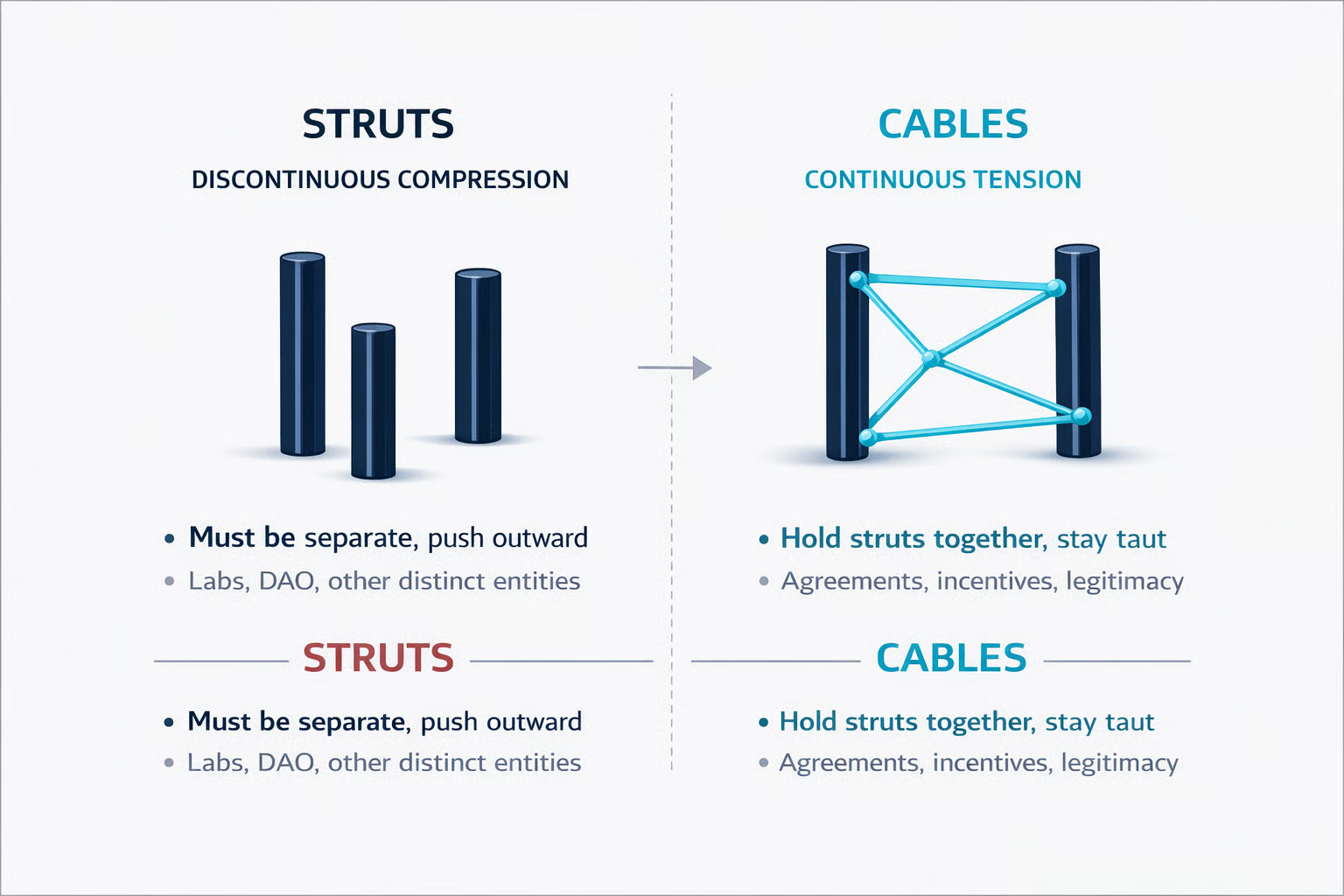
Tensegrity is a structural principle from geometry: systems that hold together through the continuous tension of pull forces balanced against discontinuous compression of push forces. Buckminster Fuller designed physical structures this way—geodesic domes, for instance—where no element bears the full load. Instead, load is distributed through the entire network via complementary tensions.
The principle translates directly to social systems. I've written extensively about how complexity organizes itself through tensegrity, from biological systems to Paradise Lost to web3 governance.
In a healthy organization, freedom doesn't oppose equality—they hold each other in tension. Innovation doesn't oppose stability; they push and pull against each other, creating a dynamic equilibrium. Inclusion and quality standards aren't enemies; they're complementary forces that, when properly designed, make each other stronger.
Local autonomy and global coordination aren't zero-sum. Individual agency and collective intelligence aren't contradictory. These are pairs of forces that need each other to create resilience and adaptation.
Here's what I mean concretely. In Archipelago, you get differentiation by separation. Island A has one set of norms; Island B has another. They're physically (or structurally) distinct. The tension between them is managed by limiting interaction.
In a tensegrity model, you'd keep the differentiation—different spaces absolutely should have different standards and purposes—but you'd add continuous feedback mechanisms and shared meta-skills that create load-sharing across the whole system. The tension between rigor and inclusion isn't eliminated by putting them on different islands. It's metabolized actively by people who've been trained to do that work.
Think of it this way. In a tensegrity bridge, you don't prevent the tension between the cables and the supports by separating them entirely. You design the bridge so that tension flows through the entire structure. Every element depends on the others. If one part fails, you have early warning signals across the whole system. And the structure gets stronger, not weaker, when it's under appropriate stress.
That's what a tensegrity-based community design does: it uses structure to enable tension rather than to avoid it.
Over the past few years, I've developed frameworks specifically for the coordination and governance challenges that Archipelago attempts to solve through separation. Here's a systematic look at where Archipelago falls short and what more robust alternatives look like:
Archipelago Gap | Why This Matters | Alternative Framework | How It Works |
|---|---|---|---|
No mechanism for navigating inherent paradoxes | Communities face paradoxes (autonomy vs. coordination, innovation vs. stability) that can't be "solved" through separation—they must be held in productive tension | Maps nine fundamental paradoxes in coordination systems; provides frameworks for metabolizing them rather than avoiding them through spatial separation | |
Bridge people as volunteers, not a structural requirement | Relies on individuals spontaneously doing high-effort translation work without support, training, or accountability | Prevolutionary Architecture (Prevolution framework) | Design systems where cross-pollination and feedback are structurally required and measurable, preventing devolution into extraction cycles |
No theory of how differentiated spaces should relate | "Islands plus minimal Unigov" gives no guidance on load distribution, feedback loops, or healthy vs. pathological differentiation |
This isn't just conceptual. These frameworks have been developed and tested in web3 governance contexts—specifically for analyzing and improving public goods funding mechanisms such as Octant, Gitcoin, and Giveth.
Let's look at specific problems and how each model approaches them.

On bad ideas spreading through the community: Archipelago says, "hope that bridge people notice and counter them; accept that some bad memes will win." Tensegrity says "design explicit feedback channels—make it easy to surface problems—and actively build shared epistemic immune system capacity through meta-skills training. Give people the ability to distinguish signal from noise, to stay in a relationship while disagreeing, to update their views."
On subculture isolation (like the Leverage situation): Archipelago says "maintain minimal shared events and rely on exit rights." Tensegrity says "make cross-pollination a structural requirement, not an optional extra. Monitor isolation as a system health metric, the way you'd monitor a bridge for stress fractures. Use Prevolutionary design to prevent extraction cycles before they start."
On norm conflicts themselves: Archipelago says, "separate the people who disagree into different spaces." Tensegrity says, "treat disagreement as productive tension. Create explicit protocols for metabolizing it. Design spaces where people can hold different views and still work together. Map the paradoxes that can't be solved, only navigated."
On execution and leadership: Archipelago acknowledges a bottleneck—it's hard to actually create and run spaces with novel norms—but doesn't address it. Tensegrity says "distribute leadership across the four governance domains (aggregation, mechanism, structural, institutional). Create multiple people who can hold different tensions. Give them frameworks and training so they're not just winging it."
On access for newcomers: Archipelago makes informal filters more legible, but still relies on network navigation. Tensegrity says "active onboarding into meta-skills; transparency about what tensions each space holds; pathways for people to move between spaces and grow. Make the architecture itself pedagogical."
The comparison isn't Archipelago vs. Some Alternative System. It's Archipelago (separation, hope, minimal intervention) vs. Tensegrity (differentiation, active capacity-building, structural continuity, measurable regeneration).
There's something specific about the moment we're in that makes tensegrity-based thinking urgent.
In the physical world, communities are constrained by geography. If you split into different islands, you literally can't coordinate much. The work of staying together requires constant, effortful bridging. So separation-based models sometimes make sense as pragmatic compromises with reality.
But in digital spaces—and especially in web3—you can coordinate across any distance at zero marginal cost. You can make the load-sharing visible in real time. You can encode governance principles directly into smart contracts. You can program regenerative feedback loops instead of hoping volunteers will do the bridging work.
Web3 enables us to make tensegrity visible and operational in ways that were never possible before. We can design systems where:
Tension-balancing is visible in dashboards and real-time data
Imbalances trigger automatic alerts and rebalancing mechanisms
Different subgroups can have different parameters while remaining integrated
The entire system gets stronger, not weaker, when exposed to productive stress
Bad actors are caught early through network-level feedback instead of isolation
Coordination work is measured for whether it's regenerative or extractive (CPE/REA)
This isn't abstract. This is what well-designed governance systems should actually do. And we have the tools to build it.
Archipelago essentially gives up. It says: "Shared capacity-building is too hard; people are too different; let's use structure to work around these problems instead of solving them."
I understand the reasoning. Building Rule Omega-style meta-skills is genuinely difficult. It requires vulnerability. It requires people to stay in relationships with people they disagree with. It requires regular practice and excellent facilitation.
But that's not a reason to abandon the goal. It's a reason to get serious about operationalizing it.
Tensegrity says: invest in both structure and capacity. Build differentiated spaces—absolutely, yes, have spaces with different purposes and standards. But also actively cultivate shared skills that enable those spaces to communicate and coordinate without fragmentation. Treat disagreement not as a problem to avoid but as fuel for learning.
The bet isn't that this is easy. The bet is that it's worth doing and that the system's architecture can make it more viable than most communities currently assume.

If you were going to design a tensegrity-based community or organization, you'd start by mapping the key tensions:
Freedom vs. Equality. How much room for individual choice? How much collective decision-making?
Inclusion vs. Quality Standards. How welcoming to newcomers? How rigorous is your work?
Innovation vs. Stability. How much experimentation? How much proven practice?
Local Autonomy vs. Global Coordination. How much can subgroups do their own thing? How much needs central alignment?
Instead of trying to solve these tensions (you can't—they're inherent), you'd design for them. You'd create structures and protocols that let each tension do its work. You'd measure system health across all of them simultaneously. You'd train people to hold these tensions actively rather than collapse them into one dimension.
And you'd be very explicit about how these tensions interact. Freedom without shared commitment to quality becomes chaos. Inclusion without any standards becomes diluted. Innovation without stability becomes randomness. Every force needs its complement.
This is harder than Archipelago. But it's also more resilient. And it's more honest about what it actually takes to hold a diverse group together around a shared purpose.
I want to be clear: I don't have empirical proof that tensegrity-based governance outperforms everything else at scale. What I do have is:
A coherent theoretical framework grounded in structural principles and organizational theory
Multiple domain-specific models (tensegrity, Prevolution, coordination paradoxes, four governance domains, CPE/REA) that address specific gaps Archipelago leaves open
Evidence from analyzing web3 governance systems suggests that these patterns predict where systems thrive vs. where they devolve into extraction
Years of thinking about how systems hold together and how they fall apart
But I'm not claiming certainty. I'm claiming that the question deserves more rigorous investigation than Archipelago received.
And I'm claiming that if you're going to bet on a governance model—especially if you're going to suggest it as a solution to real problems in real communities—it deserves substantiation better than "this is my hunch and the risks are acceptable."
The stakes are too high. The communities are too real. The chance of fracturing into bad-faith subcultures is too serious.
We need architecture. We need systems designed to hold tension. We need shared capacity for metabolizing disagreement. We need to measure whether it's working.
That's what tensegrity offers. Not a hope, but a framework. Not a prayer that bridge people save us, but a design where connection and feedback are structural requirements.
It's harder. It's also better.
This article builds on several years of work developing coordination and governance frameworks. If you're interested in exploring these ideas further:
The Hidden Architecture of Human Systems: How Complexity Organizes Itself Through Tensegrity
Beyond Funding: Web3's Real Coordination Crisis and the Paradoxes We're Ignoring
PREVOLUTION SERIES: Designing Systems That Escape Extraction Cycles
The original Archipelago post that inspired this response: The Archipelago Model of Community Standards by Raemon on LessWrong.
To learn more about Rule Omega: Rebel Wisdom's Rule Omega discussion and Beyond The Fundamentals' deep dive.
There's a problem that haunts every intentional community I've ever seen, and I suspect you've felt it too. A group starts with shared values. Everyone's excited, aligned, hungry for something better. Then, six months in—or six years—the first real disagreement surfaces. What counts as "harm"? Who gets a voice in decisions? How much risk should we tolerate in the name of experimentation?
Most groups handle this the same way: they fight. They hash it out endlessly. They watch as the energy that should go toward their actual work gets consumed by meta-debates about meta-debates. Or they fracture. The people who wanted rigor leave. The people who wanted freedom left. Everyone ends up somewhere smaller, sadder.
In November 2017, a thoughtful governance researcher named Raemon published a post on LessWrong proposing a different approach: The Archipelago Model of Community Standards. Instead of fighting over universal standards, he argued, we should split into explicit subgroups—islands—each with its own clear purpose, leadership, and norms. These islands would remain loosely connected through bridge people, shared events, and a minimal central "government" that enforces only the basics: don't actively harm others and keep exit routes open.
It's an elegant idea. But I've spent the last few years developing frameworks for how complexity organizes itself through tensegrity, and I think Archipelago is offering us a false choice. We don't have to choose between shared capacity-building (like learning to metabolize disagreement together) and structural differentiation (having spaces with different standards). We can design both.
The question isn't "one standard or many islands." It's "how do we architect systems that hold productive tension without tearing apart?"
Let's start with where Raemon is right. Consensus-driven norms in large communities create genuine pathology.
When you try to establish one set of standards for an entire group, how rigorous should you be? How warm? How risk-tolerant?- You're not actually creating shared ground. You're creating a battlefield. Everyone fights to redefine terms in ways that advantage their position. What counts as "evidence"? What constitutes "harm"? What does "good faith" even mean? The debate centers on status and tribal affiliation, not on truth or actual needs.
This burns energy. It distorts epistemics. It punishes people for changing their minds. And it often ends in either forced consensus (exhausting) or implicit fracturing (people stop showing up).
Raemon's diagnosis is sharp: many norm conflicts don't arise from misunderstanding. They arise because people genuinely want different things. They have different risk tolerances, different values, and different goals. Some people want a space optimized for deep intellectual rigor; others want one optimized for radical inclusion. Both are reasonable. Trying to average them together usually just creates a space where nobody's needs are met.
His solution: make the differentiation explicit and structural rather than implicit and painful. Create distinct spaces—islands—with declared purposes. An island optimized for rigorous epistemic work can enforce high standards without constantly negotiating with people who prioritize psychological safety. An island optimized for radical inclusion can move at its own pace without being held back by people afraid of getting things wrong.
Cooperation survives, he argues, through three mechanisms: bridge people who inhabit multiple islands and translate ideas across them; periodic shared events where everyone gathers and cross-pollinates; and a minimal central layer that enforces only the most basic shared rules (non-harm, exit rights, maybe some common education).
The problem is that Raemon doesn't actually make a case for why this would work. And he knows it. He explicitly says his belief that the net result would be positive is "just a feeling," not something he can justify. He's done several months of thinking, casually, about a proposal that would fundamentally reshape how communities organize themselves.
More importantly, he treats the most serious failure modes—fracturing, isolation, bad ideas winning because they're memetically strong—as acceptable risks. He nods at the Leverage example (a rationalist community that became increasingly isolated and, by most accounts, harmful) as a known problem. Then he proceeds with the model anyway, essentially betting that bridge people and shared events will somehow prevent this from becoming systemic.
That's not a strong argument. That's a hope.
There's a second problem, too. Archipelago still assumes a kind of scarcity: scarcity of capacity to build shared meta-skills. The implicit logic is: "Getting everyone to develop Rule Omega skills is hard. So let's use structure to work around that limitation instead of directly addressing it."
Rule Omega is an "edification protocol" for navigating disagreement without fracturing relationships—essentially, a set of practices for staying in productive dialogue when breaking new ground together. The term comes from Rebel Wisdom's work (and further developed by Beyond The Fundamentals), drawing on Revelation 22:13: "I am the Alpha and Omega"—the beginning and the unveiling.
At its core, Rule Omega asks participants to:
Maintain a beginner's mind: Suspend your attachment to existing frameworks and doctrines; approach each conversation as if you don't already know the answer
Understand fully before responding: Separate understanding from agreement—you can deeply comprehend someone's position without being persuaded by it
Give people runway: Assume good intent even when someone says something that sounds wrong, crazy, or cringe-worthy; there's often signal hidden in noise
Draw out the treasure: Every person has valuable insight (even if it's only 1-5% of what they're saying); your job is to ask questions that help them articulate it
Avoid weaponizing words: Don't jump on poor phrasing or contradictions; focus on the intent behind what someone is trying to express, especially when they're thinking out loud
The protocol is designed to break new ground together, not to reinforce established beliefs. It requires participants to transcend ego attachment to being right and cultivate the capacity to hold multiple perspectives within "possibility space" without collapsing into a single dimension.
It's hard work. It requires emotional regulation, humility, and genuine curiosity. But it's precisely the kind of shared meta-skill that makes tensegrity-based governance possible—because it gives people the capacity to metabolize disagreement rather than avoid it through separation.
But what if the real opportunity is to do both? What if the move isn't to abandon shared capacity-building in favor of structural workarounds, but to design systems where differentiated spaces AND shared meta-skills co-evolve?
Tensegrity is a structural principle from geometry: systems that hold together through the continuous tension of pull forces balanced against discontinuous compression of push forces. Buckminster Fuller designed physical structures this way—geodesic domes, for instance—where no element bears the full load. Instead, load is distributed through the entire network via complementary tensions.
The principle translates directly to social systems. I've written extensively about how complexity organizes itself through tensegrity, from biological systems to Paradise Lost to web3 governance.
In a healthy organization, freedom doesn't oppose equality—they hold each other in tension. Innovation doesn't oppose stability; they push and pull against each other, creating a dynamic equilibrium. Inclusion and quality standards aren't enemies; they're complementary forces that, when properly designed, make each other stronger.
Local autonomy and global coordination aren't zero-sum. Individual agency and collective intelligence aren't contradictory. These are pairs of forces that need each other to create resilience and adaptation.
Here's what I mean concretely. In Archipelago, you get differentiation by separation. Island A has one set of norms; Island B has another. They're physically (or structurally) distinct. The tension between them is managed by limiting interaction.
In a tensegrity model, you'd keep the differentiation—different spaces absolutely should have different standards and purposes—but you'd add continuous feedback mechanisms and shared meta-skills that create load-sharing across the whole system. The tension between rigor and inclusion isn't eliminated by putting them on different islands. It's metabolized actively by people who've been trained to do that work.
Think of it this way. In a tensegrity bridge, you don't prevent the tension between the cables and the supports by separating them entirely. You design the bridge so that tension flows through the entire structure. Every element depends on the others. If one part fails, you have early warning signals across the whole system. And the structure gets stronger, not weaker, when it's under appropriate stress.
That's what a tensegrity-based community design does: it uses structure to enable tension rather than to avoid it.
Over the past few years, I've developed frameworks specifically for the coordination and governance challenges that Archipelago attempts to solve through separation. Here's a systematic look at where Archipelago falls short and what more robust alternatives look like:
Archipelago Gap | Why This Matters | Alternative Framework | How It Works |
|---|---|---|---|
No mechanism for navigating inherent paradoxes | Communities face paradoxes (autonomy vs. coordination, innovation vs. stability) that can't be "solved" through separation—they must be held in productive tension | Maps nine fundamental paradoxes in coordination systems; provides frameworks for metabolizing them rather than avoiding them through spatial separation | |
Bridge people as volunteers, not a structural requirement | Relies on individuals spontaneously doing high-effort translation work without support, training, or accountability | Prevolutionary Architecture (Prevolution framework) | Design systems where cross-pollination and feedback are structurally required and measurable, preventing devolution into extraction cycles |
No theory of how differentiated spaces should relate | "Islands plus minimal Unigov" gives no guidance on load distribution, feedback loops, or healthy vs. pathological differentiation |
This isn't just conceptual. These frameworks have been developed and tested in web3 governance contexts—specifically for analyzing and improving public goods funding mechanisms such as Octant, Gitcoin, and Giveth.
Let's look at specific problems and how each model approaches them.
On bad ideas spreading through the community: Archipelago says, "hope that bridge people notice and counter them; accept that some bad memes will win." Tensegrity says "design explicit feedback channels—make it easy to surface problems—and actively build shared epistemic immune system capacity through meta-skills training. Give people the ability to distinguish signal from noise, to stay in a relationship while disagreeing, to update their views."
On subculture isolation (like the Leverage situation): Archipelago says "maintain minimal shared events and rely on exit rights." Tensegrity says "make cross-pollination a structural requirement, not an optional extra. Monitor isolation as a system health metric, the way you'd monitor a bridge for stress fractures. Use Prevolutionary design to prevent extraction cycles before they start."
On norm conflicts themselves: Archipelago says, "separate the people who disagree into different spaces." Tensegrity says, "treat disagreement as productive tension. Create explicit protocols for metabolizing it. Design spaces where people can hold different views and still work together. Map the paradoxes that can't be solved, only navigated."
On execution and leadership: Archipelago acknowledges a bottleneck—it's hard to actually create and run spaces with novel norms—but doesn't address it. Tensegrity says "distribute leadership across the four governance domains (aggregation, mechanism, structural, institutional). Create multiple people who can hold different tensions. Give them frameworks and training so they're not just winging it."
On access for newcomers: Archipelago makes informal filters more legible, but still relies on network navigation. Tensegrity says "active onboarding into meta-skills; transparency about what tensions each space holds; pathways for people to move between spaces and grow. Make the architecture itself pedagogical."
The comparison isn't Archipelago vs. Some Alternative System. It's Archipelago (separation, hope, minimal intervention) vs. Tensegrity (differentiation, active capacity-building, structural continuity, measurable regeneration).
There's something specific about the moment we're in that makes tensegrity-based thinking urgent.
In the physical world, communities are constrained by geography. If you split into different islands, you literally can't coordinate much. The work of staying together requires constant, effortful bridging. So separation-based models sometimes make sense as pragmatic compromises with reality.
But in digital spaces—and especially in web3—you can coordinate across any distance at zero marginal cost. You can make the load-sharing visible in real time. You can encode governance principles directly into smart contracts. You can program regenerative feedback loops instead of hoping volunteers will do the bridging work.
Web3 enables us to make tensegrity visible and operational in ways that were never possible before. We can design systems where:
Tension-balancing is visible in dashboards and real-time data
Imbalances trigger automatic alerts and rebalancing mechanisms
Different subgroups can have different parameters while remaining integrated
The entire system gets stronger, not weaker, when exposed to productive stress
Bad actors are caught early through network-level feedback instead of isolation
Coordination work is measured for whether it's regenerative or extractive (CPE/REA)
This isn't abstract. This is what well-designed governance systems should actually do. And we have the tools to build it.
Archipelago essentially gives up. It says: "Shared capacity-building is too hard; people are too different; let's use structure to work around these problems instead of solving them."
I understand the reasoning. Building Rule Omega-style meta-skills is genuinely difficult. It requires vulnerability. It requires people to stay in relationships with people they disagree with. It requires regular practice and excellent facilitation.
But that's not a reason to abandon the goal. It's a reason to get serious about operationalizing it.
Tensegrity says: invest in both structure and capacity. Build differentiated spaces—absolutely, yes, have spaces with different purposes and standards. But also actively cultivate shared skills that enable those spaces to communicate and coordinate without fragmentation. Treat disagreement not as a problem to avoid but as fuel for learning.
The bet isn't that this is easy. The bet is that it's worth doing and that the system's architecture can make it more viable than most communities currently assume.
If you were going to design a tensegrity-based community or organization, you'd start by mapping the key tensions:
Freedom vs. Equality. How much room for individual choice? How much collective decision-making?
Inclusion vs. Quality Standards. How welcoming to newcomers? How rigorous is your work?
Innovation vs. Stability. How much experimentation? How much proven practice?
Local Autonomy vs. Global Coordination. How much can subgroups do their own thing? How much needs central alignment?
Instead of trying to solve these tensions (you can't—they're inherent), you'd design for them. You'd create structures and protocols that let each tension do its work. You'd measure system health across all of them simultaneously. You'd train people to hold these tensions actively rather than collapse them into one dimension.
And you'd be very explicit about how these tensions interact. Freedom without shared commitment to quality becomes chaos. Inclusion without any standards becomes diluted. Innovation without stability becomes randomness. Every force needs its complement.
This is harder than Archipelago. But it's also more resilient. And it's more honest about what it actually takes to hold a diverse group together around a shared purpose.
I want to be clear: I don't have empirical proof that tensegrity-based governance outperforms everything else at scale. What I do have is:
A coherent theoretical framework grounded in structural principles and organizational theory
Multiple domain-specific models (tensegrity, Prevolution, coordination paradoxes, four governance domains, CPE/REA) that address specific gaps Archipelago leaves open
Evidence from analyzing web3 governance systems suggests that these patterns predict where systems thrive vs. where they devolve into extraction
Years of thinking about how systems hold together and how they fall apart
But I'm not claiming certainty. I'm claiming that the question deserves more rigorous investigation than Archipelago received.
And I'm claiming that if you're going to bet on a governance model—especially if you're going to suggest it as a solution to real problems in real communities—it deserves substantiation better than "this is my hunch and the risks are acceptable."
The stakes are too high. The communities are too real. The chance of fracturing into bad-faith subcultures is too serious.
We need architecture. We need systems designed to hold tension. We need shared capacity for metabolizing disagreement. We need to measure whether it's working.
That's what tensegrity offers. Not a hope, but a framework. Not a prayer that bridge people save us, but a design where connection and feedback are structural requirements.
It's harder. It's also better.
This article builds on several years of work developing coordination and governance frameworks. If you're interested in exploring these ideas further:
The Hidden Architecture of Human Systems: How Complexity Organizes Itself Through Tensegrity
Beyond Funding: Web3's Real Coordination Crisis and the Paradoxes We're Ignoring
PREVOLUTION SERIES: Designing Systems That Escape Extraction Cycles
The original Archipelago post that inspired this response: The Archipelago Model of Community Standards by Raemon on LessWrong.
To learn more about Rule Omega: Rebel Wisdom's Rule Omega discussion and Beyond The Fundamentals' deep dive.
Four Domains of Governance Design (Governance Beyond Game Theory) |
Provides explicit design surfaces: Aggregation (voice), Mechanism (incentives), Structural (tensegrity/load paths), Institutional (rule evolution). Each domain has clear design patterns |
Accepts "bad memes winning" as inevitable | No epistemic immune system; hopes individuals will notice and counter dangerous ideas | Shared Meta-Skills as Infrastructure | Rule Omega-style capacities (signal/noise distinction, staying in relationship through conflict) treated as trainable, measurable competencies, not optional extras |
No measurement or early warning systems | Can't tell if isolation is becoming pathological until it's too late (Leverage example) | System Health Metrics across Tensions | Monitor multiple dimensions simultaneously: innovation/stability, inclusion/rigor, local/global, individual/collective. Imbalance triggers intervention |
Separation as the primary coordination mechanism | Limits learning across differences; reduces innovation from cross-pollination | Tensegrity as Structural Principle | Continuous tension (shared protocols, rituals, meta-skills) + discontinuous compression (clear boundaries, roles, standards) = differentiation without isolation |
No regenerative feedback loops | Value created on one island doesn't strengthen the whole; extraction can happen invisibly | CPE/REA Framework (Coordination Production Efficiency / Regenerative Expense Accounting) | Measures whether coordination work is regenerative (strengthens future capacity) or extractive (depletes it); makes value flows visible |
Four Domains of Governance Design (Governance Beyond Game Theory) |
Provides explicit design surfaces: Aggregation (voice), Mechanism (incentives), Structural (tensegrity/load paths), Institutional (rule evolution). Each domain has clear design patterns |
Accepts "bad memes winning" as inevitable | No epistemic immune system; hopes individuals will notice and counter dangerous ideas | Shared Meta-Skills as Infrastructure | Rule Omega-style capacities (signal/noise distinction, staying in relationship through conflict) treated as trainable, measurable competencies, not optional extras |
No measurement or early warning systems | Can't tell if isolation is becoming pathological until it's too late (Leverage example) | System Health Metrics across Tensions | Monitor multiple dimensions simultaneously: innovation/stability, inclusion/rigor, local/global, individual/collective. Imbalance triggers intervention |
Separation as the primary coordination mechanism | Limits learning across differences; reduces innovation from cross-pollination | Tensegrity as Structural Principle | Continuous tension (shared protocols, rituals, meta-skills) + discontinuous compression (clear boundaries, roles, standards) = differentiation without isolation |
No regenerative feedback loops | Value created on one island doesn't strengthen the whole; extraction can happen invisibly | CPE/REA Framework (Coordination Production Efficiency / Regenerative Expense Accounting) | Measures whether coordination work is regenerative (strengthens future capacity) or extractive (depletes it); makes value flows visible |

 Holonic Horizons
The Stallman Paradox: How Web3 Became the Ultimate Open Source Theater
We Revere the Prophet, Yet Build the Exact System He Warned Us Against
 Holonic Horizons
Beyond Funding: Web3's Real Coordination Crisis and the Paradoxes We're Ignoring
'The uncomfortable truth is that funding, no matter how innovative or well-intentioned, cannot solve coordination problems rooted in unaddressed paradoxes.'
 Holonic Horizons
The Hidden Architecture of Human Systems: How Complexity Organizes Itself Through Tensegrity
How Dynamic Balance Shapes Everything From Relationships to Democracy
Holonic HorizonsThe Stallman Paradox: How Web3 Became the Ultimate Open Source Theater
We Revere the Prophet, Yet Build the Exact System He Warned Us Against
Holonic HorizonsBeyond Funding: Web3's Real Coordination Crisis and the Paradoxes We're Ignoring
'The uncomfortable truth is that funding, no matter how innovative or well-intentioned, cannot solve coordination problems rooted in unaddressed paradoxes.'
Holonic HorizonsThe Hidden Architecture of Human Systems: How Complexity Organizes Itself Through Tensegrity
How Dynamic Balance Shapes Everything From Relationships to Democracy
Holonic Horizons explores governance and social architecture through accessible, Integral and nondual metatheory—bridging embodied philosophy, web3 public goods, coordination, and institutional design for curious builders and systems thinkers.
Holonic Horizons explores governance and social architecture through accessible, Integral and nondual metatheory—bridging embodied philosophy, web3 public goods, coordination, and institutional design for curious builders and systems thinkers.

Subscribe to Holonic Horizons
Subscribe to Holonic Horizons
Support Holonic Horizons
Holonic HorizonsTogether, With Tension: Why Communities Need Social Architecture, Not Archipelagos
Support Holonic Horizons
Holonic HorizonsTogether, With Tension: Why Communities Need Social Architecture, Not Archipelagos
<100 subscribers
<100 subscribers
Share Dialog
Share Dialog



1 comment
Another nice read.