
Subscribe to Kage Protocol
Subscribe to Kage Protocol
Share Dialog
Share Dialog
<100 subscribers
<100 subscribers
“Privacy is necessary for an open society in the electronic age. Privacy is not secrecy. A private matter is something one doesn't want the whole world to know, but a secret matter is something one doesn't want anybody to know.”
– Eric Hughes, A Cypherpunk’s Manifesto, 1993
Mission: Our mission at Kage Protocol is simple yet bold: to serve as the portal to private DeFi. In an industry built on decentralization and self-sovereignty, we find it paradoxical that one crucial element of freedom has been left in the shadows: privacy. Kage (影, meaning "shadow") was born from a conviction that financial freedom requires the ability to operate in the shadows at will, free from constant surveillance, free from predatory interference, and free to choose what remains yours alone.
From the Kage Manifesto:
Privacy is Power: The right to choose what, when, and to whom you reveal.
Confidentiality is Freedom: Financial privacy is the backbone of sovereignty.
Code is Liberation: Cryptography as the blade that severs chains of surveillance.
Today’s DeFi is powerful, open, and permissionless, a new frontier of finance. But it is also illuminated by an unforgiving spotlight. Every transaction, every balance, every movement is laid bare on a public ledger for all to see. What started as a dream of individual empowerment has, in many ways, become a panopticon, a glass cage where everyone is watching everyone. This radical transparency has benefits: it fosters trust in protocol rules and traceability. Yet, it comes at a steep cost to individual users. Where is the freedom if you cannot escape constant observation? Where is the sovereignty if every move requires revealing your entire financial history?
As founders, we carry a personal conviction that privacy is a prerequisite for true freedom. We built Kage because we’ve felt first-hand the discomfort and danger of DeFi’s complete transparency. We refuse to accept that exposing your entire net worth and trading strategy to the world is the price of participation.
In a hyper-surveilled world, true freedom lives in the shadows. Kage (影, “shadow”) embodies the ethos of privacy and stealth, a silent guardian of individual liberty amid pervasive surveillance. The philosophy of the Kage Protocol is rooted in the belief that financial privacy is not a luxury but a fundamental right.
“Privacy is necessary for an open society in the electronic age… Privacy is the power to selectively reveal oneself to the world,”
Kage leverages advanced cryptography (like zero-knowledge proofs and stealth addresses) and intent-based trade execution to ensure users’ actions aren’t exposed in public mempools. Instead of broadcasting your trade to the world, you submit an encrypted intent that only our protocol (and not MEV bots) can act on. The result: MEV-resistant, front-run-proof transactions that are visible only when they’re finalized and even then without revealing sensitive info like your identity or exact trade path.
For all of DeFi’s achievements, it has a glaring Achilles’ heel: everything is public. Today, if you use a decentralized exchange or lending protocol, your actions are broadcast in the open. This transparency, once hailed as a virtue, has become a trap. It invites surveillance and exploitation in equal measure. Consider the trader who wants to swap a large amount of tokens: the moment they submit their transaction, an army of bots can see it coming. In the seconds before that trade is confirmed, opportunistic actors will reshuffle the deck in their favor, buying before the trader’s order and selling right after, siphoning value in what's known as a sandwich attack. The trader ends up with a worse price, essentially robbed in broad daylight by invisible predators.
DEX trading volumes are soaring, in fact, decentralized exchanges hit an all-time high of $462.7 billion in monthly volume in December 2024. Such explosive growth (illustrated below) underscores DeFi’s potential. However, every one of those trades is completely public, with details visible to anyone. This radical openness means any observer or bot can monitor and manipulate DeFi transactions in real time.
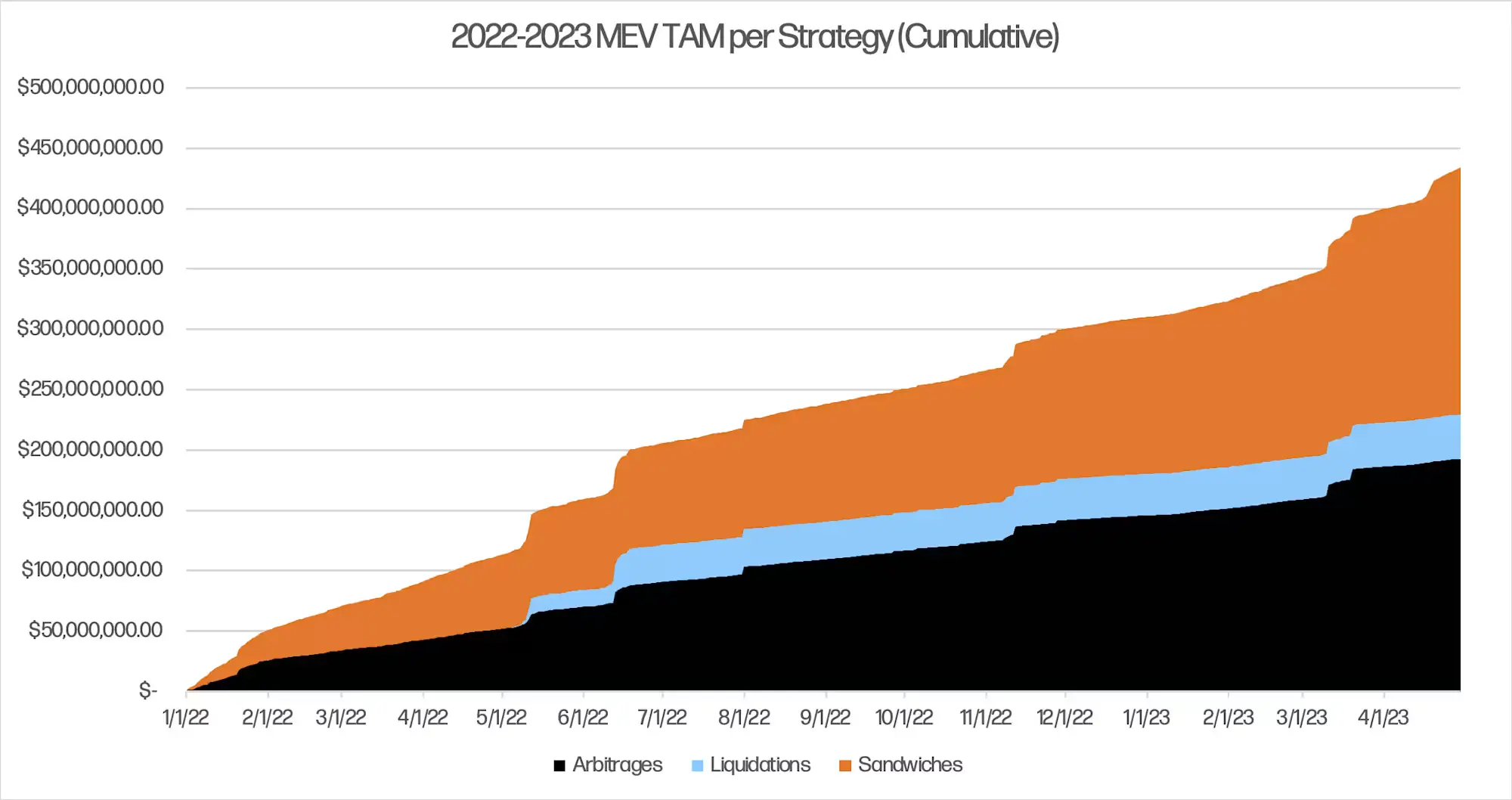
https://github.com/lsquaredleland/MEV-Distribution
The result is a decentralized dystopia where opportunists lurk in the “dark forest” of the mempool, waiting to pounce on users’ transactions.
One of the clearest illustrations of why privacy is needed is the phenomenon of Maximal Extractable Value (MEV). MEV is often called a “hidden tax” on crypto users, the value that miners/validators or bots can extract from users by reordering or inserting transactions in a block. Since DeFi activity is transparent, sophisticated bots routinely scan pending transactions and profit at the expense of ordinary users.
Research shows the lower bound of MEV extraction on Ethereum at $300M–$900M annually, and the true figure (across chains and including untracked exploits) likely exceeds $1 billion.
These aren’t just abstract numbers, this is value taken directly from traders. For example, if you submit a swap with high slippage tolerance, a bot can sandwich your trade (front-running and back-running it) and steal a portion of your output.
The result: You receive worse prices while the MEV searcher pockets the difference. Studies have found that smaller retail trades are hit the hardest, transactions under $2,000 are disproportionately targeted by MEV bots.
It’s not just the bots. Analytics firms and opportunistic traders scrutinize whale wallets, copying their moves or front-running governance proposals by anticipating on-chain actions. Competitors watch treasuries and funds, gleaning strategy from every deployment of capital. Even regular users face risks: share your wallet address and anyone can see how much you own, where you’ve been transferring funds, which NFTs you hold, and more. The lack of privacy creates perverse incentives; users now go to great lengths to obfuscate their activity, spreading funds across many wallets, using mixers or centralized exchanges as pivots, not because they intend harm but because privacy is a human desire. In traditional finance, your bank transactions aren’t public to the world by default; in DeFi, openness is the default, with privacy an afterthought.
At Kage, this is our frustration and our motivation. We are frustrated that the most revolutionary financial system in decades still runs on an infrastructure of exposure. We are frustrated that “Don’t trust, verify” in practice meant “Everyone can see everything” with no alternative. And we are driven by the belief that this is not the end of the story, that an open financial system can exist without sacrificing the right to privacy. The transparency trap can be escaped. DeFi can evolve beyond the glass walls.
Cryptographers and cypherpunks understood this deeply. The cypherpunk movement of the 1990s, the very roots from which Bitcoin emerged, was grounded in the idea that privacy is a fundamental right and a necessity for an open society. Early crypto pioneers like Eric Hughes and Timothy May spoke of a future where individuals could trade and interact anonymously, safeguarding personal freedom against any watching eye. That early dream treated privacy as sine qua non: without which the system would simply recreate the surveillance state in another form. And for a while, cryptocurrencies carried that torch: Bitcoin was pseudonymous, and projects like Zcash and Monero pushed the frontier of private digital cash.
At Kage, we often talk about “sovereignty”. Sovereignty is not just controlling your keys; it’s controlling your information. It’s the power to resist unwarranted intrusion. When we say Kage stands for shadows, freedom, surveillance and resistance, we mean: Shadows as in the space where one can move unseen; freedom as in the ability to choose and act without external coercion or observation; surveillance as the force we push back against; and resistance as the stance we take, resisting the idea that comprehensive surveillance is an acceptable default. We carry a sense of urgency because we see the trajectory: as DeFi grows, so will surveillance and data analytics. If we don’t build the privacy layer now, we may soon find ourselves in a fully monitored financial ecosystem, where every participant is naked and vulnerable. That is a future we refuse to accept. The time to act is now, before the lack of privacy ossifies into an unquestioned norm.
Kage is designed as a one-stop platform to solve the above-listed problems and more, where various DeFi activities can be conducted in shadows under the veil of privacy. Our suite will span trading, transfers, lending, and even a native private stablecoin, creating a holistic “private finance” portal.
Users enter Kage to access a parallel DeFi universe where their strategies remain in the shadows, but the outcomes (swaps, yields, loans) are real.
Kage Protocol is more than just another DeFi platform, it is a revolution in privacy. By combining zero-knowledge proofs and dynamic compliance tools, we offer a robust, self-sovereign ecosystem where every financial activity is secure and confidential.
In writing this manifesto-meets-product vision, we speak in a tone of both urgency and optimism. Urgency, because we feel in our bones that DeFi stands at a crossroads; continue down the path of total transparency and risk stagnation and predation, or chart a new course that brings back the balance of privacy and freedom. Optimism, because we sincerely believe the community is ready for this. The discourse is already changing; even the architects of Ethereum have mused about the need for privacy solutions at the base layer. Users are more educated now, they know what MEV is, they feel the pain of being watched or copied, and are yearning for a change. Kage Protocol intends to deliver that change.
The Kage Protocol stands for a simple truth: Freedom finds sanctuary in the shadows. DeFi, to fully achieve its promise of democratized finance, must embrace privacy as a core tenet. We invite you to walk through the portal with us, to experience a new kind of DeFi where you hold not just the keys to your assets, but the keys to your privacy. The shadows are not to be feared; they are where we find ourselves again – free, sovereign, and unchained.
“Privacy is necessary for an open society in the electronic age. Privacy is not secrecy. A private matter is something one doesn't want the whole world to know, but a secret matter is something one doesn't want anybody to know.”
– Eric Hughes, A Cypherpunk’s Manifesto, 1993
Mission: Our mission at Kage Protocol is simple yet bold: to serve as the portal to private DeFi. In an industry built on decentralization and self-sovereignty, we find it paradoxical that one crucial element of freedom has been left in the shadows: privacy. Kage (影, meaning "shadow") was born from a conviction that financial freedom requires the ability to operate in the shadows at will, free from constant surveillance, free from predatory interference, and free to choose what remains yours alone.
From the Kage Manifesto:
Privacy is Power: The right to choose what, when, and to whom you reveal.
Confidentiality is Freedom: Financial privacy is the backbone of sovereignty.
Code is Liberation: Cryptography as the blade that severs chains of surveillance.
Today’s DeFi is powerful, open, and permissionless, a new frontier of finance. But it is also illuminated by an unforgiving spotlight. Every transaction, every balance, every movement is laid bare on a public ledger for all to see. What started as a dream of individual empowerment has, in many ways, become a panopticon, a glass cage where everyone is watching everyone. This radical transparency has benefits: it fosters trust in protocol rules and traceability. Yet, it comes at a steep cost to individual users. Where is the freedom if you cannot escape constant observation? Where is the sovereignty if every move requires revealing your entire financial history?
As founders, we carry a personal conviction that privacy is a prerequisite for true freedom. We built Kage because we’ve felt first-hand the discomfort and danger of DeFi’s complete transparency. We refuse to accept that exposing your entire net worth and trading strategy to the world is the price of participation.
In a hyper-surveilled world, true freedom lives in the shadows. Kage (影, “shadow”) embodies the ethos of privacy and stealth, a silent guardian of individual liberty amid pervasive surveillance. The philosophy of the Kage Protocol is rooted in the belief that financial privacy is not a luxury but a fundamental right.
“Privacy is necessary for an open society in the electronic age… Privacy is the power to selectively reveal oneself to the world,”
Kage leverages advanced cryptography (like zero-knowledge proofs and stealth addresses) and intent-based trade execution to ensure users’ actions aren’t exposed in public mempools. Instead of broadcasting your trade to the world, you submit an encrypted intent that only our protocol (and not MEV bots) can act on. The result: MEV-resistant, front-run-proof transactions that are visible only when they’re finalized and even then without revealing sensitive info like your identity or exact trade path.
For all of DeFi’s achievements, it has a glaring Achilles’ heel: everything is public. Today, if you use a decentralized exchange or lending protocol, your actions are broadcast in the open. This transparency, once hailed as a virtue, has become a trap. It invites surveillance and exploitation in equal measure. Consider the trader who wants to swap a large amount of tokens: the moment they submit their transaction, an army of bots can see it coming. In the seconds before that trade is confirmed, opportunistic actors will reshuffle the deck in their favor, buying before the trader’s order and selling right after, siphoning value in what's known as a sandwich attack. The trader ends up with a worse price, essentially robbed in broad daylight by invisible predators.
DEX trading volumes are soaring, in fact, decentralized exchanges hit an all-time high of $462.7 billion in monthly volume in December 2024. Such explosive growth (illustrated below) underscores DeFi’s potential. However, every one of those trades is completely public, with details visible to anyone. This radical openness means any observer or bot can monitor and manipulate DeFi transactions in real time.
https://github.com/lsquaredleland/MEV-Distribution
The result is a decentralized dystopia where opportunists lurk in the “dark forest” of the mempool, waiting to pounce on users’ transactions.
One of the clearest illustrations of why privacy is needed is the phenomenon of Maximal Extractable Value (MEV). MEV is often called a “hidden tax” on crypto users, the value that miners/validators or bots can extract from users by reordering or inserting transactions in a block. Since DeFi activity is transparent, sophisticated bots routinely scan pending transactions and profit at the expense of ordinary users.
Research shows the lower bound of MEV extraction on Ethereum at $300M–$900M annually, and the true figure (across chains and including untracked exploits) likely exceeds $1 billion.
These aren’t just abstract numbers, this is value taken directly from traders. For example, if you submit a swap with high slippage tolerance, a bot can sandwich your trade (front-running and back-running it) and steal a portion of your output.
The result: You receive worse prices while the MEV searcher pockets the difference. Studies have found that smaller retail trades are hit the hardest, transactions under $2,000 are disproportionately targeted by MEV bots.
It’s not just the bots. Analytics firms and opportunistic traders scrutinize whale wallets, copying their moves or front-running governance proposals by anticipating on-chain actions. Competitors watch treasuries and funds, gleaning strategy from every deployment of capital. Even regular users face risks: share your wallet address and anyone can see how much you own, where you’ve been transferring funds, which NFTs you hold, and more. The lack of privacy creates perverse incentives; users now go to great lengths to obfuscate their activity, spreading funds across many wallets, using mixers or centralized exchanges as pivots, not because they intend harm but because privacy is a human desire. In traditional finance, your bank transactions aren’t public to the world by default; in DeFi, openness is the default, with privacy an afterthought.
At Kage, this is our frustration and our motivation. We are frustrated that the most revolutionary financial system in decades still runs on an infrastructure of exposure. We are frustrated that “Don’t trust, verify” in practice meant “Everyone can see everything” with no alternative. And we are driven by the belief that this is not the end of the story, that an open financial system can exist without sacrificing the right to privacy. The transparency trap can be escaped. DeFi can evolve beyond the glass walls.
Cryptographers and cypherpunks understood this deeply. The cypherpunk movement of the 1990s, the very roots from which Bitcoin emerged, was grounded in the idea that privacy is a fundamental right and a necessity for an open society. Early crypto pioneers like Eric Hughes and Timothy May spoke of a future where individuals could trade and interact anonymously, safeguarding personal freedom against any watching eye. That early dream treated privacy as sine qua non: without which the system would simply recreate the surveillance state in another form. And for a while, cryptocurrencies carried that torch: Bitcoin was pseudonymous, and projects like Zcash and Monero pushed the frontier of private digital cash.
At Kage, we often talk about “sovereignty”. Sovereignty is not just controlling your keys; it’s controlling your information. It’s the power to resist unwarranted intrusion. When we say Kage stands for shadows, freedom, surveillance and resistance, we mean: Shadows as in the space where one can move unseen; freedom as in the ability to choose and act without external coercion or observation; surveillance as the force we push back against; and resistance as the stance we take, resisting the idea that comprehensive surveillance is an acceptable default. We carry a sense of urgency because we see the trajectory: as DeFi grows, so will surveillance and data analytics. If we don’t build the privacy layer now, we may soon find ourselves in a fully monitored financial ecosystem, where every participant is naked and vulnerable. That is a future we refuse to accept. The time to act is now, before the lack of privacy ossifies into an unquestioned norm.
Kage is designed as a one-stop platform to solve the above-listed problems and more, where various DeFi activities can be conducted in shadows under the veil of privacy. Our suite will span trading, transfers, lending, and even a native private stablecoin, creating a holistic “private finance” portal.
Users enter Kage to access a parallel DeFi universe where their strategies remain in the shadows, but the outcomes (swaps, yields, loans) are real.
Kage Protocol is more than just another DeFi platform, it is a revolution in privacy. By combining zero-knowledge proofs and dynamic compliance tools, we offer a robust, self-sovereign ecosystem where every financial activity is secure and confidential.
In writing this manifesto-meets-product vision, we speak in a tone of both urgency and optimism. Urgency, because we feel in our bones that DeFi stands at a crossroads; continue down the path of total transparency and risk stagnation and predation, or chart a new course that brings back the balance of privacy and freedom. Optimism, because we sincerely believe the community is ready for this. The discourse is already changing; even the architects of Ethereum have mused about the need for privacy solutions at the base layer. Users are more educated now, they know what MEV is, they feel the pain of being watched or copied, and are yearning for a change. Kage Protocol intends to deliver that change.
The Kage Protocol stands for a simple truth: Freedom finds sanctuary in the shadows. DeFi, to fully achieve its promise of democratized finance, must embrace privacy as a core tenet. We invite you to walk through the portal with us, to experience a new kind of DeFi where you hold not just the keys to your assets, but the keys to your privacy. The shadows are not to be feared; they are where we find ourselves again – free, sovereign, and unchained.
Kage Protocol
Kage Protocol



No activity yet