 Nekodex by Perpetual Protocol 🥨
Stealth Addresses Explained (And How To Use Them)
A simple explainer of stealth addresses, the plans for making them standardized for Ethereum and a walkthrough of how to use stealth addresses on Optimism today! When looking at the overall DeFi market, privacy-preserving protocols only make up a very small part of it by total value locked. According to statistics provided by DeFiLlama, just 0.52% of the entire TVL is attributed to privacy applications, with Aztec and Tornado Cash taking the lion’s share. Cryptocurrencies hold a lot of potent...
Nekodex by Perpetual Protocol 🥨The Arrival of Real Yield: Lazy River 2.0
The most anticipated feature on Perp is finally here: USDC fee sharing! As a big upgrade to our staking program on Optimism, Lazy River 2.0 will begin distributing a stablecoin yield to vePERP holders from the protocol’s revenue.To start earning yield, you’ll first need to hold some PERP on Optimism. Check out this guide which provides a walkthrough for bridging to Optimism (we recommend using Optimism Gateway) and view the exchanges where you can buy PERP here.With the arrival of real yield,...
 Nekodex by Perpetual Protocol 🥨
How to Hedge Against Impermanent Loss with Deribit’s Volatility Futures
In this guide, we’ll show you how you can hedge against impermanent loss when providing liquidity to Perp’s Bitcoin market using Deribit’s newly launched volatility futures product. Makers (AKA liquidity providers) on Perp can earn trading fees and liquidity mining rewards. However, as the price moves away from your entry point and traders consume the liquidity you provide, you face impermanent loss (or IL for short). But there are ways to hedge described in the article below. How to Mitigate...
Trustless crypto trading for everyone!
Nekodex by Perpetual Protocol 🥨Stealth Addresses Explained (And How To Use Them)
A simple explainer of stealth addresses, the plans for making them standardized for Ethereum and a walkthrough of how to use stealth addresses on Optimism today! When looking at the overall DeFi market, privacy-preserving protocols only make up a very small part of it by total value locked. According to statistics provided by DeFiLlama, just 0.52% of the entire TVL is attributed to privacy applications, with Aztec and Tornado Cash taking the lion’s share. Cryptocurrencies hold a lot of potent...
Nekodex by Perpetual Protocol 🥨The Arrival of Real Yield: Lazy River 2.0
The most anticipated feature on Perp is finally here: USDC fee sharing! As a big upgrade to our staking program on Optimism, Lazy River 2.0 will begin distributing a stablecoin yield to vePERP holders from the protocol’s revenue.To start earning yield, you’ll first need to hold some PERP on Optimism. Check out this guide which provides a walkthrough for bridging to Optimism (we recommend using Optimism Gateway) and view the exchanges where you can buy PERP here.With the arrival of real yield,...
Nekodex by Perpetual Protocol 🥨How to Hedge Against Impermanent Loss with Deribit’s Volatility Futures
In this guide, we’ll show you how you can hedge against impermanent loss when providing liquidity to Perp’s Bitcoin market using Deribit’s newly launched volatility futures product. Makers (AKA liquidity providers) on Perp can earn trading fees and liquidity mining rewards. However, as the price moves away from your entry point and traders consume the liquidity you provide, you face impermanent loss (or IL for short). But there are ways to hedge described in the article below. How to Mitigate...
Trustless crypto trading for everyone!
Share Dialog
Share Dialog

Subscribe to Nekodex by Perpetual Protocol 🥨
Subscribe to Nekodex by Perpetual Protocol 🥨
>400 subscribers
>400 subscribers

Welcome to our market review for October, where we recap the biggest developments in the past month, provide some snapshots of the cryptocurrency markets and review the FTX contagion.
News Recap
Markets Snapshot
FTX Contagion Rattles Markets
Upcoming Events
Fed Raises Federal Funds Rate by 75 Basis Points Again on November 2nd
The benchmark interest rate was raised to 3.75%-4% and the central bank’s projections show that rates will reach a high of 4.75% in 2023.
JPMorgan Executes First DeFi Trade Using Public Blockchain
JPMorgan executed its first cross-border transaction using DeFi on the Ethereum Layer 2 network Polygon, which was facilitated by the Monetary Authority of Singapore’s Project Guardian. The transaction used a modified version of Aave’s smart contract code to explore potential DeFi applications in wholesale funding markets.
Reddit Users Created 3 Million Crypto Wallets to Scoop Up Polygon NFTs
Social media giant Reddit has brought at least 3 million new users into cryptocurrency through their collectible avatar NFTs since the series launched in July.
Art Gobblers Launches, Becomes One of the Most Popular NFT Collections
Art Gobblers, an NFT project launched by Rick and Morty creator Justin Roiland, launched on October 31st and has quickly become the second most popular collection on OpenSea, with 9,580 ETH in volume.
Record $760 Million Stolen During ‘Hacktober’
The amount of funds stolen from cryptocurrency projects rose to a record high in ‘Hacktober’ with the biggest losses coming from the BNBChain, Mango Markets and TempleDAO exploits. The total value of stolen funds in 2022 is almost at $3 billion, compared to just $1.5 billion last year.
Hong Kong Plans to Legalize Retail Crypto Trading to Become Hub
A planned mandatory licensing program for crypto platforms is expected to be put into place in March 2023 to allow retail trading. The regime for listing tokens will be similar to the approach taken for structured products, including criteria such as market value, liquidity and inclusion in third-party crypto indexes.

Vitalik Buterin tweeted an updated Ethereum roadmap on November 4th, detailing the way forward for the second largest cryptocurrency.
Fidelity’s Crypto Platform to Add Ether Trading for Institutional Clients
As of October 28th, institutional clients of Fidelity can now trade ETH after the asset management firm launched an Ethereum Index Fund for accredited investors in September.
SBF and Erik Voorhees debate crypto and DeFi regulation
FTX CEO Sam Bankman-Fried and ShapeShift founder Erik Voorhees engaged in a lively debate about cryptocurrency regulation and the Digital Commodities Consumer Protection Act (DCCPA) bill.
Layer 1 blockchain Aptos launches mainnet
After raising $150 million in July, former Meta employees launched the Layer 1 blockchain Aptos.
Elon Musk Completes Acquisition of Twitter, $DOGE and $MASK Soar
Dogecoin rose to a 5-month high on news that Elon Musk completed his acquisition of Twitter, sparking speculation that the social media platform could integrate DOGE. MASK, the native token of the Mask network, also saw massive gains following the news, jumping from above $1 to over $5.
Ethereum developers launch Shandong, the testnet for the upcoming Shanghai upgrade
The Shandong testnet was launched on October 17th to allow developers to test out the upcoming upgrades to the Ethereum protocol that will be put into place with the Shanghai, which is expected to go live sometime in 2023. A variety of Ethereum Improvement Proposals are being considered for inclusion, including EIP-4895, which will allow withdrawals of staked ETH from the Beacon chain.
The snapshot for markets on Perp v2 over October 9th to November 9th is displayed below:

Source: https://app.santiment.net/s/4N6KAI95 as of November 9th (14:30 UTC). Active addresses data unavailable for those with “-”.
Most markets are in the red over the past 30 days, with two exceptions: BNB (+8.29%) and MATIC (+11.93%). The largest declines were seen for SOL (-42.21%) and NEAR (-34.51%).
Trading volumes are up across the board with SOL, PERP and MATIC seeing the largest increases.
Looking at the wider market, the top 15 crypto-assets by volume growth and social volume growth between October 7th and November 7th are both shown below:

Source: Santiment; https://app.santiment.net/s/4wycaYih
WEMIX, a stablecoin created by the South Korean blockchain game developer Wemade, saw the greatest increase in trading volume of almost 1400% after launching on October 20th. The stablecoin is pegged to USDC and Wemade also launched WEMIX.Fi, a DeFi service to allow users to store, stake and swap Wemade’s crypto tokens.
Arweave’s AR token saw a 1125.2% gain in trading volume over the past 30 days, with the major catalyst being a collaboration with Meta for NFT storage.
FTX’s native token FTT saw a 831.2% gain in volume as revelations about the exchange’s balance sheet came to light.
IOTX, a token used as part of the IoTeX platform to link internet of things gadgets with decentralized apps, gained almost 800% in trading volume.
DOGE experienced a 420% gain in volume as Elon Musk took the reins at Twitter, sparking speculative frenzy over whether the social media platforms would integrate wallets for the memecoin.

Source: Santiment; https://app.santiment.net/s/4wycaYih
Stepn’s GMT saw the greatest gain in social volume out of the top 150 crypto-assets by market cap, recording a 954.1% rise, driven by the launch of the MOOAR NFT marketplace on Ethereum and Solana.
UNI also saw tremendous growth in social mentions, up 868.5%, on the back of news that Uniswap Labs raised $165 million in a Series B funding round. A community vote also favored launching the DEX on Ethereum’s zkSync Layer 2.
WEMIX also saw a large rise in social mentions, up 466.7%.
Exchange tokens have also been a hot topic during October, with HT and FTT both seeing social mentions rise more than 400% and 300% respectively. The rise in social mentions corresponds with a big jump in the price of HT, while FTT sparked a social buzz following the Voyager bankruptcy case and the move by a Texan securities regulator to scrutinize FTX.

Source: CoinMetrics
The MVRV for both Bitcoin and Ethereum are both below 1, suggesting a bottom is yet to play out. During October, the metric for Ethereum surpassed the threshold at 1, but with the FTX contagion, it has fallen back below this level. We’d want to see the MVRV move above one and out of the buy zone for confirmation that a long-term bottom is in, otherwise fresh lows for BTC and ETH are likely.
FTX rattled the markets and shocked the entire cryptocurrency ecosystem in recent days as it came to light that they had been secretly insolvent for quite some time. The downfall of FTX is one of the biggest shocks for crypto investors since the collapse of Mt. Gox in 2013, with the price of the platform’s native FTT token falling 75% in a single day on November 8th.

In a thrilling sequence of events that started with the founder of FTX, Sam Bankman-Fried (or SBF), lobbying Washington to get a bill passed that would benefit centralized exchanges but harm DeFi protocols ended up with SBF tweeting on November 8th that they’ve asked Binance to come in to help with the liquidity crunch.
On October 13th, Richard Chen of 1confirmation posted the following tweet. Little did anyone know that a few weeks later, SBF would announce that FTX had come to a strategic transaction with Binance to make its customers whole again.
Then in early November, reports from CoinDesk about FTX’s balance sheet revealed that Alameda, the sister market making firm of FTX, had $14.6 billion in assets mostly made up of FTT tokens ($5.8 billion) and illiquid Solana ecosystem tokens.
The exchange had seemingly loaned Alameda money using it’s FTT stake as collateral, which worked fine and allowed FTX to remain solvent, that is until the price of FTT was impacted by the following tweet from Binance’s CZ on November 6th:
The tweet precipitated a ‘bank run’ on FTX, with more than $750 million worth of assets flowing out of the exchange in the past week.
But with no new deposits and customers running for cover, FTX had to defend the price of FTT to avoid defaulting on their loans. The head of Alameda Trading offered to purchase the FTT tokens from Binance for $22, but just a day later, the price of FTT broke below this level and FTX paused withdrawals on their platform.

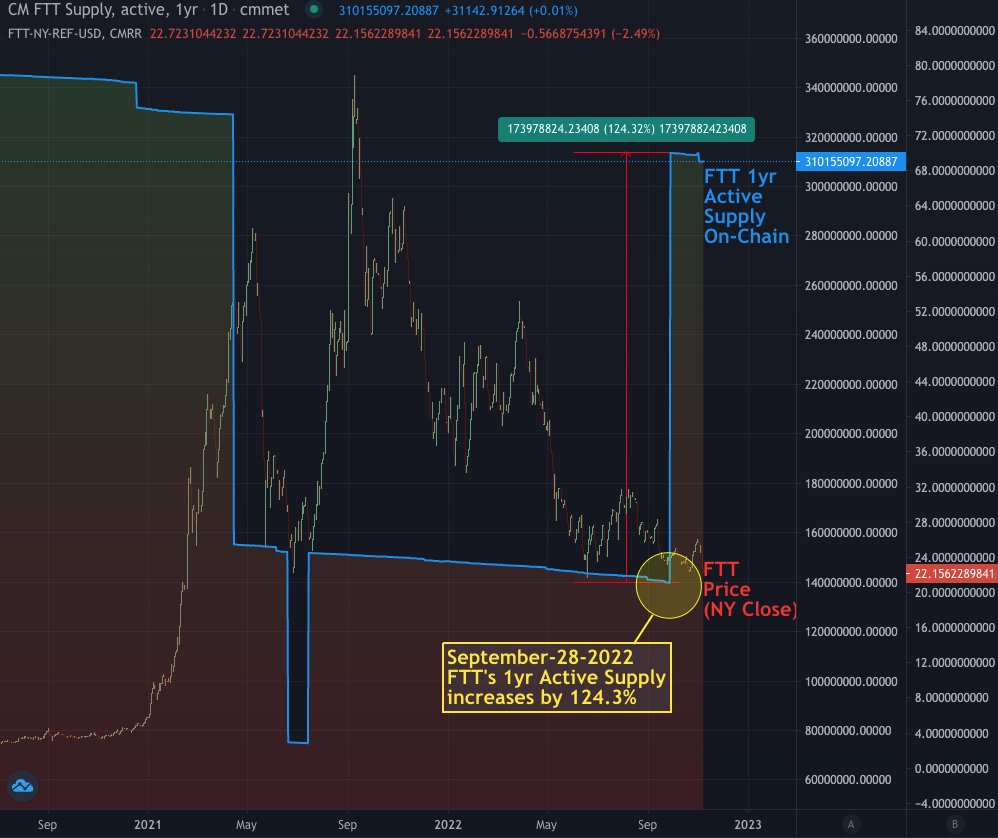
It has been reasoned by Lucas Nuzzi, CoinMetrics’ Head of R&D, that the collapse of the exchange may have stemmed from the blow up of 3AC and others in the second quarter of the year, and that around this time, Alameda was lent money by FTX to ensure its survival. Approximately 173 million FTT tokens (which were worth more than $4 billion at the time) were sent to Alameda in September from FTT’s Initial Coin Offering smart contract.


The old adage, “Not your keys, not your coins” has never been more relevant, and the FTX development underscores the importance of DEXes and the DeFi sector in general. In fact, Alameda had to pay off $13 million in MIM for its Abracadabra loans, since they would have faced liquidation if they didn’t because of the automated nature of DeFi.
FTX’s liquidity hole is estimated to be somewhere to the tune of ~$6 billion, with recent reports indicating that Binance may pass on the deal to save FTX, leaving its users in the dark. To fill this gap and repay creditors, Alameda may have to sell more of their crypto holdings and FTX may go through a lengthy bankruptcy case, just like Mt. Gox.
This Dune dashboard shows the firm’s estimated holdings (although they may have other unlabelled addresses with more funds in cold storage). Nevertheless, it’s clear that there could be a lot of selling pressure in the coming weeks for these tokens, with Alameda’s wallet mainly comprising USDC, BIT, WBTC, SUSHI, SRM and LDO.
Even outside of these tokens, a domino effect has been felt across the entire cryptocurrency market, with BTC falling to a fresh 2022 low beneath $17,000 and an increased risk of tighter regulations for crypto exchanges. A lot of details are still unclear, and it’s likely that this event will continue to weigh on the markets for some time.
November 10: US Consumer Price Index (13:30 UTC)
A higher than expected reading will be bearish for risk assets as it will put more pressure on the Fed to continue with their hawkish stance and raise interest rates at its next meeting.
November 20: Start of the FIFA World Cup
The football tournament could be a catalyst for CHZ, fan tokens for national football teams (like ARG and POR) and drive further adoption of the decentralized sports betting platform on Optimism, Overtime Markets. ALGO is another potential beneficiary, which has a partnership with FIFA.
November 23: FOMC minutes (18:00 UTC)
Investors will look for clues about the future course of monetary policy.
November 28: US Preliminary Annualized GDP for Q3 (13:30 UTC)
December 2: Non Farm Payrolls (13:30 UTC)
We want to hear your feedback and also hear what future topics you’d like to see in our monthly report. Contact us via Discord or Twitter.** **
Disclaimer: the contents of this report should not be taken as financial advice and is provided purely as market commentary. The information provided in this report is not intended to form the basis for making investment decisions and is presented here for educational purposes only. Please do your own research before participating in the crypto market, seek independent advice on crypto-assets and ensure you are aware of the risks involved.
Welcome to our market review for October, where we recap the biggest developments in the past month, provide some snapshots of the cryptocurrency markets and review the FTX contagion.
News Recap
Markets Snapshot
FTX Contagion Rattles Markets
Upcoming Events
Fed Raises Federal Funds Rate by 75 Basis Points Again on November 2nd
The benchmark interest rate was raised to 3.75%-4% and the central bank’s projections show that rates will reach a high of 4.75% in 2023.
JPMorgan Executes First DeFi Trade Using Public Blockchain
JPMorgan executed its first cross-border transaction using DeFi on the Ethereum Layer 2 network Polygon, which was facilitated by the Monetary Authority of Singapore’s Project Guardian. The transaction used a modified version of Aave’s smart contract code to explore potential DeFi applications in wholesale funding markets.
Reddit Users Created 3 Million Crypto Wallets to Scoop Up Polygon NFTs
Social media giant Reddit has brought at least 3 million new users into cryptocurrency through their collectible avatar NFTs since the series launched in July.
Art Gobblers Launches, Becomes One of the Most Popular NFT Collections
Art Gobblers, an NFT project launched by Rick and Morty creator Justin Roiland, launched on October 31st and has quickly become the second most popular collection on OpenSea, with 9,580 ETH in volume.
Record $760 Million Stolen During ‘Hacktober’
The amount of funds stolen from cryptocurrency projects rose to a record high in ‘Hacktober’ with the biggest losses coming from the BNBChain, Mango Markets and TempleDAO exploits. The total value of stolen funds in 2022 is almost at $3 billion, compared to just $1.5 billion last year.
Hong Kong Plans to Legalize Retail Crypto Trading to Become Hub
A planned mandatory licensing program for crypto platforms is expected to be put into place in March 2023 to allow retail trading. The regime for listing tokens will be similar to the approach taken for structured products, including criteria such as market value, liquidity and inclusion in third-party crypto indexes.
Vitalik Buterin tweeted an updated Ethereum roadmap on November 4th, detailing the way forward for the second largest cryptocurrency.
Fidelity’s Crypto Platform to Add Ether Trading for Institutional Clients
As of October 28th, institutional clients of Fidelity can now trade ETH after the asset management firm launched an Ethereum Index Fund for accredited investors in September.
SBF and Erik Voorhees debate crypto and DeFi regulation
FTX CEO Sam Bankman-Fried and ShapeShift founder Erik Voorhees engaged in a lively debate about cryptocurrency regulation and the Digital Commodities Consumer Protection Act (DCCPA) bill.
Layer 1 blockchain Aptos launches mainnet
After raising $150 million in July, former Meta employees launched the Layer 1 blockchain Aptos.
Elon Musk Completes Acquisition of Twitter, $DOGE and $MASK Soar
Dogecoin rose to a 5-month high on news that Elon Musk completed his acquisition of Twitter, sparking speculation that the social media platform could integrate DOGE. MASK, the native token of the Mask network, also saw massive gains following the news, jumping from above $1 to over $5.
Ethereum developers launch Shandong, the testnet for the upcoming Shanghai upgrade
The Shandong testnet was launched on October 17th to allow developers to test out the upcoming upgrades to the Ethereum protocol that will be put into place with the Shanghai, which is expected to go live sometime in 2023. A variety of Ethereum Improvement Proposals are being considered for inclusion, including EIP-4895, which will allow withdrawals of staked ETH from the Beacon chain.
The snapshot for markets on Perp v2 over October 9th to November 9th is displayed below:
Source: https://app.santiment.net/s/4N6KAI95 as of November 9th (14:30 UTC). Active addresses data unavailable for those with “-”.
Most markets are in the red over the past 30 days, with two exceptions: BNB (+8.29%) and MATIC (+11.93%). The largest declines were seen for SOL (-42.21%) and NEAR (-34.51%).
Trading volumes are up across the board with SOL, PERP and MATIC seeing the largest increases.
Looking at the wider market, the top 15 crypto-assets by volume growth and social volume growth between October 7th and November 7th are both shown below:
Source: Santiment; https://app.santiment.net/s/4wycaYih
WEMIX, a stablecoin created by the South Korean blockchain game developer Wemade, saw the greatest increase in trading volume of almost 1400% after launching on October 20th. The stablecoin is pegged to USDC and Wemade also launched WEMIX.Fi, a DeFi service to allow users to store, stake and swap Wemade’s crypto tokens.
Arweave’s AR token saw a 1125.2% gain in trading volume over the past 30 days, with the major catalyst being a collaboration with Meta for NFT storage.
FTX’s native token FTT saw a 831.2% gain in volume as revelations about the exchange’s balance sheet came to light.
IOTX, a token used as part of the IoTeX platform to link internet of things gadgets with decentralized apps, gained almost 800% in trading volume.
DOGE experienced a 420% gain in volume as Elon Musk took the reins at Twitter, sparking speculative frenzy over whether the social media platforms would integrate wallets for the memecoin.
Source: Santiment; https://app.santiment.net/s/4wycaYih
Stepn’s GMT saw the greatest gain in social volume out of the top 150 crypto-assets by market cap, recording a 954.1% rise, driven by the launch of the MOOAR NFT marketplace on Ethereum and Solana.
UNI also saw tremendous growth in social mentions, up 868.5%, on the back of news that Uniswap Labs raised $165 million in a Series B funding round. A community vote also favored launching the DEX on Ethereum’s zkSync Layer 2.
WEMIX also saw a large rise in social mentions, up 466.7%.
Exchange tokens have also been a hot topic during October, with HT and FTT both seeing social mentions rise more than 400% and 300% respectively. The rise in social mentions corresponds with a big jump in the price of HT, while FTT sparked a social buzz following the Voyager bankruptcy case and the move by a Texan securities regulator to scrutinize FTX.
Source: CoinMetrics
The MVRV for both Bitcoin and Ethereum are both below 1, suggesting a bottom is yet to play out. During October, the metric for Ethereum surpassed the threshold at 1, but with the FTX contagion, it has fallen back below this level. We’d want to see the MVRV move above one and out of the buy zone for confirmation that a long-term bottom is in, otherwise fresh lows for BTC and ETH are likely.
FTX rattled the markets and shocked the entire cryptocurrency ecosystem in recent days as it came to light that they had been secretly insolvent for quite some time. The downfall of FTX is one of the biggest shocks for crypto investors since the collapse of Mt. Gox in 2013, with the price of the platform’s native FTT token falling 75% in a single day on November 8th.
In a thrilling sequence of events that started with the founder of FTX, Sam Bankman-Fried (or SBF), lobbying Washington to get a bill passed that would benefit centralized exchanges but harm DeFi protocols ended up with SBF tweeting on November 8th that they’ve asked Binance to come in to help with the liquidity crunch.
On October 13th, Richard Chen of 1confirmation posted the following tweet. Little did anyone know that a few weeks later, SBF would announce that FTX had come to a strategic transaction with Binance to make its customers whole again.
Then in early November, reports from CoinDesk about FTX’s balance sheet revealed that Alameda, the sister market making firm of FTX, had $14.6 billion in assets mostly made up of FTT tokens ($5.8 billion) and illiquid Solana ecosystem tokens.
The exchange had seemingly loaned Alameda money using it’s FTT stake as collateral, which worked fine and allowed FTX to remain solvent, that is until the price of FTT was impacted by the following tweet from Binance’s CZ on November 6th:
The tweet precipitated a ‘bank run’ on FTX, with more than $750 million worth of assets flowing out of the exchange in the past week.
But with no new deposits and customers running for cover, FTX had to defend the price of FTT to avoid defaulting on their loans. The head of Alameda Trading offered to purchase the FTT tokens from Binance for $22, but just a day later, the price of FTT broke below this level and FTX paused withdrawals on their platform.
It has been reasoned by Lucas Nuzzi, CoinMetrics’ Head of R&D, that the collapse of the exchange may have stemmed from the blow up of 3AC and others in the second quarter of the year, and that around this time, Alameda was lent money by FTX to ensure its survival. Approximately 173 million FTT tokens (which were worth more than $4 billion at the time) were sent to Alameda in September from FTT’s Initial Coin Offering smart contract.
The old adage, “Not your keys, not your coins” has never been more relevant, and the FTX development underscores the importance of DEXes and the DeFi sector in general. In fact, Alameda had to pay off $13 million in MIM for its Abracadabra loans, since they would have faced liquidation if they didn’t because of the automated nature of DeFi.
FTX’s liquidity hole is estimated to be somewhere to the tune of ~$6 billion, with recent reports indicating that Binance may pass on the deal to save FTX, leaving its users in the dark. To fill this gap and repay creditors, Alameda may have to sell more of their crypto holdings and FTX may go through a lengthy bankruptcy case, just like Mt. Gox.
This Dune dashboard shows the firm’s estimated holdings (although they may have other unlabelled addresses with more funds in cold storage). Nevertheless, it’s clear that there could be a lot of selling pressure in the coming weeks for these tokens, with Alameda’s wallet mainly comprising USDC, BIT, WBTC, SUSHI, SRM and LDO.
Even outside of these tokens, a domino effect has been felt across the entire cryptocurrency market, with BTC falling to a fresh 2022 low beneath $17,000 and an increased risk of tighter regulations for crypto exchanges. A lot of details are still unclear, and it’s likely that this event will continue to weigh on the markets for some time.
November 10: US Consumer Price Index (13:30 UTC)
A higher than expected reading will be bearish for risk assets as it will put more pressure on the Fed to continue with their hawkish stance and raise interest rates at its next meeting.
November 20: Start of the FIFA World Cup
The football tournament could be a catalyst for CHZ, fan tokens for national football teams (like ARG and POR) and drive further adoption of the decentralized sports betting platform on Optimism, Overtime Markets. ALGO is another potential beneficiary, which has a partnership with FIFA.
November 23: FOMC minutes (18:00 UTC)
Investors will look for clues about the future course of monetary policy.
November 28: US Preliminary Annualized GDP for Q3 (13:30 UTC)
December 2: Non Farm Payrolls (13:30 UTC)
We want to hear your feedback and also hear what future topics you’d like to see in our monthly report. Contact us via Discord or Twitter.** **
Disclaimer: the contents of this report should not be taken as financial advice and is provided purely as market commentary. The information provided in this report is not intended to form the basis for making investment decisions and is presented here for educational purposes only. Please do your own research before participating in the crypto market, seek independent advice on crypto-assets and ensure you are aware of the risks involved.
AAVE (+67.23%), LINK (+34.83%) and NEAR (+34.41%) saw the greatest increase in social volume, while SAND experienced a 53% decline in social mentions. Both BTC and ETH saw a decline in social mentions, around -17% for each.
AAVE (+67.23%), LINK (+34.83%) and NEAR (+34.41%) saw the greatest increase in social volume, while SAND experienced a 53% decline in social mentions. Both BTC and ETH saw a decline in social mentions, around -17% for each.



No activity yet