

Over the past year, Pareto has continued to build and expand its credit infrastructure. TVL has grown beyond $180m, and the protocol now operates as an institutional credit platform with audited infrastructure, structured credit facilities, and live capital integrations
The market is now structurally ready for programmable credit. Stablecoin liquidity has reached a scale that can support institutional settlement, onchain data is increasingly usable as a monitoring layer, and regulatory trajectories are moving from ambiguity toward integration. The result: institutions are starting to treat blockchain rails as production infrastructure – and credit is becoming the next major asset class to migrate.
This roadmap outlines how we intend to build on that momentum - scaling institutional-grade, programmable private credit across cycles and across markets.
It’s only been three months of 2026, and we’ve already shipped several meaningful upgrades and integrations. Before we get into what’s ahead, here’s what’s already live and in production.
In 2025, Pareto and M11 Credit partnered with Morpho and Gauntlet to make FalconX Credit Vault tokens usable as collateral, turning credit exposure into a fully composable asset.
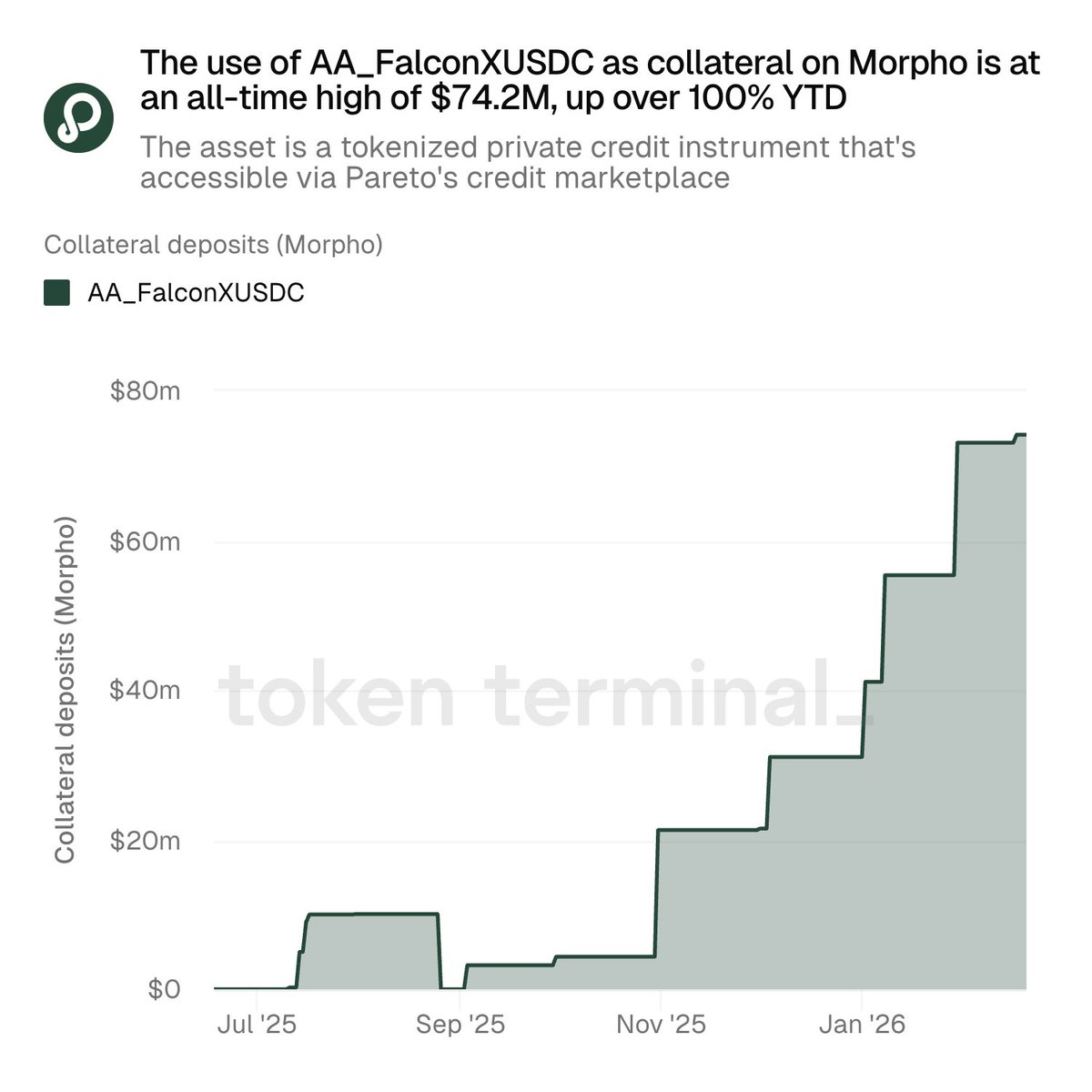
In 2026, FalconX CV tokens became one of the largest RWA collaterals on Morpho, with Gauntlet's Aera Vault accounting for most of that market through its levered strategy.


 The use of AA_FalconXUSDC as collateral on @Morpho is at an all-time high of $74.2M, up over 100% YTD.
The asset is a tokenized private credit instrument that's accessible via @paretocredit's marketplace.
A chart & development to follow

Starting with the RockawayX Credit Vault, we introduced callback and intra-cycle deposit features to increase flexibility in how our vaults operate.
Lenders no longer have to wait strictly for cycle boundaries to manage their capital, and borrowers benefit from more stable liquidity throughout the loan lifecycle.
This makes onchain credit facilities operationally smoother without compromising structure.
More flexibility for LPs, more predictability for borrowers, and fewer artificial liquidity cliffs between cycles.


LPs can now add liquidity or callback their deposits during an active loan cycle - giving LPs and borrowers more flexibility over capital!
What this means for LPs:
- Deploy capital mid-cycle, not just at rollover
- Start earning

The $PAR governance system smart contracts were successfully audited by Omniscia.
No major issues were detected, all medium-severity findings were fully resolved, and there are no outstanding remediation items. Governance logic, voting power mechanics, and snapshot functionality were reviewed and verified.
- All medium-severity findings fully fixed
- No outstanding remediation required
- Governance logic, voting power, and snapshots verified
Audited, hardened, ready for
With these milestones live, here’s what we’re building next.
We are actively developing a plug-and-play whitelabel credit stack for fintech lenders, neobanks, payment networks, and BNPL providers that want to launch private credit products without building lending infrastructure from scratch.
Partners keep the brand and the credit strategy. Pareto provides the underlying programmable credit rails, making it possible to launch and operate credit facilities in a repeatable way.
We’re designing the stack to fit institutional workflows. A dedicated SDK will streamline integration with existing systems and reduce time-to-launch. After integration, partners will receive access to a bespoke dashboard, where they will be able to set credit facility parameters (collateral types, interest rate models, liquidation thresholds), configure ongoing reporting (real-time, audit-ready reports), and use compliance tooling (automated KYC/AML checks to ensure full regulatory compliance across jurisdictions).
A fintech lender or neobank, that would previously have spent months building credit infrastructure, can now configure, simulate, and deploy a facility in days. The entry barrier for institutional credit products is no longer engineering capacity – it is credit judgment.
If this model aligns with your strategy, join the waiting list by contacting us at info@pareto.credit
The 'Stripe Moment' for Private Credit - Whitelabel Onchain Credit Infrastructure for Fintechs and Neobanks | Pareto
Onchain private credit is having its 'Stripe moment': demand is real, but the infrastructure is still fragmented. Launching a credit product still means building a lending stack from scratch. Pareto solves this with plug-and-play whitelabel onchain credit infrastructure built for: → Fintech lenders / credit platforms (e.g.

Pareto Studio is a platform on Pareto for designing, deploying, and managing onchain credit facilities on Pareto. It allows institutions to launch their own credit facility in minutes rather than building the infrastructure from scratch.
Through a visual configuration interface, partners will be able to structure and simulate credit facilities before deployment. Once finalized, facilities can be moved from testnet to mainnet with a 1-click deployment.
Built with an API-first architecture, Pareto Studio will easily integrate with existing backend systems and operational workflows, enabling credit products to be embedded directly into institutional stacks.
Unlike the whitelabel solution, which can be embedded directly into a partner’s branded stack, Pareto Studio will operate natively on Pareto as a facility design and deployment environment.
$PAR’s role is to align participants with long-term stakes in protocol quality. It is built so that commitment carries weight: longer-term participants receive stronger governance power, greater reward exposure, and a more meaningful role in shaping Pareto’s future. With vePAR (staked $PAR), liquidity, governance, and incentives are tied together by design:
$PAR Staking Model Announced & Updates Ahead of TGE
Over the past months, the Pareto community has been vocal about expectations around $PAR. The level of attention and feedback has been clear - and appreciated. It reflects how much conviction there is behind what we're building. At the same time, the last stretch of the market has been turbulent enough to remind everyone why rushing a token launch rarely pays off.

As the foundations need to be secure and resilient, the $PAR smart contracts have already been audited and hardened:
Omniscia Pareto Audit
A governance system implementation including staking and voting infrastructure.

We are also working on extending $PAR’s utility so that it plays an increasing role in aligning long-term incentives across lenders, borrowers, and curators within the Pareto ecosystem.
The next step is bringing $PAR into live circulation and activating the staking mechanics as designed. TGE is the near-term operational milestone, but the real objective is larger: to put in place a durable coordination layer that strengthens alignment across the Pareto ecosystem over the long term.
The next evolution of Credit Vaults’ oversight moves from periodic reporting to continuous monitoring: automated covenant checks, standardized financial reporting, and real-time alerts triggered against agreed limits. As the protocol grows, reporting and oversight will evolve into a more advanced and standardized layer.
This means enhancing reporting standards and refining how agreed limits and covenants are tracked within each facility. The ultimate goal is real-time, continuous monitoring. That means standardized reporting, automated covenant and limit checks, and verification that becomes more distributed and transparent as the protocol scales.
Warehouse-style Credit Vaults will work like revolving credit lines against a pre-set, live portfolio of loans. As assets enter and exit the pool, the borrowing base will recalculate available capacity and keep terms within defined limits. All backed by continuous reporting, enabling ongoing origination under one credit program instead of structuring a new loan each time.
More detail on structure, terms, and liquidity mechanics will be shared once finalized.
At Pareto, curators underwrite named borrowers, monitor reporting, and sit within the legal structure of each Credit Vault, representing lenders when needed. @M11Credit currently acts as an independent credit curator on the platform, demonstrating how this model operates in practice.
Expanding the curator base increases underwriting capacity, strengthens oversight, and reduces reliance on any single party. As the protocol grows, scaling independent credit assessment and monitoring remains essential to maintaining discipline across facilities.
Read more on our approach to credit curatorship:
Strategy Curators vs Credit Curators. The Difference That Matters | Pareto
"Curator" in DeFi usually refers to a strategy manager. They optimise collateral, leverage, and overall yield strategy. But there's another side to it. Credit curators operate within the credit and legal stack. They underwrite specific credit facilities, oversee borrowers, and give liquidity providers the transparency to decide where to allocate their capital.

Along with onboarding new curators, we’ll expand our Credit Vaults to additional blockchains. This will allow us to access new liquidity pools, integrate with broader DeFi ecosystems, and meet institutional partners where they already operate.
We continuously monitor market conditions and collect feedback from our institutional partners. Not every initiative is ready to be shared publicly, and priorities may evolve as new opportunities emerge or certain paths prove less relevant.
The roadmap is directional, not static. Our focus is to further expand our institutional-grade credit infrastructure, onboard new partners, increase Pareto’s presence in onchain private credit, and continuously strengthen product-market fit.
In 2025, more institutions began treating onchain infrastructure as a serious venue rather than a side experiment. 2026 and the years beyond should accelerate that direction: more capital moving onchain, more credit becoming programmable, and a steadily narrowing divide between TradFi and DeFi. If this trajectory continues, the outcome will not be two parallel systems, but a single market operating on shared standards and stronger infrastructure.
The question is not whether private credit moves onchain. The question is whether the infrastructure that carries it is built to institutional and enterprise standards.
That is what Pareto is for.