L2 MEV wat
Special thanks to Nikete Della Penna, RJ, Matthew Finestone, and Brecht Devos for review and valuable insights.TLDRIn this article, we “map” the current landscape of L2 MEV, thinking about different MEV consequences for different L2 designs. We also briefly overview different ways of L2s decentralization and how it might impact L2 MEV.Wat is MEVDisclaimer: feel free to skip if you are familiar with MEV. For a detailed MEV explanation, check the article “Ethereum is a dark forest” by Paradigm ...

Wrapping Up Season 6, Trailblazer Role and the Road Ahead

Eldfell L3 (alpha-4) is live!
Taiko’s fourth testnet has arrived! Eldfell L3 (alpha-4) is our first experiment with inception layers and a new staking based proving design. We are launching this testnet in order to test two things:Deploying Taiko on Taiko as an L3 inception layer (a rollup on a rollup 😏)Testing a new staking based prover economicsOur alpha-N releases are always experiments to test our hypothesis on the protocol and build a more robust system. So let's dive in!Inception layersInception layers are a n...
>52K subscribers

Decentralization is the backbone of Taiko. We are proud to take the next step and share our DAO design with the community. In an important step towards decentralizing Taiko's decision making, we have collaborated with Aragon to build the Taiko DAO. Now it’s deployed on Hekla Testnet.
A multi-threshold multisig system handles both standard and emergency situations:
Standard multisig for normal proposal flow.
Emergency multisig for urgent actions, requiring higher approval threshold.
The Security Council members creates and approves proposals.
Delegates and token holders can veto proposals during a review period.
Anyone can become a delegate if they gather any amount of token stakes.
Proposals that don't reach the veto threshold by the end of the period will be executed with a delay of 7 days (timelock).
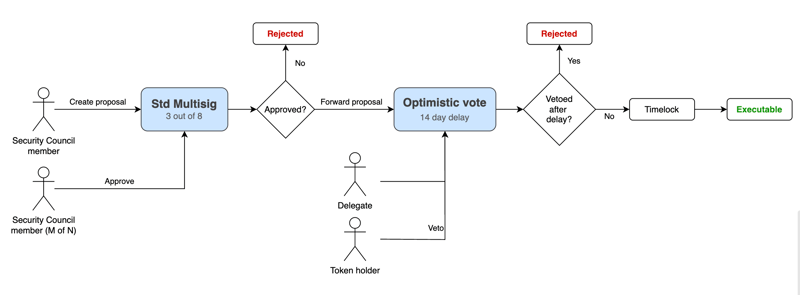
Proposals are submitted by Security Council members. This means that proposers who are not members of the Security Council must approach at least one member of the Security Council in order to make a proposal.
Proposals enter a veto period. During this time, token holders and delegates can review the proposal and vote on-chain to veto it if they disagree.
Once the proposal passes the veto stage, it goes into a 7-day timelock period before execution, in order to give community members the opportunity to exit if needed.
Once the proposal passes both the veto stage and timelock, it is automatically executed, that's why we call it "optimistic". This mechanism ensures the balance between speed and safety.
The standard multisig serves as the path for proposal development in Taiko DAO.
Any member of the Security Council can submit a new proposal through this channel to start the governance process.
Once a proposal reaches a predetermined level of support among Council members, it won't be implemented immediately. Instead, it's sent to Token Voting, where it becomes available for review by the community. The delay gives the broader community a chance to engage in the decision-making process.
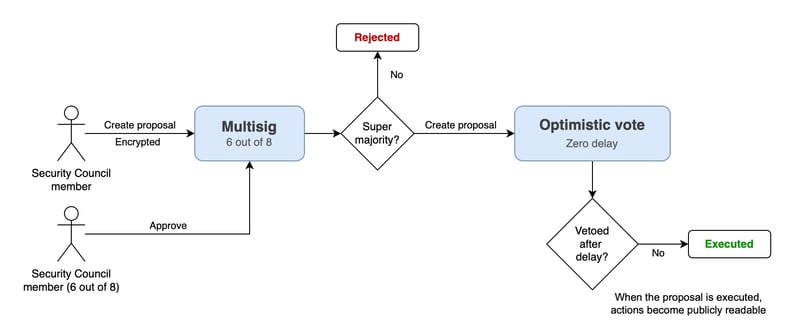
This mechanism is reserved for situations that require immediate action, such as addressing critical vulnerabilities.
While any Council member can submit proposals through the emergency channel, a supermajority of Council members is required for approval.
To maintain transparency and accountability, all details of executed Emergency Proposals are encrypted, and become public once they've been implemented. So when the Council makes a protocol upgrade to fix a vulnerability, it can't be exploited.
We will announce the members of the Security Council at a later date. For more details on the DAO design, see the Github repo here.
We will announce the members of the Security Council at a later date. For more details on the DAO design, see the Github repo here.
Token holders and delegates play a crucial role in Taiko's governance through our veto mechanism. During the veto period, token holders have two options:
Use their tokens to vote directly against proposals they disagree with.
Delegate their voting power to trusted community members who can vote on their behalf.
It's important to remember that anyone can become a delegate if they have votes/token stakes. We strongly encourage our community members to become delegates.
It's worth noting that TAIKO tokens on L2 cannot be used to veto, but this is part of our future plan to allow vetoing directly on Taiko.
We're building something exciting with Taiko DAO, and we want you to be a part of it. Your voice matters, whether you're an expert or just starting out. If you're an Ethereum aligned team with no conflicts of interest and are interested in joining our Security Council, please contact us.
Join our Discord, participate in discussions, or simply share your thoughts on our proposed design from Github. Every idea counts, and your unique perspective could help make Taiko DAO even better.
Get the latest from Taiko:
Website: https://taiko.xyz.
Discord: https://discord.gg/taikoxyz.
GitHub: https://github.com/taikoxyz.
Twitter: https://twitter.com/taikoxyz.
Community forum: https://community.taiko.xyz.
Youtube: https://www.youtube.com/@taikoxyz.
Warpcast: https://warpcast.com/taikoxyz.
Contribute to Taiko on GitHub and earn a GitPOAP! You will also be featured as a contributor on our README. Get started with the contributing manual.

Decentralization is the backbone of Taiko. We are proud to take the next step and share our DAO design with the community. In an important step towards decentralizing Taiko's decision making, we have collaborated with Aragon to build the Taiko DAO. Now it’s deployed on Hekla Testnet.
A multi-threshold multisig system handles both standard and emergency situations:
Standard multisig for normal proposal flow.
Emergency multisig for urgent actions, requiring higher approval threshold.
The Security Council members creates and approves proposals.
Delegates and token holders can veto proposals during a review period.
Anyone can become a delegate if they gather any amount of token stakes.
Proposals that don't reach the veto threshold by the end of the period will be executed with a delay of 7 days (timelock).

Proposals are submitted by Security Council members. This means that proposers who are not members of the Security Council must approach at least one member of the Security Council in order to make a proposal.
Proposals enter a veto period. During this time, token holders and delegates can review the proposal and vote on-chain to veto it if they disagree.
Once the proposal passes the veto stage, it goes into a 7-day timelock period before execution, in order to give community members the opportunity to exit if needed.
Once the proposal passes both the veto stage and timelock, it is automatically executed, that's why we call it "optimistic". This mechanism ensures the balance between speed and safety.
The standard multisig serves as the path for proposal development in Taiko DAO.
Any member of the Security Council can submit a new proposal through this channel to start the governance process.
Once a proposal reaches a predetermined level of support among Council members, it won't be implemented immediately. Instead, it's sent to Token Voting, where it becomes available for review by the community. The delay gives the broader community a chance to engage in the decision-making process.
This mechanism is reserved for situations that require immediate action, such as addressing critical vulnerabilities.
While any Council member can submit proposals through the emergency channel, a supermajority of Council members is required for approval.
To maintain transparency and accountability, all details of executed Emergency Proposals are encrypted, and become public once they've been implemented. So when the Council makes a protocol upgrade to fix a vulnerability, it can't be exploited.
We will announce the members of the Security Council at a later date. For more details on the DAO design, see the Github repo here.

We will announce the members of the Security Council at a later date. For more details on the DAO design, see the Github repo here.
Token holders and delegates play a crucial role in Taiko's governance through our veto mechanism. During the veto period, token holders have two options:
Use their tokens to vote directly against proposals they disagree with.
Delegate their voting power to trusted community members who can vote on their behalf.
It's important to remember that anyone can become a delegate if they have votes/token stakes. We strongly encourage our community members to become delegates.
It's worth noting that TAIKO tokens on L2 cannot be used to veto, but this is part of our future plan to allow vetoing directly on Taiko.
We're building something exciting with Taiko DAO, and we want you to be a part of it. Your voice matters, whether you're an expert or just starting out. If you're an Ethereum aligned team with no conflicts of interest and are interested in joining our Security Council, please contact us.
Join our Discord, participate in discussions, or simply share your thoughts on our proposed design from Github. Every idea counts, and your unique perspective could help make Taiko DAO even better.
Get the latest from Taiko:
Website: https://taiko.xyz.
Discord: https://discord.gg/taikoxyz.
GitHub: https://github.com/taikoxyz.
Twitter: https://twitter.com/taikoxyz.
Community forum: https://community.taiko.xyz.
Youtube: https://www.youtube.com/@taikoxyz.
Warpcast: https://warpcast.com/taikoxyz.
Contribute to Taiko on GitHub and earn a GitPOAP! You will also be featured as a contributor on our README. Get started with the contributing manual.

L2 MEV wat
Special thanks to Nikete Della Penna, RJ, Matthew Finestone, and Brecht Devos for review and valuable insights.TLDRIn this article, we “map” the current landscape of L2 MEV, thinking about different MEV consequences for different L2 designs. We also briefly overview different ways of L2s decentralization and how it might impact L2 MEV.Wat is MEVDisclaimer: feel free to skip if you are familiar with MEV. For a detailed MEV explanation, check the article “Ethereum is a dark forest” by Paradigm ...

Wrapping Up Season 6, Trailblazer Role and the Road Ahead

Eldfell L3 (alpha-4) is live!
Taiko’s fourth testnet has arrived! Eldfell L3 (alpha-4) is our first experiment with inception layers and a new staking based proving design. We are launching this testnet in order to test two things:Deploying Taiko on Taiko as an L3 inception layer (a rollup on a rollup 😏)Testing a new staking based prover economicsOur alpha-N releases are always experiments to test our hypothesis on the protocol and build a more robust system. So let's dive in!Inception layersInception layers are a n...
Share Dialog
Share Dialog
No comments yet