

The highly anticipated release of GLM5 and Mini Max 2.5 were the big highlights this week . ByteDance also released Seedance 2.0 though indiciations are that currently that is accessible only within China. Some discussion from a member on productivity gains he made after switching to a dictation tool Wispr Flow which I had suggested to him.
There was also Matt Shumer's long post which went viral
In the non-AI world, two major events happening in the following week based on lunisolar cycle hence the relevant imagery used in the banner (prompt and model used is at the end of this newsletter).
To those who celebrate Chinese/Korean/Vietnamese New Year wishing you the appropriate salutations for each of the regions and for those who observe the month of Ramadan, I would like to say "Ramadan Mubarak and humbly request remembrance in your prayers"
Readers who think others in their family, friends and acquaintances who are curious in knowing more about rapidly evolving AI tools/services/use cases and would benefit from being subscribers of this weekly newsletter are encouraged to share this publication link to them and invite them to subscribe
The following messages were posted on the 'All Things AI' Telegram group from Sunday 8th Feb 2026 to Saturday 14th Feb 2026
1 | From serial entrepreneur Furqan Rydhan, founder of Thirdweb and Founders Inc comes Nebula Think of it as a form of hosted openclaw (except I don't believe that its using openclaw) underneath Currently free in early access Nebula - Your Super AgentTell Nebula what you need done. It creates agents, builds workflows, manages files, and connects APIs. All from conversation. No coding required. 
I built Nebula for myself.
Work is too messy, there's a lot to do and things are everywhere. The goal was to give myself an army of highly intelligent specialized workers to let me accomplish more. Now Nebula is handling my email, calendar, summarizing slack, kicking off work 
nebula.gg
Nebula - Your Super AgentAn AI employee that manages your inbox, syncs your tools, and automates your workflows. Running 24/7 so you don't have to. |
2 | via Furqan Rydhan Thanks for posting! Think of it like a slack filled with highly autonomous agents that get things done. It’s in early access but already very powerful. Can connect to any service + implement any api. Has its own file system, trigger system, sub agents and code execution. |
3 | via Anthropic — Our teams have been building with a 2.5x-faster version of Claude Opus 4.6. We’re now making it available as an early experiment via Claude Code and our API. We granted all current Claude Pro and Max users $50 in free extra usage. This credit can be used on fast mode for Opus 4.6 in Claude Code. https://code.claude.com/docs/en/fast-mode
We granted all current Claude Pro and Max users $50 in free extra usage. This credit can be used on fast mode for Opus 4.6 in Claude Code.
To use, claim the credit and toggle on extra usage on claude.ai/settings/usage. Then, run `claude update && claude` and `/fast`. Enjoy!
Anthropic is charging 6x more per token to deliver 2.5x faster output, and developers will pay it without blinking.
The math: standard Opus 4.6 runs $5/$25 per million tokens. Fast mode runs $30/$150. A 6x premium. The 50% discount through February 16 exists to calibrate demand, |
4 | via Robby Yung Nice map of Google’s AI ecosystem.
Google isn’t trying to win the AI race.
They’re trying to own the entire AI Agent ecosystem. While everyone argues ChatGPT vs Claude, Google quietly built: Models → Gemini Pro, Flash, Deep Think, Gemma Design → Stitch, Whisk, Imagen Research → NotebookLM, AI Mode Video 
|


1 | Steve Yegge writes about Anthropic’s culture. Nothing concrete, mostly vibes. He says it has that early Google/Amazon lightning in a bottle energy. https://steve-yegge.medium.com/the-anthropic-hive-mind-d01f768f3d7b |
2 | via Kevin Dent in response to Robby Yung message on 8th Feb === I don’t think there will be any absolutes in the agent race. I don’t even think it’s going to be a race. The way I look at agents right now is that they started off as children, and in doing so essentially started life on a learned experience. Now those children are young adults; ChatGPT is the fun one, Claude is the nerd, Gemini is the high potential student, but sometimes they burn down the lab. I also don’t believe in tech absolutes, browsers are a great example. I started off using Netscape! It was amazing until it wasn’t. Then I moved to IE, once again MSFT followed the pack and it was amazing, until it wasn’t. On and on it went with browsers such as Firefox, Chrome, dark web browsers etc. Much like iPhone iterations now, they all feel the same. My theory is that agents will become something similar to our social circle. There will be agents much like friends that we ask relationship advice and those that we ask for advice on fixing the dishwasher. |
3 | 33-page guide on how to build skills in Claude from Anthropic https://resources.anthropic.com/hubfs/The-Complete-Guide-to-Building-Skill-for-Claude.pdf |
1 | The various X tweets/threads have jaw dropping visuals ByteDance's Seedance 2.0 Generates Hyper-Real AI Videos in China ByteDance released Seedance 2.0 in beta on its Jimeng AI platform, allowing users to create 1080p video clips from prompts, images, or audio, with consistent characters, multi-shot stories, and even edits to swap actors or backgrounds. Demos range from Dragon Ball Z live-action fights and Arcane-style chases to realistic war scenes and dance videos that have drawn millions of views. While creators celebrate the tool's physics and rhythm mastery, filmmakers worry it threatens VFX jobs and raises deepfake and IP concerns access remains China-only for now. |
2 | via Fares Hey, I just wrote an article on OpenClaw let me know what you think |
3 | via Prashish Hey everyone, wrote an article breaking down the architecture of a framework for multi agent collaboration: routing, memory, context sharing, and delegation. I hope this is helpful: How AI Agents Collaborate: A Framework ArchitectureNote: This article is part of an ongoing AI-assisted development series (/ai). In keeping with the subject matter, all the code for this system was written by Claude Opus 4.6 while I provided the ...  |

1 | From Thomas Dohmke, former CEO of Github — The purpose of our new co mpany Entire is to build the world's next developer platform where agents and humans can collaborate, learn, and ship together. A platform that will be open, scalable, and independent for every developer, no matter which agent or model you use. Our vision is centered on three core components: 1) A Git-compatible database that unifies code, intent, constraints, and reasoning in a single version-controlled system. 2) A universal semantic reasoning layer that enables multi-agent coordination through the context graph. 3) An AI-native user interface that reinvents the software development lifecycle for agent–human collaboration.
tl;dr Today, we’re announcing our new company @EntireHQ to build the next developer platform for agent–human collaboration. Open, scalable, independent, and backed by a $60M seed round. Plus, we are shipping Checkpoints to automatically capture agent context.
In the last three
Beep, boop. Come in, rebels. We’ve raised a 60m seed round to build the next developer platform. Open. Scalable. Independent. And we ship our first OSS release today.
entire.io/blog/hello-ent… Hello Entire World · Entire BlogAnnouncing Entire with $60 million seed round and shipping our first product, called Checkpoints.  |
2 | via Robby Yung Great article about Amanda Askell, Anthropic’s philosopher in residence. |
3 | via Robby Yung Nothing has launched a vibe coding app creation interface natively within their OS -
Create apps shaped exactly around your specific needs and context.
That's what Essential Apps are. You describe what you need. AI builds it. It appears on your phone's home screen, ready to use. One billion apps for one billion people. Beta starts today on Nothing Playground. 
|
4 | via Robby Yung Instaclaw from Virtuals:
Most AI agent platforms give you a chatbot in a shared container and call it a day.
InstaClaw gives every agent its own machine, its own crypto wallet, and a job waiting for it on day one. Here's what we built. ↓ 
|


1 | Zhipu AI Launches GLM-5, Top Open-Source Model for Coding and Agents The 744 billion parameter mixture-of-experts model activates only 40 billion per use, trained on 28.5 trillion tokens with a 200,000-token context window. It tops open-source benchmarks like 77.8% on SWE-bench Verified for coding and leads agent leaderboards, matching closed models like Claude Opus. Available now on chat.z.ai for subscribers, with open weights on Hugging Face under MIT license and low pricing on OpenRouter at $0.80 per million input tokens.
GLM-5 places 1st on the KingBench Agent Leaderboard
and 3rd on KingBench (private coding benchmark) 
I have been testing GLM-5 for the last few weeks. It beats Opus 4.6 and Claims #1 spot on my agentic coding benchmarks (leaderboard in video & threads). Here's the video of all my thoughts and testing: youtube.com/watch?v=63Ail-…
GLM-5 scores higher than Gemini 3 Pro on the Artificial Analysis Intelligence Index
GLM-5 is now the open-weight model with the highest score 
Pony Alpha Stealth model reveal: GLM-5 from @Zai_org
GLM-5 is a new 744B foundation model for coding and agentic usecases. It achieves SOTA scores on top agent benchmarks, and has been used successfully in many agent flows during its Stealth period. Live now on OpenRouter! |
2 | xAI has just publicly posted the full 45 minute all-hands meeting that Elon Musk had with employees recently. An X poster asked grok to provide highlights of this meeting in bullet points which I'm sharing below ==== - xAI's rapid progress: #1 in voice/image/video gen, forecasting; 1M GPU equivalents; Grokkopedia to surpass Wikipedia. - Reorg into Grok (main/voice), Coding (self-improving), Imagine (multimodal), Macro Hard (company emulation). - Voice: From zero to leader in 1 year; integrated in 2M+ Teslas. - Coding: Aiming for SOTA in 2-3 months; direct binary creation. - Imagine: #1 in 6 months; 6B images/month; real-time video soon. - Infra: Massive Memphis cluster; orbital/moon data centers planned. - X app: 1B+ users; payments, chat open-sourcing; space exploration for universe understanding. ==== |


1 | It's raining models particularly from Chinese labs in the runup to Chinese New Year MiniMax releases M2.5, claiming the model delivers on the “intelligence too cheap to meter” promise M2.5 tops benchmarks like 80.2% on SWE-Bench Verified for GitHub issues and 76.3% on web navigation, edging out rivals like Claude Opus in their tests—though independent leaderboards await updates. Its Mixture-of-Experts design activates just 10 billion of 230 billion parameters per run, slashing costs to $0.30 per million input tokens and enabling cheap, always-on agents.
Introducing M2.5, an open-source frontier model designed for real-world productivity.
- SOTA performance at coding (SWE-Bench Verified 80.2%), search (BrowseComp 76.3%), agentic tool-calling (BFCL 76.8%) & office work. - Optimized for efficient execution, 37% faster at complex 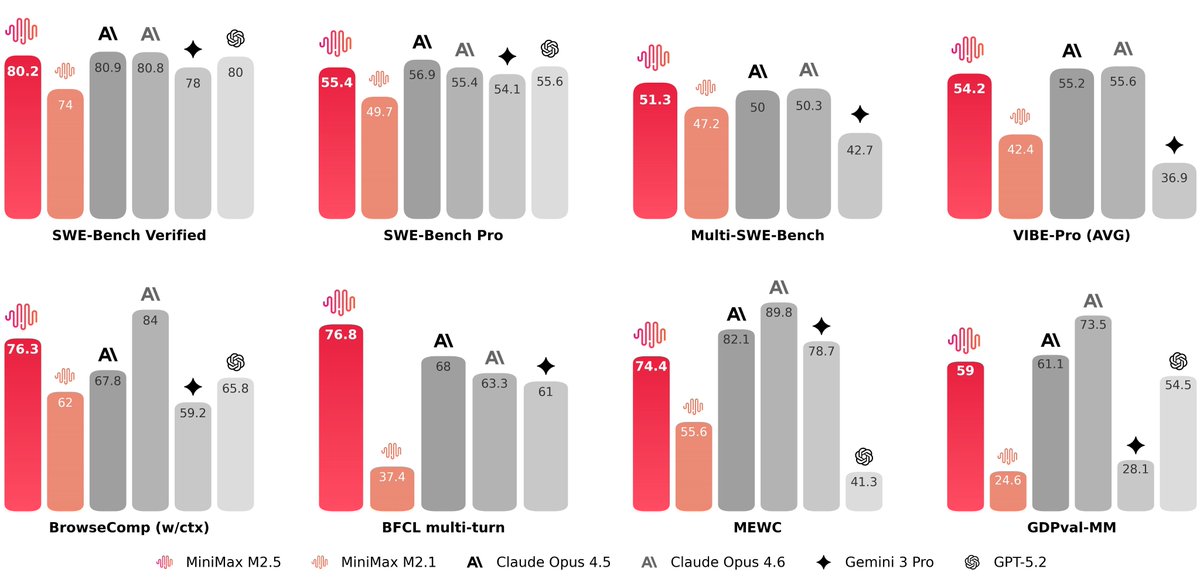
With M2.5 we're also shipping MiniMax Experts.
general agents sound nice until you realize they don't know your stack, your domain, or how you actually work. now you can build experts that do. share yours, grab others'. community already made: clawbot assistant, crypto trading  Meet Expert Collection from MiniMax Agent Meet Expert Collection from MiniMax AgentA team of specialized AI experts — office productivity in docs, Excel, PDFs & slides, finance in research & McKinsey-style decks, and coding — working together inside MiniMax Agent. Test directly with our showcase queries or bring 
MiniMax M2.5 is live now on OpenRouter!
@MiniMax_AI's update to their powerful agentic model M2.1 comes with improved reliability and performance on long running tasks. It's become a powerful general agent, capable of much more than writing code.  Meet Expert Collection from MiniMax Agent Meet Expert Collection from MiniMax AgentA team of specialized AI experts — office productivity in docs, Excel, PDFs & slides, finance in research & McKinsey-style decks, and coding — working together inside MiniMax Agent. Test directly with our showcase queries or bring
|
2 | via Tom Ho === I am skeptical of the benchmark cuz I am also a user of Kimi , Qwen and GLM along side with Claude, openAI and Gemini models When I tried glm 4.7 with incredible benchmarks it didn’t seem to perform as well as I had hoped in cursor. But I didn’t try it inside Claude code, it may be the toolset optimization. Claude opus and sonnet just seem to perform much better for programming |
3 | via Mau Codex 5.3 is pretty on par with opus 4.6 for coding from my experience. It’s faster too, can read bigger codebases rather quickly |
4 | Google Chrome Ships WebMCP - Major Breakthrough for AI Agents Google and Microsoft jointly launched WebMCP (Web Model Context Protocol) in Chrome 146 Canary. This proposed web standard lets any website expose structured, callable tools directly to AI agents through a new browser API (navigator.modelContext). This could be the "USB-C of AI agent interactions" - replacing expensive screen-scraping and DOM parsing with single structured tool calls. Dan Petrovic called this the biggest shift in technical SEO since structured data. Glenn Gabe called this a big deal. WebMCP is available for early preview | Blog | Chrome for DevelopersWebMCP aims to provide a standard way for exposing structured tools, ensuring AI agents can perform actions on your side with increased speed, reliability, and precision.  Google Chrome Releases Early Preview Of WebMCPThe Google Chrome team announced its early preview of WebMCP, "a standard way for exposing structured tools, ensuring AI agents can perform actions on your side with increased speed, reliability, and precision," André Cipriani Bandarra from Google wrote. 
WebMCP seems to be a very much needed tool for the web to stop agents scraping and guessing content and allowing maintainers to point them to where they need to go instead. developer.chrome.com/blog/webmcp-epp
Tomorrow I am hosting two of the team on Coffee With Developers to learn more. 
developer.chrome.com
WebMCP is available for early preview | Blog | Chrome for DevelopersWebMCP aims to provide a standard way for exposing structured tools, ensuring AI agents can perform actions on your side with increased speed, reliability, and precision. |
5 | via Fazri Zubair I would concur that Codex 5.3 is another level better. I've been using it for the last few days here and it is a marked improvement over 5.2 which was my go-to choice for most of my coding tasks with Opus for Planning. I might just stick with 5.3 for both Planning and Execution of my tasks. |
6 | via Fazri Zubair  On another note, Yusuf introduced me to dictation-based prompting and I’ve been using Wispr Flow for emails, messages, and prompting my AIs for coding tasks this week. I was honestly skeptical at first because I’m pretty old-school and prefer typing, but I’ve seen a noticeable improvement in my workflow. The dictation tech is way better than I expected. What I really like is how it uses AI to auto-correct intelligently. If I change my mind mid-sentence or say “actually replace that with this,” it understands the intent and cleans it up in the final output. That’s been surprisingly powerful. It’s significantly increased my productivity this week. I’m planning to roll this out to my engineers as well. It’s a great way to improve both productivity and accuracy when working with AI models. You speak faster than you can type. 150+ words per minute is easily hit using this method. |
7 | For those regularly switching 'harnesses' or working on a repo with different teammates using different 'harnesses', do watch out for subtletlies in making sure you know where your harness is picking up skills wrt directory locations. Whilst there is a movement to standardize towards .agent/skills as the canonical location, Anthropic as of now still uses .claude/skills. Read docs and talk to developers of your agent harness as to what is the current canonical location and if there are fallbacks Sometimes what you think of as an IDE may have an implicit harness. Cursor, Kilo Code, Cline are examples such products that come to mind  Open call to agent builders: Let's read agent skills from `.agents/skills`, so people don't have to manage separate folders per agent. Open call to agent builders: Let's read agent skills from `.agents/skills`, so people don't have to manage separate folders per agent.Today we pulled the trigger for Codex to read `.agents/skills`. Goal is to deprecate `.codex/skills`. Pls like/tag/RT for momentum.
Guys, I think it's finally going to happen!
All AI agents should use the ".agents/skills" directory. Kudos to @AmpCode, @OpenAI, @geminicli, @github , @Kimi_Moonshot, and @opencode! If you work for one of the companies that is NOT using the standard, make sure you push for this  Agent SkillsGive Codex new capabilities and expertise  https://github.com/agentskills/agentskills/issues/15#issuecomment-3813596535 One can also use a tool such as rulesync to keep things aligned |


Below is my personal website which aggregates links to many of my socials as well as the various content and community that I curate. Feel free to share this link to others who you think may find this content/community useful to them
The cover image of this newsletter via generated via the Google Nano Banana Pro model within the Freepik tool via the following prompt
Hyper-detailed A surreal, mesmerizing depiction of a massive purple full moon dominating the night sky, its surface glowing with intricate, textured patterns that seem almost alive. The moon radiates a warm, ethereal light, surrounded by dramatic dark clouds with luminous silver linings, creating an otherworldly and mystical atmosphere.