
The recent events within DeFi have shown that yield-bearing stablecoins must balance transparency, solvency and risk control. Many models rely on black box strategies, unverified collateral or directional exposure that creates vulnerabilities during volatile market conditions. The market has consistently demonstrated a need for a stable asset with verifiable backing and a predictable yield profile that does not depend on token emissions or market direction.
Unitas was created with that premise in mind. The protocol issues USDu, a digital dollar built with verifiable collateral, hedged market exposure and institutional custody. USDu combines stability with a yield strategy designed to operate through any market conditions. The architecture is built around transparency, predictable mechanics and risk-controlled execution.
This article provides a detailed overview of the Unitas protocol, explaining how collateral is utilized, how USDu and sUSDu operate, and how yield is generated through market-neutral mechanics, even during low funding rate periods. It also outlines the transparency framework that ensure users can verify solvency and understand how the system behaves under market stress.
USDu is a digital dollar issued by Unitas. It is supported by a delta-neutral strategy using JLP as its primary collateral. JLP is the liquidity provider token for the Jupiter Perps platform. It consists of a diversified mix of SOL, ETH, BTC and USDC. The pool earns revenue from swap fees, trade execution fees and liquidations within the platform. Because JLP captures real trading activity, it provides a revenue stream that is not dependent on market conditions.
Despite its low risk design, JLP still holds market exposure to the underlying assets. To remove this directional risk, Unitas opens perpetual short positions that mirror the asset composition of JLP. This hedging process offsets spot long exposure by shorting the derivatives of the volatile assets. The result is a market neutral position that earns fee revenue without relying on price appreciation.
This design allows USDu to maintain a $1 value while benefiting from market activity that generates revenue from the Jupiter Perps platform. The yield comes from trading volume, liquidations and perp usage, which makes the yield independent of market conditions and based on actual trader activity.
Learn more about JLP: https://support.jup.ag/hc/en-us/sections/18430416902812-Jupiter-Liquidity-Provider-JLP
Acquiring USDu involves several components working together: a DEX liquidity pool, the Fund Vault, JLP acquisition, CEFFU custody, perpetual hedging and the multisig wallet that holds JLP onchain.
Most users do not mint USDu directly. Minting is restricted to whitelisted addresses to ensure orderly collateral management. Regular users acquire USDu through swaps on the Unitas app (powered by the LI.FI widget), or directly on Orca, which is the primary liquidity endpoint.
Acquire USDu on our app now: https://app.unitas.so/buy

When regular swap liquidity is insufficient, or when a whitelisted participant wants to deposit into the protocol without slippage, USDu is minted directly. Whitelisted addresses are the only parties permitted to mint or redeem USDu.
The USDC used to mint new USDu enters the asset flow outlined below, where it is usd to acquire JLP, which is hedged on perpetuals as part of the underlying strategy.
When a whitelisted participant mints new USDu, the USDC they supply is routed into the asset flow.
A portion of that USDC (~80%) is sent from the Fund Vault to a DEX and used to acquire JLP tokens. The acquired JLP is transferred into a multisig wallet, where it acts as main collateral that backs USDu.
JLP generates revenue from:
Swap fees
Liquidation fees
Price impact from trades executed on Jupiter Perps
Underlying assets appreciating in value
This revenue stream forms the main portion of the sUSDu yield.
The remaining USDC (~20%) is sent to CEFFU custody. CEFFU mirrors the balance to the protocol’s Binance sub-account through MirrorX. The USDC never leaves the custodian; MirrorX allows margin posting while remaining segregated from the CEX account.
This capital is used as margin collateral for short perpetual futures positions. These shorts offset the long exposure of JLP. Hedging typically operates at 2x to 4x leverage. If leverage approaches internal thresholds, the system receives alerts and increases margin to maintain safe hedging ratios.
Whitelisted addresses mint USDu by depositing USDC
The USDC used for minting is sent to the Fund Vault
From there, USDC is split into purchasing JLP and hedging it
The perpetual positions offset JLP’s price exposure
Yield is produced through the combination of JLP revenue and funding rate payments
The multisig holds the JLP collateral onchain
CEFFU and MirrorX maintain segregated custody for hedge margin
The yield is deposited into the staking contract, increasing sUSDu's value

The recent events within DeFi have shown that yield-bearing stablecoins must balance transparency, solvency and risk control. Many models rely on black box strategies, unverified collateral or directional exposure that creates vulnerabilities during volatile market conditions. The market has consistently demonstrated a need for a stable asset with verifiable backing and a predictable yield profile that does not depend on token emissions or market direction.
Unitas was created with that premise in mind. The protocol issues USDu, a digital dollar built with verifiable collateral, hedged market exposure and institutional custody. USDu combines stability with a yield strategy designed to operate through any market conditions. The architecture is built around transparency, predictable mechanics and risk-controlled execution.
This article provides a detailed overview of the Unitas protocol, explaining how collateral is utilized, how USDu and sUSDu operate, and how yield is generated through market-neutral mechanics, even during low funding rate periods. It also outlines the transparency framework that ensure users can verify solvency and understand how the system behaves under market stress.
USDu is a digital dollar issued by Unitas. It is supported by a delta-neutral strategy using JLP as its primary collateral. JLP is the liquidity provider token for the Jupiter Perps platform. It consists of a diversified mix of SOL, ETH, BTC and USDC. The pool earns revenue from swap fees, trade execution fees and liquidations within the platform. Because JLP captures real trading activity, it provides a revenue stream that is not dependent on market conditions.
Despite its low risk design, JLP still holds market exposure to the underlying assets. To remove this directional risk, Unitas opens perpetual short positions that mirror the asset composition of JLP. This hedging process offsets spot long exposure by shorting the derivatives of the volatile assets. The result is a market neutral position that earns fee revenue without relying on price appreciation.
This design allows USDu to maintain a $1 value while benefiting from market activity that generates revenue from the Jupiter Perps platform. The yield comes from trading volume, liquidations and perp usage, which makes the yield independent of market conditions and based on actual trader activity.
Learn more about JLP: https://support.jup.ag/hc/en-us/sections/18430416902812-Jupiter-Liquidity-Provider-JLP
Acquiring USDu involves several components working together: a DEX liquidity pool, the Fund Vault, JLP acquisition, CEFFU custody, perpetual hedging and the multisig wallet that holds JLP onchain.
Most users do not mint USDu directly. Minting is restricted to whitelisted addresses to ensure orderly collateral management. Regular users acquire USDu through swaps on the Unitas app (powered by the LI.FI widget), or directly on Orca, which is the primary liquidity endpoint.
Acquire USDu on our app now: https://app.unitas.so/buy
When regular swap liquidity is insufficient, or when a whitelisted participant wants to deposit into the protocol without slippage, USDu is minted directly. Whitelisted addresses are the only parties permitted to mint or redeem USDu.
The USDC used to mint new USDu enters the asset flow outlined below, where it is usd to acquire JLP, which is hedged on perpetuals as part of the underlying strategy.
When a whitelisted participant mints new USDu, the USDC they supply is routed into the asset flow.
A portion of that USDC (~80%) is sent from the Fund Vault to a DEX and used to acquire JLP tokens. The acquired JLP is transferred into a multisig wallet, where it acts as main collateral that backs USDu.
JLP generates revenue from:
Swap fees
Liquidation fees
Price impact from trades executed on Jupiter Perps
Underlying assets appreciating in value
This revenue stream forms the main portion of the sUSDu yield.
The remaining USDC (~20%) is sent to CEFFU custody. CEFFU mirrors the balance to the protocol’s Binance sub-account through MirrorX. The USDC never leaves the custodian; MirrorX allows margin posting while remaining segregated from the CEX account.
This capital is used as margin collateral for short perpetual futures positions. These shorts offset the long exposure of JLP. Hedging typically operates at 2x to 4x leverage. If leverage approaches internal thresholds, the system receives alerts and increases margin to maintain safe hedging ratios.
Whitelisted addresses mint USDu by depositing USDC
The USDC used for minting is sent to the Fund Vault
From there, USDC is split into purchasing JLP and hedging it
The perpetual positions offset JLP’s price exposure
Yield is produced through the combination of JLP revenue and funding rate payments
The multisig holds the JLP collateral onchain
CEFFU and MirrorX maintain segregated custody for hedge margin
The yield is deposited into the staking contract, increasing sUSDu's value
Unitas actively monitors liquidity conditions across DEX pools. If pools such as Orca run out of USDC or USDu, the protocol can redeem or mint using its own reserves to rebalance. This protects market depth to remove friction for user onboarding.
Guide on how to provide USDu/USDC liquidity on Kamino:
sUSDu is the staked version of USDu. When users stake USDu, they receive sUSDu, which represents a proportional claim on the yield produced by the delta-neutral strategy.
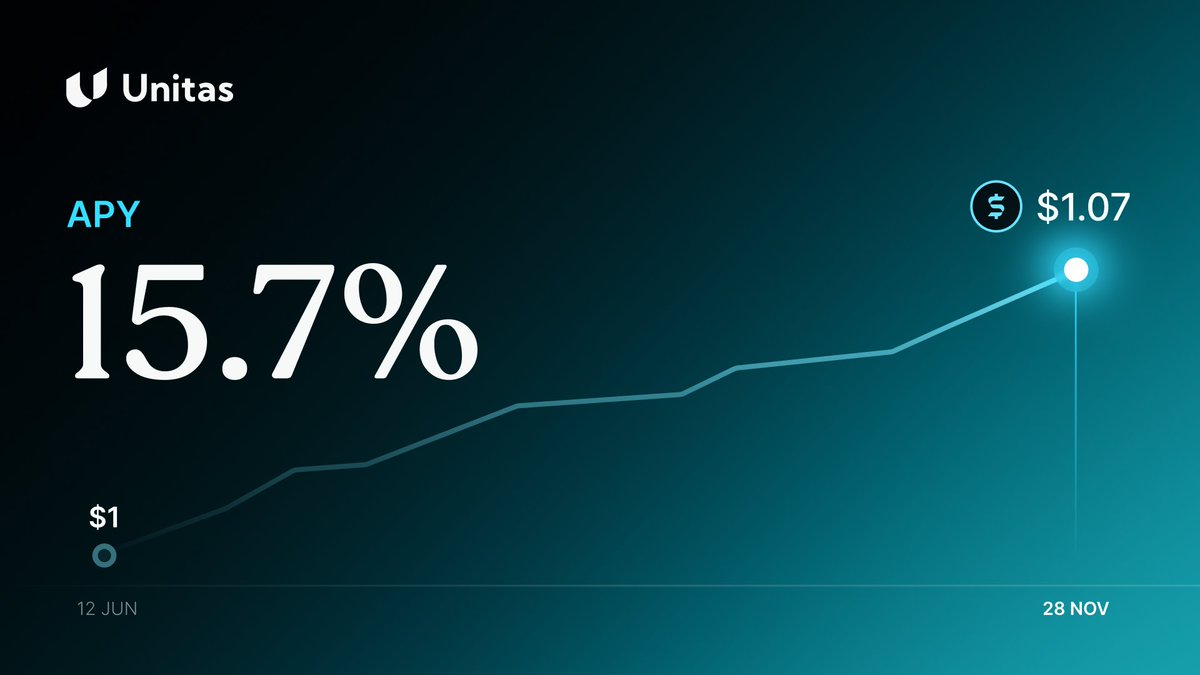
sUSDu increases in value as the USDu collateral earns revenue. JLP fees and funding rate payments are deposited into the staking contract and sUSDu reflects that accumulated yield over time. The revenue generation is driven by trading activity, independent from market conditions.
This is why sUSDu can deliver reliable returns during periods when funding rates are near zero or negative. JLP’s revenue offsets the cost of hedging and maintains a consistent yield stream, as highlighted in our latest breakdown:
The USDu mechanism has several advantages that derive from the delta-neutral structure and the use of real trading revenue:
Yield originates from actual trading activity
Directional risk is offset by hedging
JLP provides diversified exposure to bluechip assets while the hedge offsets their price impact
JLP revenue can offset periods of negative funding
The model scales naturally as derivatives volume increases
Users hold a stable asset while the protocol manages complex operations behind the scenes
This creates a stablecoin that behaves reliably across all market conditions and does not depend on risk-taking to deliver yield.
A core design principle of Unitas is transparency. USDu collateral is held in two vault types: onchain through multisig wallets that hold JLP, and offchain through CEFFU, which maintains segregated custody for hedge margin. Users can view these balances through Unitas’s transparency dashboard.
The transparency dashboard displays:
Overcollateralization ratios
Onchain multisig addresses
Custodial balances
Asset composition

Unitas uses Proof of Solvency through Accountable. Accountable connects to custodians and offchain sources to verify balances. It uses zero-knowledge attestations and secure enclave verification to confirm that assets are present without revealing proprietary details. This provides public reassurance that USDu is fully backed.

An insurance fund receives 10% of the protocol's revenue. It acts as a capital buffer during periods when funding turns negative or in a scenario when the strategy incurs losses. This fund covers short-term gaps of market neutrality, so yield generation remains consistent even when markets behave unpredictably.
The protocol also monitors the JLP asset composition in real time. The hedge is adjusted whenever needed to keep the exposure aligned with the underlying assets and to avoid drift that could introduce unintended directional risk.
Unitas is focused on expanding the reach of USDu and sUSDu across the broader DeFi landscape. The protocol is progressing toward support on additional chains and deeper integration with systems that rely on stable collateral and market-neutral yield sources. As these connections grow, USDu and sUSDu will be available across a wider range of applications, giving users more ways to hold a transparent dollar asset and access its yield profile.
The objective is to provide a stablecoin framework that provides collateral transparency at all times, earns yield from real trading activity and acts predictably across different market conditions. With continued development and broader ecosystem alignment, USDu is positioned to serve as a reliable yield-bearing dollar for users and protocols that require stability supported by transparent mechanics.
Unitas actively monitors liquidity conditions across DEX pools. If pools such as Orca run out of USDC or USDu, the protocol can redeem or mint using its own reserves to rebalance. This protects market depth to remove friction for user onboarding.
Guide on how to provide USDu/USDC liquidity on Kamino:
sUSDu is the staked version of USDu. When users stake USDu, they receive sUSDu, which represents a proportional claim on the yield produced by the delta-neutral strategy.
sUSDu increases in value as the USDu collateral earns revenue. JLP fees and funding rate payments are deposited into the staking contract and sUSDu reflects that accumulated yield over time. The revenue generation is driven by trading activity, independent from market conditions.
This is why sUSDu can deliver reliable returns during periods when funding rates are near zero or negative. JLP’s revenue offsets the cost of hedging and maintains a consistent yield stream, as highlighted in our latest breakdown:
The USDu mechanism has several advantages that derive from the delta-neutral structure and the use of real trading revenue:
Yield originates from actual trading activity
Directional risk is offset by hedging
JLP provides diversified exposure to bluechip assets while the hedge offsets their price impact
JLP revenue can offset periods of negative funding
The model scales naturally as derivatives volume increases
Users hold a stable asset while the protocol manages complex operations behind the scenes
This creates a stablecoin that behaves reliably across all market conditions and does not depend on risk-taking to deliver yield.
A core design principle of Unitas is transparency. USDu collateral is held in two vault types: onchain through multisig wallets that hold JLP, and offchain through CEFFU, which maintains segregated custody for hedge margin. Users can view these balances through Unitas’s transparency dashboard.
The transparency dashboard displays:
Overcollateralization ratios
Onchain multisig addresses
Custodial balances
Asset composition
Unitas uses Proof of Solvency through Accountable. Accountable connects to custodians and offchain sources to verify balances. It uses zero-knowledge attestations and secure enclave verification to confirm that assets are present without revealing proprietary details. This provides public reassurance that USDu is fully backed.
An insurance fund receives 10% of the protocol's revenue. It acts as a capital buffer during periods when funding turns negative or in a scenario when the strategy incurs losses. This fund covers short-term gaps of market neutrality, so yield generation remains consistent even when markets behave unpredictably.
The protocol also monitors the JLP asset composition in real time. The hedge is adjusted whenever needed to keep the exposure aligned with the underlying assets and to avoid drift that could introduce unintended directional risk.
Unitas is focused on expanding the reach of USDu and sUSDu across the broader DeFi landscape. The protocol is progressing toward support on additional chains and deeper integration with systems that rely on stable collateral and market-neutral yield sources. As these connections grow, USDu and sUSDu will be available across a wider range of applications, giving users more ways to hold a transparent dollar asset and access its yield profile.
The objective is to provide a stablecoin framework that provides collateral transparency at all times, earns yield from real trading activity and acts predictably across different market conditions. With continued development and broader ecosystem alignment, USDu is positioned to serve as a reliable yield-bearing dollar for users and protocols that require stability supported by transparent mechanics.


Subscribe to Unitas Labs
Subscribe to Unitas Labs
Share Dialog
Share Dialog
<100 subscribers
<100 subscribers



No comments yet