The Hybrid Vault: Yield Basis scaling preserving $crvUSD stability
This article proposes the Hybrid Vault solution to scale Yield Basis, enabling Personal Caps for LPs participating in $crvUSD stability support.

Yield Basis: upcoming migration to new pools implementation

YB Fee Switch: the next YieldBasis milestone
YB Fee Switch activated
<100 subscribers


The Hybrid Vault: Yield Basis scaling preserving $crvUSD stability
This article proposes the Hybrid Vault solution to scale Yield Basis, enabling Personal Caps for LPs participating in $crvUSD stability support.

Yield Basis: upcoming migration to new pools implementation

YB Fee Switch: the next YieldBasis milestone
YB Fee Switch activated
Share Dialog
Share Dialog
Based on the analysis of the YieldBasis chat history, here is a structured list of the main user questions and challenges, sorted by criticality, along with the answers provided by the project administration and experienced users.
a) User Question: I am trying to migrate from the old pools (V1) to the new ones, but the transaction fails. I get "Debt too high" error, or simply cannot deposit funds. Why isn't the migration working, and what should I do?
Answer: The new pools have strict caps on deposit volume and the overall leverage (crvUSD debt limit). Since many users have already migrated and the price of Bitcoin has risen, the pools have reached their current limits. The error "Debt too high" or the inability to deposit means that the system temporarily has no space for new funds.
Reason: The pools lack sufficient free crvUSD to create new positions due to the overall debt limit (150M crvUSD) and the imbalance caused by the rising BTC price.
Solution: You must wait until someone withdraws funds from the pool (freeing up space) or until the Bitcoin price corrects, which will change the pool's balance. Migration is not time-limited, so it is recommended to try again later.
Note: The limits (caps) will only be increased after the market stabilizes and the current migration phase is complete.
b) User Question: I am trying to migrate from the old pools (V1) to the new ones, but the transaction fails. I get "Slippage" errors, or simply cannot deposit funds. Why isn't the migration working, and what should I do?
Answer: You can also try slightly increasing the slippage if the error is related to that.
It’s better to migrate from V1 to V2 when the pool is close to a 50:50 balance to reduce slippage.

User Question: I see that my balance in BTC has decreased (a drawdown of about 1-3%). Why am I losing money, and is this impermanent loss (IL)?
Answer: The observed drawdowns are expected short-term fluctuations related to the pool imbalance (e.g., asset ratio of 60/40 or 70/30) amid high market volatility. This is not a realized loss but a temporary deviation in value.
Mechanism: When the BTC price changes sharply, arbitragers must rebalance the pool to return it to a 50/50 ratio. Until this happens, you may see a "paper" loss.
Outlook: The balance is expected to recover (repeg) through accumulated trading fees and the actions of arbitragers. The administration confirms that these fluctuations are "reversible."
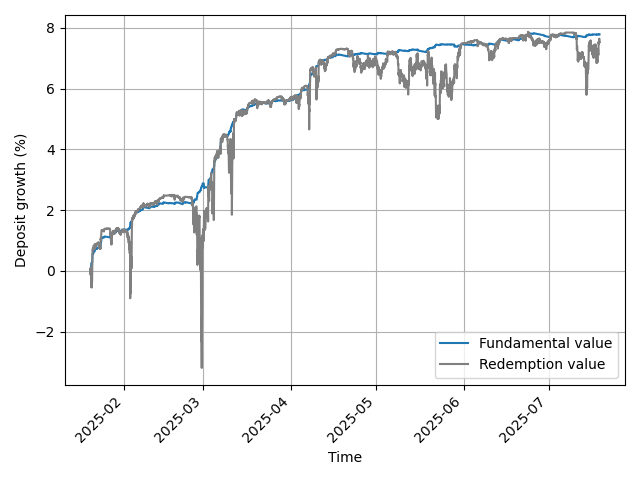
Terminology: This is not classic Impermanent Loss but rather a TRD: "Temporary Redemption Discount".
Description in the UI: TRD: “Pools may become imbalanced during high volatility, causing redemption discounts. Arbitrage and swaps naturally rebalance them with time, reducing the discount to 0
As a result, we get two PPS (price-per-share) indexes:
• Fundamental — the one you get when withdrawing at a 50:50 pool balance
• Withdrawable — the one you get when withdrawing at any imbalance
The difference between them called Temporary Redemption Discount, or the FUD-generation mechanism (a joke from the chat).


YieldBasis is based on using leverage through Curve pools (BTC/crvUSD). The drawdown occurs due to the temporary inefficiency of the pool during moments of high volatility:
Imbalance: A sharp movement in the BTC price (rise or fall) leads to a skew in the asset ratio within the pool (e.g., 70% crvUSD and 30% BTC).
Lag: The interface values your share (LP token) based on the current, imbalanced state of the pool, which shows a decrease in value (1-3% drawdown).
Dependence on Arbitrage: The protocol relies on arbitragers to execute profitable swaps to return the pool to a 50/50 balance. Until this occurs, the imbalance and the "paper loss" persist.
A prolonged delay (days or weeks) is not related to high gas costs but is explained by the protocol's mathematical rebalancing model:
"Rebalancing Budget": Rebalancing only occurs when the accumulated fees (budget) are sufficient to cover the loss incurred from the price movement.
Unidirectional Movement (Monotonic Trend): If the BTC price moves only in one direction, the "cost" of rebalancing (the divergence loss to be realized) grows faster than fees accumulate, causing the pool to get "stuck."
Conclusion: The system protects itself from realizing excessive losses, waiting until an adequate "cushion" (fees) accumulates or until the price corrects.
How quickly the balance is restored depends on market action (volatility and trade volume):
Negative Scenario (Stagnation): The price continues a strong one-way trend (down-only/up-only) with low volumes. Fees accumulate slowly, and the budget for rebalancing is met slowly, keeping the pool in a drawdown for weeks.
Neutral Scenario (Gradual Recovery): The market stabilizes or moves sideways. Arbitrage becomes mildly profitable. The pool gradually returns to balance over several days as fees trickle in.
Positive Scenario (High Volume Event): A sharp price movement triggers massive liquidations on other platforms (like Compound/Morpho), which are routed through YieldBasis. This instantly generates significant trade fees for the pool, leading to rapid rebalancing and often a spike in APR.
The stability of your staked position depends on the price relationship between the two tokens:
yb (Yield Bearing) Token: This token increases in price as fees accumulate, and its conversion rate relative to the syb token is always > 1 and growing.
syb (Staking Vault) Token: This token is pegged to BTC and should ideally maintain a 1:1 ratio under normal conditions. The syb pool price relative to BTC can be monitored here: ybmonitor.com/metrics.
Impact of Lag: If the yb pool's price experiences a temporary drawdown due to Rebalancing Lag, the syb pool's price will experience the same temporary drawdown until both pools return to equilibrium.
Compensating Deviation: Periodically, the syb price may drop by fractions of a percent, even if the pool is in balance. This drop will be compensated by temporarily redirecting admin fees to this pool until the BTC peg is restored.
V2 Stability: Losses in syb V2 are approximately 10-20 times smaller than they would have been in the old pools during similar market movements.

User Question: I lost funds in the old pools (V1) due to errors in fee calculations. When and how will compensation be paid?
Answer: Compensation for the excessively charged administrative fees in version V1 was be paid retroactively. This applies to those who held funds in the staked pools.
Condition: Distribution will begin after the migration reaches a minimum of 75% TVL across all pools and the necessary accounting scripts are written.
Payment Method: Compensation will be sent directly to users' wallets; no additional action (claim) is required.
Amount: The payment involves returning the difference between the charged and the correct fee (approximately 44 BTC will be returned).
User Question: Based on the charts, the cbBTC pool has recovered and shows a profit, while tBTC and WBTC are still in drawdown. Why is there this difference?
Answer: The cbBTC pool showed better results due to a fortunate confluence of market events.
Reason: Large liquidations on third-party platforms (e.g., Compound and Morpho) were routed through the YieldBasis pool. These large swaps generated a significant volume of trading fees for the cbBTC pool.
Result: The high fees allowed cbBTC to rebalance faster and move into profit.
Status of Other Pools: The tBTC and WBTC pools have not yet received this volume of arbitrage and are awaiting rebalancing. tBTC devs already implemented staking changes to reduce redemption fees and time to redeem.
User Question: I locked tokens in veYB. Where does the yield come from, and when will I start receiving real BTC fees?
Answer: The fee switch is activated, administrative fees are already accumulating in the contracts. See docs to get more information about veYB fee accumulation and distribution.
Source of Income: veYB income is generated from administrative fees (admin fees) taken from a portion of the protocol's trading fees when ybBTC pools are over watermark rate.
Payment Currency: Rewards will be paid in "ybBTC" pool tokens (a mix of cbBTC, WBTC, tBTC) and ybETH (ybWETH).
User Question: When will you raise the pool limits to 500M or 1B so everyone can join properly?
Answer: Limit increases are planned, but the team is maintaining a conservative approach.
Conditions: The team monitors the crvUSD peg to avoid creating volatility. Each expansion must be preceded by a strengthening of the peg. There are several areas in which the team is working to achieve this goal.
Process: Proposal Increase credit line to Yield Basis to 1B crvUSD was passed on forum. The increase will occur in stages (batches of 1-50M), not all at once. Security and real-world system testing are currently prioritized over rapid TVL growth.
Hybrid Vaults: The next step for pools capacity increase -- implementing more "supply sinks" for crvUSD to stabilize it's peg. One of the solutions was proposed in "The Hybrid Vault: Yield Basis scaling preserving $crvUSD stability"

User Question: Why does the Fundamental Value PPS drop?
Answer: On the Price Per Share chart, there are periods where the fundamental value falls sharply and then continues rising. This comes from how Curve CryptoSwap and fxSwap pools — the core of YieldBasis — operate. The mechanism accumulates 50% of swap fees to rebalance the pool. When 20% of the collected fees is enough to shift the liquidity concentration center by one minimum step, the shift happens and that portion of the fees is spent. After that, fees start accumulating again, and the pool performs better because liquidity becomes concentrated closer to the current price.
Based on the analysis of the YieldBasis chat history, here is a structured list of the main user questions and challenges, sorted by criticality, along with the answers provided by the project administration and experienced users.
a) User Question: I am trying to migrate from the old pools (V1) to the new ones, but the transaction fails. I get "Debt too high" error, or simply cannot deposit funds. Why isn't the migration working, and what should I do?
Answer: The new pools have strict caps on deposit volume and the overall leverage (crvUSD debt limit). Since many users have already migrated and the price of Bitcoin has risen, the pools have reached their current limits. The error "Debt too high" or the inability to deposit means that the system temporarily has no space for new funds.
Reason: The pools lack sufficient free crvUSD to create new positions due to the overall debt limit (150M crvUSD) and the imbalance caused by the rising BTC price.
Solution: You must wait until someone withdraws funds from the pool (freeing up space) or until the Bitcoin price corrects, which will change the pool's balance. Migration is not time-limited, so it is recommended to try again later.
Note: The limits (caps) will only be increased after the market stabilizes and the current migration phase is complete.
b) User Question: I am trying to migrate from the old pools (V1) to the new ones, but the transaction fails. I get "Slippage" errors, or simply cannot deposit funds. Why isn't the migration working, and what should I do?
Answer: You can also try slightly increasing the slippage if the error is related to that.
It’s better to migrate from V1 to V2 when the pool is close to a 50:50 balance to reduce slippage.

User Question: I see that my balance in BTC has decreased (a drawdown of about 1-3%). Why am I losing money, and is this impermanent loss (IL)?
Answer: The observed drawdowns are expected short-term fluctuations related to the pool imbalance (e.g., asset ratio of 60/40 or 70/30) amid high market volatility. This is not a realized loss but a temporary deviation in value.
Mechanism: When the BTC price changes sharply, arbitragers must rebalance the pool to return it to a 50/50 ratio. Until this happens, you may see a "paper" loss.
Outlook: The balance is expected to recover (repeg) through accumulated trading fees and the actions of arbitragers. The administration confirms that these fluctuations are "reversible."
Terminology: This is not classic Impermanent Loss but rather a TRD: "Temporary Redemption Discount".
Description in the UI: TRD: “Pools may become imbalanced during high volatility, causing redemption discounts. Arbitrage and swaps naturally rebalance them with time, reducing the discount to 0
As a result, we get two PPS (price-per-share) indexes:
• Fundamental — the one you get when withdrawing at a 50:50 pool balance
• Withdrawable — the one you get when withdrawing at any imbalance
The difference between them called Temporary Redemption Discount, or the FUD-generation mechanism (a joke from the chat).


YieldBasis is based on using leverage through Curve pools (BTC/crvUSD). The drawdown occurs due to the temporary inefficiency of the pool during moments of high volatility:
Imbalance: A sharp movement in the BTC price (rise or fall) leads to a skew in the asset ratio within the pool (e.g., 70% crvUSD and 30% BTC).
Lag: The interface values your share (LP token) based on the current, imbalanced state of the pool, which shows a decrease in value (1-3% drawdown).
Dependence on Arbitrage: The protocol relies on arbitragers to execute profitable swaps to return the pool to a 50/50 balance. Until this occurs, the imbalance and the "paper loss" persist.
A prolonged delay (days or weeks) is not related to high gas costs but is explained by the protocol's mathematical rebalancing model:
"Rebalancing Budget": Rebalancing only occurs when the accumulated fees (budget) are sufficient to cover the loss incurred from the price movement.
Unidirectional Movement (Monotonic Trend): If the BTC price moves only in one direction, the "cost" of rebalancing (the divergence loss to be realized) grows faster than fees accumulate, causing the pool to get "stuck."
Conclusion: The system protects itself from realizing excessive losses, waiting until an adequate "cushion" (fees) accumulates or until the price corrects.
How quickly the balance is restored depends on market action (volatility and trade volume):
Negative Scenario (Stagnation): The price continues a strong one-way trend (down-only/up-only) with low volumes. Fees accumulate slowly, and the budget for rebalancing is met slowly, keeping the pool in a drawdown for weeks.
Neutral Scenario (Gradual Recovery): The market stabilizes or moves sideways. Arbitrage becomes mildly profitable. The pool gradually returns to balance over several days as fees trickle in.
Positive Scenario (High Volume Event): A sharp price movement triggers massive liquidations on other platforms (like Compound/Morpho), which are routed through YieldBasis. This instantly generates significant trade fees for the pool, leading to rapid rebalancing and often a spike in APR.
The stability of your staked position depends on the price relationship between the two tokens:
yb (Yield Bearing) Token: This token increases in price as fees accumulate, and its conversion rate relative to the syb token is always > 1 and growing.
syb (Staking Vault) Token: This token is pegged to BTC and should ideally maintain a 1:1 ratio under normal conditions. The syb pool price relative to BTC can be monitored here: ybmonitor.com/metrics.
Impact of Lag: If the yb pool's price experiences a temporary drawdown due to Rebalancing Lag, the syb pool's price will experience the same temporary drawdown until both pools return to equilibrium.
Compensating Deviation: Periodically, the syb price may drop by fractions of a percent, even if the pool is in balance. This drop will be compensated by temporarily redirecting admin fees to this pool until the BTC peg is restored.
V2 Stability: Losses in syb V2 are approximately 10-20 times smaller than they would have been in the old pools during similar market movements.

User Question: I lost funds in the old pools (V1) due to errors in fee calculations. When and how will compensation be paid?
Answer: Compensation for the excessively charged administrative fees in version V1 was be paid retroactively. This applies to those who held funds in the staked pools.
Condition: Distribution will begin after the migration reaches a minimum of 75% TVL across all pools and the necessary accounting scripts are written.
Payment Method: Compensation will be sent directly to users' wallets; no additional action (claim) is required.
Amount: The payment involves returning the difference between the charged and the correct fee (approximately 44 BTC will be returned).
User Question: Based on the charts, the cbBTC pool has recovered and shows a profit, while tBTC and WBTC are still in drawdown. Why is there this difference?
Answer: The cbBTC pool showed better results due to a fortunate confluence of market events.
Reason: Large liquidations on third-party platforms (e.g., Compound and Morpho) were routed through the YieldBasis pool. These large swaps generated a significant volume of trading fees for the cbBTC pool.
Result: The high fees allowed cbBTC to rebalance faster and move into profit.
Status of Other Pools: The tBTC and WBTC pools have not yet received this volume of arbitrage and are awaiting rebalancing. tBTC devs already implemented staking changes to reduce redemption fees and time to redeem.
User Question: I locked tokens in veYB. Where does the yield come from, and when will I start receiving real BTC fees?
Answer: The fee switch is activated, administrative fees are already accumulating in the contracts. See docs to get more information about veYB fee accumulation and distribution.
Source of Income: veYB income is generated from administrative fees (admin fees) taken from a portion of the protocol's trading fees when ybBTC pools are over watermark rate.
Payment Currency: Rewards will be paid in "ybBTC" pool tokens (a mix of cbBTC, WBTC, tBTC) and ybETH (ybWETH).
User Question: When will you raise the pool limits to 500M or 1B so everyone can join properly?
Answer: Limit increases are planned, but the team is maintaining a conservative approach.
Conditions: The team monitors the crvUSD peg to avoid creating volatility. Each expansion must be preceded by a strengthening of the peg. There are several areas in which the team is working to achieve this goal.
Process: Proposal Increase credit line to Yield Basis to 1B crvUSD was passed on forum. The increase will occur in stages (batches of 1-50M), not all at once. Security and real-world system testing are currently prioritized over rapid TVL growth.
Hybrid Vaults: The next step for pools capacity increase -- implementing more "supply sinks" for crvUSD to stabilize it's peg. One of the solutions was proposed in "The Hybrid Vault: Yield Basis scaling preserving $crvUSD stability"

User Question: Why does the Fundamental Value PPS drop?
Answer: On the Price Per Share chart, there are periods where the fundamental value falls sharply and then continues rising. This comes from how Curve CryptoSwap and fxSwap pools — the core of YieldBasis — operate. The mechanism accumulates 50% of swap fees to rebalance the pool. When 20% of the collected fees is enough to shift the liquidity concentration center by one minimum step, the shift happens and that portion of the fees is spent. After that, fees start accumulating again, and the pool performs better because liquidity becomes concentrated closer to the current price.
yieldbasis
yieldbasis
No comments yet