Start typing to search this publication.
Brandon Donnelly logo Brandon Donnelly
Open menu
Brandon Donnelly logo

Subscribe to Brandon Donnelly

Get new posts delivered straight to your inbox.

Brandon Donnelly — Daily insights for city builders. Published since 2013 by Toronto-based real estate developer Brandon Donnelly. — Page 6

Cities grow — or should grow — like forests

  • Planning
  • Urbanism
  • Bottom-up urbanism

One of the themes that we like to talk about on this blog is that cities are chaotic living organisms. We often like to fool ourselves into thinking that everything can be neatly organized and that we can plan for all of the possible outcomes, but we know this is impossible.

Cities will always evolve in ways that we couldn’t predict and, in fact, this is exactly what we want, even if it can feel somewhat uncomfortable. We don’t want to suppress potentially positive outcomes unnecessarily; we want the potential of cities, and their residents, to be unencumbered to the greatest extent possible.

Some of the common names for this are bottom-up planning or organic urbanism. And at its core, it is an acknowledgement that the master planners and builders at the top do not have all the answers, and never will. The only way to arrive at optimal outcomes is to instead allow individuals, small entrepreneurs, and local actors to create, innovate, and scratch their own itches.

La raison pour laquelle nous avons oublié comment une ville croit comme une forêt, ou comme un être vivant, est assez simple : le processus de croissance organique est opéré pour une très large part non par la puissance publique mais par des particuliers, des marchands de bien,… https://t.co/wt2tagJdcp

— David Miet (@MietDavid) October 30, 2026

I was reminded of all of this when I came across this tweet by David Miet over the weekend, arguing that cities grow — or should grow — like forests. David is co-founder and CEO of an organic urbanism group out of France called Villes Vivantes.

They work with individual property owners and local municipalities to unlock gentle, incremental housing supply, whether that be accessory dwellings or the conversion of under-used sites and buildings.

This is not a scale that big developers generally care about, but I would encourage you to check them out, because it is a scale of housing that is good for cities. Bottom-up planning and intervention is a key ingredient in good city building.
Cover image for The Bank of Canada raised rates, but mortgages are still relatively cheap

The Bank of Canada raised rates, but mortgages are still relatively cheap

  • Finance
  • Housing
  • Real estate

The Bank of Canada raised its policy rate by 25 basis points this week to 2.5%. It was the first increase since July 2023, and it was largely because of high oil prices:

Given persistently high oil prices, CPI inflation has been around 3% since April and is expected to rise to about 3½% by the end of the year. Excluding gasoline, inflation was 2.2% in September and measures of core inflation remain close to 2%. But cost pressures are building, with high fuel prices raising the costs of production and transportation. Imported industrial and electronics input prices have also increased. While businesses have mostly absorbed higher input costs so far, Bank surveys suggest cost pass-through will increase over the next year. Near-term household and business inflation expectations have risen, while longer-term inflation expectations remain well anchored.

David Rosenberg of the Globe and Mail called the hike “totally unnecessary and premature” given that this is an energy cost problem and that the bank seems to be wearing rose-coloured glasses when looking at GDP growth estimates.

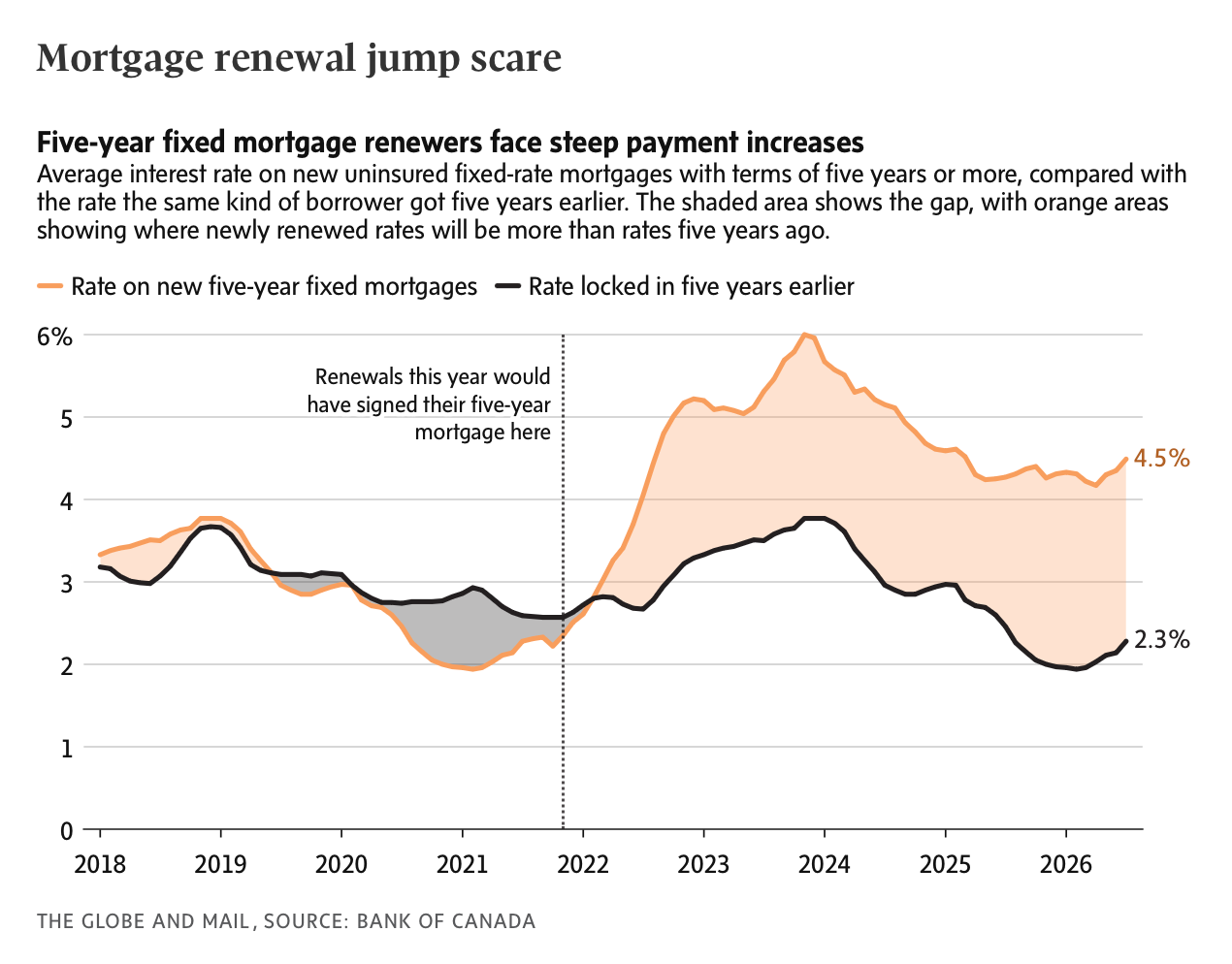
Cue the mortgage renewal scare articles:

But let’s keep in mind that 4.5% is not that high. Historically, this is still relatively low-cost debt. The concern isn’t the absolute level — it’s the delta, and the fact that real estate values are highly sensitive to interest rates and get re-priced when rates change.

Now, when it comes to Canadian housing, a five-year mortgage is very typical, and then the rate resets to market. That’s why 2026 was predicted to be an alarming year for homeowners. That hasn’t been the case. And the faster the market normalizes, the healthier it will be.

On the other hand, I often think about the US where 30-year fixed-rate mortgages are possible and there are homeowners sitting on 2-3% rates with a powerful economic incentive never ever to move. This is going to be a massive generational distortion to the housing market.

When people don’t move, inventory declines, people become over-housed, and urban labour markets become less dynamic. Canada’s 5-year resets might create periodic jump scares, but they force reality into the housing market.

Cover image for The fragility of paper wealth

The fragility of paper wealth

  • Business
  • Development
  • Finance

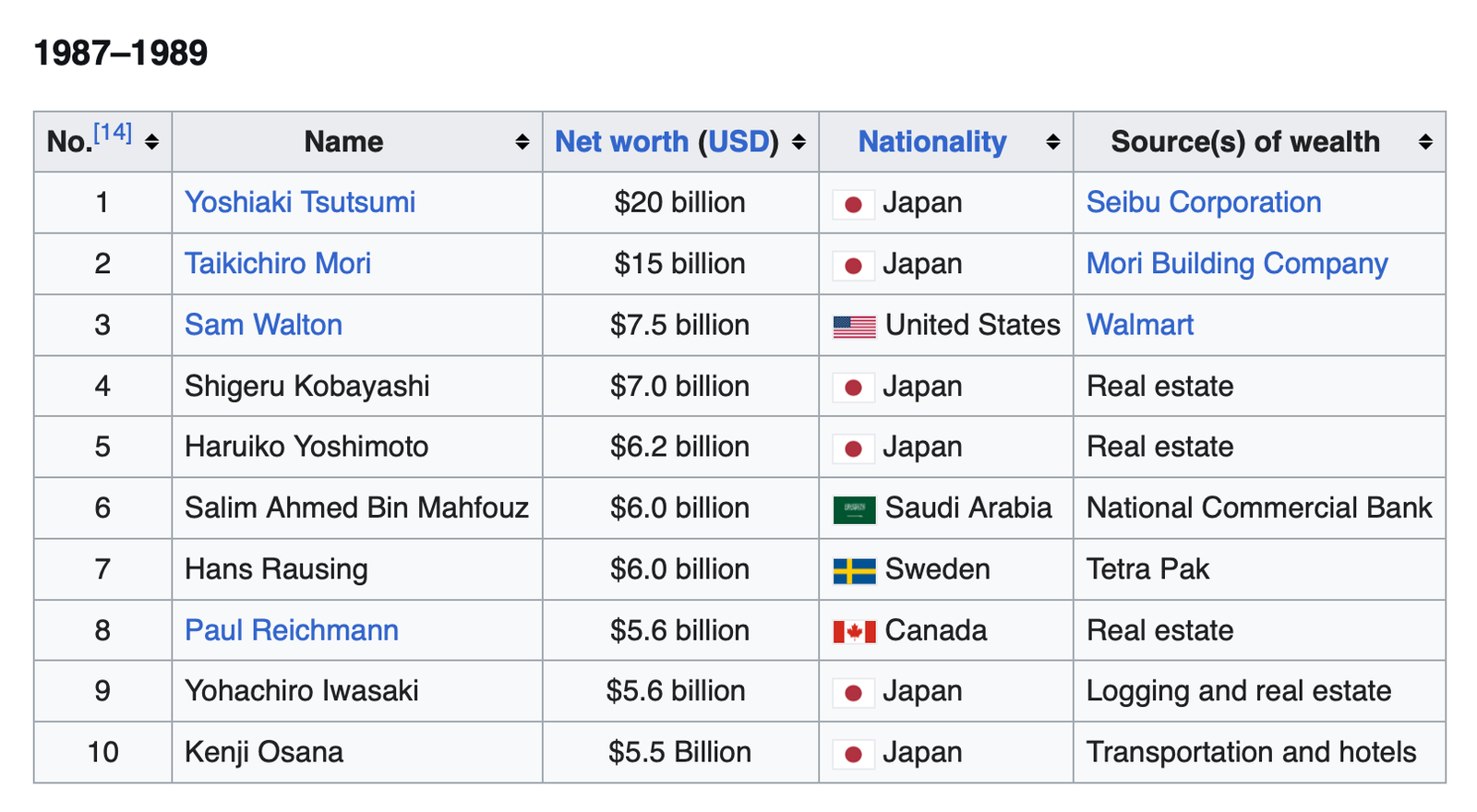
I recently came across this list of the world’s richest people between 1987 and 1989:

The obvious takeaway is Japan, which makes up 60% of this top 10 list. As we know, the late 80s marked a massive asset bubble in the country that seemed to be creating unprecedented wealth and affluence — and the ability for the Japanese to buy trophy real estate around the world — but then collapsed in 1990.

Another interesting name on this list is Paul Reichmann. Those of you in the real estate industry may know that Paul Reichmann and his brothers, Albert and Ralph, founded a development company in the 1950s in Toronto called Olympia & York. It was the outgrowth of their Olympia Flooring and Tile Company.

Olympia & York developed First Canadian Place in 1975, the World Financial Center in Battery Park City, New York, in 1985, One Canada Square in London in 1991 (the tallest building in the UK at the time), and became the largest property development company in the world in the 1980s — hence Paul’s spot on the list.

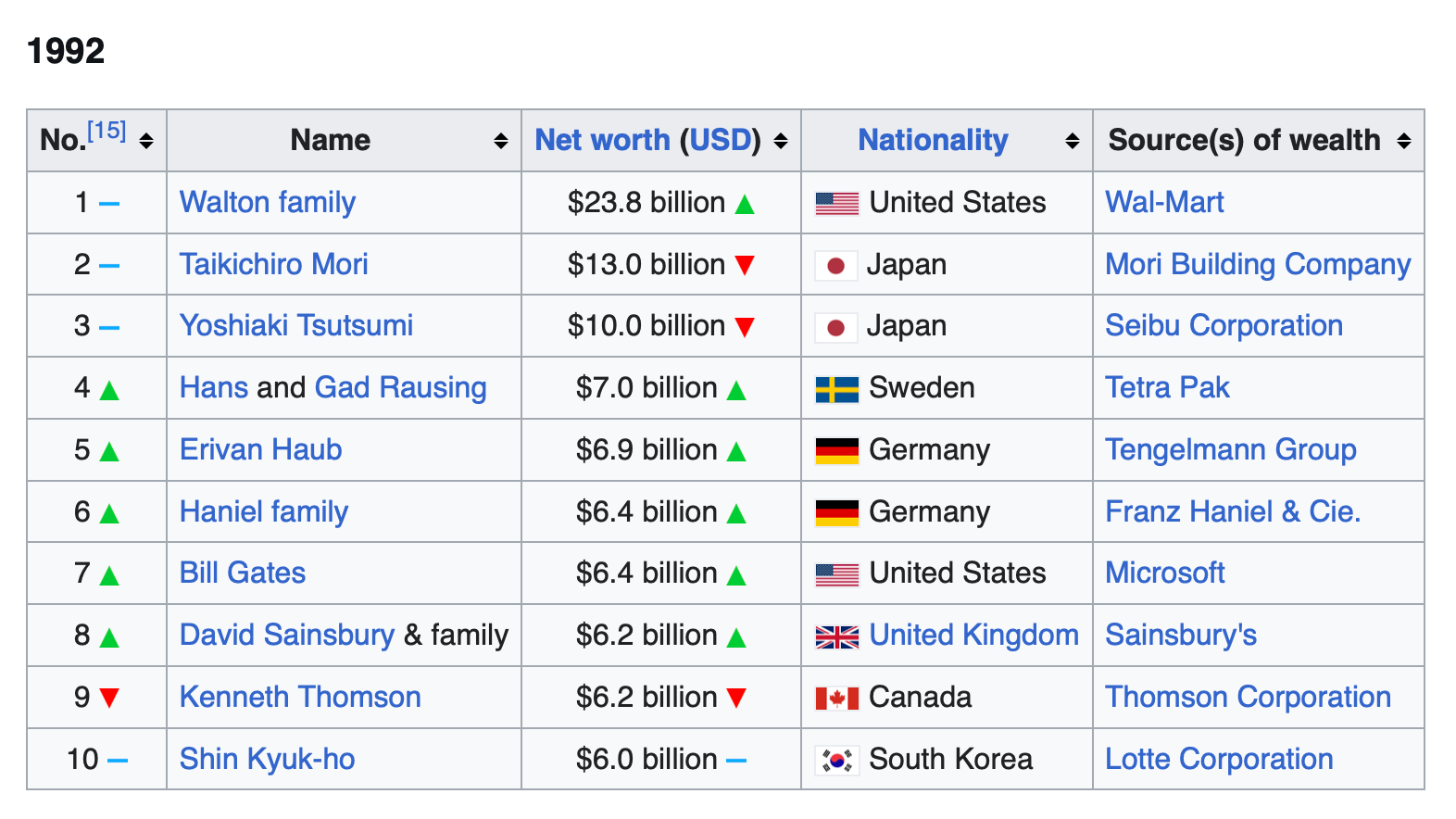
But now here’s this same top 10 list for 1992:

The Japanese are far less prominent, and Paul is no longer on the list. Olympia & York filed for bankruptcy in 1992, and by the following year had been broken up. It’s a reminder that when we’re talking about the world’s richest people, we’re talking about paper equity tied to market cycles, rather than cash sitting in a high-interest savings account.

Market dynamics trump individual performance, or to put it another way, it’s a lot harder to be a genius when the market turns against you.

Subscribe to Brandon Donnelly

Daily insights for city builders. Published since 2013 by Toronto-based real estate developer Brandon Donnelly.